Day: August 22, 2025

  • White House. America by Design

    White House. America by Design

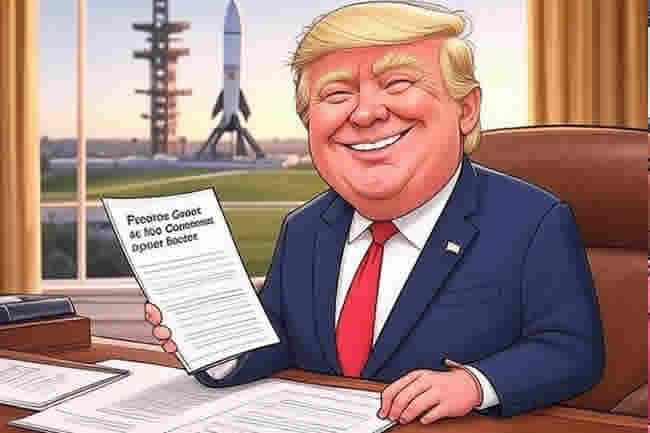
    On August 21, 2025, President Donald J. Trump signed an executive order launching “America by Design,” a national initiative to modernize and improve the usability of federal digital and physical services. The order establishes the National Design Studio within the White House and introduces a Chief Design Officer to lead efforts in recruiting top creative talent, standardizing government design, and enhancing user experiences. Agencies are directed to prioritize updates to high-impact websites and services by July 4, 2026, ensuring compliance with modern digital standards while reducing costs from outdated systems. The initiative underscores the administration’s policy to deliver government services that are not only efficient but also visually engaging and accessible for all Americans.

    IMPROVING OUR NATION
    THROUGH BETTER DESIGN

    By the authority vested in me as President by the Constitution and the laws of the United States of America, it is hereby ordered:

    Section 1.  Purpose and Policy.  America has long led the world in innovation, technological advancement, and design.  But with a sprawling ecosystem of digital services offered to Americans, the Government has lagged behind in usability and aesthetics.  There is a high financial cost to maintaining legacy systems, to say nothing of the cost in time lost by the American public trying to navigate them.  It is time to fill the digital potholes across our Nation.

    With this order, I am announcing “America by Design,” a national initiative to improve experiences for Americans, starting by breathing new life into the design of sites where people interface with their Government.  It is time to update the Government’s design language to be both usable and beautiful.  This effort will be facilitated by a new National Design Studio and by a new Chief Design Officer.  The Chief Design Officer will help recruit top creative talent, coordinate with executive departments and agencies (agencies), and devise innovative solutions.

    It is the policy of my Administration to deliver digital and physical experiences that are both beautiful and efficient, improving the quality of life for our Nation.  Towards that end, the National Design Studio will advise agencies on how to reduce duplicative design costs, use standardized design to enhance the public’s trust in high-impact service providers, and dramatically improve the quality of experiences offered to the American public.

    Sec. 2.  Establishing America by Design and the National Design Studio.  (a)  There is established a national initiative, America by Design, to improve comprehensively the visual presentation and usability of Federal services provided to the public in both digital and physical spaces, creating first-class online and offline experiences for Americans.

    (b)  To help facilitate the America by Design initiative, there is established within the White House Office of the Executive Office of the President the National Design Studio (NDS) and, within the NDS, a new position entitled the Chief Design Officer.  The NDS shall be led by an Administrator, who shall report to the Office of the White House Chief of Staff.  There is further established within the NDS, in accordance with section 3161 of title 5, United States Code, a temporary organization headed by the NDS Administrator and dedicated to helping advance the America by Design initiative.  The temporary organization shall terminate 3 years from the date of this order, but that termination shall not be interpreted to imply the termination, attenuation, or amendment of any other authority or provision of this order.

    Sec. 3.  Implementing America by Design.  (a)  Heads of agencies shall consult with the Chief Design Officer to implement the America by Design initiative at their respective agencies and shall produce initial results by July 4, 2026. 

    (i)    Heads of agencies shall prioritize improving websites and physical sites that have a major impact on Americans’ everyday lives. 

    (ii)   The Administrator of General Services shall consult with the Chief Design Officer to update the United States Web Design System consistent with the policies set forth in this order.

    (iii)  Heads of agencies shall consult with the Chief Design Officer to ensure Government-wide compliance with the 21st Century Integrated Digital Experience Act, Public Law 115-336.

    (b)  The Chief Design Officer shall consult with thought leaders and research and design firms on how best to implement the America by Design initiative.  In order to employ the most talented designers of our generation to serve their country, the Chief Design Officer shall help recruit designers and other experts from the private sector as well as other sources of expertise.  Heads of agencies shall use all relevant hiring authorities to facilitate this effort, including title IV of the Intergovernmental Personnel Act of 1970, Public Law 91-648, 5 U.S.C. 3371 et seq.

    (c)  The Chief Design Officer shall consult with the Director of the Office of Management and Budget, as appropriate, in carrying out his or her obligations under this order.

    Sec. 4.  General Provisions.  (a)  Nothing in this order shall be construed to impair or otherwise affect:

    (i)   the authority granted by law to an executive department or agency, or the head thereof; or

    (ii)  the functions of the Director of the Office of Management and Budget relating to budgetary, administrative, or legislative proposals.

    (b)  This order shall be implemented consistent with applicable law and subject to the availability of appropriations.

    (c)  This order is not intended to, and does not, create any right or benefit, substantive or procedural, enforceable at law or in equity by any party against the United States, its departments, agencies, or entities, its officers, employees, or agents, or any other person.

                                 DONALD J. TRUMP

    THE WHITE HOUSE,

        August 21, 2025.

    Executive Orders Presidential Actions

    Sources: White House , Midtown Tribune

    #DonaldTrumpNews #USANewsToday #FunUSAWhiteHouse #WhiteHousePictures
    Midtown Tribune Independent USA news from New York

  • Americans Nationwide to Save Thousands in Taxes Under President Trump’s One Big Beautiful Bill

    Americans Nationwide to Save Thousands in Taxes Under President Trump’s One Big Beautiful Bill

    One-Paragraph Summary:
    President Trump’s One Big Beautiful Bill Act is delivering sweeping tax relief across the country, with the average American taxpayer set to save $3,752 in 2026, according to the nonpartisan Tax Foundation. From Alaska’s $3,485 average savings to Nevada’s $4,220, Florida’s $5,000, and Miami-Dade County’s $5,872, families in every state will feel the impact through lower taxes and higher take-home pay. The bill makes the 2017 tax cuts permanent while introducing new breaks, including deductions for tips and overtime income, tax relief for seniors, expanded child-care credits, and enhanced small business incentives. In Ohio alone, savings are projected to protect 232,000 jobs and boost wages by as much as $6,100, while Michigan and North Carolina families will save an average of over $3,000 each. With provisions like permanent Opportunity Zones, manufacturing support, and business-friendly deductions, the bill is being hailed as the most significant federal tax reform in decades — fueling job creation, simplifying the tax code, and putting more money in the pockets of working Americans.

    Across the Country, Americans Will Pay Less in Taxes Thanks to President Trump’s Big Beautiful Bill

    Americans across the country will feel the benefits of President Trump’s One Big Beautiful Bill this tax season, with the average taxpayer saving more and paying less.

    Here’s what outlets across the country are saying:

    Must Read Alaska (Homer, AK): Alaska Taxpayers to Save an Average of $3,485 Under New Federal Tax Law

    “Alaska taxpayers will see significant relief under the One Big Beautiful Bill Act, with average savings of $3,485 thanks in part to the Alaska delegation’s support for working-family tax cuts, according to a new analysis from the Tax Foundation.”

    Reno Gazette-Journal (Reno, NV): Nevada Ranks in Top States for Tax Cuts from Trump’s Big Budget Bill

    “Nevadans will see among the biggest tax reductions of any state because of changes in this year’s federal budget package. The average tax cut for each Nevada resident who files a return in 2026 will be $4,220 — with Washoe County filers seeing a $6,313 drop. That’s according to the nonpartisan, nonprofit Tax Foundation, a national think tank that advocates for lower taxes and limited government.”

    The Tennessean (Nashville, TN): How Much Can Middle Tennessee Taxpayers Expect to Save Under Trump’s Tax Cuts? These Counties Will Save the Most.

    “Middle Tennessee residents are among the Tennesseans set to experience the most financial relief by tax cuts introduced under President Donald Trump’s ‘Big Beautiful Bill.’

    Signed into law on July 4, the legislation marks the most significant overhaul of federal tax policy since the 2017 Tax Cuts and Jobs Act, which lowered average tax burdens across income levels and temporarily streamlined the filing process through structural reforms, according to an analysis by the Tax Foundation. The new bill not only makes the 2017 tax cuts permanent but also introduces additional breaks, including deductions on tips and overtime pay, tax relief for seniors and an expanded child-care tax credit.”

    WKMG-TV (Orlando, FL): Tax Cuts are Coming to Florida Next Year. Here’s How Much to Expect

    “With the One Big Beautiful Bill Act (OBBBA) being signed into law last month, Florida is slated to see plenty of individual and business tax cuts. That’s according to The Tax Foundation, which put together a study this month detailing what Florida residents can expect during the upcoming 2026 tax season.

    The study predicts that the OBBBA will bring down federal taxes on average for individual taxpayers in every state, largely thanks to features like new deductions for tipped/overtime income, as well as an expanded child tax credit and standard deduction.”

    Axios Phoenix (Phoenix, AZ): Arizonans Will See Tax Cuts From “Big, Beautiful Bill”

    “Arizonans’ average tax cut will be $3,521 in 2026, a bit under the national average of $3,752, per an analysis from the Tax Foundation, a nonpartisan research group that mostly supports lower taxes. But if you’re in Maricopa County, the average tax savings will be $4,049, the biggest cuts of any county in the state.”

    Spectrum News 1 (Toledo, OH): Ohio Lawmakers Seek to Frame Big Beautiful Bill During Congress’ August Recess

    “The average Ohio taxpayer will save $3,175 in 2026 because of tax cuts in the so-called One Big, Beautiful Bill Congress passed in July, according to an analysis by the nonpartisan Tax Foundation… The analysis is based on the tax rate that would have taken effect if the 2017 tax cuts expired at the end of this year, so the average Ohio filer will see $1,036 in savings on their 2026 taxes compared to 2025.”

    Axios Richmond (Richmond, VA): Richmonders to get $3.5K Tax Cut in 2026

    “The average Richmonder will see a federal tax cut of nearly $3,500 in 2026 thanks to the ’big, beautiful bill,’ per an analysis from the Tax Foundation, a nonpartisan research group that mostly supports lower taxes.,, The spending bill Congress passed last month made President Trump’s first term tax cuts permanent — and added on a bunch more. The new tax breaks include deductions for tips and overtime income, a cut for seniors and an expanded child-care credit.”

    The Ohio Press Network (OH): Ohio Officials Discuss OBBBA Tax Cuts, Benefits at White House Event

    “Nationwide, the act makes permanent the 2017 TCJA provisions, preventing tax hikes for 62% of filers in 2026 according to a Tax Foundation analysis. It also introduces new deductions for tipped and overtime income, expands the child tax credit, and enhances the standard deduction.

    In the Buckeye State, the Council of Economic Advisors (CEA) projects OBBBA will significantly boost Ohio’s economy, raising wages by $3,400 to $6,100 over the next four years and increasing take-home pay for a typical family with two children by $7,000 to $9,800, according to CEA analysis.

    CEA predicts OBBBA will protect 232,000 Ohio jobs with 5% of the workforce benefiting from no taxes on tips, 2.1 million seniors gaining from no taxes on Social Security, and 24% of employees (plus 65% in eligible occupations) advantaged by no taxes on overtime. The bill supports manufacturing (14% of Ohio’s employment) and extends the 199A deduction for 141,000 small businesses statewide. Enhanced Opportunity Zones, now permanent, have already created 43,000 jobs and 13,000 housing units in Ohio’s 320 zones.”

    Axios Miami (Miami, FL): Miami-Dade, Broward Residents See $5K Tax Cut in 2026

    In Miami-Dade, the average tax break is expected to be $5,872 next year. In Broward County, it’s $4,441. In Florida, the average tax cut will be about $5,000, per the Tax Foundation analysis. Collier County residents will see some of the largest average tax cuts in the state ($14,315).”

    Axios Des Moines (Des Moines, IA): Iowa Taxpayers Expected to See Average of $3,000 in Savings

    Iowa’s average cuts in 2026 range from $2,311 in Appanoose County to $4,330 in Dallas County. Iowa’s all-Republican congressional delegation supported the bill. Sen. Chuck Grassleycalled it a ‘resounding victory,’ outlining a dozen ways he believes it benefits Iowans. Sen. Joni Ernstsaid it will keep more money in people’s pockets.”

    Axios Kansas City (Kansas City, KS/MO): How the “Big, Beautiful Bill” Affects Your 2026 Taxes

    “On the Kansas side,Johnson County filers are projected to receive an average cut of $5,344 in 2026. Wyandotte County filers are estimated to get an average cut $2,115. In Missouri, Platte County leads with an estimated average cut of $4,104. Cass County is projected at $3,240, Clay County at $3,138 and Jackson County at $3,039.”

    The Greenville News (Greenville, SC): Chamber of Commerce Lobbyist Touts One Big Beautiful Bill as “game-changer” for Businesses

    “The law makes the 20 percent qualified business income deduction permanent – ‘a game-changer for businesses,’ Jackson said. She also pointed to the 100 percent deduction for research and experimental expenses. Jackson was pleased that businesses will receive an expanded employer-provided childcare tax credit because ‘we know that childcare is one of the biggest hurdles to getting people into the workforce and keeping people in the workforce.’”

    The Dallas Express (Dallas, TX): Tax Foundation: Trump’s ‘One Big Beautiful Bill’ Cuts Taxes, Creates Jobs

    “American taxpayers will receive an average tax cut of $3,752 under President Donald Trump’s One Big Beautiful Bill, according to a new analysis released Friday by the nonpartisan Tax Foundation. The organization also projects that the legislation will create nearly one million new jobs nationwide. The sweeping tax overhaul represents the centerpiece of Trump’s economic agenda. White House officials tout it as historic relief for middle-class families.”

    The Columbus Dispatch (Columbus, OH): The Buckeye State has Reason to Thank Donald Trump. He Just Gave Workers a Raise

    “Among the many commonsense and overdue measures to jumpstart the U.S. economy, President Donald Trump’s Big Beautiful Bill specifically targets middle-class blue-collar and service-sector workers for relief from high taxes, so that every American — and especially those here in the Buckeye State — can benefit from a growing economy.

    The bill’s provision on cutting taxes on overtime, up to $12,500 a year, means more money in the pockets of our hardest-working Ohioans. Overtime taxes are essentially a tax on production, since labor is such a big cost in making things right here at home.”

    The Midwesterner (Michigan): Tax Foundation Study Shows Avg $3,151 Tax Cut for Michiganders After One Big Beautiful Bill

    “The Tax Foundation’s report estimates that, in 2026, the average Michigan taxpayer would see a $3,151 tax cut. Every county would benefit, with some seeing larger reductions than others: Ingham County residents would save $2,657 on average, Kalamazoo County $3,276, Grand Traverse County $3,855, Genesee County $2,430, Macomb County $2,693, Oakland County $5,006, and Saginaw County $2,462.

    The ‘One Big Beautiful Bill’ is a comprehensive federal tax reform package passed by Trump’s administration. It includes cuts to individual and corporate tax rates, expands child tax credits, and reduces certain deductions. Supporters say it is designed to simplify the tax code, stimulate economic growth, and put more money in the pockets of middle-class families.”

    The Mountaineer (Waynesville, NC): Report: Average Tax Cut Coming is $3,264

    “More than $3,200 in tax cut savings is projected on average for North Carolinians, a report from The Tax Foundation says. Long range, more than 26,000 jobs are forecast to be added in the state as well, says the international nonprofit research organization publishing studies on American tax policies. The report was done in response to the July 4 signing of House Resolution 1, known also as the One Big Beautiful Bill Act.”

    Axios Atlanta (Atlanta, GA): Fulton County Residents to get $5,666 Tax Cuts in 2026

    “At $5,666, Fulton residents will see the second-highest average tax cut next year in Georgia, per the Tax Foundation. Residents of Cherokee, Cobb, DeKalb, Fayette and Forsyth counties will see at least $3,500.”

    The White House

    August 21, 2025

    Sources: White House , Midtown Tribune News

    Midtown Tribune Independent USA news from New York

  • President Trump Delivers Safer Streets in D.C. and Sparks Investment Boom with One Big Beautiful Bill

    President Trump Delivers Safer Streets in D.C. and Sparks Investment Boom with One Big Beautiful Bill


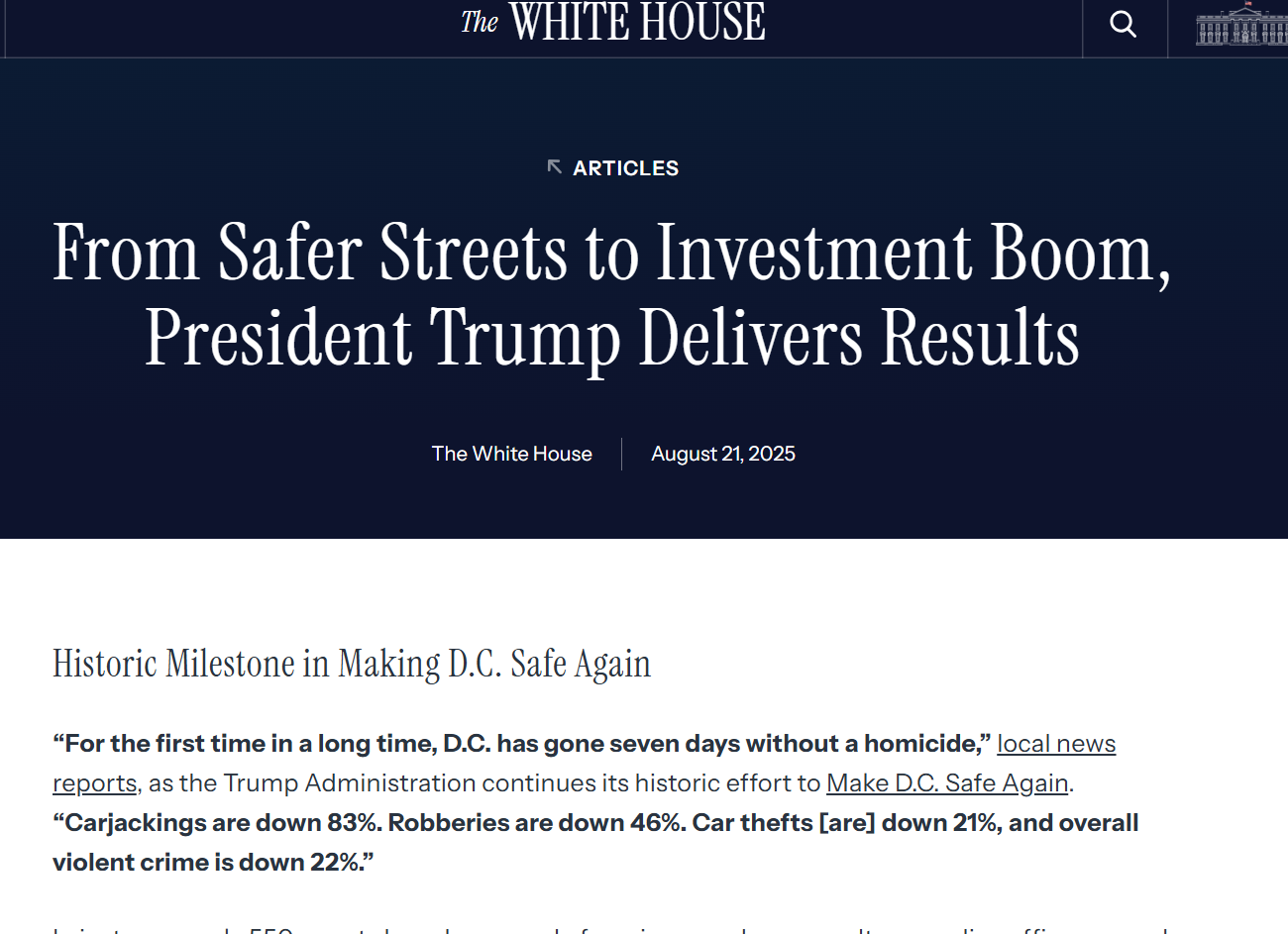
    President Trump’s policies are showing measurable results both in public safety and economic growth, as Washington, D.C. experiences its first week without a homicide in years and violent crime drops by 22%, with carjackings down 83%, robberies down 46%, and car thefts down 21%. In just seven days, law enforcement made 550 arrests for serious offenses ranging from armed robbery to child abuse, while also removing dangerous illegal immigrants, including MS-13 gang members, from the streets. The administration is also tackling urban blight by clearing homeless encampments and cleaning graffiti. On the economic front, Trump’s landmark One Big Beautiful Bill Act is driving a manufacturing resurgence, with Johnson & Johnson announcing a new $2 billion facility in North Carolina as part of its $55 billion U.S. investment commitment, credited to the administration’s push to restore American industrial and pharmaceutical strength.

    From Safer Streets to Investment Boom, President Trump Delivers Results

    Historic Milestone in Making D.C. Safe Again

    “For the first time in a long time, D.C. has gone seven days without a homicide,” local news reports, as the Trump Administration continues its historic effort to Make D.C. Safe Again“Carjackings are down 83%. Robberies are down 46%. Car thefts [are] down 21%, and overall violent crime is down 22%.”

    In just one week, 550 arrests have been made for crimes such as assault on a police officer, armed robbery, assault with a deadly weapon, involuntary manslaughter, child abuse, driving under the influence, and more. Authorities have also removed dozens of criminal illegal immigrants from the streets, including one MS-13 gang member and another charged with sex crimes against a child.

    Meanwhile, dozens of homeless encampments have been cleared and graffiti is being cleaned up as the Trump Administration works to restore glory and prestige to our nation’s capital.

    One Big Beautiful Bill Driving Investment

    As President Donald J. Trump continues his pursuit of American manufacturing dominance and restoring America’s pharmaceutical supply chain, Johnson & Johnson announced a new $2 billion investment to build a manufacturing facility in North Carolina — adding to their $55 billion commitment earlier this year.

    Joaquin Duato, the company’s chairman and CEO, credited President Trump’s landmark One Big Beautiful Bill for the continued investment: “With the recent signing of the One Big Beautiful Bill Act, we continue to expand our investment in the U.S. to lead the next era of healthcare innovation.”

    The White House

    August 21, 2025

    Sources: White House , Midtown Tribune News

    Midtown Tribune Independent USA news from New York

  • President Trump Criticizes Smithsonian’s Woke Exhibits and Progressive Agenda

    President Trump Criticizes Smithsonian’s Woke Exhibits and Progressive Agenda

    President Trump has taken aim at the Smithsonian Institution, highlighting a series of exhibits and programs that critics say push an extreme progressive agenda under the guise of cultural education. Museums including the National Museum of African American History and Culture, the American History Museum, the National Portrait Gallery, and the National Museum of the American Latino have featured content portraying America’s founding as rooted in racism and colonization, celebrating illegal border crossings, and reframing historic events such as the Texas Revolution and Mexican-American War through an anti-American lens. Displays include LGBTQ+ identity showcases, activist-driven narratives on immigration, exhibits that reinterpret the Pilgrims and Benjamin Franklin primarily through slavery, and even artwork proposing a transgender Statue of Liberty. Trump argues that such programming, filled with activist voices and radical reinterpretations of U.S. history, disrespects American heritage and misrepresents the nation’s founding principles.

    President Trump Is Right About the Smithsonian

    • The National Museum of African American History and Culture debuted a series to educate people on “a society that privileges white people and whiteness” — defining so-called “white dominant culture“ as “ways white people and their traditions, attitudes, and ways of life have been normalized over time” and portraying “the nuclear family,” “work ethic,” and “intellect” as white qualities rooted in racism.
    • As part of its campaign to stop being “wealthy, pale, and male,” the National Portrait Gallery featured a choreographed “modern dance performance“ detailing the “ramifications“ of the southern border wall and commissioned an entire series to examine “American portraiture and institutional history… through the lens of historical exclusion.”
    • The American History Museum prominently displays the “Intersex-Inclusive Progress Pride flag” at its entrance, which was also flown alongside the American flag at multiple Smithsonian campuses.
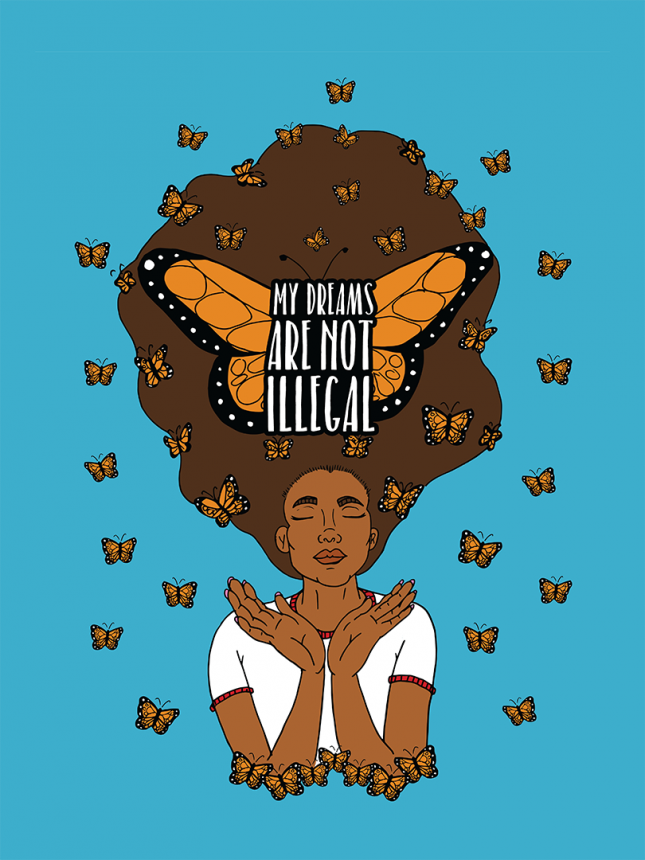
    • The National Portrait Gallery features art commemorating the act of illegally crossing the “inclusive and exclusionary” southern border — even making it a finalist for one of its awards.
    • The National Museum of African Art displayed an exhibit on “works of speculative fiction that bring to life an immersive, feminist and sacred aquatopia inspired by the legend of Drexciya,” an “underwater kingdom populated by the children of pregnant women who had been thrown overboard or jumped into the ocean during the Middle Passage.”
    • The American History Museum’s “LGBTQ+ History” exhibit seeks to “understand evolving and overlapping identities such as lesbian, gay, bi-sexual, transgender, queer, transsexual, transvestite, mahu, homosexual, fluid, invert, urning, third sex, two sex, gender-bender, sapphist, hijra, friend of Dorothy, drag queen/king, and many other experiences,” and includes articles on “LGBTQ+ inclusion and skateboarding“ and “the rise of drag ball culture in the 1920s.”
    • The National Museum of the American Latino features programming highlighting “animated Latinos and Latinas with disabilities” — with content from “a disabled, plus-sized actress” and an “ambulatory wheelchair user” who “educates on their identity being Latinx, LGBTQ+, and disabled.”
    • The National Museum of the American Latino characterizes the Texas Revolution as a “massive defense of slavery waged by ‘white Anglo Saxon’ settlers against anti-slavery Mexicans fighting for freedom, not a Texan war of independence from Mexico,” and frames the Mexican-American War as “the North American invasion” that was “unprovoked and motivated by pro-slavery politicians.”
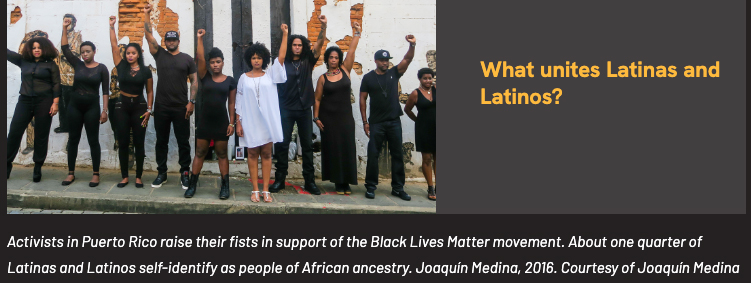
    • According to the National Museum of the American Latino, “what unites Latinas and Latinos“ is “the Black Lives Matter movement.”
    • The American History Museum’s exhibit marking the 50th anniversary of Title IX includes biological men competing in women’s sports and argues in favor of “transgender” athletes competing in sports against the opposite biological sex.
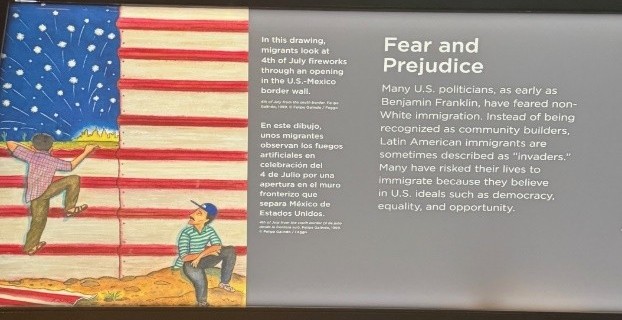
    • A exhibit at the American History Museum depicts migrants watching Independence Day fireworks “through an opening in the U.S.-Mexico border wall” and says America’s founders “feared non-White immigration.”
    • The American History Museum features a display that refers to the founding of America as “a profound unsettling of the continent.”
    • The American History Museum’s “American Democracy” exhibit claims voter integrity measures are “attempts to minimize the political power” of “new and diverse groups of Americans,” while its section on “demonstrations” includes only leftist causes.
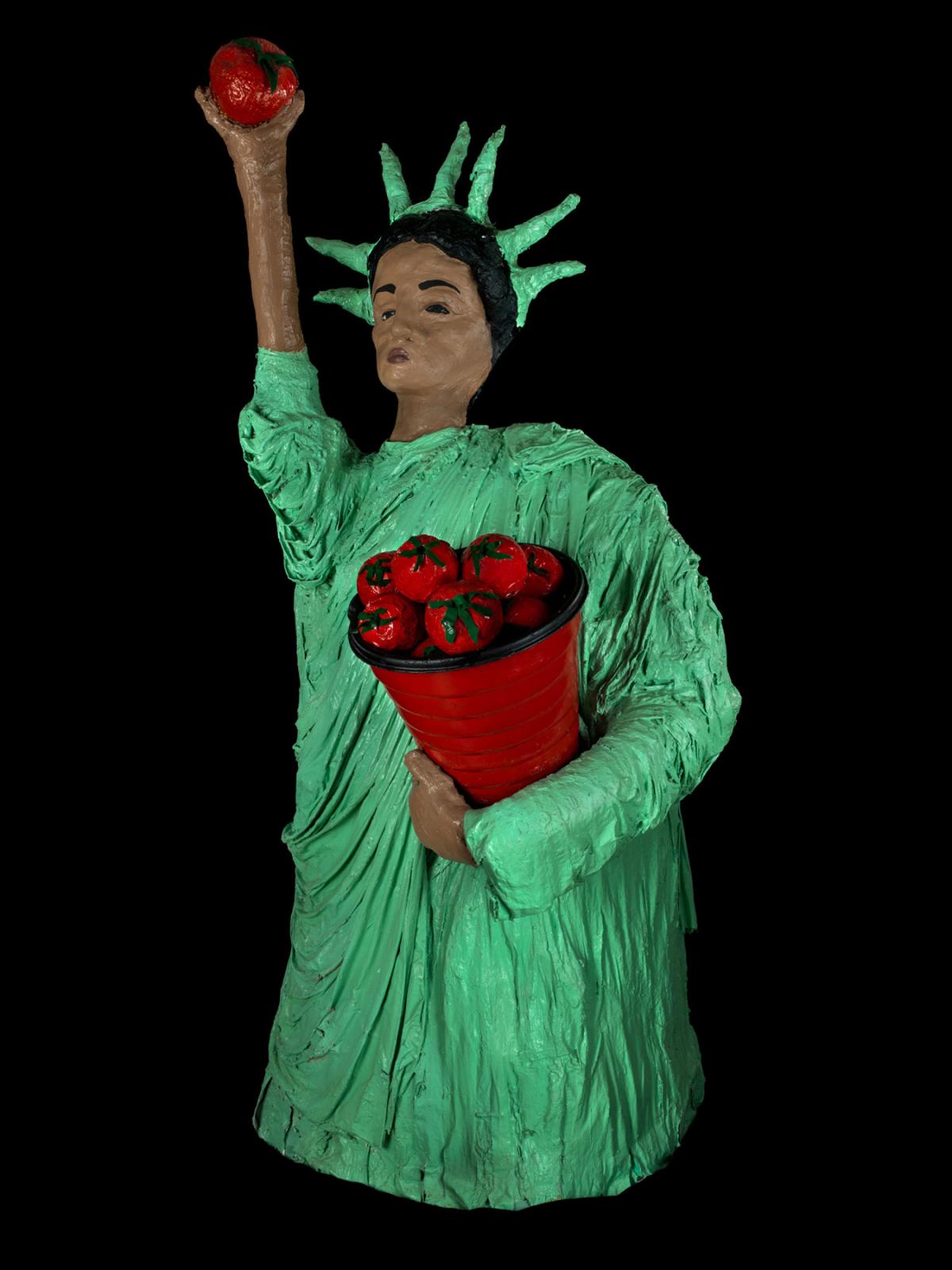
    • An American History Museum exhibit features a depiction of the Statue of Liberty “holding a tomato in her right hand instead of a torch, and a basket of tomatoes in her left hand instead of a tablet.”
    • The National Museum of the American Latino features an anti-American exhibit that defines Latino history as centuries of victimhood and exploitation, suggests the U.S. is stolen land, and characterizes U.S. history as rooted in “colonization.”
      • The exhibit features writing from illegal immigrants “fighting to belong.”
      • The exhibit displays a quote from Claudia de la Cruz, the socialist nominee for president and a director an anti-American hate group, as well as another quote that reads, “We didn’t cross the border; the border crossed us.”
      • The exhibit remains prominently featured on its website alongside a quote from the Communist Party USA’s Angela Davis, who was once among the FBI’s Top 10 Most Wanted Fugitives.
    • The National Museum of the American Latino describes the post-Mexican-American War California describes a “Californio” family losing their land to American “squatters.”
    • The Museum of American Art uses American sculpture “to invite dialogue and reflection on notions of power and identity.”
    • The American History Museum’s “Upending 1620” exhibit claims Pilgrims are a “myth,” instead framing them as colonizers.
    • The American History Museum’s exhibit about Benjamin Franklin focuses almost solely on slavery, directing visitors to learn more about his “electrical experiments and the enslaved people of his household,” noting his “scientific accomplishments were enabled by the social and economic system he worked within.”
    • The National Portrait Gallery was set to feature a “painting depicting a transgender Statue of Liberty” before the artist withdrew it.
    • The former interim director of the future Smithsonian American Women’s History Museum declared the museum will be “inclusive” of biological men posing as women.

    The White House

    August 21, 2025

    All illustration from White House Website

    Sources: White House , Midtown Tribune

    Midtown Tribune Independent USA news from New York

  • White House. U.S. and EU Announce Framework Agreement on Reciprocal, Fair, and Balanced Trade

    White House. U.S. and EU Announce Framework Agreement on Reciprocal, Fair, and Balanced Trade

    The United States and the European Union have unveiled a landmark Framework Agreement on Reciprocal, Fair, and Balanced Trade, designed to strengthen one of the world’s largest economic relationships and address longstanding trade imbalances. Under the deal, the EU will eliminate tariffs on U.S. industrial goods and expand market access for American agricultural and seafood products, while the U.S. will adjust tariffs on European goods, including cars, aircraft parts, pharmaceuticals, and semiconductors. The agreement also prioritizes cooperation on energy security, with the EU planning $750 billion in U.S. energy purchases and $40 billion in AI chip imports, alongside expanded European investments of $600 billion in U.S. industries. Key commitments cover defense procurement, mutual recognition of standards, technology and cybersecurity cooperation, agricultural trade, digital trade protections, labor rights, and supply chain resilience. Positioned as a first step, the Framework Agreement sets the stage for broader transatlantic economic cooperation and long-term industrial revitalization.

    Joint Statement on a United States-European Union Framework on an Agreement on Reciprocal, Fair, and Balanced Trade

    The United States and the European Union are pleased to announce that they have agreed on a Framework on an Agreement on Reciprocal, Fair, and Balanced Trade (“Framework Agreement”). This Framework Agreement represents a concrete demonstration of our commitment to fair, balanced, and mutually beneficial trade and investment.  This Framework Agreement will put our trade and investment relationship – one of the largest in the world – on a solid footing and will reinvigorate our economies’ reindustrialization. It reflects acknowledgement by the European Union of the concerns of the United States and our joint determination to resolve our trade imbalances and unleash the full potential of our combined economic power. The United States and the European Union intend this Framework Agreement to be a first step in a process that can be further expanded over time to cover additional areas and continue to improve market access and increase their trade and investment relationship.

    The key terms include: 

    1.​ The European Union intends to eliminate tariffs on all U.S. industrial goods and to provide preferential market access for a wide range of U.S. seafood and agricultural goods, including tree nuts, dairy products, fresh and processed fruits and vegetables, processed foods, planting seeds, soybean oil, and pork and bison meat. The European Union will immediately take the necessary steps to extend the Joint Statement of the United States and the European Union on a Tariff Agreement announced on August 21, 2020, with respect to lobster (that expired 31 July 2025), coupled with an expanded product scope to include processed lobster.

    2.​ The United States commits to apply the higher of either the U.S. Most Favored Nation (MFN) tariff rate or a tariff rate of 15 percent, comprised of the MFN tariff and a reciprocal tariff, on originating goods of the European Union. Additionally, effective as of 1 September 2025, the United States commits to apply only the MFN tariff to the following products of the European Union: unavailable natural resources (including cork), all aircraft and aircraft parts, generic pharmaceuticals and their ingredients and chemical precursors. The United States and the European Union agree to consider other sectors and products that are important for their economies and value chains for inclusion in the list of products for which only the MFN tariffs would apply.

    3. ​The United States intends to promptly ensure that the tariff rate, comprised of the MFN tariff and the tariff imposed pursuant to Section 232 of the Trade Expansion Act of 1962, applied to originating goods of the European Union subject to Section 232 actions on pharmaceuticals, semiconductors, and lumber does not exceed 15 percent. When the European Union formally introduces the necessary legislative proposal to enact the tariff reductions set forth in Section 1 of this Framework Agreement, the United States will reduce tariffs on automobiles and automobile parts originating from the European Union subject to Section 232 tariffs as follows: No Section 232 automobile or automobile parts tariffs will apply to covered European Union goods with an MFN tariff of 15 percent or higher; and for covered goods with an MFN rate lower than 15 percent, a combined rate of 15 percent, comprised of the MFN tariff and Section 232 automobile tariffs, will be applied. These tariff reductions are expected to be effective from the first day of the same month in which the European Union’s legislative proposal is introduced. The United States expects the European Union’s legislative proposals will be consistent with this Framework Agreement and enacted by the necessary legislatures. All modifications to U.S. Section 232 tariffs will be executed in a manner that reinforces and is consistent with U.S. national security interests. With respect to steel, aluminum, and their derivative products, the European Union and the United States intend to consider the possibility to cooperate on ring-fencing their respective domestic markets from overcapacity, while ensuring secure supply chains between each other, including through tariff-rate quota solutions.

    4. ​The United States and the European Union will negotiate rules of origin that ensure that the benefits of the Agreement on Reciprocal Trade accrue predominately to the United States and the European Union.

    5. ​The United States and the European Union commit to cooperate on ensuring secure, reliable, and diversified energy supplies, including by addressing non-tariff barriers that might restrict bilateral energy trade.  As part of this effort, the European Union intends to procure U.S. liquified natural gas, oil, and nuclear energy products with an expected offtake valued at $750 billion through 2028. In addition, the European Union intends to purchase at least $40 billion worth of U.S. AI chips for its computing centers. The European Union further plans to work with the United States to adopt and maintain technology security requirements in line with those of the United States. in a concerted effort to avoid technology leakage to destinations of concern. The United States will endeavor to facilitate such exports once such requirements are in place.

    6. ​The United States and the European Union share one of the world’s largest economic relationships, supported by mutual investment stocks exceeding $5 trillion, and intend to promote and facilitate mutual investments on both sides of the Atlantic. In this context, European companies are expected to invest an additional $600 billion across strategic sectors in the United States through 2028. This investment reflects the European Union’s strong commitment to the transatlantic partnership and its recognition of the United States as the most secure and innovative destination for foreign investment.

    7. ​The European Union plans to substantially increase procurement of military and defense equipment from the United States, with the support and facilitation of the U.S. government.  This commitment reflects a shared strategic priority to deepen transatlantic defense industrial cooperation, strengthen NATO interoperability, and ensure that European allies are equipped with the most advanced and reliable defense technologies available.

    8. ​The United States and the European Union commit to work together to reduce or eliminate non-tariff barriers. With respect to automobiles, the United States and the European Union intend to accept and provide mutual recognition to each other’s standards. Cooperation on standards plays a crucial role in enhancing the transatlantic marketplace. The European Union and United States commit to enhance opportunities for technical cooperation between EU- and U.S.-domiciled standards development organizations with the objective of identifying and developing standards for the transatlantic marketplace in key sectors of mutual interest.  The United States and the European Union commit to facilitate conformity assessments to cover additional industrial sectors.

    9. ​Recognizing the importance of continued engagement to resolve longstanding concerns, the European Union and the United States commit to work together to address non-tariff barriers affecting trade in food and agricultural products, including streamlining requirements for sanitary certificates for pork and dairy products.

    10. ​Recognizing that production of the relevant commodities within the territory of the United States poses negligible risk to global deforestation, the European Union commits to work to address the concerns of U.S. producers and exporters regarding the EU Deforestation Regulation, with a view to avoiding undue impact on U.S.-EU trade.

    11. ​Taking note of the U.S. concerns related to treatment of U.S. small and medium-sized businesses under the Carbon Border Adjustment Mechanism (CBAM), the European Commission, in addition to the recently agreed increase of the de minimis exception, commits to work to provide additional flexibilities in the CBAM implementation.

    12. ​The European Union commits to undertake efforts to ensure that the Corporate Sustainability Due Diligence Directive (CSDDD) and the Corporate Sustainability Reporting Directive (CSRD) do not pose undue restrictions on transatlantic trade.  In the context of CSDDD, this includes undertaking efforts to reduce administrative burden on businesses, including small- and medium-sized enterprises, and to propose changes to the requirement for a harmonized civil liability regime for due diligence failures and to climate-transition-related obligations.  The European Union commits to work to address U.S. concerns regarding the imposition of CSDDD requirements on companies of non-EU countries with relevant high-quality regulations.

    13. ​The European Union reaffirms that U.S. conformity assessment bodies can be designated as Notified Bodies in accordance with the Sectoral Annex for Telecommunications Equipment to the Agreement on Mutual Recognition Between the European Community and the United States (1998) to carry out the tasks in relation to all essential requirements, including cybersecurity, in the Radio Equipment Directive 2014/53/EU.  In addition, the United States and the European Union will commit to negotiate a mutual recognition agreement on cybersecurity.

    14.​ The European Union and the United States commit to strengthen cooperation and action related to the imposition of export restrictions on critical mineral and other similar resources by third countries.

    15. ​The United States and the European Union commit to discuss high-standard commitments related to intellectual property rights protection and enforcement.

    16. ​The European Union and the United States commit to work together to ensure strong protection of internationally recognized labor rights, including with regard to the elimination of forced labor in supply chains.

    17.​ The United States and the European Union commit to address unjustified digital trade barriers. In that respect, The European Union confirms that it will not adopt or maintain network usage fees. The United States and the European Union will not impose customs duties on electronic transmissions. The United States and the European Union intend to continue to support the multilateral moratorium on customs duties on electronic transmissions at the World Trade Organization and seek the adoption of a permanent multilateral commitment.

    18.​ The European Union intends to consult with the United States and U.S. traders on digitalization of trade procedures and implementation of the legislation currently proposed on EU Customs Reform.

    19. ​The United States and the European Union agree to strengthen economic security alignment to enhance supply chain resilience and innovation by taking complementary actions to address non-market policies of third parties as well as cooperating on inbound and outbound investment reviews and export controls, as well as duty evasion. This includes addressing non-market practices, unfair competition, and lack of reciprocity in public procurement with respect to third countries. The United States and the European Union will cooperate on further implementation measures. ​

    The United States and the European Union, in line with their relevant internal procedures, will promptly document the Agreement on Reciprocal, Fair, and Balanced Trade to implement this Framework Agreement.

    The White House

    August 21, 2025

    Sources: White House , Midtown Tribune

    Midtown Tribune Independent USA news from New York

  • Hochul Unveils $52.6M Broadband Boost to Connect Thousands of New Yorkers

    Hochul Unveils $52.6M Broadband Boost to Connect Thousands of New Yorkers

    Summary: Gov. Kathy Hochul announced $52.6 million in new broadband funding to expand internet access for more than 24,000 households, businesses, and community sites across 28 New York counties. The plan will add 234 miles of fiber and 46 wireless hubs, with a major focus on affordable housing and underserved rural areas. Backed by federal and state dollars, the initiative is part of more than $308 million already invested to connect 142,500 homes statewide, helping families, students, and small businesses get reliable, low-cost internet they need for school, work, healthcare, and everyday life.

    Governor Hochul Announces $52.6 Million in Broadband Infrastructure Awards

    ConnectALL Awards Will Build 234 Miles of Fiber and 46 Wireless Hubs To Serve More Than 24,000 Households with Affordable Broadband in 28 Counties Across the State

    In Total, These Programs Have Awarded More Than $308 Million to Connect More Than 142,500 Households, Including 32,117 Affordable Homes with Reliable, Accessible and Affordable Internet

    Governor Kathy Hochul today announced 15 broadband infrastructure awards through the Municipal Infrastructure Program (MIP), Affordable Housing Connectivity Program (AHCP), and Deployment Program County Partnerships totaling $52.6 million. These awards will directly connect 6,900 locations across the state, including 24,000 total households, businesses, and anchor institutions, with 19,000 of those being affordable housing units, and build 234 miles of new fiber infrastructure and 46 new wireless hubs.

    “New York State is leading the nation in closing the digital divide once and for all,” Governor Hochul said. “Today’s $52 million in awards represents our commitment to connecting communities that need it most. In today’s economy, broadband isn’t a luxury, it’s a necessity for education, healthcare, economic opportunity, and full participation in modern life.”

    Empire State Development President, CEO and Commissioner Hope Knight said, “Expanding broadband access strengthens New York’s economy and improves quality of life. These awards will help to connect more than 24,000 households — including affordable housing residents — with high-speed service. By giving small businesses the tools to grow, students and workers the ability to succeed, and families access to critical services, we are building stronger, more connected communities across the state.”

    Senator Charles Schumer said, “Access to high-speed internet is not a luxury, but a necessity, a utility as vital as electricity for everyday life. Today, New York State takes a leap towards closing the digital divide. I’m proud to deliver millions in federal funding to help expand broadband infrastructure to boost affordable, high-quality internet access for over 24,000 homes and businesses across NY. This will help communities in 28 counties in every corner of NY from Buffalo and Albany to rural parts of the Finger Lakes and Southern Tier. It will help families stay connected to education, to healthcare, economic opportunity, and each other. When I led the American Rescue Plan and Bipartisan Infrastructure & Jobs Law to passage, I made sure there was funding for long term investments like this that would create good paying jobs helping build the 21st century infrastructure needed to make high-speed internet reach every corner of the state. I’m grateful for Governor Hochul’s work putting these federal dollars to work to ensure all New Yorkers get the equitable access to the internet that they deserve.”

    Senator Kirsten Gillibrand said, “Affordable and high-speed internet should be accessible to all New Yorkers, regardless of background. Investing in broadband infrastructure is critical for children to receive high-quality education, seniors to access telehealth services, and workers to engage in the digital economy. I am proud that this nearly $53 million investment will help connect communities across our state, and I will continue fighting for more funding that closes the digital divide once and for all.”

    Representative Jerrold Nadler said, “Access to reliable, high-speed internet is essential for every New Yorker, no matter their zip code or income. I welcome Governor Hochul’s announcement of over one million dollars to help close the digital divide so all Manhattan families can stay connected to each other and the world. As I did with the American Rescue Plan, I will always fight to make sure New Yorkers get the reliable, high-speed internet they need to succeed.”

    Representative Paul Tonko said, “Over the past several years, I’ve been proud to lead the charge in Congress to expand broadband here in New York and nationwide. That’s because internet access is not a luxury — it’s a necessity for families, businesses, and communities here in our Capital Region and across our state. These investments will help ensure that New Yorkers of all income levels can stay better connected to their jobs, their schools, and their loved ones, while strengthening the very fabric of our communities. I’m thrilled to join Governor Hochul in celebrating this important step forward in our efforts to bring critical infrastructure improvements to the families who need them most.”

    Representative Grace Meng said, “Broadband isn’t a luxury, it’s a necessity for New Yorkers of all ages. In Congress I have fought to expand broadband access in Queens and make at-home internet access more affordable for all families. This $52 million investment builds on the progress we’ve made to ensure that all New Yorkers are online, regardless of whether they live in a metropolitan or rural community across the state.”

    Representative Joseph Morelle said, “Affordable, reliable internet isn’t a luxury anymore—it’s how families connect to jobs, schools, and each other. This $4 million in funding for our community will transform the lives of thousands of families, giving them the resources and support they need to thrive. I’m grateful to Governor Hochul for leading New York State on our mission to close the digital divide once and for all.”

    Representative Tim Kennedy said, “Investing in broadband infrastructure is one of the most meaningful ways we can strengthen our communities and expand opportunities for working families across Western New York and New York State. This investment will improve access and connectivity for our region’s schools, first responders, small businesses, and households that have been left behind for far too long. By investing in broadband, New York is working to ensure that every student can learn, every patient can access telehealth, and every family can fully participate in today’s economy.”

    Representative John W. Mannion said, “Investing in broadband infrastructure is crucial for our rural communities and delivers government that prioritizes the people. The $2.7 million for the Greater Syracuse area will connect houses and communities across my district, and the nearly $10 million in Madison County will build hundreds of miles of fiber to connect thousands of homes and businesses, providing vital resources to rural communities and farmers. I’ll continue advocating for connectivity and broadband for Central New York and the Mohawk Valley to connect constituents and their businesses. I thank Governor Hochul for her commitment and leadership delivering results across New York State.”

    The $52.6 million in awards will support long-term economic development across 28 counties and the internet service will improve affordability so all residents can participate in the digital economy. The broadband internet service in some cases will be as low as $10 per month and in all cases will include high-speed options below the regional average prices.

    These projects build on a foundation of prior investment by ConnectALL, which has previously awarded more than $13 million in AHCP grants connecting more than 12,000 affordable housing units, and $242.5 million in MIP grants bringing high-speed internet to an additional 105,000 households across the state. Funded by the US Department of Treasury, these initiatives reflect a targeted state and federal partnership that aims to accelerate progress toward universal connectivity and ensure that all New Yorkers have access to reliable, affordable internet.

    Assemblymember Steve Otis said, “New York State has led the nation in developing innovative programs to provide broadband access in neglected rural, suburban, and urban areas. This announcement is especially exciting with the focus on providing access to affordable and public housing complexes that are the types of facilities often left out of high-speed broadband access many take for granted. Special recognition for this important work goes to Governor Kathy Hochul, ESD President and Commissioner Hope Knight, and ConnectALL Chair Josh Breitbart for their leadership in making sure underserved New Yorkers gain access. As Chair of the Assembly Science and Technology Committee, I know that both houses of the Legislature have been partners in this work.”

    Municipal Infrastructure Program Awards

    The Municipal Infrastructure Program builds critical broadband infrastructure through public-private partnerships, focusing on expanding access in underserved rural areas.

    • Southern Tier Network MIP Expansion (Southern Tier) – $1,363,264: STN will extend its existing middle mile network by building a high-capacity, open-access fiber line connecting to the Phase 1 network in Newark Valley, improving service reliability and supporting ISPs delivering affordable broadband to rural and underserved areas.
    • Madison County (Central New York) – $9,928,784: Madison County will partner with Empire Access to build 120 miles of fiber connecting more than 2,600 homes, businesses, and community anchor institutions. By leveraging existing USDA ReConnect contracts with 20% designated as open-access fiber for other providers, the County will extend service to rural and agricultural communities with limited high-speed service options.
    • Wyoming County (Finger Lakes) – $15,682,943: Wyoming County and Community Broadband Networks will partner on two projects; the first will construct a 36-mile fiber optic backbone connecting approximately 100 locations supporting Fiber-to-the-Home service, with capacity to support further last-mile expansions from multiple internet service providers; the second will deploy 20 fixed wireless Points of Presence reaching more than 1,900 locations. POPs will be installed on utility poles, custom masts, and municipal assets like water towers to deliver broad public benefit.
    • ErieNet Local Development Corporation (Western New York) – $5,088,381: Erie County will utilize funds to extend their open-access middle-mile network 42 miles to serve 82 additional community anchor institutions providing essential life and safety protection in Erie County, including police, fire, emergency management services and community centers owned by the municipalities of City of Buffalo, City of Lackawanna, and Erie County Public Safety.

    Affordable Housing Connectivity Program Awards

    The Affordable Housing Connectivity Program provides high-speed internet access to affordable and public housing properties, ensuring digital equity for low-income residents. Awards have been announced to two grantees: Flume Internet and Community Broadband Networks, across the following regions:

    • Greater Rochester (Monroe, Livingston, Ontario, Orleans, Wayne, Yates Counties) – $4,063,313: Community Broadband Networks will deploy hybrid fiber-fixed wireless networks to affordable and public housing properties in Greater Rochester, offering service at $10/month and Gigabit service at $30/month for 10+ years.
    • Greater Albany (Albany, Rensselaer, Saratoga, Schenectady, Schoharie Counties) – $3,364,105: Community Broadband Networks will deploy hybrid fiber-fixed wireless networks to affordable and public housing properties in Greater Albany, offering service at $10/month and Gigabit service at $30/month for 10+ years.
    • Brooklyn (Kings County) – $2,979,787: Flume Internet will deploy hybrid fiber-fixed wireless networks to affordable and public housing properties in Brooklyn, offering service at $10/month and Gigabit service at $30/month for 10+ years.
    • Greater Buffalo (Erie, Niagara Counties) – $2,849,775: Community Broadband Networks will deploy hybrid fiber-fixed wireless networks to affordable and public housing properties in Greater Buffalo, offering service at $10/month and Gigabit service at $30/month for 10+ years.
    • Greater Syracuse (Onondaga, Oswego, Madison Counties) – $2,748,215: Community Broadband Networks will deploy hybrid fiber-fixed wireless networks to affordable and public housing properties in Greater Syracuse, offering service at $10/month and Gigabit service at $30/month for 10+ years.
    • Manhattan (New York County) – $1,299,485: Flume Internet will deploy hybrid fiber-fixed wireless networks to affordable and public housing properties in Manhattan, offering service at $10/month and Gigabit service at $30/month for 10+ years.
    • Greater Ithaca (Tompkins County) – $1,012,456: Community Broadband Networks will deploy hybrid fiber-fixed wireless networks to affordable and public housing properties in Greater Ithaca, offering service at $10/month and Gigabit service at $30/month for 10+ years.
    • Lower Hudson (Westchester, Rockland Counties) – $929,662: Community Broadband Networks will deploy hybrid fiber-fixed wireless networks to affordable and public housing properties in Westchester and Rockland Counties, offering service at $10/month and Gigabit service at $30/month for 10+ years.
    • City of Geneva (Ontario County) – $203,663: Community Broadband Networks will deploy hybrid fiber-fixed wireless networks to affordable and public housing properties in Geneva, offering service at $10/month and Gigabit service at $30/month for 10+ years.

    County Partnership Infrastructure Awards

    The County Partnership Infrastructure Awards support local broadband deployment through strategic partnerships with counties and private providers.

    • Albany County (Capital District) – $1,022,608: Albany County is partnering with Archtop Fiber and State Telephone to deliver reliable, high-speed internet to more than 100 locations in the county.

    Expanding New York’s Digital Infrastructure

    Governor Hochul has made expanding broadband access a cornerstone of her administration’s efforts to create a more equitable New York. Through the ConnectALL initiative, New York State is investing more than $1 billion to transform the state’s digital infrastructure, enhance competition among providers, and ensure that every New Yorker has access to reliable, affordable high-speed internet. To date, ConnectALL has overseen the successful launch and implementation of several programs to advance broadband access, including:

    • The Municipal Infrastructure Program has awarded more than $242 million to support construction of open access municipal broadband networks across the state. The program, primarily funded by the U.S. Department of the Treasury under the American Rescue Plan’s Capital Projects fund, facilitates a variety of models of municipal broadband and public-private partnerships to provide New Yorkers with affordable, high-quality service options. The Beta ConnectALL Projects Dashboard provides details on projects funded by the Municipal Infrastructure Program.
    • The Digital Equity Program will invest $50 million to implement the New York State Digital Equity Plan to close the digital divide. The Plan outlines New York’s statewide strategy to increase its capacity to improve digital literacy and digital job readiness skills, facilitate access to affordable internet and devices, enhance digital privacy and safety, and make government services more accessible through the internet.
    • The Affordable Housing Connectivity Program will bring new broadband infrastructure to homes in affordable and public housing leveraging a $100 million federal investment from the U.S. Treasury Department’s Capital Projects Fund. The Beta ConnectALL Projects Dashboard provides details on projects funded by the Affordable Housing Connectivity Program.
    • The ConnectALL Deployment Program will provide funding for internet service providers to reach unserved and underserved locations, drawing on an allocation of $644.6 million in federal funding as described in the ConnectALL Broadband Deployment Initial Proposal. The Requests for Applications for the Deployment Program ended in July, and ConnectALL is currently reviewing applications for inclusion in its Final Proposal for these funds.
    • The Connectivity Innovation Program advances innovation and new broadband solutions, business models, and technologies in order to increase private sector investment and entrepreneurship; drive equity and innovation in the broadband marketplace; and reinforce a thriving research, development, and manufacturing ecosystem to support connectivity innovation in New York. ConnectALL is reviewing applications to the Connectivity Innovation – Mobile Service RFA, which closed in June 2025.
    • The Excelsior Broadband Network is a new statewide public broadband network. The first component of this project will be a new fiber line running the full length of the New York Thruway which will connect public broadband assets across the state and improve access to consistent high-speed internet and reliable cell phone service for communities across the state.
    • The Mobile Service Connectivity initiative will work with local stakeholders, state agencies, and industry to develop regional plans to expand cellular coverage across the state. The program will identify top opportunities to expand coverage and provide funding to deploy innovative, scalable solutions that can address gaps in wireless cellular coverage.

    August 21, 2025

    Albany, NY

    Sources: Governor.ny.gov , Big New York News BigNY.com
    Midtown Tribune news

    Midtown Tribune Independent USA news from New York