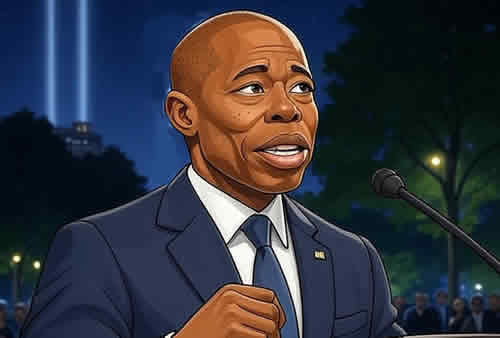
On WBLS 107.5’s “Hear From the Mayor,” Eric Adams reflected on the 24th anniversary of 9/11 and New York’s resilience, then welcomed retired NYPD inspector Paul McCormack, now legally blind from 9/11 injuries, to spotlight Ground Zero 360—the traveling exhibition he and photojournalist Nicola McLean created, now installed in City Hall’s Rotunda with personal effects from 11 fallen first responders and more than 100 artworks, with hopes to return for the 25th anniversary. McCormack honored Officer Moira Smith and noted that deaths from 9/11-related illnesses have surpassed the initial toll, thanking the Mount Sinai 9/11 health program. Callers raised concerns about Bed-Stuy seniors losing homes due to high property taxes and deed theft; Adams said he’s pushing tax reform in Albany and praised AG Letitia James and DA Eric Gonzalez for aggressive deed-theft prosecutions. The show closed with a call for unity and an invitation for New Yorkers to stay engaged and connect with the mayor online.
Transcript: Mayor Adams Hosts “Hear From the Mayor” Radio Show
Gary Byrd: Each and every second Sunday of the month, as you know by now, WBLS is proud to welcome a brother. He’s the 110th mayor of New York City, the second mayor of color and the first hip hop mayor in the city’s history. It’s time for us to hear from the mayor, Eric L. Adams. And the mayor wants to hear from you right here from 107.5 WBLS. Let’s get it started. Good morning, Brother mayor. Good to have you with us as always.
Mayor Eric Adams: Thank you. Great to be with you also, Gary. And to all the listeners out there. As you tune in to hear from the mayor and your mayor, Eric Adams. If this is your first time tuning in, the purpose is just really to share dialogue with you and other New Yorkers.
Listeners should give me a call and hear directly from me or hear some of the things that we’re doing to building a better city. Or you can sign up to hear more from me by visiting NYC.gov/hearfromEric. And you can also sign up on our website to text with Eric and talk with me on WhatsApp. But today, this morning, Sunday, this is a beautiful day out, by the way. Get outdoors and enjoy it. You could also call me at (212) 545-1075.
As many of you know, this past Thursday was September 11th, 2025. We reflect on what took place over 24 years ago on September 11th, 2001, when we lost nearly 3,000 people who perished on that terrible, terrible day when two planes flew into our World Trade Center. And it just created so much havoc throughout our country, because, as you know, we also had a plane that flew into the Pentagon. And we saw a plane that crashed in the field in Shanksville, Pennsylvania. And the names of those lost during this terrorist attack were read aloud during the testimony and ceremony during the ceremony at the 9/11 Memorial. And so 24 years, we have not forgotten them and we want to keep them in mind.
The most remarkable thing I always say is not the tragedy of what happened on September 11th, but what took place September 12th. We got up, teachers taught, builders built, retailers sold their goods. And we showed those who thought they would impact us of our level of resiliency as New Yorkers. And our resiliency cascaded throughout the entire country. And we saw our country stand up and state that we would not be terrorized by terrorists.
And one person who really personifies that is my guest today, Paul McCormack. Amazing, amazing individual, former New York City Police Department inspector. He was the CEO of the 13th precinct. And he turned what I like to say, he turned pain into purpose. He didn’t sit back and say, what was me? He said, why not me? Let me be the leader from the front. And when he retired due to his injuries sustained in the line of duty on 9/11, it left him legally blind.
He continued to make sure that we would never forget this moment. He’s the CEO of Ground Zero 360. It’s a traveling exhibition honoring the victims of 9/11 and their families. And earlier this week, I had the honor of unveiling the art installation at the Rotunda at City Hall. If you haven’t seen it, please come out and see it.
It is an accumulation of 14 years of work that he has put together and moved around the country, visited 60 cities, featuring photography, artifacts, and artwork. It tells the real story of the courage, the loss, and the resiliency. And the exhibition includes personal effects of 11 fallen first responders and 100 artworks reflecting on 9/11.
It is really an important exhibit. And I just want to thank him and his wife, his wife, Nicola McLean, a photojournalist who was working in New York City on that terrible day of September 11. And the two of them married and created Ground Zero 360 together. So I want to turn it over to you, Paul. That was a mouthful of what you have done and accomplished. Tell us the concept of your exhibit and how did it come about?
Paul McCormack, CEO, Ground Zero 360: Well, first off, mayor, thank you for having me here. And thank you for having us at City Hall. It was a tremendous honor and privilege to be there. And very, very kind of you to have us there. As I said, I was the commanding officer of the 41st Precinct on 9/11 in the South Bronx. And my wife was working for the Irish Voice and Irish American Magazine on 9/11. And my wife was down there on the 11th. And when the towers fell, in the days and weeks thereafter, there was a lot of people showing up with missing posters.
I think any of your listeners that were around at the time, missing posters started going up everywhere in the city at all of the bus shelters, train stations, hospitals. People were desperately looking to find their lost loved ones. And it was desperately sad. It was really sad. And my wife got really affected by it. She knew then that she wanted to do something to honor the victims and their families. And she and I, she created Ground Zero 360. And as most wives do, she came to me looking for help. What am I going to do? Say, whatever you want, hon, whatever you want.
But no, she created an incredible exhibition to honor the victims. And the mission is to keep the memory alive and never forget the sacrifice of so many on that terrible day. And a lot of the pictures that she took, it was on 35mm film, were of messages that were written in the dust from. There was a lot of firefighters. There were 343 firefighters who were lost, 23 members of the NYPD, 37 Port Authority police officers. And there were some, like, really sad messages that were written on the car windshields, on the store windows. And she asked me to track down some of the families that were in the messages, and we did.
And as you mentioned earlier, we actually have 13 family members that lost loved ones on 9/11. And I went to the families and asked them if they would be involved in the project, because we wanted to remember their families. And they’re all basically family members of ours right now. We have their personal effects in the exhibition. And it’s an emotional thing, Mr. Mayor, but it’s a privilege to be able to do it every year. It’s a labor of love. And like you mentioned, being a member of the NYPD, you said September 12th it would show the true nature of our country.
By God, it did. Like, I remember traveling down from the Bronx to Ground Zero. For three months, I was traveling down there, and the people were lined up in the streets. And I think every American became a New Yorker after 9/11. We became—America became a community. And by God, I was never—and I mean never—as proud to be a New Yorker. I was never as proud to be a member of the NYPD or as proud to be an American as I was at that time. Because there was no left or right, Democrat, Republican. None of that nonsense. We were all a united country. And Jesus, I wish we could get back to that, to that united feeling.
But the exhibition for the 10th anniversary, Nicola wanted to do—it was basically going to be a three-week memorial in her hometown in Dublin at the National Museum of Ireland. And that has turned into a 14-year odyssey right now, where you mentioned we have artists from all over the world. Fifteen countries have created pieces of art that they’ve given to us to show their—it affected everybody worldwide. It really did. It was so—so many countries and so many people affected. And, like, I remember for the 20th anniversary, my wife gave me a list of 15 artists. And she said, I’d like you to contact these people to do some art for us. And they were like big names, like Sean Scully and Hughie. And I was like, these guys are going to tell me to go jump in a river.
But it was quite the opposite. They were all like, we’d love to do something to honor the victims. And it went from 15 artists to over 100 artists right now. But it’s people like yourself. I remember speaking to you on St. Patrick’s Day this year about this event. And you didn’t even hesitate. You were like, yeah, we’re going to have this in City Hall. And we’re going to give it the right space, the right place to show this. And you didn’t even hesitate. And it’s people like yourself that really make us feel good about what we’re doing, because you make it so easy for us. And thank you so much for just a magnificent venue. Thank you.
Mayor Adams: No, so true. You know, like they say, we all gave something, but some gave all. And we should remember those who gave all. And as your work, it really allows us to reflect on it through the visual art, which is very powerful. And some of the paintings really reflect the spirit and the energy. What is the next destination for the exhibit?
McCormack: Well, we’re going to be at City Hall for the next few months. We’re hoping to return next year. The 25th anniversary is probably going to be the biggest anniversary since it happened. And as I said to you on Monday at City Hall, there’s no place like home. So we want to have it in New York again. So God willing, we can have it back at City Hall, because it’s the right venue to honor these victims and their families. And it was a very special.
We had a few families there. Jimmy Smith, who lost his wife Moira, was there. Really powerful. Like, I remember being in my office in the 41st Precinct with my executive staff. And my most vivid memory of 9/11 was when the first tower fell. A female police officer came over the radio calling for help. And you know yourself, mayor, as a cop, there’s nothing worse than hearing a fellow officer, especially when it’s a female. Not being sexist, but when it’s a female calling for help, it’s a different call. And there’s nothing more sickening in your gut when there’s absolutely nothing you can do about it.
And I remember that female voice was police officer Moira Smith. And Jimmy, who’s a retired cop from the 13th Precinct, Jimmy gave us Moira’s personal effects as part of the exhibition. And one of the paintings right at the bottom of the steps of the rotunda is a painting that Jim Fitzpatrick did of Moira, who is probably the greatest example of courage, selflessness, heroism that you’ll ever find as a police officer. And one example for cops worldwide. Just an unbelievable inspiration for all of us. And something we could strive to be like. She ran in there. Her last picture was taking a bloodied guy out of the towers. And she went right back in afterwards and made the ultimate sacrifice. So for us to be able to honor people like that is just a privilege.
Mayor Adams: So true, and now due to your work there, you lost your sight. What is your personal story?
McCormack: Well, I got chemicals in my eyes. So my eyesight deteriorated rapidly after 9/11 to the point where I couldn’t drive and I couldn’t shoot anymore. Not much use as a cop if you can’t do those two things. But I had to retire from the job. I loved being a cop. But I turned, as you said, I tried to turn that into doing things to help people.
I started up The Finest Federal Credit Union to help law enforcement in New York City, which is now rolled into New York State. I teach for a promotional school called The Key. You probably know that. I think you were one of our students back in the day, I believe, when you were studying for captain. I think you were one of my students, by the way.
So, yeah, but delighted to be continuing helping cops. And I was a big sports person. And one of the things, like, I used to play a lot of golf. And I had to give it up cold turkey for 13 years. And then I got involved with the United States Blind Golf Association. And I didn’t even know that there was such thing as blind golf. Like, people, they say blind golf. What the hell are you talking about, blind golf? But there are so many organizations out there that can help the blind and visually impaired.
I wound up joining the [The United States Blind Golf Association,] which gives you an outlet. Being blind and visually impaired can be a very dark and lonely and depressing place. It can. It’s frustrating. I can tell you, if I have five kids and to not be able to see them playing sports from the sideline and see things that other adults and parents can see, it can be depressing.
But when you can get involved with organizations like the United States Blind Golf Association, and you get out to outings where you can socialize and meet people, and it’s just a healthy way. It’s healthy for your mind and body. And, like, you represent your country at certain events. And I had the honor of representing New York and the United States at the World Blind Golf Championships in Canada last month. So I was delighted to do that.
Mayor Adams: You know, it’s a powerful story because sometimes we believe that after the buildings collapsed and the rebuilding, people still had to rebuild their lives. And, you know, oftentimes when you’re going through these difficult moments, it really calls on you. You know, faith is crucial. And hearing your story of how that terrorist attack also impacts your vision, impacts the lives of others. But you have truly turned that pain into purpose.
McCormack: You mentioned faith, mayor. I grew up a Catholic in Ireland. Went to Mass every week, every weekend. But when, you know, I moved over to America, emigrated to America in 86. I worked construction, joined the Police Department. And you kind of get away from your faith. But it’s amazing how events like that can bring you back and closer to God.
I remember Trinity Church was right there beside, still there, and was such a source of inspiration and hope. And I remember going in there and just praying. It got me closer to God, that event. And I remember going in and praying, reflecting, resting. And I think a lot of people felt that way. Sometimes it’s sad to say, but it takes events like that to really get you closer to God and make you realize the important things in life. It makes us reset.
Mayor Adams: You know, I hear the music, and we’re going to move to a break. Please stay with us. Paul has more to share. And if you have any questions, you could call us again. The number is (212) 545-1075.
Byrd: The program is Hear From the Mayor. And in addition, the mayor wants to hear from you. As you heard, (212) 545-1075 is the number to call. (212) 545-1075. We’ll come back with the mayor and his special guest right after this. From 107.5 WBLS.
[Commercial Break.]
Byrd: The program is Hear From the Mayor, and the mayor wants to hear from you. Stand by, he’ll be taking your calls in just a moment. Let’s welcome back Mayor Eric Adams and his special guest.
Mayor Adams: Thank you so much, and I’m here with Paul McCormack, retired inspector of the NYPD and CEO of Ground Zero 360. Before we go to calls, Paul, tell me about the continuous death. We hear about the 3,000 on September 11, 2001, but there are many deaths that are taking place even now.
McCormack: I think that’s something that a lot of people don’t realize, Mr. Mayor. I think there’s more than double the amount that got killed in the attacks, have died since 9/11, of cancers, respiratory diseases, and other illnesses. It’s really sad.
I’d like to do a thank you to the Mount Sinai Medical Program for what they do for the sick and injured. Every year, anybody that was down there, probably yourself included, should be getting checked up. But every year we go to the Mount Sinai program, but it’s sad. We have a sergeant that worked for me, Steve Chaffee. We honor him in the exhibition as well. He died of cancers from 9/11, and we’re honored to honor him in our exhibition as well. It’s something that police think and pray for all of the people that work there.
Mayor Adams: Yes. Before we go to the callers, callers, if you have a question for Paul or myself, Mayor Adams, you’re on the air, caller.
Question: Good morning, mayor. Good morning. I’m calling on behalf of the senior citizens, especially in Bed-Stuy. Our senior citizens are losing their homes at an alarming rate, primarily because of the taxes. They pay higher taxes in Bed-Stuy than they do in Park Slope. And a lot of our senior citizens are getting to the point where they can’t pay their taxes.
Somebody comes along and they offer them a loan, and they get into these predatory loans, and they get into deed theft. Is there anything, a bill, that can be put in place where you can put an abatement on senior citizens so their tax rate won’t be so high?
Mayor Adams: Yeah, and thank you for that. And I’m one of them. You know, I own property in Bed-Stuy, and I was going to join the original suit that Martha Stark, former finance commissioner, was put in place. I couldn’t join because I was an elected official at the time. But you are right. We have been, one, put in place changes in Albany to do tax reform because one, communities should not be paying higher. The out-tax laws are wrong.
They are unfair, particularly to communities like Bed-Stuyvesant and other moderate, middle, low-income communities. And we are going to try to push that legislation through Albany. But two, the Attorney General Letitia James and DA Eric Gonzalez are looking to prosecute those who go after our property owners with deed theft. This is something that has been plaguing the community, and they have been extremely aggressive. It was something I was fighting for even when I was born president. So there’s a combination of the two that we are really looking at this real problem. Caller, you’re on air.
Question: Hello?
Mayor Adams: Yes, how are you, caller? We have a little amount of time, so we want to get to your question, okay.
Question: Thank you to the 9/11 Memorial with Officer McCormack there. I am one of the workers from the 9/11 Mount Sinai program. And I just wanted to thank you all for your service. And just share with you that I appreciate Officer McCormack saying that we should, it would be good to get back to a state of unity. You know, because at the 9/11 program, I served previously. I’m not there anymore.
But at the time when I served right after 9/11, the actual Ground Zero tragedy, we did not care who the person voted for, what political party they were part of, or what their life choices were. We served everybody, anybody, and we came unified to try to bring some healing and some help and some coordination for everybody that participated, or lived around and was affected by the 9/11 tragedy, either physically there or emotionally or psychologically. And I still have that practice today, that it doesn’t matter who you voted for, what you are.
Mayor Adams: You’re right, sister. I’m sorry, sister, you’re right. That music is, we’re ending, but we got the spirit of what you were saying. And I thank you so much for what you have done and the energy you’re putting out right now. And I want to thank all our listeners in WBLS for allowing us to communicate with you. Thank you, and have a great, great weekend.
September 14, 2025
Sources: NYC.gov , Midtown Tribune News
Big New York news BigNY.com
Midtown Tribune Independent USA news from New York