NY1 Interview: Schools Chancellor Melissa Avilés-Ramos on Staying Under Mayor-Elect Mamdani, Universal Child Care, and Closing NYC’s “Opportunity Gap”
In this NY1 segment, the host frames the looming transition at City Hall: Mayor-elect Alex Zoron Mamdani is expected to announce early appointments while also weighing whether to retain senior officials from the Adams administration. The focus then turns to NYC Schools Chancellor Melissa Avilés-Ramos, who signals she wants to remain in the role and says she has already met with the mayor-elect for what she describes as a wide-ranging conversation on education priorities.
Avilés-Ramos highlights a mix of safety, academic performance, and student support initiatives. She points to efforts aimed at boosting math and reading proficiency and emphasizes an initiative launched earlier in the year—“Every Child and Family is Known”—designed to better support students in temporary housing by strengthening connections to families and city resources. On universal child care, she draws a clear line between “daycare” and early childhood education and argues that community-based providers and caregivers should be supported and treated as educators who help prepare children for academic success from the earliest years.
On outcomes, she reframes the traditional “achievement gap” discussion as an “opportunity gap,” arguing that improved resources and consistent instructional supports drive score gains—citing noted growth among Black and Latino students even as proficiency rates remain under 50%. She credits standardized curriculum work under “NYC Reads” and “NYC Solves,” including a K-5 push to concentrate schools into one of three curricula to enable targeted, job-embedded coaching. The conversation also touches on compliance with the state class-size law, a proposal for paid apprenticeship-style pathways for new teachers, the impact of federal immigration enforcement on students and families (including “Project Open Arms”), and the rollout of cell-phone restrictions with flexible, school-by-school approaches. Avilés-Ramos closes by underscoring that she is “first and foremost a parent” in the system and wants to be an advocate for families.
NYC City Hall Hanukkah Event: Police Commissioner Jessica Tisch, Deputy Mayor Fabian Levy, and Mayor Eric Adams Address Security and Rising Antisemitism
At a City Hall Hanukkah gathering, an emcee opens by identifying as a “loud and proud Jew” and recognizes multiple City Hall staff members before introducing NYPD Police Commissioner Jessica Tisch. Tisch thanks Mayor Eric Adams for his support of New York’s Jewish community and addresses the weekend terror attack in Australia, saying there is “no known nexus” to New York City and no specific credible threats tied to local Hanukkah events, but that the NYPD has increased security at menorah lightings and houses of worship across all five boroughs.
The program blends speeches and performances: a vocalist leads a crowd singalong of “Hallelujah” (with modified lyrics), and Council Member Gale Brewer offers brief remarks wishing a happy Hanukkah, calling the Sydney attack a “wakeup call,” thanking allies, and thanking the NYPD and Commissioner Tisch for keeping people safe. The event continues with music and additional acknowledgments of senior administration officials on stage.
Later, speakers pivot back to policy and public messaging. One official leads a prayer and references City Hall’s efforts to combat antisemitism, including executive actions described as adopting the IHRA definition of antisemitism and creating rules related to protests and city policy. Deputy Mayor Fabian Levy then delivers a longer address framing Hanukkah as a story of resilience and praising Mayor Adams for consistently standing with the Jewish community; Adams follows with a speech urging New Yorkers not to hide their Jewish identity out of fear and calling on allies to speak up. The program culminates in lighting a “Hanukkiah of hope,” described as made from fragments of missiles and tied with hostage-family ribbons, followed by blessings led by clergy and closing thanks to event sponsors.
NYC Weekly City Hall Recap: Citywide Translation Tech, $1B Coney Island Shoreline Plan, and 100 Gold Street Housing Conversion
This short City Hall–style recap frames the week as part of New York City’s “next chapter,” highlighting recent actions the administration says are aimed at improving day-to-day life for working-class New Yorkers. The narration positions the updates as proof the administration is “getting stuff done,” emphasizing operational changes and big capital commitments.
One major focus is language access: the city says it is rolling out language applications on all city-owned smart mobile devices and directing agencies to leverage translation technology. The stated goal is to improve communication with residents whose first language is one of the many languages spoken across the five boroughs.
The video also spotlights two large development and resiliency initiatives. First, it cites a $1 billion investment to renovate the Coney Island shoreline—reimagining the boardwalk, building flood-resilient infrastructure, upgrading public spaces, and adding 1,500 new homes. Second, it describes next steps in a housing initiative to convert the city-owned building at 100 Gold Street into a mixed-income residential project with 3,700 housing units (with at least 25% “permanently affordable”), plus 40,000 square feet of public space and new facilities for public use.
New York State is putting more than $300 million into hospital upgrades aimed at making care safer and more connected, Governor Kathy Hochul announced. The funding will support 22 projects statewide to improve health information technology, expand electronic medical records, strengthen cybersecurity to protect patient data, and grow telehealth services. State officials say the goal is to help hospitals—especially financially strained providers—modernize critical systems, reduce cyber risk, and make it easier for New Yorkers to access care remotely. The awards are part of New York’s broader push to improve hospital infrastructure and resilience across the state.
Governor Hochul Announces More Than $300 Million to Advance Health Information Technology and Cybersecurity in Hospitals Across New York State
Governor Kathy Hochul today announced more than $300 million in new state funding to support health care transformation projects across New York. The awards, made through the Statewide Health Care Facility Transformation Program IV and V, will support 22 projects aimed at improving health information technology by expanding patient electronic medical records, strengthening cybersecurity and patient information security, and expanding telehealth services.
“By modernizing our hospitals’ IT infrastructure and protecting patients’ information, we’re strengthening the foundation of health care in New York State,” Governor Hochul said. “These investments will help ensure that hospitals have the tools they need to safeguard patient data, expand telehealth services and deliver a healthier future for all New Yorkers.”
New York State Department of Health Commissioner Dr. James McDonald said, “With these investments, we are focused on developing safe, reliable and connected patient-centered care. By expanding data capabilities and improving cybersecurity defenses, we’re enhancing clinical decision making across the state’s health care network.”
This funding prioritizes projects that:
Support financially distressed providers;
Modernize critical health information technology infrastructure;
Strengthen cybersecurity and patient information security; and
Expand telehealth services.
Awardees include hospitals in every region of the State.
This investment builds on Governor Hochul’s continued efforts to strengthen New York’s health care delivery system. The Statewide Health Care Facility Transformation Program has awarded more than $1.75 billion to providers working to improve access, equity, and quality of care across New York. These awards are part of a broader, long-term commitment that has directed more than $4.7 billion in health care capital funding statewide since 2016.
Under Governor Hochul’s leadership, New York State enacted nation-leading cybersecurity regulations for hospitals, establishing a robust blueprint to protect critical systems and enhance the resilience of the state’s health care network against cyber threats.
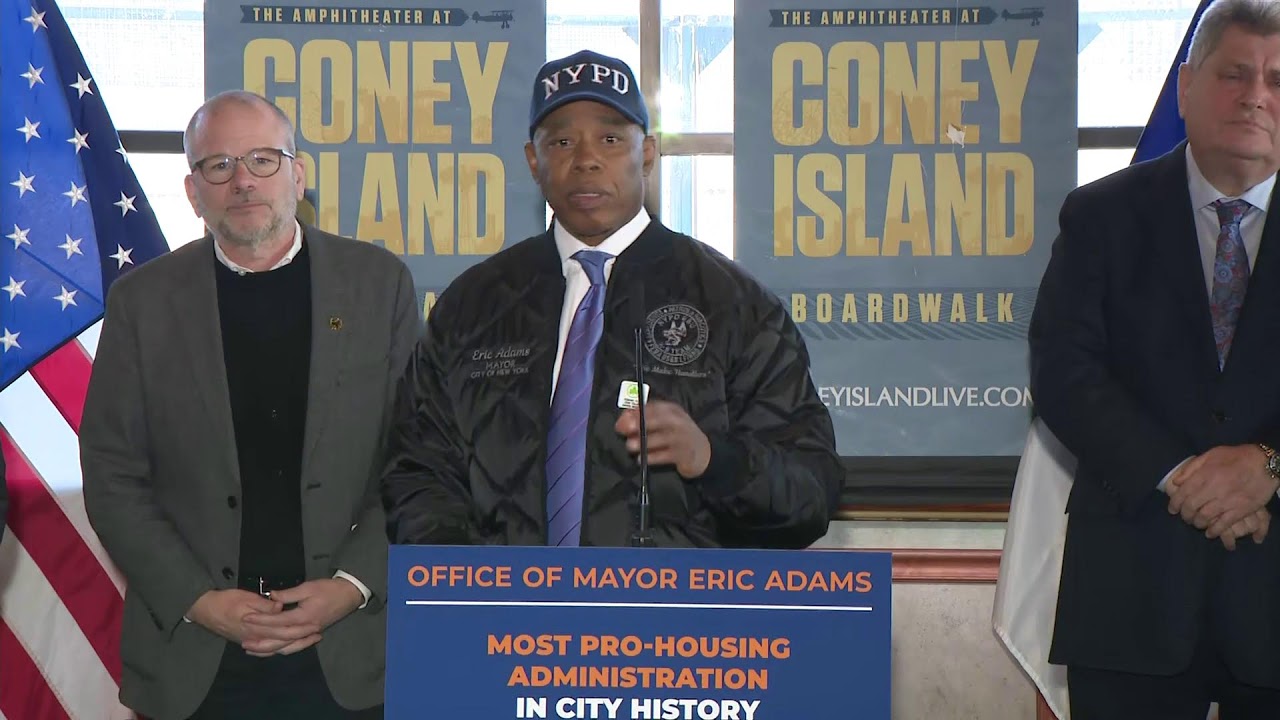
In Coney Island, Mayor Eric Adams announced a historic $1 billion investment to revitalize the iconic waterfront community, marking a major commitment in the final weeks of his administration. Reflecting on his early career as a transit police officer in the area, Adams highlighted Coney Island’s legacy as “America’s playground” while acknowledging past underinvestment. The plan includes constructing 1,500 new mixed-income homes (with 25% affordable), fully reconstructing the century-old Riegelmann Boardwalk, upgrading infrastructure such as streets and sewers, and renovating the Abe Stark Sports Center with a $42 million project to modernize its ice rink and facilities. Adams emphasized stabilizing life for residents, preventing displacement, and transforming the area into a year-round livable community rather than just a seasonal attraction.
Speakers, including Parks Commissioner Sue Donoghue and EDC President Andrew Kimball, underscored the investment’s focus on climate resiliency amid rising sea levels and extreme weather. Detailed technical surveys have informed plans to rebuild the boardwalk from the ground up with storm-protective measures inspired by Superstorm Sandy, incorporating sustainable materials and elevated design for future flood protection. The project will proceed with extensive community engagement, with a request for proposals for design and construction expected in early 2026, followed by phased work to minimize disruption to beachgoers and businesses. Additional efforts include recent selections for nearby mixed-income housing and retail developments to support economic growth.
Community leaders and local officials praised the announcement as transformative, crediting Adams’ long-standing advocacy for Coney Island. Assemblyman Alec Brook-Krasny and others expressed gratitude, noting the mayor’s personal connection to the neighborhood and his administration’s record on affordable housing. During the Q&A, officials clarified that while no final decisions have been made on materials or exact timelines, the project will continue through the transition to the incoming administration, with potential adjustments at the new mayor’s discretion. The event concluded on a note of optimism for a more resilient, vibrant, and equitable Coney Island for generations to come.
New York Governor Kathy Hochul and Queens County District Attorney Melinda Katz announced the successful disruption of a Queens-based organized retail theft ring responsible for stealing over $2.2 million in merchandise from 128 Home Depot locations across nine states. A 780-count indictment charges 13 individuals with first-degree grand larceny, criminal possession of stolen property, and conspiracy, leveraging new provisions in the FY 2025 Enacted Budget—secured by Governor Hochul—that permit aggregation of stolen goods values across incidents and enhance penalties for fencing operations. The case, developed through a joint investigation by the Queens DA’s Office and the New York State Police Organized Retail Theft Task Force (funded with more than $40 million in state resources), marks a significant enforcement milestone: 11 defendants have been arraigned, with maximum penalties of up to 25 years for theft crew members and 15 years for fences. The operation’s takedown contributes to broader statewide results, including 1,261 arrests, recovery of $2.6 million in stolen goods, and a 14% year-over-year decline in retail theft in New York City as of December 2025.
Governor Hochul and Queens District Attorney Katz Announce Indictment Charges in $2.2 Million Organized Retail Theft Bust
Governor Kathy Hochul and Queens District Attorney Melinda Katz today announced that 13 individuals have been charged in a 780-count indictment for operating a stolen goods and resale ring that targeted Home Depot locations in New York and eight other states. The individuals are facing grand larceny, conspiracy, and criminal possession of stolen property charges, including those included in the FY25 Enacted Budget that strengthened larceny laws by combining the value of merchandise stolen in separate incidents. In addition to these new crimes targeting organized retail theft, the FY25 Enacted Budget included a new crime specific to assault on retail workers, and more than $40 million for law enforcement secured by Governor Hochul. That funding created a dedicated Organized Retail Theft Task Force within the New York State Police, the work of which was integral to this case, and augmented efforts by district attorneys and local police departments to investigate and prosecute these cases.
“Since taking office, my highest priority has been driving down crime and keeping New Yorkers safe,” Governor Hochul said. “Following a post-pandemic spike in retail theft, I committed new funds to establish a dedicated organized retail theft task force and secured stronger laws to hold people who commit these crimes accountable. With better support for District Attorneys, local police departments and the State Police, we’re stopping organized retail theft rings in their tracks and ensuring a safer retail environment for business owners, staff and shoppers throughout New York.”
Queens District Attorney Melinda Katz said, “Thirteen defendants, over $2.2 million in merchandise, 319 incidents of theft, nine states and 128 separate Home Depot stores are the facts alleged, resulting in a 780-count indictment. The defendants took breaks for lunch and dinner, sometimes hitting the same Home Depot up to four times in one day. The stolen items were then resold to consumers, through a Brooklyn storefront or on Facebook Marketplace. Working with our partners at the New York State Police, we brought this brazen operation to a halt. I thank Governor Hochul for signing laws that provide prosecutors’ offices with tools to more efficiently investigate, and more effectively charge, organized retail theft and fencing operations.”
The District Attorney’s Office investigation began in June 2024, when members of the District Attorney’s Detective Bureau observed stolen air conditioners from Home Depot while conducting surveillance in a separate matter. The District Attorney’s Crime Strategies and Intelligence Bureau built the case in-house and worked closely with the New York State Police’s Organized Retail Theft Task Force, part of the agency’s Special Investigations Unit.
“Since taking office, my highest priority has been driving down crime and keeping New Yorkers safe”
Governor Kathy Hochul
New York State Police Superintendent Steven G. James said, “This case sends a strong message to would-be criminals – if you engage in retail theft, we will find you and hold you accountable to the full extent of the law. Retail theft has real victims – threatening the safety of shoppers and retail workers, creating enormous losses for businesses, and rising prices for the rest of us. I want to commend the outstanding work of our investigators and our partners at the Queens County District Attorney’s Office, and I want to thank Governor Hochul for the support she has provided to help us fight back against organized retail theft.”
Eleven individuals were arraigned yesterday on a 780-count indictment including charges of first-degree grand larceny, first-degree criminal possession of stolen property, fourth-degree conspiracy, and other crimes. One defendant remains at large and another will be arraigned at a later date. If convicted, members of the alleged theft crew face up to 25 years in prison, and the alleged black market retailers, known as fences, up to 15 years in prison.
According to the indictment and investigation, members of the theft and fencing ring are accused of stealing home construction tools, building supplies, power tools, smoke alarms, air conditioners, paper towels and other goods totaling more than $2.2 million during a 13-month period from August 2024 to September 2025. The items — stolen during 319 different incidents — were then sold to black market resellers, known as fences, who allegedly ordered the specific items to be stolen and then resold those goods to consumers.
The theft crew met almost daily to determine the locations of Home Depots they would target based on a review of merchandise in each store. Among the most common items stolen were insulation kits, buckets of reflective roof coating, power tools, air conditioners and smoke and carbon monoxide detectors. The amount of merchandise stolen in a single day ranged from about $1,800 to nearly $35,000.
Not including arrests and stolen goods recovered from this operation, the State Police and local law enforcement partners have recovered more than $2.6 million in stolen goods, made 1,261 arrests and filed 2,219 charges across 1,057 retail theft enforcement operations. As of December 2025, retail theft is down 14 percent year over year in New York City. Across the rest of the state, larceny is down 14 percent in the first seven months of 2025 vs. 2024.
Following a post-pandemic spike in reported retail theft in New York City and a statewide surge in reported larcenies, Governor Hochul also advanced new initiatives to strengthen laws, hold perpetrators accountable, protect retail workers and support small businesses, including:
Elevating the assault of a retail worker from a misdemeanor to a felony, ensuring any person who causes physical injury to a retail worker performing their job is subject to enhanced criminal penalties
Allowing prosecutors to combine the value of stolen goods when filing larceny charges, and allowing retail goods from different stores to be aggregated for the purposes of reaching a higher larceny threshold when stolen under the same criminal scheme
Making it illegal to foster the sale of stolen goods to go after third-party sellers
Securing $5 million to fund tax credits to help small businesses invest in and alleviate the financial burden for added security measures
State Senator Leroy Comrie said, “Organized retail theft is not a victimless crime, it hurts workers, drives up costs for families and threatens the stability of small businesses in our communities. I commend District Attorney Katz, the New York State Police and all law enforcement partners whose dedicated work brought this operation down. Their collaboration shows what is possible when we give agencies the tools they need to investigate and prosecute these complex cases. We must continue working together to protect retail workers, strengthen enforcement and ensure that every neighborhood in Queens remains a safe and reliable place to shop and do business.”
State Senator John Liu said, “This brazen retail theft ring and the rise in shoplifting following the pandemic show exactly why we strengthened retail theft laws in the state budget. Retail theft has preyed on our local businesses for far too long, with thieves targeting everything from paper towels to air conditioners. Thank you to DA Katz, Governor Hochul, and our local law enforcement for showing that the days of taking what you want and simply walking through the front door without fear of consequences are over, and that New York is committed to protecting our local businesses and restoring safety in our communities.”
Assemblymember Clyde Vanel said, “New York is sending a powerful message that coordinated retail theft rings will find no safe harbor here. This indictment makes clear that the new tools secured in the FY25 Budget, thanks to the leadership of Governor Hochul and the Legislature, are delivering real results. Dedicated and results-driven district attorneys like Melinda Katz are now better equipped than ever to take down organized crime and protect our communities and businesses.”
Assemblymember Steven Raga said, “The scale of this organized retail theft shows exactly why the Legislature strengthened our laws to combat organized criminal activity. These crimes impact the safety of workers, increase costs for consumers, and harm the economic health of communities across Queens. As a former retail worker myself, I understand how these incidents create real risks for people on the frontlines and destabilize the neighborhoods they serve. I commend Governor Hochul, District Attorney Katz, and the Task Force for taking decisive action that brings accountability and restores trust. This is the type of collaborative enforcement our state needs to keep people safe.”
Assemblymember Sam Berger said, “Queens is fortunate to have DA Melinda Katz taking on retail theft and bringing organized criminal rings to justice. I’m grateful to the brave men and women in state and local law enforcement who work every day to keep our communities safe. I was proud to stand with Governor Hochul and my colleagues in the Legislature to give prosecutors the tools they need to hold repeat offenders accountable.”
Retail Council of New York State President and CEO Melissa O’Connor said, “Governor Hochul and District Attorney Katz have made it abundantly clear that organized retail crime and habitual retail theft will not be tolerated in New York. This criminal activity goes well beyond the obvious financial loss for retailers – it is a serious issue that compromises the safety of store employees and customers. I want to thank Governor Hochul, District Attorney Katz and the New York State Police for holding these crime syndicates accountable to the full extent of the law. We will continue to work with the executive, lawmakers, prosecutors, and law enforcement agencies to further our shared goal of safer communities.”
Mayor Eric Adams announced a historic $1 billion investment to revitalize Coney Island, focusing on restoring the iconic Riegelmann Boardwalk, building 1,500 new mixed-income homes (with 25% affordable), upgrading infrastructure, and renovating the Abe Stark Sports Center. Speaking in Coney Island, Adams reflected on his early career as a transit officer in the area and emphasized the community’s long-standing need for investment, stating that residents should not be priced out and that life there should offer stability, not just seasonal tourism. He highlighted the boardwalk’s poor condition for decades and committed to making the waterfront a year-round place to live, work, and raise families.
Speakers including Parks Commissioner Sue Donoghue and EDC President Andrew Kimball underscored the project’s focus on climate resiliency, with plans to reconstruct the boardwalk using durable, sustainable materials to withstand rising sea levels and extreme weather, informed by technical surveys and lessons from storms like Sandy. The initiative includes community engagement for design and phasing to minimize disruption, with an RFP for boardwalk construction expected in early 2026. Additional efforts involve new streets, sewers, open spaces, and recent developments like 500 mixed-income units and retail nearby.
Local leaders and partners expressed gratitude for Adams’ personal commitment to Coney Island, crediting his long advocacy and the administration’s record on affordable housing. During the Q&A, officials noted no final decisions on materials or exact timelines yet, emphasizing community input and resiliency measures, while acknowledging the incoming administration could review ongoing projects. The announcement was celebrated as a transformative step for a resilient, thriving Coney Island.
New York City Mayor Eric Adams announced that GFP Real Estate has been selected to transform the city-owned site at 100 Gold Street in Lower Manhattan into a major mixed-income housing development with approximately 3,700 new apartments, including more than 900 permanently affordable units created without HPD subsidy. The project will convert the outdated office building into a vibrant residential community featuring about 40,000 square feet of new public open space, a publicly accessible fitness center, and a modern, purpose-built older adult center, while relocating HPD and other city agencies to improved office space without disrupting services. Advanced under the Adams administration’s “City of Yes for Housing Opportunity” and broader pro-housing agenda, the redevelopment is part of a larger effort that has already created, preserved, or planned over 433,000 homes citywide and leverages new state tools like tax incentives for multifamily construction and office-to-residential conversions. NYCEDC, HPD, and GFP Real Estate will continue robust community engagement as the project moves through environmental review and aims to enter ULURP in 2027, with business, labor, and housing advocates highlighting 100 Gold Street as a model for using city-owned land to deliver large-scale, transit-oriented, mixed-income housing in a neighborhood rich with amenities.
Most Pro-Housing Administration in City History: Mayor Adams Announces Next Steps for Thousands of New Homes, Older Adult Center at 100 Gold Street
– New York City Mayor Eric Adams today announced the next steps in the transformation of a city-owned site at 100 Gold Street in Lower Manhattan into a new, mixed-income residential building. The city has selected GFP Real Estate to build approximately 3,700 units of high-quality, mixed-income housing, with a minimum of 25 percent of the homes required to be permanently affordable as more than 900 units of affordable housing are created without any subsidy from the New York City Department of Housing Preservation and Development (HPD). Additionally, proceeds from the disposition of the city-owned site will be used to acquire new office space for HPD and other agencies that currently occupy 100 Gold. GFP Real Estate will also build and maintain approximately 40,000 square feet of new public open space as well as a new state-of-the-art, publicly-accessible fitness center inside the building. Finally, the development will include an upgraded older adult center for the community. After Mayor Adams issued a historic executive order last year requiring city agencies to review their portfolios and identify potential sites for new housing, the New York City Economic Development Corporation (NYCEDC) led a competitive request for proposals (RFP) process to identify a developer for 100 Gold. Along with proposals to build thousands of new homes on city-owned sites like Flushing Airfield, Gansevoort Square, 390 Kent Avenue, and more, today’s announcement will help the Adams administration create, preserve, or plan over 433,000 homes for New Yorkers.
“From an abandoned airfield in Queens to an old office building in Manhattan, our administration is using every piece of land we have to build the housing we need,” said Mayor Adams. “With today’s announcement, we’ll give thousands of families an affordable place to live, thousands of city employees new high-quality office space, and all New Yorkers new public space and amenities to enjoy. Whether it’s passing the most pro-housing legislation in city history, creating record amounts of affordable housing, or issuing a historic executive order to turn city land into new homes, we are proud to be the most pro-housing administration in city history, and our record reflects exactly that.”
“100 Gold is exactly the kind of bold step New York needs to meet the moment on housing,” said Deputy Mayor for Housing, Economic Development, and Workforce Adolfo Carrión, Jr. “With GFP Real Estate on board, we are creating thousands of homes, expanding affordability, and delivering new community amenities. And as this work advances, the city will secure a modern home for HPD, the dedicated-team driving our affordable housing mission”
“For decades, 100 Gold Street has been the physical nerve center of our work to expand affordable housing across the city. Transforming our headquarters into new homes at the scale made possible under this proposal is a bold expression of that mission. A building that has supported the people fighting for affordability will soon provide real homes for the New Yorkers we serve,” said HPD Acting Commissioner Ahmed Tigani. “With a dynamic and highly skilled team leading this commercial-to-residential conversion, we are leveraging our newly established land use tools and proven expertise to reimagine office space as a vibrant, mixed-use community. This project unlocks the full potential of the site, maximizes its transit-oriented development advantages, and welcomes new individuals and families into a neighborhood rich with amenities. By rethinking how we plan for city offices and applying every tool for thoughtful development, HPD is strengthening its ability to serve New Yorkers, deliver the housing this city urgently needs, and pursue our mission with renewed focus.”
“Transforming outdated city-owned sites into mixed-income housing is at the core of NYCEDC’s mission, and bold projects like 100 Gold are critical to tackling New York City’s ongoing affordability crisis,” said New York City Economic Development Corporation (NYCEDC) President and CEO Andrew Kimball. “The historic redevelopment will deliver thousands of high-quality, mixed-income housing units and public amenities for New Yorkers, and NYCEDC is proud to partner with GFP Real Estate to bring this extraordinary vision to life in Lower Manhattan.”
GFP Real Estate is a proven family-owned real estate firm with over 70 years of experience in New York City. Their development experience positions them as a key driver of the Financial District’s shift from a traditional office hub to a vibrant mixed-use neighborhood, including 25 Water Street, the largest office-to-residential conversion in the country. GFP is also a leading developer of housing in the Financial District, with nearly 2,500 units completed or under development, including more than 620 designated as permanently affordable.
The current building — which was constructed in the 1960s and requires significant investments — currently houses the Hamilton-Madison House older adult center. The proposed development will include a new, purpose-built facility for the older adult center on site, reflecting feedback from months-long community outreach and engagement, that will deliver a substantial improvement in space, accessibility, and overall experience. During construction, a temporary facility will be provided nearby to ensure no disruption in service.
The release of this RFP follows public engagement with elected officials, Manhattan Community Board 1, and other key stakeholders. To date, NYCEDC has hosted two public engagement meetings and released a public survey. Following today’s announcement, the development team will conduct site due diligence and environmental review. The project anticipates certifying into the Uniform Land Use Review Procedure (ULURP) in 2027, where robust community engagement will continue.
“On behalf of GFP Real Estate, we are honored to have been selected by NYCEDC and HPD to advance the redevelopment of 100 Gold Street. We look forward to a collaborative process with the community, local leaders, and our partners in government,” said Brian Steinwurtzel, co-CEO and principal, GFP Real Estate.
“When public land is leased to private developers, the affordability of the upcoming project is always our top priority,” said New York City Councilmember Christopher Marte. “We look forward to working with the city and the development team to achieve this project to meet the affordability crisis that our city is facing.”
“This project is a smart, innovative means of addressing the city’s ongoing housing crisis while opening more accessible pathways for hardworking people to pursue the middle class,” said Gary LaBarbera, president, Building and Construction Trades Council of Greater New York. “Thanks to the wage and workforce development standards outlined in 485-x, the redevelopment of 100 Gold Street will not only help generate much-needed affordable homes but also help create family-sustaining union careers for our city’s tradesmen and tradeswomen. We look forward to continuing to collaborate with city leadership and GFP Real Estate to help this come to fruition in a manner that will improve the lives of countless New Yorkers.”
“By taking advantage of City of Yes zoning changes, this project will bring an incredible 3,700 new homes to Lower Manhattan,” said Andrew Fine, chief of staff and policy director, Open New York. “As we face rising rents and a critically low 1.4 percent vacancy rate, we must maximize opportunities on city-owned land to build more housing in every neighborhood. The scale of this project should be a model for the future.”
“The Manhattan Chamber of Commerce congratulates GFP Real Estate on being selected to lead the 100 Gold Project, which represents a pivotal moment in the continued evolution of Lower Manhattan into a vibrant, 24/7 mixed-use community,” said Jessica Walker, president and CEO, Manhattan Chamber of Commerce. “This development hits all the right notes: creating massive housing stock, upgrading community facilities, and expanding public space. We are proud to support this initiative, which will drive foot traffic to local businesses and ensure the Financial District remains a dynamic place to live, work, and visit.”
“The New York Building Congress applauds NYCEDC and GFP Real Estate for advancing this transformative vision for 100 Gold Street. This project delivers exactly what New York needs right now: thousands of new, premium mixed-income homes, including more than 900 permanently affordable units, 40,000 square-feet of new public open space, and a modern older adult center that strengthens services for our neighbors,” said Carlo A. Scissura, Esq., president and CEO, New York Building Congress. “Our city is in a real housing crisis, and 100 Gold is proof that we can rise to the moment with bold action, smart planning, and a commitment to building for every New Yorker. We are excited to support this effort and keep pushing for more projects that move our city forward.”
Since entering office, Mayor Adams has made historic investments to create more affordable housing and ensure more New Yorkers have a place to call home. Earlier this year, Mayor Adams announced that his administration has created, preserved, or planned approximately 426,800 homes for New Yorkers through its work through the end of the last fiscal year — a number which has already grown to over 433,250 homes to date. Mayor Adams also announced that, in Fiscal Year 2025, the Adams administration created the most affordable rental units in city history and celebrated back-to-back-to-back record-breaking years for producing permanently-affordable homes for formerly-homeless New Yorkers, placing homeless New Yorkers into housing, and connecting New Yorkers to housing through the city’s housing lottery.
In addition to creating and preserving record amounts of affordable and market-rate housing for New Yorkers, the Adams administration has also passed ambitious plans that will create tens of thousands of new homes as well. Last December, Mayor Adams celebrated the passage of City of Yes for Housing Opportunity, the most pro-housing proposal in city history that will build 80,000 new homes over 15 years and invest $5 billion in critical infrastructure updates and housing.
Building on the success of City of Yes for Housing Opportunity, Mayor Adams unveiled his “City of Yes for Families” strategy in his State of the City address earlier this year to build more homes and create more family-friendly neighborhoods across New York City. Under City of Yes for Families, the Adams administration is advancing more housing on city-owned sites, creating new tools to support homeownership, and building more housing alongside schools, playgrounds, grocery stores, accessible transit stations, and libraries.
Further, the Adams administration is actively working to strengthen tenant protections and support homeowners. The “Partners in Preservation” program was expanded citywide in 2024 through a $24 million investment in local organizations to support tenant organizing and combat harassment in rent-regulated housing. The Homeowner Help Desk, a trusted one-stop shop for low-income homeowners to receive financial and legal counseling from local organizations, was also expanded citywide in 2024 with a $13 million funding commitment.
Finally, Mayor Adams and members of his administration successfully advocated for new tools in the 2024 New York state budget that are already helping spur the creation of urgently needed housing. These tools include a new tax incentive for multifamily rental construction, a tax incentive program to encourage office conversions to create more affordable units, lifting the arbitrary “floor-to-area ratio” cap that held back affordable housing production in certain high-demand areas of the city, and the ability to create a pilot program to legalize and make safe basement apartments.
This video report covers a shocking attack in the New York City subway, where a homeless man was set on fire while sleeping on a train in Midtown. Reporters recap the details of the incident and emphasize how brutal and senseless this act of violence was. The story fits into a broader conversation about safety on public transit and raises serious questions about how vulnerable people are protected in the city’s subway system.
The segment provides an important update on the victim’s condition. Viewers learn that he has already undergone one surgery and will need another due to severe burns. The report shows a photo from the hospital shared by his family and notes that doctors expect a long and difficult recovery. The coverage also highlights the medical challenges ahead and the kind of support the man will need as he fights for his life.
Another key part of the story focuses on his family. Relatives explain that they had been searching for him for weeks and only recently learned that he was the victim of this attack. Their emotions—shock, pain, and relief that he is at least alive and found—give a deeply human dimension to the news. The segment concludes with information about the ongoing investigation, a call for witnesses to come forward, and renewed discussion about safety measures and support for people living on the streets and using public transportation.
The NYC Workforce Development Board meeting on December 3, 2025, co-chaired by Merryill from Partnership for New York City and Audrey Pal, focused on enhancing discussion time and strategic planning amid a mayoral transition. Key updates included finalization of the 2025-2029 WIOA local plan, receipt of delayed federal funding tranches, and anticipation of a 2026 federal compliance audit. The board approved October meeting minutes and recognized members appointed to the incoming mayor’s transition committees. Doug Lafari, Executive Director, emphasized the board’s role in shaping workforce priorities, while the ongoing strategic roadmap—drawing from over 200 participants and 550 ideas—was slated for early 2026 release to guide the new administration.
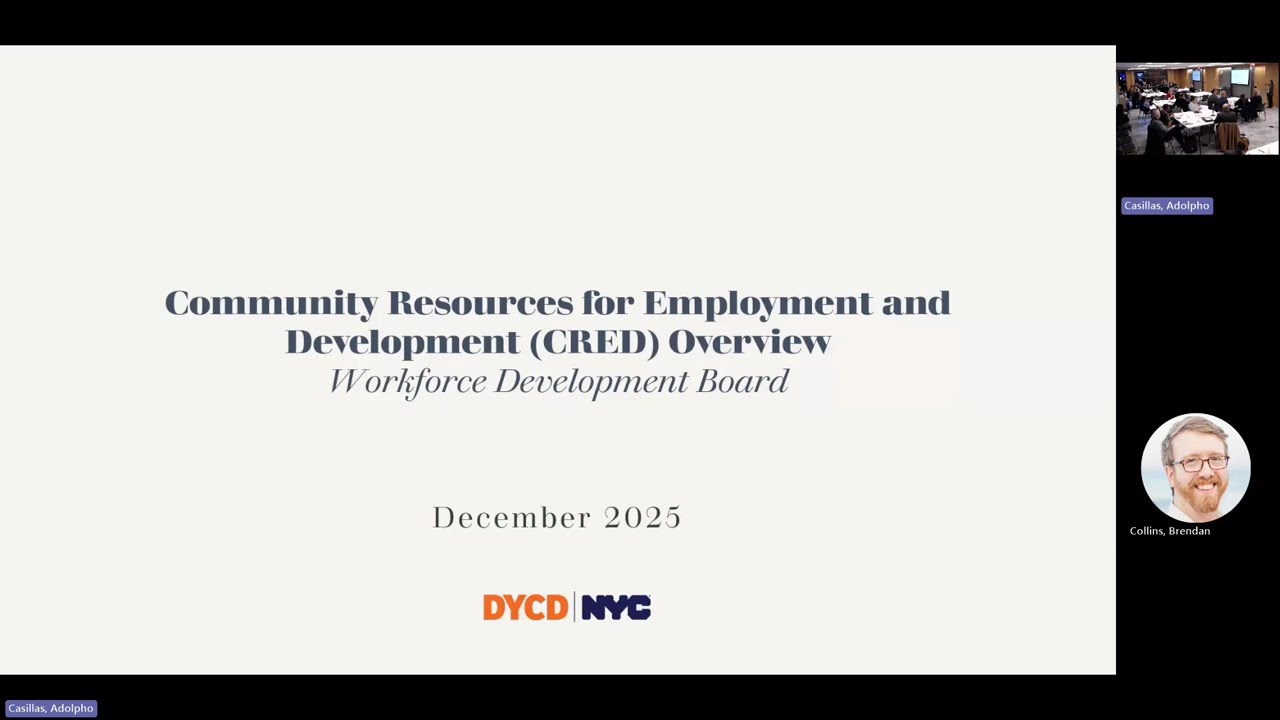
Valerie Mulligan from the Department of Youth and Community Development (DYCD) highlighted the Community Resources for Employment and Development (CRED) program, a comprehensive initiative for ages 18-40 facing barriers like justice involvement or low income, offering paid training ($20/hour), internships, wraparound services, and job placement across sectors like healthcare and construction. With 16 providers funded at ~$780,000 each annually (scaling to 2,000 slots), success stories included CDL credentialing and culinary placements. Discussion addressed prescriptive staffing requirements and procurement flexibility. Randy from Small Business Services (SBS) updated on Workforce One contracts, noting improved placements, professional development, and Jobs NYC events reaching thousands, while Commissioner Pearson explained a strategic $41.7M carry-in budget to maintain stability amid shrinking federal awards.
Bylaws Revision, SNAP/Medicaid Work Requirements, and Closing
The board voted to revise outdated bylaws to strengthen governance, reporting timelines, procurement oversight, and priority-setting, with a redlined version forthcoming for feedback. Scott French from the Human Resources Administration detailed new federal SNAP Able-Bodied Adults Without Dependents (ABAWD) work requirements (80 hours/month starting March 2026 post-waiver), exemptions, and compliance pathways, plus upcoming Medicaid rules, emphasizing partnerships for community service and workforce connections to minimize benefit loss for potentially hundreds of thousands. Group discussions raised concerns over system strain, nonprofit roles, seasonal workers, and coordination needs. The meeting adjourned after planning 2026 calendars, underscoring collaborative efforts amid policy changes.