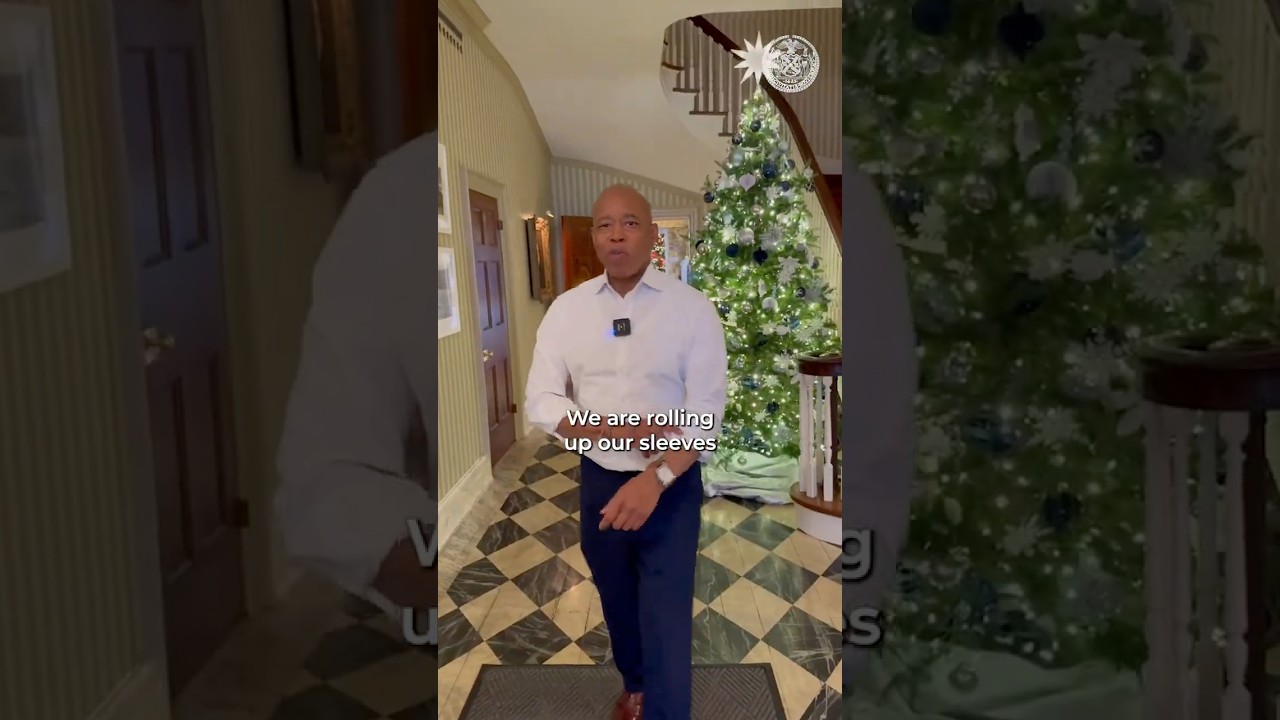
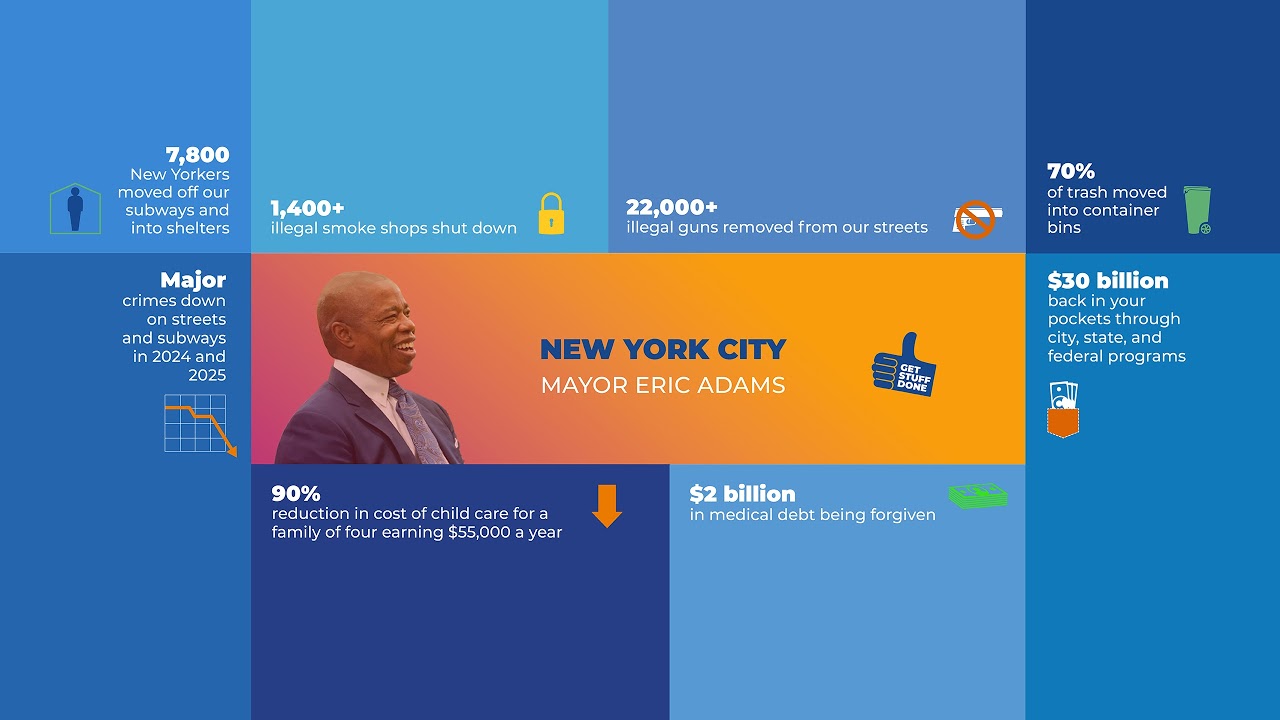
In the NYC Mayor’s Office “Week in Review” video for November 29 to December 5, 2025, Mayor Adams highlighted a landmark $38.9 million settlement with Starbucks, the largest worker protection settlement in city history, requiring over $35.5 million in restitution to more than 15,000 baristas for violations of the Fair Workweek Law, emphasizing accountability regardless of company size. The administration also celebrated the opening of the “Harlem Field of Dreams,” an $11 million renovation of Brigadier General Charles Young Playground into a state-of-the-art multi-sport turf field serving over 800 young athletes. Additional investments included creating Brooklyn’s first “blue belt” in Prospect Park with nature-based solutions to combat climate-induced flooding, and $30 million in capital funding for Staten Island public spaces, including the zoo, Bloomingdale Park Playground, and Snug Harbor Cultural Center.
Combating Antisemitism and Executive Actions
Mayor Adams addressed rising antisemitism by traveling to New Orleans for the Combat Antisemitism Movement Conference and African American Mayors Association discussions. In response to a recent protest outside a Park Synagogue, he signed Executive Order 61 to protect New Yorkers’ right to pray peacefully without harassment, while upholding free speech and assembly rights, directing the NYPD to evaluate protest guidelines around houses of worship. Another executive order prohibited city leadership from boycotting or divesting from Israel, ensuring investment decisions remain financially sound and free from discriminatory practices.
Housing Progress and Ongoing Commitment
The video marked the one-year anniversary of the “City of Yes” housing initiative, declaring the Adams administration the most pro-housing in city history by reforming outdated zoning laws to build more affordable homes in every neighborhood. This revolutionary effort aims to tackle the housing crisis head-on, affirming a commitment to working-class New Yorkers. Overall, the week underscored continued progress in public safety, community spaces, equity, and affordability, with the administration focused on “getting stuff done” for residents.
New York Gov. Kathy Hochul signed legislation allowing local governments to offer property-tax exemptions of up to 65% for eligible senior homeowners, raising the previous cap from 50% for the first time in decades. Under the measure, known as S5175A/A3698A, municipalities can set income limits and other criteria to determine who qualifies, with state officials estimating potential savings of about $300 a year for the average senior on a fixed income. The change is aimed at helping roughly 1.8 million older New Yorkers remain in their homes amid rising housing costs and inflation, and comes as part of a broader affordability push that includes middle-class tax cuts, expanded child tax credits, inflation rebate checks and free school meals for all K–12 students.
Governor Hochul Authorizes Real Property Tax Exemptions for New York Seniors
Governor Kathy Hochul signed legislation that enhanced real property tax exemptions for New York seniors. Legislation S5175A/A3698A allows localities to provide a real property tax exemption for senior citizens who meet the income eligibility limits, among other criteria, up to 65 percent percent of the assessed valuation of their properties. This legislation builds on the Governor’s affordability agenda, which included tax cuts for middle-class New Yorkers.
“No New York senior should lose their home because they can no longer afford their property taxes,” Governor Hochul said. “By signing this legislation, we are working to make New York more affordable for our seniors on fixed incomes and empowering them to age in place, at home, in the communities they know and love.”
The bill will give localities the option to offer real property tax exemptions of up to 65 percent to seniors living below the maximum income eligibility level set by the locality. Prior to, the maximum percentage of exemption local governments have been able to offer senior citizens was set at 50 percent and has not been raised in decades. Increasing the exemption from 50 percent to 65 percent could translate into savings of up to $300 annually for the average senior.
New York State Office for the Aging (NYSOFA) Acting Director Greg Olsen said, “Governor Hochul is coming through yet again on making New York more affordable for individuals and their families. Property taxes, especially for those on fixed incomes, can often be difficult to afford. With more than 1.8 million older adults who own their own homes, this important law will continue to help older adults remain in the homes and communities of their choice and keeping their vast contributions within New York State.”
State Senator Leroy Comrie said, “Seniors have faced rising housing costs and inflation— oftentimes living on fixed income. Signing S5175A into law is an important step toward restoring real affordability for older adults across New York. This law allows localities to offer up to a 65 percent discount to eligible seniors so long-time homeowners can remain in their communities with dignity and security. I thank Governor Hochul, my colleagues and especially Assemblymember David Weprin for partnering to deliver meaningful support for the New Yorkers who helped build this state.”
Assemblymember David Weprin said, “I’m grateful for Governor Kathy Hochul’s commitment to improving affordability for all New Yorkers, including our senior citizen homeowners. By advancing this bill into law, we will provide relief from the burden of increasing real property taxes and ensure stability for elderly homeowners on low fixed incomes. I look forward to continued partnership with Governor Hochul and my fellow elected leaders to advance this critical affordability agenda.”
This legislation builds on Governor Hochul’s affordability agenda, which includes:
Middle-Class Tax Cut: Approximately 8.3 million New Yorkers will benefit from decreased tax rates, bringing middle-class taxes to their lowest levels in 70 years.
Child Tax Credit Expansion: The Child Tax Credit is increasing to up to $1,000 per child under the age of four and up to $500 for school-aged children, starting in 2026.
Inflation Refund Checks: Eligible New Yorkers have received up to $200 per person or $400 per family, reaching 8.2 million people.
Free School Meals: All K-12 students now have access to free breakfast and lunch, saving families up to $1,600 per child annually.
New York’s subway system logged fresh post-pandemic ridership highs, carrying 4.61 million riders on Dec. 3 and 4.63 million on Dec. 4, surpassing an October record and coming in roughly 6% above year-earlier levels, Gov. Kathy Hochul said. November on-time performance reached 84.4%, the strongest for that month since the pandemic, extending a run of improved reliability tied to service increases, new equipment and upgraded signals. At the same time, the Metropolitan Transportation Authority is accelerating the shift to its OMNY tap-and-ride payment system, with 94% of subway and bus trips now paid contactlessly and MetroCard sales scheduled to end Dec. 31, 2025, ahead of full phaseout in 2026. The MTA, which has rolled out OMNY card giveaways, 2,700 retail locations and 980 station vending machines, projects at least $20 million in annual savings from retiring MetroCard and moving to a single, fully contactless fare system.
Governor Hochul Announces Record Subway Ridership of 4.6 Million Riders and Best November for Subway Performance
Governor Kathy Hochul today announced that the New York City Subway surpassed 4.6 million riders, setting a post-pandemic ridership record, while also achieving an on-time performance record for November of 84.4 percent — the best November since the pandemic. On Wednesday, December 3, 4.61 million customers rode the subway, and on Thursday, December 4, 4.63 million customers rode the subway. Both days eclipsed the previous record set on October 29, 2025 of 4.6 million subway customers and were up 6 percent from the same dates in 2024. These milestones come as 94 percent of subway and bus trips are now paid with the MTA’s new contactless tap and ride system.
“The subway is the lifeblood of New York City, and thanks to our investments in safety and reliability, ridership continues to come roaring back,” Governor Hochul said. “We know our work is far from finished, and that’s why we’re investing in new subway cars, upgraded signals and tools like cameras and law enforcement to keep riders safe. The subway is already the best way to get around, and thanks to these investments, we are making it better than ever.”
The November OTP record extends the trend of historically strong subway performance in 2025. Subway on-time performance reached 85 percent in September — the best September in modern history — maintaining August’s 85.1 percent, which was the best August in a decade, and building on May’s record-setting 85.2 percent, the highest non-pandemic OTP on record. These gains coincide with service increases on the A and L lines, reducing wait times for more than 100,000 weekday riders. Beginning Monday, December 8, rush hour service will also increase on the M line.
MTA Chair and CEO Janno Lieber said, “No secret: transit is the best way to get around New York. When our subways are safe, frequent and reliable, people will use them more and more. That’s what’s happened and the records are going to keep coming.”
NYC Transit President Demetrius Crichlow said, “Hitting 4.6 million subway riders as we achieve another on-time performance milestone shows once again that when you deliver safe and reliable service riders will take it. We’re determined to carry this momentum into 2026, as we continue to tout all the opportunities available to riders to seamlessly switch to tap and ride.”
MTA Chief Customer Officer Shanifah Rieara said, “New Yorkers have embraced tap and ride and we’re proud to see that as more and more people return to the city, they are choosing mass transit. As the end of MetroCard sales nears, we are focusing on reaching the remaining 6 percent to make the switch and unlock the benefits and convenience of tap and ride technology.”
In an effort to facilitate the transition to Tap and Ride, the MTA recently launched an OMNY Card Giveaway on November 18, where the first 400 customers at every Customer Service Center could transfer their MetroCard balance to fee-waived OMNY cards. These fee-waived OMNY cards are currently available at the following nine Customer Service Centers while supplies last:
125 St 4 5 6
161 St-Yankee Stadium B D 4
168 St-Broadway A C 1
E. 177 St-Parkchester 6
Fordham Rd B D
Myrtle Av J M Z
St. George, Staten Island Railway (SIR)
Stillwell Av-Coney Island D F N Q
Sutphin Blvd F
By the end of the year, fourteen new Customer Service Centers will open at locations across the Bronx, Brooklyn, Manhattan, and Queens. The first 400 customers to visit those new Customer Service Centers and transfer their MetroCard balances to OMNY will also be able to receive the promotional fee-waived OMNY cards.
As announced in March, the last day to purchase or reload a MetroCard will be December 31, 2025, with the acceptance of MetroCards ending in mid-2026. While the Tap and Ride payment system doesn’t require an OMNY card and allows riders to pay fares directly with digital wallets and contactless bank cards, customers will find it twice as easy to purchase or reload an OMNY card with a robust OMNY retail network currently at 2,700 locations — more than double the MetroCard partnering locations.
The MTA has also installed 980 OMNY card vending machines across all 472 subway stations. And, most recently, shared a list of 102 opportunities for members of the public who live in bus-reliant areas to transfer MetroCard balances to the OMNY cards for those who opt to use the physical card.
By eliminating the sale of MetroCard and fully transitioning to one fare collection method, the MTA expects to save at least $20 million annually in costs related to MetroCard production and distribution; vending machine repairs; and cash collection and handling. Moving to a contactless payment also unlocks potential for new customer-friendly promotions and fare discounts.
New York City Mayor Eric Adams is marking the first anniversary of his “City of Yes for Housing Opportunity” zoning overhaul by touting a 22.8% rise in permitted housing units in 2025 compared with the year before the policy was approved, as well as a growing pipeline of affordable units and office-to-residential conversions. The package, billed as the most pro-housing legislation in city history, relaxes parking mandates, legalizes accessory dwelling units, creates new high-density districts and offers an affordability bonus that has attracted more than 100 projects expected to yield some 5,400 homes, including roughly 900 income-restricted units. New R11 and R12 zones in Midtown South and other locations could add nearly 11,000 homes, while conversions of underused office buildings are projected to produce more than 12,000 apartments, 3,000 of them permanently affordable. Combined with five neighborhood rezonings slated to deliver about 50,000 homes and what City Hall describes as record production of nearly 86,000 affordable units since Adams took office, the administration is seeking to cement its legacy as aggressively pro-development amid a long-running housing shortage.
“One year ago today, our city said ‘yes’ to more housing and a more affordable future for working-class New Yorkers. We turned the page on decades of half-measures and proved that government can still meet the challenges of our time with energy, ambition, and resolve,” said Mayor Adams. “One year later, we are already seeing the results, with thousands of new affordable homes in the pipeline across our city. Whether it’s passing the first citywide rezoning in six decades, investing historic amounts of money into new homes, or creating record amounts of affordable housing, we are proud to be the most pro-housing administration in city history.
“With the adoption of City of Yes for Housing Opportunity, we have begun to turn the tide on the housing crisis in New York City. The full impact of these changes will take time to be felt, but twelve months in, we’re already seeing success delivering a little more housing in every neighborhood,” said DCP Director Garodnick. “New York City’s housing crisis has been growing for so long that it is easy to take it for granted. But with City of Yes and other policy changes, we are changing course and creating a more affordable city for generations to come.”
The initiative — which was approved by the New York City Council on December 5, 2024 — aims to deliver “a little more housing in every neighborhood” through carefully-crafted zoning changes, including creating a new affordable housing bonus; legalizing accessory dwelling units (ADU) for homeowners; re-legalizing three-, four-, or five-story apartment buildings near transit and along commercial corridors; reducing costly parking mandates for new construction; and allowing underused office buildings to become housing; among other reforms.
Already, many of these new tools are being used to create new housing across the city:
Universal Affordability Preference: Over 100 housing developments across the five boroughs have already applied to use the Universal Affordability Preference, which allows buildings in medium- and high-density parts of the city to add at least 20 percent more housing if the additional homes are permanently affordable. These projects are expected to deliver 5,400 new homes, of which approximately 900 would be affordable to households at an average 60 percent Area Median Income.
High-density zoning districts: New, higher-density R11 and R12 zoning districts created through City of Yes have been mapped in Mayor Adams’ Midtown South Mixed-Use Plan that the City Council approved in August, where they will deliver 9,500 new homes, including 2,800 permanently income-restricted affordable homes. These new zoning districts are also being proposed at the site of the future 125th Street Second Avenue Subway station and at 395 Flatbush Avenue Extension in Downtown Brooklyn, which are currently in public review, where they could deliver another 1,800 new homes.
Reduced parking mandates: Rolled-back requirements for off-street parking are also helping to deliver more housing near transit. For example:
At 2060 Walton Avenue in the Bronx, an underused lot close to the 4, B, and D trains is being transformed into 94 new homes — without the 25 parking spots that had previously been required, a change that meaningfully lowers building costs.
At 21 Freeman Street in Brooklyn, a vacant lot close to the G train is set to become over 500 new homes without the 140 parking spaces that would have been required prior to City of Yes.
Meanwhile, as envisioned, new housing in less transit-accessible areas continues to include parking.
Office-to-residential conversions: Together with the 467-M tax incentive — which the Adams administration successfully advocated for in Albany — City of Yes has supported a boom of office-to-residential conversion projects. There are more than 12,000 homes in the pipeline from office conversions, including more than 3,000 permanently affordable units.
Landmark Transferable Development Rights: In the last year, five landmarked buildings have begun seeking approval to transfer their development rights to nearby housing projects through a process that was streamlined and expanded by City of Yes. These transfers will enable over 400,000 square feet of new development, while bringing in additional revenue to support maintenance of landmarked buildings. Those five applications in less than one year compare to a total of 15 applications over more than 50 years before City of Yes.
Accessory Dwelling Units: So far this year, the New York City Department of Buildings has received 98 filings from homeowners in Brooklyn, the Bronx, Queens and Staten Island, seeking to construct ADUs on their properties. Half of these filings have come in just the past two months, since the city finalized rules for safe, code-compliant ADUs and launched the “ADU for You” homeowner assistance program. ADUs like backyard cottages, garage conversions, and basement apartments are a proven tool to support homeowners and expand housing choice in lower-density areas without a changing neighborhood’s look-and-feel.
As these City of Yes tools are deployed, new data shows that New York City permitted 22.8 percent more new homes in 2025 than the same time period in 2024 (through October 23), when the Adams administration was already shattering several housing records for the second year in a row. This permitting increase includes a boom in homes from alterations — more than double the number of permitted units from 2024, many of which are from office conversions — and an increase in units from new construction over the previous year.
The Adams administration has continued working to deliver the full benefits of City of Yes, including successfully defending the policy in court, where a judge recently dismissed a challenge. HPD also recently released the Shared Housing Roadmap, which — building on the City of Yes zoning reforms and in concert with new legislation — clears the way for reintroducing shared homes as a safe, affordable housing option for single New Yorkers.
Since entering office, Mayor Adams has made historic investments to create more affordable housing and ensure more New Yorkers have a place to call home. In Fiscal Year (FY) 2025, the Adams administration created the most affordable rental units in city history and celebrated back-to-back-to-back record-breaking years for producing permanently-affordable homes for formerly-homeless New Yorkers, placing homeless New Yorkers into housing, and connecting New Yorkers to housing through the city’s housing lottery. HPD has now produced nearly 86,000 affordable homes since the start of the Adams administration, with the last three fiscal years representing the most new affordable homes ever created in a three fiscal-year stretch (FY 2023 to FY 2025).
Building on the success of City of Yes for Housing Opportunity, Mayor Adams unveiled his “City of Yes for Families” strategy in his State of the City address earlier this year to build more homes and create more family-friendly neighborhoods across New York City. Under City of Yes for Families, the Adams administration is advancing more housing on city-owned sites, creating new tools to support homeownership, and building more housing alongside schools, playgrounds, grocery stores, accessible transit stations, and libraries.
Further, the Adams administration is actively working to strengthen tenant protections and support homeowners. The “Partners in Preservation” program was expanded citywide in 2024 through a $24-million investment in local organizations to support tenant organizing and combat harassment in rent-regulated housing. The Homeowner Help Desk, a trusted one-stop shop for low-income homeowners to receive financial and legal counseling from local organizations, was also expanded citywide in 2024 with a $13 million funding commitment.
“A mayoral administration rarely advances a policy that can fundamentally change the future health of a city for generations to come. The City of Yes for Housing Opportunity, coupled with the City Council led “City For All” initiative, is such a policy,” said Marc Greenberg, executive director, Interfaith Assembly on Homelessness and Housing. “With City of Yes, the Adams administration has changed the momentum of a city that has been losing ground on affordable housing for decades and has begun again to lift Lady Liberty’s Lamp beside New York City’s golden door.”
“One year after the passage of City of Yes for Housing Opportunity, the results speak for themselves. Across all five boroughs, thousands of new homes are being constructed thanks to modernized zoning that promotes transit-oriented development, the elimination of outdated parking mandates, new tools like the Universal Affordability Preference, expanded opportunities for office-to-residential conversions, and more,” said Carlo A. Scissura, Esq., president and CEO, New York Building Congress. “Among the most significant wins are more than 12,000 homes, including 3,000 permanently affordable units, already in the pipeline from office-to-residential conversions, breathing new life into underused buildings and neighborhoods. This is the smart, forward-thinking development New York has needed for decades, and it’s exactly why the Building Congress worked so closely with the Adams administration to get it across the finish line.”
“City of Yes is already proving to be a major step toward achievement of our housing goals,” said Kathryn Wylde, president and CEO, Partnership for New York City. “This carefully crafted initiative is encouraging development that is consistent with neighborhood standards by lowering costs and accelerating or eliminating the need for multiple public approvals.”
“As we mark one year since the launch of the City of Yes for Housing Opportunity, we’re already seeing real progress on housing growth in New York City,” said Rachel Fee, executive director, New York Housing Conference. “Housing continues to be one of New Yorkers’ most urgent needs, and City of Yes shows what a common-sense approach can deliver. By modernizing outdated rules and unlocking new housing in every community, City of Yes is giving New Yorkers the tools to spur affordable housing production. This initiative is clearing the path for meaningful housing victories, including the passage of ballot Proposals 2 – 5, and laying the groundwork for even more progress in the year ahead. We commend the administration for advancing these critical reforms to reduce delays and promote a fairer, more equitable distribution of housing across the city.”
“One year after the passage of City of Yes for Housing Opportunity, we’re seeing what happens when New York City chooses vision over fear,” said Emma Pfohman, CEO, Association for a Better New York (ABNY). “ABNY applauds the herculean work of the Adams administration, in partnership with Governor Hochul and the City Council, to pass the City of Yes for Housing Opportunity and approve the creation of thousands of units through the successful rezonings championed by the Department of City Planning over the last year. Together, these efforts ensure New York remains a city where every resident has the chance to live, thrive, and build their future.”
“In just its first year, City of Yes has opened the door to more homes in every borough,” said Andrew Fine, chief of staff and policy director, Open New York. “In the Bronx, longtime proposals are finally moving forward with deeper levels of affordability. Homeowners from Staten Island to Queens are excited to add ADUs, and in Brooklyn, new apartment buildings near the subway are being built without costly parking requirements. In Manhattan, the Midtown South rezoning was the first to use new higher-density districts, creating room for more homes through office conversions and new construction. All of this shows what is possible when City leaders work together to break down barriers to housing. And since then, the need for homes and the public’s support for building them have only grown. With November’s historic pro-housing ballot proposals behind us, we are ready to keep working toward a more affordable future for New York.”
“A year on from the most expansive citywide zoning changes for housing that New York City has seen, it’s a great moment to reflect on this achievement, and redouble our commitment to its implementation,” said Howard Slatkin, executive director, Citizens Housing and Planning Council. “City of Yes has opened the door for a generation of new housing achievements, which with sustained effort can stand as a legacy to what we can do when we agree that no challenge is too large for New Yorkers to tackle.”
“One year ago marked a turning point in the fight against New York City’s housing crisis with the enactment of the City of Yes zoning text amendments,” said Baaba Halm, senior vice president for programs, Enterprise Community Partners. “By allowing more housing types, increased density, and more flexible zoning options in a wider swath of New York, we collectively took a major step toward significantly increasing needed housing supply and reducing development barriers which add costs. Importantly, the amendments also specifically increased affordable housing, and came alongside robust new capital and programmatic resources. The results are already evident through more projects in the pipeline, and we look forward to seeing them come to fruition.”
“Habitat for Humanity NYC and Westchester is driven by a simple goal, to create permanent, affordable homeownership opportunities for New Yorkers who need them most,” said Sabrina Lippman, CEO, Habitat for Humanity NYC and Westchester. “One year after the approval of City of Yes for Housing Opportunity, we’re already expanding our pipeline by nearly 50 percent as a direct result of zoning reforms that remove barriers and make it easier to build. City of Yes is perfectly aligned with Habitat’s work to build stable, inclusive communities and ensure more families can call New York City home.”
“One year in and we are already seeing the tremendous impact of City of Yes for Housing Opportunity. This landmark rezoning has already begun to unlock meaningful opportunities to deliver high quality, affordable homes in neighborhoods across the city. By removing outdated barriers and enabling smarter, more flexible design, we are creating the conditions for a more equitable and resilient city,” said Jesse Lazar, executive director, American Institute of Architects New York Chapter. “Building on the momentum generated by City of Yes, we must continue to explore how we capture the future value of our city today, creating thriving communities and building housing that serves all New Yorkers.”
“The rising cost of housing is chipping away at hard-earned wages and pushing too many New Yorkers out of the city. Last year’s passage of the landmark City of Yes legislation represented a monumental step forward toward addressing the urgent housing affordability crisis,” said Manny Pastreich, President of 32BJ SEIU. “We’re seeing progress and look forward to continuing this momentum alongside stakeholders, to deliver the housing essential workers and their communities need, while creating thousands of good jobs.”
“City of Yes is a landmark achievement and a testament to the hard work of everyone who helped make these vital zoning reforms a reality,” said Basha Gerhards, executive vice president of public policy, Real Estate Board of New York. “With growing momentum behind adaptive reuse, New York City has the best conversion rules in the country, positioning us to unlock much needed homes across all five boroughs.”
“After one year, City of Yes is delivering on the promise of more affordable housing and giving hope to the over 2 million New Yorkers struggling to keep a roof over their head,” said Rich Buery, CEO, Robin Hood. “By taking an all-of-the-above approach, the city is unleashing the pent-up potential we knew existed. When paired with the recent pro-housing City Charter amendments, overwhelmingly approved by voters, our city is making progress toward being a place where people of all incomes can live, raise children, and flourish.”
“City of Yes set a new bar for what pro-housing policy can look like in New York, and the first year has already shown that the old excuses for doing nothing don’t hold up,” said Aaron Carr, founder and executive director, Housing Rights Initiative. “It’s given us a real foundation to build upon and proven that smarter zoning and bolder reforms can actually make a dent in our housing crisis. This is just the beginning.”
Governor Kathy Hochul announced 19 new nominations to the State and National Registers of Historic Places, positioning communities across New York to leverage powerful economic development tools, including state and federal historic rehabilitation tax credits and preservation grants. Spanning urban public housing, energy-efficient commercial design in Buffalo, industrial complexes, rural mill neighborhoods, and architecturally significant churches and residences, these designations help drive private investment, support adaptive reuse, and catalyze community revitalization. New York already leads the nation in the use of historic tax credits, with $7.17 billion in rehabilitation costs between 2018 and 2024 and more than $16.4 billion in project expenditures since 2009, generating over 91,000 jobs and $1.79 billion in tax revenue. The newly nominated sites further align historic preservation with economic growth, offering property owners and municipalities expanded access to incentives that strengthen local economies while safeguarding long-term cultural and real estate value.
Governor Hochul Announces 19 Nominations for State and National Registers of Historic Place
Governor Kathy Hochul… announced recommendations by the New York State Board for Historic Preservation to add 19 properties and districts to the State and National Registers of Historic Places. The nominations include an office building with a pioneering design in energy efficiency in Buffalo, an Arts and Crafts church on Staten Island, a new historic district in Essex County, and the Cortland home of a leader in New York’s Women’s Club Movement.
“The history of the people of New York is imprinted in the architecture and places around us,” Governor Hochul said. “These nominations to the State and National Registers show our commitment to preserving New York’s rich and diverse story and making it accessible for future generations. By recognizing these landmarks and the people behind them, we are strengthening our communities, boosting local pride and ensuring that history remains a living part of New York’s future.”
The nominations were reviewed on December 3, 2025, at a meeting of the New York State Board for Historic Preservation.
New York State Office of Parks, Recreation and Historic Preservation Acting Commissioner Kathy Moser said, “Identifying and nominating historic resources for the State and National Registers is a key step in preserving our shared past. As stewards for New York’s history, we recognize the positive impact listings in the registers have on communities throughout the state. From recording local history before it is lost to unlocking access to grants and incentive programs, the State and National Register programs create opportunities to inspire pride of place, encourage investment, and catalyze collaborations.”
State and National Register listings can assist owners in revitalizing properties, making them eligible for various public preservation programs and services, such as matching state grants and federal and state historic rehabilitation tax credits.
New York State Office of Parks, Recreation and Historic Preservation Deputy Commissioner for Historic Preservation Daniel Mackay said, “The Division for Historic Preservation works to ensure that the State and National Registers of Historic Places continue to grow and reflect New York’s remarkable history. With this goal, we are expanding our understanding of our past and providing access to incentive programs that can help preserve and revitalize our historic assets for the future. By connecting property owners with resources, historic preservation becomes a shared, statewide effort. We’re proud to be part of this impactful work.”
New York State continues to lead the nation in the use of historic tax credits, with $7.17 billion in total rehabilitation costs from 2018-2024. Since 2009, the historic tax credit program has stimulated over $16.4 billion in project expenditures in New York State, creating significant investment and new jobs. According to a report, between 2019-2023, the credits in New York State generated 91,386 jobs and over $1.79 billion in local, state and federal taxes.
The State and National Registers are the official lists of buildings, structures, districts, landscapes, objects and sites significant in the history, architecture, archaeology and culture of New York State and the nation. There are more than 128,000 historic properties throughout the state listed in the National Register of Historic Places, either individually or as components of historic districts. Property owners, municipalities and organizations from communities throughout the state sponsored the nominations.
Once recommendations are approved by the Commissioner, who serves as the State Historic Preservation Officer, the properties are listed in the New York State Register of Historic Places and then nominated to the National Register of Historic Places, where they are reviewed by the National Park Service and, once approved, entered in the National Register. More information, with photos of the nominations, is available on the Office of Parks, Recreation and Historic Preservation website.
Capital Region
Dr. Jay McDonald Towers, Albany County – Constructed in 1972, this ten-story senior housing tower is the City of Cohoes’ first example of senior apartments. The building is located in the central business district, anchoring the north end of Remsen Street as a mid-rise, red brick building with an exposed concrete structural system. The design embodies a restrained modern aesthetic with an emphasis on form, materials, and structure. Inside, the apartments follow standard recommendations for senior housing, featuring bathtubs with grab bars, non-skid floors, and wider door openings. The McDonald Towers are associated with the Cohoes Housing Authority’s Model Cities Program, authorized by the Demonstration Cities and Metropolitan Development Act of 1966. In addition to funding new, improved housing, the Model Cities program also endeavored to provide additional community services, such as job training, code enforcement, and improved public education. In 1970, Housing and Urban Development (HUD) approved a $13 million Model Cities grant to Cohoes, and McDonald Towers was among the most significant of the projects proposed.
Roulier Heights Historic District, Albany County – This small complex of ten apartment buildings and one community center in the City of Cohoes was the Cohoes Housing Authority’s first completed project. Built in 1961, the complex was designed around an elliptical drive just west of Cohoes’s central business district. The rows line both sides of the street, face each other, and there are paved paths in front of and behind the buildings. Each apartment block comprises a row of six to ten two-story townhouses, with individual entrances, interior wood floors, and dedicated storage space. Established in 1952 with support from state legislation and federal funding, the Cohoes Housing Authority was formed to respond to post-World War II housing shortage pressures in the city, which was felt even more severely with the significant downsizing of Cohoes’ nation-leading textile manufacturing mills which also happened after the war.
Central New York
Benton-Sherwood House, Cortland County – The house at 79 Central Avenue in Cortland is significant for its association with Jeannette Benton Sherwood (1863-1938) and the Women’s Club Movement of the early twentieth century. A key organizer of women’s clubs in Cortland County and later a leader in statewide roles with the New York State Federation of Women’s Clubs, Sherwood hosted numerous meetings at her childhood home, which she occupied from 1899-1921. Sherwood’s father, lumberman and one-time village president Henry F. Benton, built the substantial brick Second Empire style house in 1874. The largest and most elaborate of its type in Cortland, the house features a French-inspired mansard roof, a central tower that contains both the front entrance and spiraling cantilevered stair, as well as fine doors, moldings, and parquet floors. Many architectural details may have been manufactured at Benton’s nearby planing mill. The house’s parlor was a popular meeting space for groups connected with Sherwood; it served as the location of the founding meeting of the Tioughnioga Chapter of the Daughters of the American Revolution in 1900. In addition to her women’s clubs activities, Sherwood was also chair of the Cortland Fresh Air committee, chair of the statewide Victory War Fund during the First World War, participated in the Women’s Suffrage Movement, served as the founder and first president of the Cortland County Historical Society, and served on the board of the New York Historical Association.
Lustron House Westchester Deluxe Model 02, Onondaga County –Located in the city of Syracuse, the house showcases important developments in post-World War II prefabricated houses. It is an excellent example of the Lustron Corporation’s Westchester two-bedroom “Model 02” and includes “deluxe” features such as a pass-through cabinet dividing the kitchen and dining area, a living room bay window, and a built-in vanity in the master bedroom. The Lustron Corporation, located in Columbus Ohio, used an assembly line to produce all-steel building components that could be shipped in pieces across the country and assembled on-site. The technology was an advanced prefab solution to the severe housing shortages in the post-war era.
Mohawk Valley
West Winfield Historic District, Herkimer County – Located in the Town of Winfield, the historic district consists of 315 resources at the intersection of the historic Great Western Turnpike (State Route 20) and County Route 51. The district embodies a community that developed because of these transportation routes and the local mills along the North Winfield Creek and the East Branch of the Unadilla River. The built environment in West Winfield represents its development from ca. 1790 through 1970. Architectural styles convey popular trends from the 1800s to the mid-1900s.
New York City
Bay View Houses, Kings County –Bay View Houses is a large public housing complex for middle-income tenants in the Canarsie neighborhood of Brooklyn. It was built in 1955-56 under New York City Housing Authority’s City IV program, the last phase of city-funded public housing before legislation such as the Mitchell-Lama law of 1955 shifted the responsibility for building middle-income housing onto private developers and away from city government. It reflects ideas about public housing, methods of financing, siting, and design at a time when the nation as a whole was grappling with the proper role of government and private capital in developing affordable housing, especially for middle-income residents.
Northwest Bronx Scatter Site Housing, Bronx County (Three Nominations: Bailey Ave-West 193rd St Houses; East 180th St-Monterey Ave Houses; Fort Independence St-Heath Ave Houses) – These three public housing developments in the Bronx, all completed in the early 1970s, are the bricks-and-mortar embodiment of the long, often messy, and ultimately imperfect work of implementing the Civil Rights Act of 1964. They were built under New York City Housing Authority’s (NYCHA) scatter site program, a federally mandated attempt to enforce Title VI of the Civil Rights Act. That law prohibited discrimination based on race, color, or national origin in any federally funded program, including public housing. The federal government’s solution was to require local housing authorities to disperse (or scatter) a portion of new housing developments throughout the city, particularly in middle-class neighborhoods on the periphery, away from areas of racial concentration. New York City’s scatter site program launched in early 1966 during the first months of Mayor John Lindsay’s administration, with NYCHA completing its first scatter site developments in the early 1970s. In developing the scatter site housing program, federal and local housing officials implicitly acknowledged that decades of earlier policies had actively contributed to racial discrimination and residential segregation. Reactions to New York’s scatter site program revealed deep divisions among city residents, as well as persistent prejudice and racism. The first of NYCHA’s proposed scatter site developments met with significant resistance in many of the neighborhoods for which they were proposed, including those in the Northwest Bronx.
Richard Mott House, Queens County – The Richard Mott House is locally significant as a rare, unique, and intact example of Shingle-style architecture in the Bayswater neighborhood of Far Rockaway. Richard Mott, a hotel owner and member of a well-established Far Rockaway family, refashioned a barn or outbuilding into a two-story beachside cottage in 1909 to use as his art studio. After his retirement in 1915, he lived full-time in the house until his death in 1925. With the demolition or alteration of many other Shingle homes in the neighborhood, the Richard Mott House stands as a remnant of a style which was common among coastal vacation towns such as Far Rockaway in the late 1800s and early 1900s. Moreover, the house is significant as an idiosyncratic, vernacular labor of Richard Mott. Mott was a hobbyist landscape artist and builder who customized the house as his personal refuge, studio, and gallery of his work and tastes. The house is replete with Mott’s own murals of Far Rockaway’s scenic marine landscapes, built-in wood furniture, custom wood molding, and stained-glass windows.
Unitarian Universalist Church of Staten Island, Richmond County – The Unitarian Universalist Church of Staten Island (UUCSI) is locally significant as an example of the application of Arts and Crafts principles to a suburban church complex. Designed by Brooklyn-based architect, Quaker, and social reformer Frank Haviland Quinby, UUCSI’s buildings incorporate Tudor Revival, Queen Anne, and Shingle style references in an eclectic mix. Quinby’s choice of Arts and Crafts principles is notable because of their alignment with Unitarian faith’s social and political aims, placing UUCSI’s campus in a tradition of late-1800s Unitarian “Church Home” buildings emphasizing warmth, functionality, natural materials, and modest, residential scales.
North Country
Au Sable Forks Historic District, Essex County – Au Sable Forks Historic District is in the far northern reaches of Essex County and is uniquely positioned on a peninsula where the western and eastern branches of the Saranac River meet. The region’s abundant lumber, waterways, and proximity to iron deposits made it an ideal location for logging and iron ore processing in the 1800s, and it later became a hub for the pulp industry. The J.&J. Rogers Company was the primary driver of industrialization, with Au Sable Forks as their headquarters. The district, which is roughly bound by the branches of the river, essentially developed as a company town for the Rogers Company and remained as such until the early 1970s. The town is notable as one of the few intact company towns in this part of the Adirondacks. Additionally, Au Sable Forks suffered a tragic fire in 1925 that wiped out its entire commercial corridor. The resulting architecture in the wake of the fire was entirely fireproof and provides a good representative example of a Main Street almost entirely composed of 1920s and early 1930s commercial architecture. There are 80 resources within the district, including two properties that are already individually-listed on the National Register: the Graves Mansion and the Tahawus Masonic Lodge.
Hamlet of Schuyler Falls Historic District, Clinton County – The proposed district is located at the intersection of NY Route 22B (Pleasant Street) and Felton Road in the Hamlet of Schuyler Falls and comprises twenty-two resources. After the Turner Grist Mill was established on the Salmon River in 1827, the area developed as a largely residential neighborhood for mill owners, managers, and working-class employees. The extant grist mill and remaining homes express the ways in which residents created a tight-knit rural community that was collectively focused on both industry and agriculture throughout the 1800s. Buildings range from the 1820s to approximately 1900 and include a variety of architectural styles.
Western New York
Buffalo Envelope Company Building, Buffalo, Erie County – The Buffalo Envelope Company Building, at the corner of Michigan Avenue and Seneca Street, derives its significance from industrial history for its association with envelope manufacturing and sales between 1909 and 1959. The Buffalo Envelope Company, founded at another location in 1888, moved into the six-story portion of this building (built for speculative purchases in 1899) in 1899. Multiple additions to the building were built during the twentieth century until it occupied an entire city block, attesting to the growth and success of the industry. A spiraling chute is still intact in the tall portion of the building, showing how envelope production started at the top and then step by step the envelopes worked their way down through the building as part of the assembly process. Buffalo Envelope Company was bought by Ohio-based Champion International in 1959, and they in turn sold the building in 1989, when it ceased to be used as a production facility.
Burton H. Hurd House, Erie County – The Burton H. Hurd House in Elmira is locally significant as an early-1900s suburban residence with Colonial Revival style features. The house was built for Burton H. Hurd, a descendent of one of Elma’s earliest families and a regionally prominent business figure in Buffalo’s lumber industry. In 1912, he commissioned architects Harris & Merritt to design a secondary residence for use in the summer months. As a member of a wealthy and prominent family, Hurd desired a space to entertain guests and demonstrate his social status while also allowing servants to discretely perform domestic labor. The emphasis on separation of utilitarian space is evident in Harris & Merritt’s plan, with all such areas housed in the north wing, offsetting the facade’s design. The separation of service space is further emphasized by features such as the small first floor pantry that connects to the kitchen and dining room, and a set of stairs that provides direct access to the maids’ room, kitchen, and laundry room in the basement. These design choices allowed staff to remain virtually hidden while serving the family or guests. Essential elements, including the front and rear porches, balustrades, and windows have all remained largely intact to the building’s original design. While some alterations have occurred, the primary spaces retain the majority of their materials, finishes, and configuration, reflecting their contemporary use and patterns of living.
Center and Pearl Streets Historic District, Chautauqua County – The Center and Pearl Streets Historic District is part of the former village of Forestville in the town of Hanover. Situated between Forestville’s commercial Main Street and the railroad depot, the district encompasses an area that evolved from a collection of mills and houses in forested land in the early 1800s, into a vibrant tree-lined streetscape that was the home to some of the community’s most prosperous families. The district grew in the sparsely developed land between the town center and rail depot following the arrival of the New York & Erie Railroad in 1851. The Center and Pearl Streets Historic District preserves a rare residential enclave that experienced continued changes and expansion over the course of a century as passenger and freight use of the railroad gave way to automobiles and trucks. The residents of the historic district directly contributed to and benefitted from access to railroad, ranging from railroad employees, local business owners, farmers, and locally significant professional lawyers, all who settled along for convenient access to both a major regional transportation route and the nearby town business district. This broad pattern of development was unique to Forestville, providing a rich study in the development of an isolated rural agricultural community into one connected to the larger world through the railroad.
Norstar Building, Erie County – Downtown Buffalo’s Norstar Building, conceived by Mark Mendell of Cannon Design and constructed in 1981-1982, is architecturally significant for its pioneering design in the realm of energy efficiency. In the wake of the energy crisis of the late 1970s and early 1980s, the office building’s design utilizes multiple elements that enabled cost-saving systems, including its dramatically angled site orientation that incorporates passive solar design and wind screening, an emphasis on natural lighting using light shelves and a skylit atrium, and roof-mounted phase change solar collectors for heat transfer. Many of these elements were the first of their kind in downtown Buffalo and represent their first appearance together to provide an innovative approach to energy efficiency. Despite being less than fifty years of age, the building has exceptional significance as an early experiment in what is now recognized as sustainable design.
The Saint Mary of the Angels Complex, Cattaraugus County – Nestled on a small hill rising from the Allegany river in a shady residential neighborhood in the City of Olean, the Saint Mary of the Angels Complex encompasses five buildings: the Roman Catholic Basilica of St. Mary of the Angels, the former Saint Mary’s convent, former rectory and carriage house, and the parish life center/former Saint Mary’s Academy. Built in 1915, the basilica of Saint Mary of the Angels is a magnificent twin-spired three-story Gothic Revival stone church, renowned not just for its exterior beauty but also the magnificent Munich-style windows and interior art. The former Academy building and convent, built together in 1924, are themselves stately red brick Tudor-style buildings with limestone trim, and the former rectory and carriage house form a well-preserved example of a Victorian residence. The Saint Mary of the Angels complex has long been a significant part of the spiritual and educational fabric of the Olean community and the basilica – one of only 93 so designated in the United States – is widely regarded as an architectural and artistic gem.
Smith-Henry Building, Erie County – Originally built in 1855 as a two-story single-family residence with a rear extension for hatmaker Samuel Smith, the Smith-Henry Building in Buffalo is an exemplary example of early 1900s adaptive reuse that demonstrates the impact of commercial real estate development on 1800s domestic architecture in an evolving urban setting. In 1914 the brick building was altered and enlarged by lawyer and real estate developer John J. Henry to accommodate two ground-floor storefronts and several apartment units upstairs. Henry’s unorthodox alteration of the building involved enveloping the front of the house with a new three-story portion that expanded the building’s potential to meet the changing rental needs of the neighborhood. The result is a building that contains both mid-1800s details in what otherwise appears as a 1910s two-part commercial block.
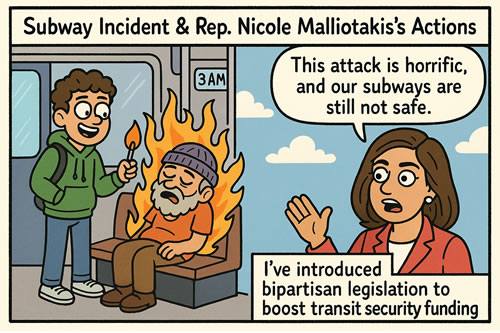
A shocking attack in the New York City subway has raised new fears about rider safety. Police say 18-year-old Manhattan resident Hiram Carrero allegedly set a sleeping homeless man on fire in a No. 3 train car around 3 a.m. The incident happened near Times Square/Penn Station. The 56-year-old victim suffered serious burns but is expected to survive, according to the NYPD.
The suspect, who was seen in surveillance video, was later perp walked out of the 9th Precinct after his arrest. Carrero has been identified by police and is being charged with attempted murder, three counts of assault, arson, and reckless endangerment. The case has quickly become another example used in the debate over crime and safety in the NYC subway system.
New York Congresswoman Nicole Malliotakis called the attack “horrific” and says it proves that the subway is still not truly safe. She notes that the NYPD is thousands of officers below past staffing levels and argues that more police are needed on trains and platforms. In Congress, Malliotakis is pushing a bipartisan transit security bill to increase federal funding for subway safety, including more officers, better lighting, more cameras, and upgraded surveillance systems to protect riders and the city’s most vulnerable residents.
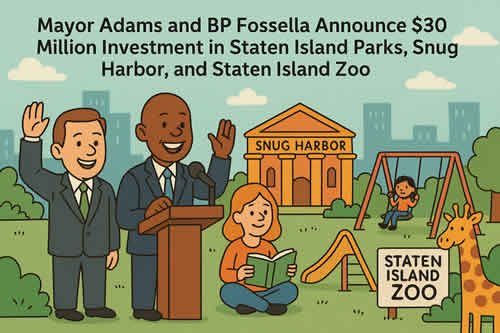
New York City Mayor Eric Adams and Staten Island Borough President Vito Fossella are teaming up to deliver nearly $30 million in upgrades to some of Staten Island’s favorite places to play and explore. The funding will revamp Bloomingdale Park’s playground with new equipment, water features, lighting, and landscaping; modernize Snug Harbor Cultural Center and Botanical Garden, along with key improvements for the Staten Island Museum and Noble Maritime Collection; and create a new interactive, sensory-friendly education center at the Staten Island Zoo. Together, these projects aim to make Staten Island’s parks, cultural hubs, and zoo more fun, accessible, and welcoming for families and visitors of all ages.
Mayor Adams, Staten Island Borough President Fossella Celebrate $30 Million in Funding for Parks, Open Space on Staten Island
– New York City Mayor Eric Adams and Staten Island Borough President Vito Fossella today announced that they have partnered to invest nearly $30 million of capital funding in three parks and public recreation projects on Staten Island. Investments will improve quality-of-life for Staten Islanders by making upgrades at Bloomingdale Park playground, Snug Harbor Cultural Center and Botanical Garden, and the Staten Island Zoo. The investments were made in the Fiscal Year (FY) 2026 Adopted Budget, which builds on Mayor Adams’ FY 2026 Executive Budget, often called the “Best Budget Ever.”
“Public space in our city is precious, and we cherish every inch of it — no matter where it is, no matter what borough it is in,” said Mayor Adams. “Under our administration, we have always made it a priority to take care of Staten Island and today’s announcement is just the latest example of how we are living up to that promise. In partnership with Staten Island Borough President Fossella, we are proud to celebrate nearly $30 million in investments in several parks and recreation projects throughout the borough invested through our ‘Best Budget Ever.’ This funding will upgrade Bloomingdale Park playground, the Snug Harbor Cultural Center and Botanic Garden, and the Staten Island Zoo — expanding access to these public spaces and improving quality of life for all Staten Islanders. We thank Borough President Fossella for his partnership and helping bring us closer to becoming a city that is the best place to raise a family.”
“We have some of the most scenic spaces and vibrant cultural institutions right here in Staten Island,” said Borough President Fossella. “We will continue to improve our parks and open spaces, and to support cultural institutions so they can continue to flourish and provide the best for our residents. We appreciate that we have a partner in Mayor Adams, who is committed to helping us to achieve our goals. We thank Mayor Adams for being a strong partner to make our parks and public spaces even better.”
“Bloomingdale Park is a thriving oasis of greenspace and recreation on Staten Island,” said New York City Department of Parks & Recreation Commissioner Iris Rodriguez-Rosa. “These new capital investments in Bloomingdale Playground will offer the community a revitalized place to gather and play, with all-new play equipment, an enhanced spray shower, improved lighting, and more plantings. We’re excited to watch this project come to fruition and are grateful to Mayor Adams and Borough President Fossella for funding improvements that will benefit Staten Islanders for years to come.”
“As my fellow Staten Islanders and I know, our cultural institutions contribute so much to making this borough an extraordinary place to visit, live, and raise a family,” said New York City Department of Cultural Affairs Commissioner Laurie Cumbo. “We’re proud of the city’s investments in the borough’s cultural infrastructure, which will enhance the incredible museums, cultural centers, and zoos that serve residents and attract visitors for years to come.”
As a result of a $5.6 million investment made by Mayor Adams and Borough President Fossella, Bloomingdale Park playground will see significant improvements resulting in a vibrant reconstructed play space for the community. The reconstruction project — led by the New York City Department of Parks and Recreation — will include new play equipment, a spray play area, fencing, security lights, and an upgrade of electrical and water utilities. This project will also be supplemented with new landscape improvements. The renovations are the next major investment in this heavily utilized park, building on recent improvements, including installation of adult fitness equipment, as well as a shade structure at the bocce court. In 2021, the Bloomingdale Park athletic field project was completed, resulting in new multi-use and soccer synthetic turf fields to accommodate activities, including toss sports, free play, picnics, and more. The project is expected to begin design in the spring of 2026 following a community input meeting where members of the public will have the opportunity to share their vision for this space.
The Snug Harbor Cultural Center and Botanical Garden received $6.5 million in funding from the Adams administration and Borough President Fossella to advance key infrastructure projects for the 83-acre campus and its cultural tenants. The site-wide improvements will upgrade the building management system and other infrastructure to improve the security, energy efficiency, and visitor experience across the campus. The project will modernize one of Snug Harbor’s key facilities, which provides the cultural center with programming space and revenue-generating rentals.
Several organizations located on the Snug Harbor campus also received new funding from Mayor Adams and Borough President Fossella in the FY 2026 Adopted Budget. The Staten Island Museum received $6 million for the next phase of the museum’s expansion project, which will transform the currently vacant Building B into a state-of-the-art STEAM education center, with additional public space for natural history collections and exhibitions, a lab classroom for hands-on STEAM learning, and a café. The project will also include exterior restoration of the historic, Greek revival building. The Noble Maritime Collection, located in Building D on the Snug Harbor campus received $3.8 million to replace the museum’s existing chiller and air conditioning system. The group has struggled to maintain its existing aging system to ensure the comfort for guests in hotter weather and to maintain the protection of their extensive collections of maritime history from Staten Island and beyond. The Noble Maritime Collection’s 20,600 square foot space is one of the anchor institutions for the Snug Harbor Cultural Center and contains the entirety of the museum’s administrative and programmatic space.
At the Staten Island Zoo, a combined $8 million in funding from Mayor Adams and Borough President Fossella will support the creation of a new interactive education center, which will provide a fun and enriching experience for children and visitors themed around sensory abilities in people and animals. The project will create a public purpose for special opportunities to have guests with sensory or developmental disabilities enjoy defined experiences for them, as well as a 1960’s-era children’s center with a modern, diverse and inclusive “Learn & Play Zone.”
“At the Noble Maritime Collection, our staff and Board of Trustees are deeply committed to ensuring that our landmarked building remains a welcoming, inclusive, and accessible space for all,” said Megan Beck, executive director, Noble Maritime Collection. “We are grateful to Mayor Adams, Commissioner Cumbo, and the Department of Cultural Affairs for their generous capital investment in a new chiller and air conditioning system — an essential upgrade that will help preserve our collections and historic building. We also appreciate their continued support for major capital improvements at the Snug Harbor Cultural Center and at the Botanical Garden, the beautiful and storied campus we are proud to call home.”
“The Staten Island Zoo staff and visitors are excited to launch our vision for an entirely new re-imagined experience in our popular Children’s Center at the Zoo,” said Ken Mitchell, executive director, Staten Island Zoo. “Thanks to the generosity and support of Mayor Adams and Borough President Fossella, as well as our Staten Island City Council delegation, the zoo can start to bring this vision into the planning stage and ultimately reality. With our expertise in animal care, education, and exhibit design, the zoo can provide a unique experience and special place for children of all backgrounds to connect with nature and animals.”
“The Staten Island Museum’s board and staff are grateful to Mayor Adams, Cultural Affairs Commissioner Cumbo, and Borough President Fossella for their deep support of and investment in the STEAM Education Center expansion that will activate the adjoining historic building at Snug Harbor into a distinctive environment for exploring natural history while meeting professional standards for collections preservation,” said Janice Monger, president and CEO, Staten Island Museum.
“Snug Harbor Cultural Center and Botanical Garden is profoundly grateful to Mayor Adams, Commissioner Cumbo, our New York City councilmembers, and Borough President Fossella for their visionary investment in Staten Island culture,” said Jessica Vodoor, president and CEO, Snug Harbor Cultural Center and Botanical Garden. “This funding will support critical ongoing HVAC infrastructure projects in buildings that support a myriad of public activities at Snug Harbor.”
At a packed grand opening on December 4 in Sheepshead Bay, former Councilman Ari Kagan and GOP leaders pitch a multi-ethnic, “open door” Republican movement.
A new Republican clubhouse has joined the Brooklyn political map. On December 4, 2025, the Community First Republican Club held its grand opening at 2101 East 16th Street, 2nd floor, near Avenue U in Southern Brooklyn, drawing a standing-room crowd of local voters, activists and elected officials. Online listings billed the evening as a two-hour reception with greetings from GOP officials, networking and refreshments, including kosher food.
Club president Ari Kagan, a former New York City councilman, opened the event by explaining why the new organization carries the name Community First. “People ask me, why did you decide to name it Community First?” he told the room. “I believe it should be the priority for every elected official, for every party leader, for every American, for every New Yorker to put community first – to support our local communities, to make sure that we have a good quality of life.” He stressed that the club plans to work with “all other clubs, not just in Brooklyn but beyond,” and even offer associate memberships to “common sense Democrats” willing to cooperate on public safety, taxes and quality-of-life issues.
The night doubled as a show of Republican unity in a borough where the party has quietly expanded its footprint over the past decade. Newly elected Kings County Republican chairman Liam McCabe – introduced by Kagan as an EMS worker “saving lives” by day – praised both the turnout and the club’s name. “Community First is a perfect name for Ari Kagan,” McCabe said, recalling years when the two worked as staffers solving neighborhood problems from opposite parties. “There’s no Republican or Democratic way to pick up the garbage – and that’s really the truth… So it’s a perfect name for this club and for you to be the president of it.”
McCabe framed the club as part of a broader effort to reconnect the GOP with everyday neighborhood concerns rather than abstract ideological fights. His remarks echoed social media posts from party activists who described the opening as “crowded, crowded” and celebrated the launch as a sign of “growing energy” among Southern Brooklyn Republicans.
Former Brooklyn GOP chairman Richard Barsamian (introduced by Kagan as the man who “carried the Republican torch in Brooklyn for some difficult years”) used his speech to send a message of internal unity and outward outreach. He stressed that he and McCabe are “unified in delivering success after success” and insisted, “We are not interested in attacking Democrats. We are not interested in negativity. What we are interested in is the future of New York City… for all those who follow the law, who have love in their heart, whether they are Christians, Muslims, or Jews. They are New Yorkers and they are Americans.” Barsamian said the “R” in Republican should also stand for “responsible,” urging activists to “fight” for their neighborhoods while rejecting hatred and division.
The club’s political mission was spelled out most clearly when Kagan ran through the 2026 election calendar – from governor and statewide offices to the State Assembly and Senate – and urged members to back GOP candidates on a platform of “strong national security, public safety, low taxes, legal immigration and sanity of life.” He reminded the audience that just 20 or 30 years ago, “everybody would say, Republican? No, no, not a chance,” but noted that today Brooklyn has “many, many Republican elected officials – and more to come.” That message was reinforced by the lineup in the room: Assemblymembers Michael Novakhov, Alec Brook-Krasny, Lester Chang and others were repeatedly name-checked as examples of a new GOP presence in heavily Democratic New York City.
When his turn came to speak, Assemblymember Michael Novakhov described what he called a “Republican movement” taking shape in Brooklyn. He pointed to the diverse crowd – Pakistani community members, Chinese Americans gathered in a Chinese adult day care center, Russian-speaking Brooklynites and longtime locals – as proof that the party is becoming “a party of the people” in neighborhoods that feel things have gone “really, really wrong” in recent years. Clubs like Community First, he argued, do more than host meetings: they recruit candidates, knock on doors and help Republicans survive in a deep-blue city. “It’s very tough to be a Republican in a blue state… extremely tough,” Novakhov said, but insisted that more clubs mean more recruits, more volunteers and, ultimately, more elected officials.
The grand opening also highlighted the club’s recent community-service work. In the weeks leading up to December 4, members of the new organization joined a Thanksgiving turkey giveaway that distributed around 180 turkeys to nonprofits and families across Southern Brooklyn – a story that featured prominently in the club’s early social media presence and in posts by local elected officials. That outreach fits Kagan’s repeated refrain that the Republican Party must be “on the ground, talking to people, listening to communities,” not “living somewhere in the air.”
On its official channels, the Community First Republican Club says it intends to “support Republican candidates and advocate for Southern Brooklyn communities”, positioning itself as both a campaign hub and a neighborhood problem-solving center. After its debut night, organizers signaled that the club will continue regular meetings, voter-registration drives and candidate events at its East 16th Street address – with the explicit goal, as Novakhov put it, of electing “more and more Republican officials in the great city of New York and the great borough of Brooklyn.”
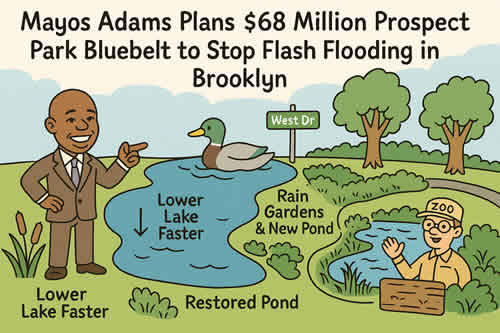
New York City Mayor Eric Adams has announced a $68 million plan to build Brooklyn’s first-ever Bluebelt in Prospect Park to reduce flash flooding and protect nearby neighborhoods like Ditmas Park, Kensington, Prospect Park South, and Windsor Terrace from climate change–driven extreme weather. In partnership with NYC DEP, NYC Parks, and the Prospect Park Alliance, the project will enhance the park’s lake and wetlands with nature-based solutions, including upgraded drainage to lower lake levels in under 36 hours, new rain gardens and a pond along West Drive to capture stormwater, and a restored historic pond near Flatbush Avenue to help protect the Prospect Park Zoo. Up to $50 million from DEP will fund the Bluebelt, complementing a $20 million Lakeshore restoration that will rebuild the shoreline of Brooklyn’s only lake, improve habitat, add visitor amenities, and boost stormwater management. Building on a separate $146 million flooding mitigation project in East New York’s Jewel Streets, construction of the Prospect Park Bluebelt is expected to begin in 2029 and be completed by 2032, strengthening Brooklyn’s long-term climate resilience.
Mayor Adams Announces $68 Million Plan to Tackle Flash Flooding in Prospect Park and Nearby Neighborhoods, Protect NYC Against Extreme Weather Events
– New York City Mayor Eric Adams, New York City Department of Environmental Protection (DEP) Commissioner Rohit T. Aggarwala, New York City Department of Parks & Recreation (NYC Parks) Commissioner Iris Rodriguez-Rosa, and the Prospect Park Alliance (PPA) today announced the city’s plan to protect Brooklyn from flash flooding caused by climate change. The Adams administration has allocated $68 million to build Brooklyn’s first Bluebelt in Prospect Park and continue to restore the park’s lakeshore. The Bluebelt will use nature-based solutions — enhancing the park’s lake and wetlands — to manage intense rainfall. With up to $50 million allocated from DEP for the Bluebelt, this investment complements PPA’s ongoing $20 million lakeshore restoration plan. These actions will help protect Prospect Park, the Prospect Park Zoo, and surrounding neighborhoods against extreme weather events.
“Today’s announcement marks a major step forward in protecting Brooklyn from the growing threat of climate-driven flash flooding,” said Mayor Adams. “By investing up to $68 million to create Brooklyn’s first-ever Bluebelt at the iconic Prospect Park, we’re harnessing the power of nature-based solutions to strengthen the park’s lake and wetlands, and better manage intense rainfall. Working hand-in-hand with the Prospect Park Alliance, this project will safeguard Prospect Park, the Prospect Park Zoo, and the surrounding communities for generations to come. We are proud to make this investment in resilience, sustainability, and the future of Brooklyn.”
“By using Prospect Park to manage stormwater, we’re turning one of Brooklyn’s most cherished public spaces into a powerful tool for climate resilience,” said DEP Commissioner Aggarwala. “This project brings Brooklyn its first Bluebelt and demonstrates how restoring and enhancing the park’s natural drainage not only preserves its scenic waterways but also protects the surrounding neighborhood. Thanks to the partnership with NYC Parks and the Prospect Park Alliance, we are able to implement creative solutions that will benefit both the park and the community.”
“Our public parks are more than just beautiful places to take in the scenery — they are also natural infrastructure making our city more resilient. With this investment, we’re helping protect Prospect Park and the surrounding neighborhoods from flooding, which is critical as climate change leads to more extreme weather events,” said NYC Parks Commissioner Rodriguez-Rosa. “We look forward to working with our partners to bring an inventive Bluebelt system to Prospect Park, complementing the ongoing Lakeshore improvement project, and making ‘Brooklyn’s Backyard’ an integral part of New York City’s sustainable future.”
“Prospect Park plays an essential role in the health and well-being of our community, and through this Bluebelt initiative, it will play an even more important role in protecting our community from severe storms and flooding,” said Morgan Monaco, president, PPA. “This project demonstrates the importance of our city parks and green spaces as a first line of defense against climate change and supports the work we are accomplishing through our Lakeshore restoration, which will greatly enhance Brooklyn’s only lake for the benefit of all our visitors.”
The Adams administration’s investment comes after a year-long study by DEP of flooding in the surrounding Brooklyn communities and how stormwater moves through Prospect Park during heavy rain. Together with NYC Parks and the PPA, the nonprofit that operates the park in partnership with the city, DEP studied the park’s landscape and water systems to find ways to improve drainage. The study found that during intense storms, rainwater often rushes over the ground instead of flowing into the park’s 60-acre lake, leading to flash flooding. The 150-year-old lake also has limited capacity, which can cause it to overflow and strain the sewer system.
To address this, DEP is working with NYC Parks and PPA to enhance many original landscape design features, along with adding new ones to adapt for climate change. The improvements will include:
Lowering Lake Levels Faster: Upgrading the lake’s drainage infrastructure to lower water levels in less than 36 hours, instead of three weeks — giving the park more capacity to handle large storms.
Using Rain Gardens and a New Pond to Capture West Drive Floodwaters: A new pond and a continuous stretch of planted rain gardens along West Drive will slow and filter rainwater and ultimately drain to the lake after a storm, instead of flooding homes and streets to the south.
Reducing Flooding on Flatbush Avenue and Helping Protect the Zoo with a Restored Pond: A new pond north of the zoo, in the location of a historic pond that was later filled in, will collect rainwater off of Flatbush Avenue and help protect the zoo from future flash flooding events like the one that forced it to close after the record-breaking storm in September 2023.
DEP first pioneered the Bluebelt system in Staten Island, where it has proven successful at reducing flooding while also creating open green space communities and wildlife habitat. NYC Parks collaborates with DEP on Bluebelt designs in parks to integrate nature-based flood management that improves long-term resiliency and provides ecological, educational, and recreational benefits. Now, Brooklyn will benefit from the same approach. DEP has kicked off the design process with construction anticipated to start in 2029 and be completed in 2032.
Conceptual rendering of restored pond that will drain Flatbush Avenue and help protect the zoo from flash flooding.
Lakeshore Restoration Plan
The project complements Lakeshore — the current restoration of the shoreline of the lake — which the PPA is undertaking through $20 million in funding, including $18 million from Mayor Adams and $2 million from the New York City Council. This project will reconstruct the shoreline of Brooklyn’s only lake to improve its environmental resiliency and enhance the visitor experience. The reconstructed shoreline will closely follow the historic design by park creators Frederick Law Olmsted and Calvert Vaux, and includes new lighting, seating, and viewing areas, as well as green infrastructure for stormwater management, newly landscaped areas to enhance wildlife habitat, and improved ADA access to this important park destination. The project is an extension of the award-winning Lakeside restoration from 2010, which includes the Shelby White and Leon Levy Esplanade with walkways and picnic areas featuring newly placed boulders, native trees, shrubs, and aquatic plants. Additionally, five acres of the lake were excavated to recreate Baier Music Island, which serves as a wildlife habitat.
About the Bluebelt System
Originally implemented by DEP on Staten Island, the Bluebelt program preserves natural drainage corridors, including streams, ponds, and wetlands, and revitalizes and enhances them to optimize their functions of conveying, storing, and filtering stormwater. Bluebelts have proven to be an excellent mechanism for reducing urban flooding, while creating a rich, natural environment for the local community. As New York City prepares for rising sea levels and heavier rains due to climate change, Bluebelts offer a natural and effective solution for stable and sound stormwater management. As detailed in PlaNYC: Getting Sustainability Done, DEP is working to expand the Bluebelt system where feasible across the five boroughs. The agency currently manages 545 acres of Bluebelts and natural areas in the Bronx, Queens, and on Staten Island.
This announcement follows the Adams administration’s previous investment in combatting flooding in the Jewel Streets neighborhood in East New York, Brooklyn. The $146-million investment is addressing chronic flooding in the neighborhood and installing drainage infrastructure, such as storm sewers and catch basins, at four intersections in the north and south Jewel Streets. These investments have dramatically improved conditions, as the amount of time it takes water to drain at those intersections has plummeted from 60 days to just two days.
“With climate-change fueled superstorms becoming a regular occurrence we must invest in greater resilience now,” said New York State Assemblymember Robert Carroll. “I applaud DEP’s multi-pronged effort to mitigate flooding from the park. I know that many of my constituents will benefit tremendously.”
“Prospect Park is one of the most important green spaces for my district of Crown Heights, Prospect Lefferts Gardens, and Flatbush, and as flooding becomes a more prevalent issue for our neighborhoods, I am encouraged to see this investment in nature-based solutions that protect our communities from rising flood risks,” said New York State Assemblymember Brian Cunningham. “I appreciate the work of DEP, NYC Parks, and the Prospect Park Alliance for driving this plan forward. When we care for the park’s landscape and water systems, we safeguard the homes, streets, families, and vital small businesses surrounding it.”
“Brooklyn deserves a climate infrastructure that is as resilient and forward-thinking as the communities it protects,” said New York City Councilmember Shahana Hanif. “This investment in Prospect Park’s first-ever Bluebelt is a transformational step toward safeguarding Kensington, Prospect Park South, and Windsor Terrace from the devastating flash floods we’ve seen in recent years. By embracing nature-based solutions and restoring the heart of our borough’s most cherished green space, we’re not only preparing for extreme weather, we’re honoring our responsibility to build a greener, more climate-just future for every Brooklynite.”
“Building Brooklyn’s first-ever Bluebelt right here in Prospect Park embraces smart, nature-based solutions that will strengthen our resilience and protect our neighborhoods, from Ditmas Park and Kensington to Prospect Park South and Windsor Terrace,” said New York City Councilmember Rita Joseph. “This $50-million investment, paired with the $20 million lakeshore restoration efforts, represents a commitment to modernizing how we manage stormwater. As a staunch advocate for infrastructure investments that prioritize environmental justice, I am proud to see our city taking bold, forward-thinking action to meet the challenges of climate change head-on.”
“This is a culmination of over a decade of advocacy from Community Board 14 to the Department of Parks and Recreation, to the Department of Environmental Protection and to an array of local elected officials,” said Karl-Henry Cesar, chair, Brooklyn Community Board 14. “This is an exciting plan that promises ecological, environmental, and aesthetic improvements in Prospect Park while simultaneously resolving the long-endured flooding issues affecting our residents, businesses, and other public assets. We are gratified and enthusiastic and are standing by to offer the continued support of CB14.”