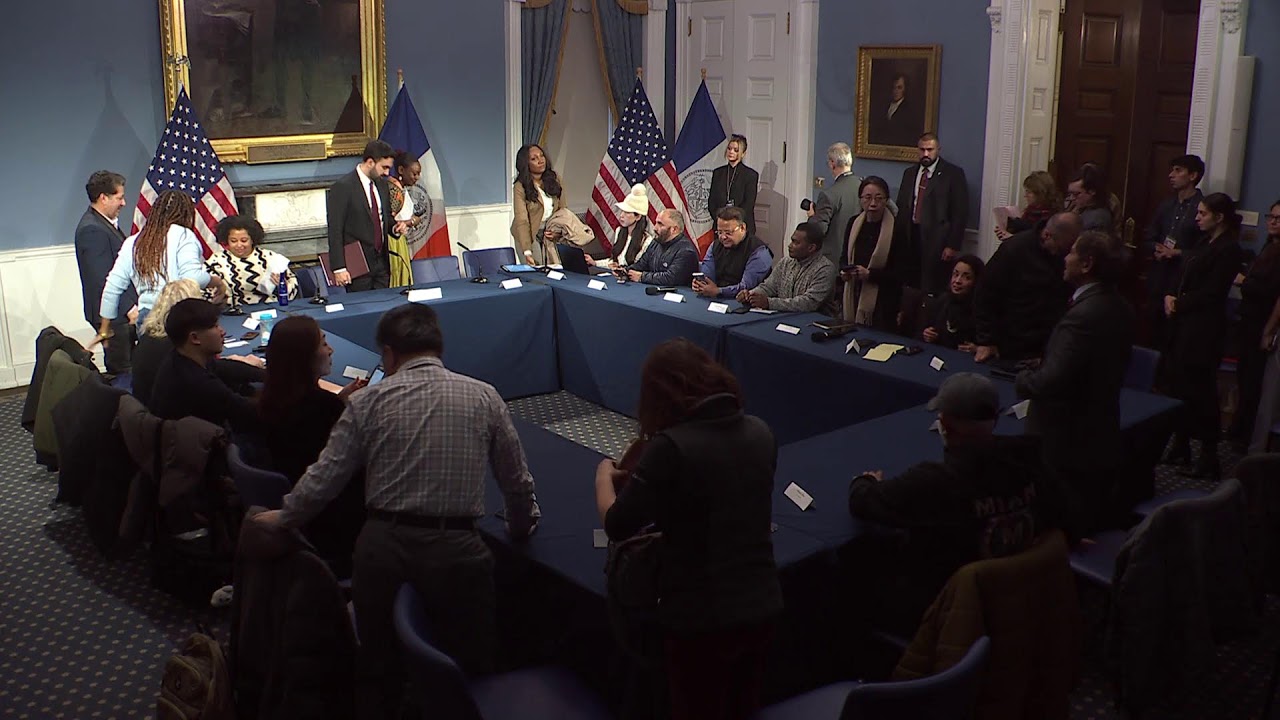
In this NYC Mayor’s Office video, Mayor Zohran Mamdani makes the case that “New York is a football town” by turning a major city landmark into a public celebration of the world’s game. Speaking to a crowd gathered downtown at Manhattan’s Surrogate’s Court, he says what unites people in the room is both love for Africa—a continent many were born in or connected to—and love for football, which he calls a daily source of energy and meaning.
The moment centers on the city-hosted AFCON final watch party (Morocco vs. Senegal): fans from different backgrounds share one space, one match, and one city. Mamdani frames it as a snapshot of New York at its best—rooting for different teams, but still together—and ties it to what’s coming next: bringing “the world’s game” to New York City in the months ahead, as the region prepares for the 2026 World Cup summer.
January 23, 2026 Morocco-Senegal AFCON final game downtown at the Surrogate’s Court building.
At a City Hall roundtable with ethnic and community media, Mayor Zohran Mamdani urged New Yorkers to act quickly as the application window for 3-K and Pre-K (free early childhood programs for three- and four-year-olds) moves toward its February 27, 2026 deadline. Opening the briefing, City Hall communications staff outlined the agenda, followed by remarks from Emmy Liss (Executive Director, Mayor’s Office of Child Care), Simone Hawkins (Deputy Chancellor for Early Childhood), and Travanda Kelly (Chief Enrollment Officer, NYC Public Schools), before the mayor shared parent testimonials and took questions focused strictly on registration and child care access.
The mayor framed the message as both practical and urgent: families with children turning three or four at any point in 2026 are eligible, and applying by the deadline guarantees an offer. He emphasized that the program is not first-come, first-served, and described universal child care as a citywide affordability strategy—helping parents return to work, strengthening children’s long-term outcomes, and easing pressure on household budgets in what he called “the most expensive city in the United States.”
City officials highlighted multiple application routes and language access. Families can apply online through MySchools.nyc, by phone at 718-935-2009, or in person at Family Welcome Centers across the five boroughs. The administration stressed that the system is built to serve New Yorkers who may be less connected to government—especially immigrant families and households where English is not the first language—pointing to 13 languages available online and phone interpretation in 200+ languages.
Several questions from reporters focused on barriers that can discourage enrollment, including fear in immigrant communities amid heightened ICE activity, documentation concerns, and confusion about waitlists. The mayor stated that 3-K and Pre-K do not ask for a child’s immigration status, and reiterated New York City’s sanctuary-city policies, including limits on ICE access to schools and other city facilities absent a judicial warrant signed by a judge. On waitlists, enrollment leaders clarified that being waitlisted often means a family received an offer but is queued for a higher-ranked choice; families can track their waitlist position in MySchools, and the waitlist process can continue beyond the main deadline.
The event also underscored City Hall’s reliance on ethnic and community media as “trusted validators” to reach parents who may not follow traditional press conferences or English-language outlets. Officials described an outreach push—posters, street teams, community-based partners, and direct engagement in places like transitional housing—summed up by the mayor’s campaign-style slogan: “GOTC: Get Out the Child Care.”
Key details for families
Who can apply: Children turning 3 or 4 in 2026
Deadline:February 27, 2026
How to apply:MySchools.nyc | 718-935-2009 | Family Welcome Centers
Language access: Website in 13 languages; phone interpretation in 200+ languages
Guarantee: Apply by the deadline and you will receive an offer (not first-come, first-served)
The video “Anti-ICE Protestors Issue Me a Chilling Warning” by intrepid (and apparently frostbite-resistant) independent journalist Nate Friedman is a hilarious, teeth-chattering dispatch straight from the frozen tundra of a New York City anti-ICE rally—conveniently timed one year after Trump’s big comeback. Nate rolls up early, hands turning into popsicles while he quips about yanking off his gloves, and right away drops the million-dollar question that’s clearly kept every virtue-signaling hipster up at night: “Why are we shivering outside a library like sad penguins when we could be blocking traffic at Trump Tower literally every single day?”
Cue the greatest hits of performative outrage. A private chef brandishes a “Murderer” sign aimed at the big bad orange man, confidently brands Tom Homan (ICE’s deportation champ) a full-on Nazi… until Nate casually mentions Obama slapped a shiny medal on Homan in 2015 for crushing deportation records. Plot twist! Her enlightened response: “Uh… Trump probably got to him somehow.” Because nothing says “deep thinker” like retroactively canceling your own side’s heroes.
Then there’s the visionary who wants open borders drenched in “empathy” (because empathy fixes logistics, apparently), and the absolute galaxy-brain suggestion to abolish ICE and replace it with… the immigrants themselves. Yes, folks: let the people who just crossed the border moonlight as border guards. What could possibly go wrong? Efficiency, accountability, national security—pfft, details. A Maoist Communist Union duo earnestly pitches their “pre-party organization,” lecturing on mass line theory and brushing off Mao-era famines and purges as mere “bourgeois smears.” But relax—they assure us coffee will survive the revolution. “The workers harvested the beans, comrade.”
The vibe gets extra spicy with masked coordinators slinking around like low-budget spies, hissing “Don’t talk to that Zionist” to anyone who makes eye contact with Nate. When he innocently inquires, “Hey, when’s the Free Iran rally scheduled?” the response is pure gold: “Talk to the People’s Forum.” Classic deflection—because nothing screams “principled solidarity” like selective outrage.
All the while, the crowd chants “F*** ICE” on loop, waves trans flags alongside Ukrainian ones (priorities!), hawks $20 “revolutionary” T-shirts, and engages in profound philosophical debates about whether storming a Minneapolis church mid-service to heckle an ICE-linked parishioner is “a bit much” or “totally fine if the pastor’s chill.” Spoiler: opinions are split, but the nuance is razor-thin.
Nate, bless his chilled soul, endures the nonstop rejection, the “drop dead, fascist” love notes, and actual tailing by what he suspects are paid pros trying to dox his address—all while asking the one question nobody wants to answer: “Okay, abolish ICE… then what?” The answers range from vague “empathy reforms” to letting immigrants self-police the border to straight-up “shut down the whole system.” Passion? Overflowing. Concrete plans? Crickets. It’s a masterclass in feelings-over-facts theater.
His raw, no-makeup style—freezing in the snow, shrugging off insults, and politely pressing for actual solutions—peels back the curtain on this glorious circus: endless rage, zero roadmap, and a burning desire to dismantle government, borders, and common sense itself in the Trump era. All masterfully orchestrated, we can only assume, by the usual shadowy hand behind the curtain (you know the one—rhymes with “People’s Forum funding streams”).
The White House said President Donald J. Trump welcomed the formation of the National Committee for the Administration of Gaza (NCAG) as a key step in Phase Two of his 20-point “Comprehensive Plan to End the Gaza Conflict,” with NCAG leader Dr. Ali Sha’ath tasked with restoring public services, rebuilding civil institutions, stabilizing daily life, and laying the groundwork for self-sustaining governance. The statement claims the framework aligns with U.N. Security Council Resolution 2803 (2025) and is overseen by a “Board of Peace” chaired by Trump, supported by a founding Executive Board—named as Secretary Marco Rubio, Steve Witkoff, Jared Kushner, Sir Tony Blair, Marc Rowan, Ajay Banga, and Robert Gabriel—plus senior advisors Aryeh Lightstone and Josh Gruenbaum for day-to-day execution. It also names Nickolay Mladenov as High Representative for Gaza to coordinate between the Board and NCAG, appoints Major General Jasper Jeffers to command an International Stabilization Force to support security, demilitarization, and aid delivery, and establishes a Gaza Executive Board (including Witkoff, Kushner, Turkey’s Minister Hakan Fidan, Sir Tony Blair, Marc Rowan, Minister Reem Al-Hashimy, Sigrid Kaag, and others) to assist governance and service delivery, with additional members to be announced in the coming weeks.
Statement on President Trump’s Comprehensive Plan to End the Gaza Conflict
Yesterday, President Donald J. Trump congratulated the formation of the National Committee for the Administration of Gaza (NCAG), a vital step forward in implementing Phase Two of his Comprehensive Plan to End the Gaza Conflict—a 20-point roadmap for lasting peace, stability, reconstruction, and prosperity in the region.
The NCAG will be led by Dr. Ali Sha’ath, a widely respected technocratic leader who will oversee the restoration of core public services, the rebuilding of civil institutions, and the stabilization of daily life in Gaza, while laying the foundation for long-term, self-sustaining governance. Dr. Sha’ath brings deep experience in public administration, economic development, and international engagement, and is widely respected for his pragmatic, technocratic leadership and understanding of Gaza’s institutional realities.
This milestone perfectly aligns with United Nations Security Council Resolution 2803 (2025), which endorsed President Trump’s Comprehensive Plan and welcomed the establishment of the Board of Peace. The Board of Peace will play an essential role in fulfilling all 20 points of the President’s plan, providing strategic oversight, mobilizing international resources, and ensuring accountability as Gaza transitions from conflict to peace and development.
To operationalize the Board of Peace’s vision—under the chairmanship of President Donald J. Trump—a founding Executive Board has been formed, composed of leaders with experience across diplomacy, development, infrastructure, and economic strategy. The appointed members are:
Secretary Marco Rubio
Steve Witkoff
Jared Kushner
Sir Tony Blair
Marc Rowan
Ajay Banga
Robert Gabriel
Each Executive Board member will oversee a defined portfolio critical to Gaza’s stabilization and long-term success, including, but not limited to, governance capacity-building, regional relations, reconstruction, investment attraction, large-scale funding, and capital mobilization.
In support of this operating model, the Chairman has appointed Aryeh Lightstone and Josh Gruenbaum as senior advisors to the Board of Peace, charged with leading day-to-day strategy and operations, and translating the Board’s mandate and diplomatic priorities into disciplined execution.
H.E. Nickolay Mladenov, an Executive Board member, will serve as the High Representative for Gaza. In this capacity, he will act as the on-the-ground link between the Board of Peace and the NCAG. He will support the Board’s oversight of all aspects of Gaza’s governance, reconstruction, and development, while ensuring coordination across civilian and security pillars.
To establish security, preserve peace, and establish a durable terror-free environment, Major General Jasper Jeffers has been appointed Commander of the International Stabilization Force (ISF), where he will lead security operations, support comprehensive demilitarization, and enable the safe delivery of humanitarian aid and reconstruction materials.
In support of the Office of the High Representative and the NCAG, a Gaza Executive Board is being established. The Board will help support effective governance and the delivery of best-in-class services that advance peace, stability, and prosperity for the people of Gaza. The appointed members are:
Steve Witkoff
Jared Kushner
Minister Hakan Fidan
Ali Al-Thawadi
General Hassan Rashad
Sir Tony Blair
Marc Rowan
Minister Reem Al-Hashimy
Nickolay Mladenov
Yakir Gabay
Sigrid Kaag
The United States remains fully committed to supporting this transitional framework, working in close partnership with Israel, key Arab nations, and the international community to achieve the objectives of the Comprehensive Plan. The President calls on all parties to cooperate fully with the NCAG, the Board of Peace, and the International Stabilization Force to ensure the swift and successful implementation of the Comprehensive Plan.
Additional Executive Board and Gaza Executive Board members will be announced over the coming weeks.
In an “America 250” message dated January 17, 2026, the White House commemorates Benjamin Franklin on what would have been his 320th birthday, praising him as a printer, inventor, diplomat, public servant, and patriot whose life helped define the American character. The statement highlights Franklin’s self-education and rise as a leading colonial publisher, along with practical innovations and civic contributions such as the lightning rod, bifocals, experiments with electricity, and the creation of public-serving institutions like a library and volunteer fire department, as well as his role as the first Postmaster General. It also emphasizes his central role in the founding era: service in the Second Continental Congress, involvement in drafting the Declaration of Independence, securing French support, helping negotiate the 1783 Treaty of Paris, and advocating for Constitution ratification. The message closes by framing Franklin’s legacy as enduring through American institutions and the nation’s civic ideals, calling him the “First American” and linking his impact to 250 years of national history.
America 250: Presidential Message on the Birthday of Benjamin Franklin
Today, we celebrate the towering life and legacy of Benjamin Franklin—printer and philosopher, inventor and diplomat, public servant and patriot, and one of the most consequential Americans to ever live. On what would have been his 320th birthday, we honor his restless genius, his steadfast devotion to liberty, and his legendary contributions to our national story.
Born on January 17, 1706, in Boston, Massachusetts, Franklin grew up the 15th of 17 children. Raised with little formal education, he taught himself how to read and write, emerging at age 23 as one of the most successful and influential publishers in the Colonies. He was also a passionate innovator, always striving to improve the lives of his fellow citizens through public service and the marvels of science. Throughout his life, he invented the lightning rod and the first bifocal glasses, harnessed the power of electricity with his famous “key and kite” experiment, established the first public library and volunteer fire department, and served as the first Postmaster General, binding the Colonies together with an organized mail system long before they were bound together as one Nation.
Of his countless triumphs and successes, his most epic contributions to our Republic were those that fortified the cause of freedom. While living in England as an ambassador for the Pennsylvania Assembly, Franklin witnessed firsthand the growing British hostility toward the Colonies. In 1775, Franklin was selected as a delegate to the Second Continental Congress, where, together with fellow patriots John Adams and Thomas Jefferson, he helped draft the Declaration of Independence, suggesting to Jefferson that he include the immortal phrase: “We hold these truths to be self-evident, that all men are created equal.”
Franklin’s unshakable commitment to the causes of the Revolution ultimately led him across the Atlantic once more, where he played a pivotal role in securing French support for the patriot cause against the British Empire and acted as a principal negotiator of the 1783 Treaty of Paris, which ended the Revolutionary War. After American independence was finally won, he played a vital role in rallying support for the ratification of the Constitution in 1788. Franklin is one of only six men to have signed both the Declaration of Independence and the Constitution.
Benjamin Franklin is often remembered as the “First American”—a title that reflects a life devoted to curiosity, industry, and the cause of human freedom. His intellect and character helped shape an American identity grounded in courage, self-reliance, and civic duty. Franklin gave the young country confidence and direction, demonstrating how knowledge and public service could advance the cause of liberty. His legacy endures in our institutions, our Constitution, and the very character of our Republic—a testament to how one man’s ideas and actions can echo through the history of a nation for 250 glorious years.
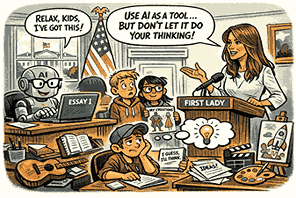
In remarks delivered from the White House for a national Zoom webinar, Melania Trump urged students to treat AI as a creative tool, not a substitute for judgment.
WASHINGTON—First Lady Melania Trump used a virtual address to thousands of classrooms Friday to pitch artificial intelligence as a once-in-a-generation accelerator of learning and creativity—while cautioning students not to let the technology do their thinking for them. (The White House)
Speaking in opening remarks for “Zoom Ahead: AI for Tomorrow’s Leaders,” a national learning event hosted by Zoom, Mrs. Trump described an “Age of Imagination” in which curiosity can be satisfied “almost magically, in seconds,” and argued that the decisive skill in the AI era is not memorization but asking better questions. (The White House)
The event—scheduled for Jan. 16 at 9:00 a.m. Pacific via Zoom Webinar—was positioned by the company and the White House as part of a broader push to build AI literacy for K–12 students and educators, with a particular emphasis on responsible use. (Zoom)
“Age of Imagination,” “intellectual freedom”
Mrs. Trump’s prepared remarks read like a motivational address aimed at demystifying AI for young audiences: a student who wants to design fashion, write music, or create an animated superhero series can now use AI tools from home to draft concepts, characters and scripts. (The White House)
But the core of the speech was less about software than mindset. “In the new AI era, the most powerful skill is knowing what to ask, why it matters, and how to think beyond the first answer,” she said, urging students to be “stubbornly curious” and to “question everything.” (The White House)
Her closing message, however, drew a bright line between generation and meaning. AI can create “images and information,” she said, but “only humans can generate meaning and purpose.” She urged students to “never surrender your thinking to AI,” warning against treating the technology as a shortcut. (The White House)
A corporate partnership with a classroom pitch
The White House said the initiative is intended to “improve America’s children’s understanding” of AI and to “empower the next generation” to use it in education and later careers, with Zoom as a partner reaching “thousands of schools nationwide.” (The White House)
Zoom, for its part, framed the webinar as part of a wider AI literacy program and emphasized confidence and ethics in adoption. The company’s release said its event is designed to help students understand how AI can be used “responsibly, creatively, and confidently,” and noted that Mrs. Trump would deliver opening remarks live from the White House. (Zoom)
Eric Yuan, Zoom’s chief executive and founder, echoed the responsible-use theme, arguing that the spread of AI in learning and work makes literacy and ethical norms essential for students and educators. (The White House)
The politics of AI education
Mrs. Trump has increasingly made technology and youth-focused education a signature lane, using the language of national competitiveness alongside personal development. The Zoom release quoted her as saying students and educators have a “unique chance to get ahead” by learning AI early, positioning literacy as a workforce advantage and a way for communities to shape, not simply absorb, technological change. (Zoom)
The White House statement also tied Friday’s remarks to a broader agenda, noting that Mrs. Trump had called on the international community at the 2025 United Nations General Assembly to join her efforts and that she plans to host an inaugural meeting of a related initiative, “Fostering the Future Together,” at the White House this spring. (The White House)
A simple message for a complicated technology
For all the talk of “imagination,” the subtext of the address reflected a debate that has moved quickly from Silicon Valley to school districts: how to harness AI’s ability to draft, summarize and generate media without weakening core skills like reasoning, writing and judgment.
Mrs. Trump offered a practical rule of thumb: use AI to widen the field of ideas—but keep ownership of conclusions. “Be intellectually honest with yourself,” she said. “Use AI as a tool—but do not let it replace your personal intelligence.” (The White House)
In an era when students can produce a passable essay or a polished slide deck in minutes, the First Lady’s prescription was old-fashioned: do the hard part yourself. The technology may be new; the standard she set was not.
Mayor Zohran Mamdani used a media availability at Gracie Mansion to mark what he called a personal milestone and a civic obligation: moving into the mayoral residence while promising to keep it, in his words, “the people’s house.” Standing in the garden on moving day—his first night sleeping at the mansion—Mr. Mamdani, joined by his wife, Rama, framed the residence as a public asset with a long, utilitarian history, citing past uses ranging from language classes for immigrants to community workshops. He said the new administration intends to be “custodians” rather than owners, signaling that changes would be less about aesthetics than about ensuring the space reflects the city’s civic fabric and is more accessible to New Yorkers who typically do not visit.
In a lighter exchange that underscored his populist brand, the mayor fielded questions about the household basics: he joked about the “ghost” that some say haunts Gracie Mansion, floated an “aspirational” plan to install a bidet, and said he is getting allergy shots in hopes of adopting a cat. He also said his dietary preferences include “no pork,” and offered an early pick for bagels and lox on the Upper East Side. Asked about a note reportedly left by former Mayor Eric Adams, Mr. Mamdani said he had not found it and would go looking.
The questioning quickly moved from the personal to policy, with Mr. Mamdani previewing his return to Albany for the governor’s State of the State and budget rollout. He characterized the city-state relationship as historically “framed more by dysfunction” than shared priorities, and said he would soon have more to share about his approach—particularly as he touted a partnership with the governor to begin delivering universal child care in New York City. Pressed on taxation and ideas such as corporate taxes, he did not commit to specifics, saying discussions would continue as part of a broader affordability agenda and the city’s fiscal health. He also indicated he would raise related priorities with legislative leaders, including questions around transit affordability.
Mr. Mamdani also confronted more charged issues, including antisemitism and immigration enforcement. He said his administration is looking to fill a city position tied to combating antisemitism and argued that condemning extremist language and support for terrorist organizations is a baseline obligation, one he said he intends to demonstrate through actions as well as words. On federal enforcement, he emphasized adherence to New York City’s sanctuary policies, saying the city cannot coordinate with ICE to enter city property absent a judicial warrant, while noting that certain cooperation with federal authorities is permitted in cases involving serious crimes. He criticized immigration raids as “cruel and inhumane,” arguing they generate anxiety among New Yorkers without improving public safety—an argument he said he has raised both publicly and directly with President Donald Trump.
New York City Council data analyst, Rafael Andres Rubio Bohorquez – an immigrant from Venezuela, was detained by Immigration and Customs Enforcement (ICE) on January 12, 2026, during a routine immigration appointment on Long Island, despite having work authorization until October 2026, sparking outrage from city officials who called it government overreach and demanded his immediate release.
Key Details:
Who: An unnamed data analyst on the City Council’s central staff, who is from Venezuela.
When: Monday, January 12, 2026, during a routine appointment.
Where: Bethpage, Long Island, before being taken to a federal facility in Manhattan.
Why (officials’ view): City Council Speaker Julie Menin and others denounced the detention as an “egregious” action, stating the employee was following all rules and had legal status.
Status: The employee was granted one phone call, which he used to contact the Council’s HR department, who then learned of the situation.
Response: City officials, including Mayor Zohran Mamdani and Speaker Menin, are demanding his immediate release and protesting the federal government’s actions, linking it to broader immigration crackdowns.
At Wednesday’s House Oversight Committee hearing, Rep. Nancy Mace (R-SC) called to subpoena the immigration records of Rep. Ilhan Omar (D-MN) and her ex-husband.
During a House Oversight & Accountability Committee hearing on Minnesota fraud allegations (the committee’s “Oversight of Fraud and Misuse of Federal Funds in Minnesota: Part I” hearing), Rep. Nancy Mace (R-SC) offered a motion to subpoena immigration/naturalization records tied to Rep. Ilhan Omar (D-MN) and individuals connected to her family and prior marriages. Mace argued the records were relevant to potential legislative reforms on immigration fraud and denaturalization processes.
Rep. Robert Garcia (D-CA) responded by offering an amendment that would direct subpoenas toward records involving Rep. Cory Mills (R-FL)—including documents about his military service record and business dealings—framing it as a reciprocal step given that a sitting Democratic member was being targeted.
A procedural fight then broke out over whether Oversight should be investigating sitting members at all (several members argued that the House Ethics Committee is the proper venue, even if Oversight has broad investigative authority). In the end, Garcia withdrew his Mills-related amendment and instead made a motion to table Mace’s subpoena motion. The committee agreed to table it—meaning the subpoena effort did not move forward in that moment.
President Donald J. Trump has scored another remarkable foreign policy triumph: the bold capture and extradition of Nicolas Maduro, the indicted narcoterrorist and socialist dictator who plunged Venezuela into chaos, starved its people, and menaced American security, now detained on U.S. soil to face long-overdue justice.
Democrats spent years howling that Maduro was a ruthless tyrant who had to be delegitimized, pressured, and removed. But the instant President Trump succeeds where they failed, they erupt in furious hypocrisy — prioritizing their unhinged hatred of President Trump over American interests and national security.
Here are just a few of the many hypocritical Democrats then vs. now:
Sen. Chuck Schumer
THEN: “And the President brags about his Venezuela policy. Give us a break. He hasn’t brought an end to the Maduro regime. The Maduro regime is more powerful today and more entrenched today than it was when the President began.” (2/5/20)
NOW: “This is reckless. And the American people are just, this morning, in fear of what’s going to happen here.” (1/4/26)
Sen. Dick Durbin
THEN: “The people of Venezuela deserve better than this. We can’t allow this President’s short attention span to stop us from delivering on our promise to help the Venezuelan people rebuild their country… Though President Trump may seem ready to throw in the towel, I stand committed to aiding the people of Venezuela.” (6/20/19)
NOW: “I disagree with President Trump’s use of U.S. military forces without Congressional approval & worry deeply about this Admin’s follow through on foreign policy interventions.” (1/3/26)
Sen. Chris Van Hollen
THEN: “[T]he United States is now going to use its levers and influence to push for a negotiation to have a transition to the truly elected leader… Obviously, we know Maduro and his cronies do not want to go quietly into the night, but the United States needs to work with its partners and allies in the region to ratchet up the pressure…” (8/2/24)
NOW: “It is an illegal act of war to replace Maduro.” (1/3/26)
Sen. Chris Murphy
THEN: “If Trump cared about consistency, he would make the realist case for intervention in Venezuela (getting rid of Maduro is good for the United States) rather than trying to pretend his Administration all of the sudden cares about toppling anti-democratic regimes.” (1/23/19)
NOW: “The invasion of Venezuela has nothing to do with American security. Venezuela is not a security threat to the U.S.” (1/4/26)
Sen. Tim Kaine
THEN: “This is a deeply concerning development for Venezuelans and for the entire region, since instability abroad impacts us here at home, too.” (9/2/24)
NOW: “President Trump’s unauthorized military attack on Venezuela to arrest Maduro… is a sickening return to a day when the United States asserted the right to dominate the internal political affairs of all nations in the Western Hemisphere.” (1/3/26)
Sen. Amy Klobuchar
THEN: “I have of course supported bringing in the new president and delegitimizing the Maduro government. You always leave things on the table.” (5/2/19)
NOW: “I have strongly opposed sending American forces into harm’s way in Venezuela without authorization from Congress. We should not put Americans at risk in this way without careful deliberation among the people’s elected representatives. Wars for regime change can lead to unintended consequences.”(1/3/26)
Sen. Elizabeth Warren
THEN: “Maduro is a dictator and a crook who has wrecked his country’s economy, dismantled its democratic institutions, and profited while his people suffer. The United States should lead the international community in addressing Venezuela’s humanitarian crisis and supporting regional efforts to negotiate a political transition.” (7/30/2019)
NOW: “What does it mean that the U.S. will ‘run’ Venezuela, and what will Trump do next around the world? The American people voted for lower costs, not for Trump’s dangerous military adventurism overseas that won’t make the American people safer.” (1/3/26)
Rep. Jamie Raskin
THEN: “The democratic world must stand up for the rule of law in Venezuela and oppose Maduro’s assault on the electoral process and free speech. The right-wing attack on democratic institutions anywhere is a threat to freedom everywhere.” (8/2/24)
NOW: “Trump is not only violating our Constitution, but he is shredding the rules-based international order created after World War II, whose essential building block is the political sovereignty and territorial integrity of each nation.” (1/4/26)
Rep. Darren Soto
THEN: “Honored to speak with @cdvorlando yesterday about Venezuelan TPS, raising the reward for Maduro’s capture to $100M, and bringing democracy back to Venezuela. #VenezuelaLibre” (10/6/24)
NOW: “Trump’s trading one dictator for another just to get oil? This will do NOTHING to help my constituents’ family members who just lost their TPS and still can’t return home.” (1/5/26)