Category: NYC – CITY HALL

  • New York. Mayor Adams Hosts “Hear From the Mayor” Radio Show on WBLS 107.5 FM

    New York. Mayor Adams Hosts “Hear From the Mayor” Radio Show on WBLS 107.5 FM

    On his monthly Hear From the Mayor segment on WBLS 107.5 FM, New York City Mayor Eric Adams honored fallen firefighter Patrick Brady before discussing major technology and affordability initiatives with Chief Technology Officer Matthew Fraser. They highlighted the new Emergency Alert System connecting schools directly to 911, efforts to expand broadband and provide hundreds of thousands of Chromebooks to students, digital literacy programs for seniors, and strengthened citywide cybersecurity through the Joint Security Operations Center. They also detailed cost-saving measures like discounted cell phone plans for city employees. Callers phoned in to thank Adams for his service as he reflected on his administration’s achievements—from expanding housing, internships, and financial literacy to improving public safety and digital access—while expressing gratitude and optimism as he nears the end of his term.

    Gary Byrd: Well, as you know, each and every [second] Sunday of the month, WBLS has been proud to welcome the 110th mayor of New York City, second mayor of color, and the first hip-hop mayor in the city’s history, we [were] talking about him just a few minutes ago. Well it’s time to Hear from the Mayor, Mayor Eric Adams joins us this morning from 107.5 WBLS. Mr. Mayor, good morning.

    Mayor Eric Adams: Hey Gary, how are you to all of the listeners? It’s great to be on this Sunday and I want to welcome you back to another episode of Hear from the Mayor. I’m your Mayor Eric Adams and really before we get started, I just want to take a moment to honor Firefighter Patrick Brady. He was responding to the scene of a fire on Kings Highway in Brooklyn last night and tragically passed away in the line of duty. Hearts go out to Patrick’s family, his wife, his brothers and uncles who are also firefighters. 

    The Brady family is a well-known firefighter community, and so we want to give them our deep condolences. He’s [given] his life to protect this city that we all love. And so today, we want to talk about things that I love around technology. And if this is your first time tuning in, really the show is just to hear from me and to interact in a dialogue. Listeners should give me a call and hear directly from me at (212) 545-1075. 

    You can also sign up to hear more from me by visiting nyc.gov/HearFromEric. Today’s guest is really, you know, one of my favorite commissioners. My brother, Matt Fraser is over at the Office of Technology. He’s the youngest and I believe the first person of color to hold that position. and what you have done has brought a level of innovation that’s unbelievable. You know, he’s my chief technology officer and we’re gonna talk about something that he introduced that really marriages public safety. 

    But I want to, before we get off the air, to talk about some of the other initiatives that you have brought as well, you know, as you’re rocking your God Speed hat. So, Matt, EAS, the acronym for Emergency Alert System, directly integrates New York City Public Schools with New York City 911 services and is capable of initiating 911 response in under 10 seconds. Give me the whole concept behind EAS.

    Matthew Fraser, Chief Technology Officer, New York City Office of Technology and Innovation: Yeah, so when we look at what happened, not just in New York City, what we saw on Park Avenue, what we saw across the global landscape, and what we see in terms of active shooter situations. Parents that have kids that are in school, they want to know that their students, their kids’ safety is paramount. They want to make sure that we provide the fastest support possible. 

    And the emergency alert system gives us the capability of doing that. Now, with the system, it’s more than just being able to put in a call into 911. It’s giving those that respond the contacts necessary to know where to respond to. So imagine being a student in a school and the school has you know a couple dozen classrooms, someone comes in, and then something occurs, when a teacher hits a button it gives the capability for 911 to know that there’s an incident happening in the school. 

    At the same time it gives school safety– which is located in the school the ability to know that something is occurring in a specific classroom and it also gives the school administration the capability of knowing where something is happening so it gives them a better capability of who to move kids how to lock down classrooms to minimize any impact that it could have.

    Mayor Adams: You know it’s unfortunate we even have to have this conversation about how to respond to active shooters but they’re real. We saw what happened at 345 Park Avenue. We see what’s playing out in schools across the country. Knock on wood we have not had a mass shooting inside our schools but it’s better to be proactive than just reactive and so if I understand you correctly when the button is hit it would identify and assist responding personnel and school personnel to move children to an area of safety.

    Fraser: Exactly, exactly. So when someone approaches the school and being able to have the school safety agent or someone that’s in the school administration know where in the school the incident is occurring, not just that something’s happening but the where is very important. And minimize times to respond to things that are actually happening, and if something is moving through the school, having the capability of tracking where it’s moving to. 

    So I think it’s one of those things that it’s an unfortunate circumstance that it’s something that we have to look at, but it’s a reality. And it’s one of those things that we’re the first school system in the nation, the first city in the nation to adapt this type of technology, and it will blaze the trail for many others to do the same. 

    Mayor Adams: How many schools are we starting out with? 

    Fraser: So we’re getting out into eight schools at this moment, and then we’re gonna expand much further beyond that. But right now, it’s to make sure that the first phase of the rollout was to prove the concept works out, and we’re at that phase, and the next look is expanding beyond that. 

    Mayor Adams: And our students must not only be safe, but they have to feel safe, and this technology is a way to do it. Is it a possibility that the next administration could expand this out to city buildings because we have many cases of shootings in city buildings, post offices. I mean, there’s a whole terminology of going postal because of that. What are your thoughts on that?

    Fraser: So I think that this sets the foundation at which point that the city could expand and take it further. Again, safety is the most important thing, making sure that people that enter buildings leave those buildings safely. And in the event that something happens, giving responders the capability in real time to get to the areas where it’s happening to minimize impact to human life. And I can’t stress that enough.

    Mayor Adams: I want to roll, I want to go into some of the other stuff you’ve done. You know, you’re sort of behind the scenes, but people don’t realize how you changed the game [by]  using technology in this city. Let’s talk about number one, the Chromebooks.

    Fraser: Yeah. 

    Mayor Adams: Give me an overview of that. 

    Fraser: Yeah, so when we stepped into office in 2022 and we came in, one of the first things that we tackled in terms of challenges was cybersecurity. Beyond cybersecurity, we looked at equity and access. And I was alarmed to see that we had a significant portion of those that lived in public housing that didn’t have access to basic things like broadband. 

    And then what frightened me a little bit more was looking at the fact that there are many students that participate in the school system that don’t have access to devices. So in this digital age where artificial intelligence is getting wings and moving at the speed of light, having those that participate in our school system have access to the basics, connectivity and devices, is one of those things that it shouldn’t be an option, it’s a necessity and we should treat it as such. 

    That’s why when we launched a program to deploy Chromebooks, we got about 350,000 Chromebooks. We gave it to New York City Public Schools to distribute, but in addition to that they already had about 400,000 devices in hand. So if you look at the numbers what we’re basically doing is we’re creating the foundation so that we can have anyone that participates in the public school system have a device with a connection so that schooling of the education experience can extend beyond the classroom and they can take it home.

    Mayor Adams: Excellent, and you know you touched on NYCHA. You did something else that was really innovative with high-speed broadband. Can you elaborate on that as well?

    Fraser: Yeah, so when we came in in ‘22, one of the things that we saw was that over 50 percent of the people that lived in public housing didn’t have access to broadband, which was, you know, a travesty, especially considering that we came in this administration off the heels of COVID. So what I like to tell people is imagine being a kid that got sent home to a unit in public housing, you got given a device, but you had no way to use that. 

    Now you have a significant amount of over a two-year span, there’s learning loss, there’s social dejection, because now you don’t have a way to maintain peership with your friends, because most of the folks that went home at that time, they had Chromebooks, iPads, they were playing Roblox, and like that, that was more than just an education tool with social peership. So when we saw that, there was a program when we came in called the Internet Master Plan. It was funded for $157 million, with a total projected cost of about $2 billion. 

    And across a multi-year span, they were going to provide broadband to public housing. But when we came in, out of that $157 million, not a single dollar had been spent and not a single connection had been issued. So from within one year of being in office, we brought all the cable providers together, Verizon, Altice, Charter Communications. We said, you guys have access to infrastructure. We have people that need it, and they need it now. 

    And within one year of being in office, We launched a program, Big Apple Connect, under your leadership, and we were able to give every unit in public housing free access to broadband and basic TV. So the cool thing about that is now when someone enters public housing, they get access to those resources like they get access to running water, heat and hot water.

    Mayor Adams: Yeah, because access to the internet is a service that is just as important as heat and hot water and electricity. And you know, what’s interesting is that this free access allows children to go online when you’re doing remote learning, parents doing telemedicine. I saw that too when I was borough president that far too many NYCHA residents did not have access to this. And it fit into our overall plan. Many people talk about affordability, but these are ways that are within the power of the mayor to make life more affordable. 

    If you’re a NYCHA resident, now we’re going to expand into Section 8 housing. That’s $159, $160 a month you are no longer paying out of your pocket. That is part of the $30 billion we put back in the pocket of working class people, such as no income tax for low-income New Yorkers, paying off college tuition for our foster care children, dropping the cost of childcare. 

    When you start adding up how much money we put in the pockets of people, It’s not just talking about affordability, it’s making them affordable. But you also expanded a whole program around digital literacy training for our seniors. Can you talk about that a bit?

    Fraser: Yeah, so one of the things that we want to ensure is that as we continue to connect New Yorkers [that] no one got left behind. So building a set of programs so that those that were interested in increasing their skill sets using technology, could do that from the comfort of their home. So we have both programs that are available online where someone can take it at their own pace or they can go to one of our digital centers and they can pick up those programs and get skills. 

    And what that really does is it gives people the capability to see what’s beyond what they’re used to. When you look at today’s market space and you look at the job and employment space, technology is an underpinning or a significant part of how those sectors are underpinned. And being able to teach people how to leverage these things that they’re now being connected to is super important. 

    The way I like to think about it is if you look at broadband and you look at technology, you know the old proverb, you give a person a fish, they’ll eat for a day, you teach them how to fish, they’ll eat for a lifetime. Broadband is like access to water. A device is like access to a fishing pole. And skills training is like teaching them how to use that fishing pole to feed themselves. So the more that we can invest in that, not just into our seniors, but everywhere along the journey, the better that we will be as New Yorkers.

    Mayor Adams: Well said and as we look towards the future on using technology to allow people to access the goods and services of the government is so important when we think about that and you know you have really just changed the game. When I came into office one of the things that Mayor de Blasio shared with me was [that] the biggest threat was cyber security. It was a real concern. When people hear about cyber security, they think it’s esoteric, “Okay, that’s nothing to do with me,” but it does. And, you know, you have really heartened many of our soft locations. Tell us what you have done around cybersecurity.

    Fraser: Yeah, so for the first time in February ‘22, this is like one month since we’ve been in office, talk about moving at lightning pace. We created the Joint Security Operations Center. So for those of you that don’t know, in New York City, when we look at what we look like from a cybersecurity perspective, we see, on average, about 100 billion cyber security threats per week. And that number is 100 billion. And in order to combat that, we have a security operations center in New York City Cyber Command that runs 24/7 to monitor those types of threats to see how we respond to it. 

    In February of ‘22, one of the things that we did that took that to the next level is we created a partnership between [the] New York State [and] federal government in the private sector so that we could start to combat cyber security incidents as a collective versus doing it individually. So now the Joint Security Operations Center in real time has resources that are working 24/7 from the state, the federal government, and the city all working towards the same mission of keeping us safe.

    Mayor Adams: And the goal is to do what? What is our end result? What would we like to accomplish?

    Fraser: So our goal across the board is to minimize as many cybersecurity incidents as we can and also use the skills and the capabilities that we’ve built to reduce the amount of impacts that it has to the critical infrastructure sectors or our critical partners. If you think about what most people consider to be critical, 90 percent of it lives outside of what the government controls. 

    So by creating this cooperation that brings all levels of government together and brings the private sector and it makes our hospitals safer, our financial institutions better, more safe, and the things that people depend on like their grocery stores and things along that lines, it gives them the capability to partner with someone that has the resources that can help them.

    Mayor Adams: You know, you don’t appreciate things until they actually break and you’re preventing that breaking from happening. Speaking of break, we got to go on a break, you know, so we’ll talk with Brother Matt Fraser, chief technology officer on the other side of the break and we look forward to continuing this conversation and again you can reach me (212) 545-1075.

    Byrd: It’s Hear from the Mayor and of course more importantly, the mayor wants to hear from you,  (212) 545-1075, is the number to call. Stand by, we’ll come back right after these messages from 107.5 WBLS. 

    [Commercial Break.] 

    Byrd: (212) 545-1075 is the number to call. Let’s go back to our mayor and his special guest. 

    Mayor Adams: Thank you, thanks so much Gary and again I’m here with our Chief Technology Officer Matt Fraser going into many of the things that we’re doing and also when we look at affordability Matt, we also did a change in cell phone payment. What was that deal that we put together? Can you go into it?

    Fraser: Yeah sure, so one of the things that we could do better as a government is start using the power of government to work for the people. And one of the things that we did was we took a look at our cell phone services. Imagine if you work for a company, a private company like Pepsi, UPS, when you go in, and if they give you a corporate device, you don’t get to choose what the carrier is. You might be able to choose a device, but not the carrier. 

    So by consolidating all of the city’s buying power and by negotiating our telecom or mobile phone plans, we were able to get, not just save money as a government, but we were able to get an employee saver program. So now if you work for the city, do you have a program where you can get cell phone service for $10 a month, not just for you, but for you and up to four members of your household? 

    So imagine being a family that’s right above the poverty line or at the line, or a family that’s doing moderately better, and you’re paying $200 bucks a month for a phone, for four phones in a household, and all of a sudden that goes down to $40. Significant savings that impacts people in a real way.

    Mayor Adams: Excellent, excellent. So why don’t we go to the phones. Caller, you’re on the air.

    Question: Yes, good morning, Mayor Adams. I just wanna call you and thank you for all the great work that you did in providing us with jobs and opportunity to have a better life. Thank you very much.

    Mayor Adams: Thank you. Thank you. It was a great pleasure being the mayor of the City of New York as we finish up this last month and 20 days. I look forward to moving the board forward. We have more work to do. We’re not done yet. And we’re going to continue to move forward. And I thank you for being a constant caller and a real vision over the city. Thank you. Caller, you’re on the air.

    Question: My name is [Karen Brooke]. Mayor, as far as I’m concerned, I even voted for you this last time, but you didn’t make it. I mean, I know everybody got their thoughts, but you did a good job in a lot of things also. But sometimes we have to move on. But God’s gonna have over you like he’s gonna have all the rest of us. Everybody’s going through something, especially me for the past year. 

    But listen, my blessings finally came and I’m getting ready to go to church. Now I’m going to two churches. My main church is the Bronx, Catholic, but I’m going to first a [inaudible] church. I love the pastor, Black pastor that finally got her own church, because she was [inaudible]. So thank you Eric Adams, you helped out a lot. God bless you, have a beautiful day.

    Mayor Adams: Thank you, God has blessed me so much. I mean, when you go from a kid from South Jamaica, Queens, struggling with a learning disability, watching mommy struggle with those three jobs, raising six children, and she raised a mayor. And you know, I am blessed every day, and there’s only been 110 of us, and I’m 110, so my picture would be up in City Hall. 

    So I thank you, that’s a blessing, and hope all the young people out there that feel they hit a bend in the road, it’s not the end of the road, just make a turn and keep moving and reach your destiny.

    Caller, you’re on the air. 

    Question: Yes, I was hoping to speak to the mayor. 

    Mayor Adams: Yes, you are, you’re speaking to the mayor.

    Question: Yes, mayor, you know, it hurt my heart that you didn’t stay in the race. Because, you know, I believe you’re one of the most prolific. And you did a real great job for the people and the City of New York. And even the last initiative that you had where you wanted to open up the job roles to those who got terminated in the COVID was such a great initiative. 

    I hope you stay connected to the people because if you stayed in the race, my vote was definitely going for you and I know a lot of people were disappointed that you dropped out. But kudos to the great job that you did and Almighty God continues to bless you and surround you with grace and mercy for the next leg of your journey.

    Mayor Adams: So true, thank you brother. You know, it’s been 40 years, 40 committed years of doing this work, you know. And many people look at the glamor of having mayor in front of your name and they don’t realize the awesome responsibilities of taking care of 8.5 million people with 35 million opinions, you know. People will give you a thumbs up and they’ll give you the middle finger all in the same day in the same conversation. And you just have to be able to be committed to the work. And we’ve done that. 

    Something as simple as making sure there are benches at every bus stop, making sure that we have 11,000 internship programs for our young people, what we’re doing with financial literacy, teaching our young people how to manage their money by doing [in-school] banking, what we’re doing around universal afterschool program, making sure that we expanded the pre-K to children with special needs, breaking the record 11 times on more jobs in the city’s history, building more housing than the city’s history. 

    So we had one heck of a run. And so when I come to the end of the race, I’m looking for the next level of this journey. I am so excited that I can just enjoy life and just sit back and look over the real opportunities that are waiting for me. When you run the city, like New York, you can run anything and I’m ready for it. So thank you so much, great to be on the air with you and WBLS, thank you Gary and your entire crew.

    Byrd: Giving thanks my brother and thank you of course for the service that you brought to our city. 

    November 9, 2025 New York

    Sources: NYC.gov

  • NYC Mobilizes Public-Private Support as SNAP Halt Hits 1.8 Million, Adams Says

    NYC Mobilizes Public-Private Support as SNAP Halt Hits 1.8 Million, Adams Says

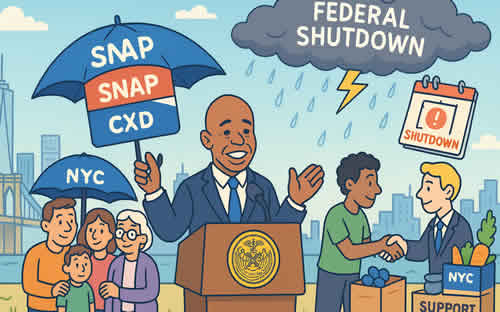
    New York City Mayor Eric Adams announced a business-backed relief plan to cushion SNAP recipients after a prolonged federal shutdown halted benefits for nearly 1.8 million residents. Leveraging partners including the New York Community Trust, United Way of New York City, the Partnership for New York City, City Harvest, Food Bank for NYC, Lemontree, and The Roundtable: Allies for Food Access, the effort builds on a $15 million city allocation and more than $820 million budgeted this fiscal year for food services. While two judges have ordered the federal government to deploy emergency funds for November, City Hall is coordinating stopgap distribution and outreach with nonprofit networks.
    The administration underscores the stakes for households and local commerce, citing USDA data that every $1 in SNAP generates $1.54 in economic activity across communities.

    New York News SNAP

    Mayor Adams Announces Public-Private Initiatives to Support NYC’s SNAP Recipients as Federal Government Shutdown Threatens to Cut Off Benefits for 1.8 Million New Yorkers

    — New York City Mayor Eric Adams today announced that a slate of public-private initiatives will help Supplemental Nutrition Assistance Program (SNAP) recipients continue receiving a portion of their food benefits as the federal government shutdown enters into its second month and has halts SNAP benefits to some of the city’s most vulnerable New Yorkers. Effective today, nearly 1.8 million New Yorkers who rely on SNAP to put food on the table are no longer receiving the federally funded benefits to which they are entitled, and the U.S. Department of Agriculture (USDA) has not issued any contingency funds to sustain this critical lifeline during the protracted shutdown. These initiatives build on the city’s $15 million additional investment announced last month and the more than $820 million budgeted in this fiscal year for food services programs. Last week, two judges ordered the federal government to use emergency funds to cover food stamp benefits for Americans in November. Until the federal government complies, the Adams administration is working with partners across the city to support New Yorkers and ensure they receive the aid they need. 

    “When New Yorkers support one another in times of need, we become a better city. That’s why today, along with the New York Community Trust, the United Way, and the Partnership for New York City, we’re launching a slate of public-private initiatives to support SNAP recipients in our city who rely on these much-needed benefits to put food on their tables,” said Mayor Adams. “As a child, members of my church would drop off food for my siblings and me when times were hard; this type of generosity is what makes our city great. While we sadly can never provide as much support as our federal partners, our social services agencies are ready to help New Yorkers in need, and we’re calling on business leaders, philanthropic partners, faith leaders, and community members to join us in this effort.”

    “Local government and philanthropy cannot come close to replacing federally funded entitlement programs, but we can certainly help support the organizations that are collecting and distributing food during this emergency,” said Kathryn Wylde, president & CEO, Partnership for New York City. “We will encourage member companies and foundations to support the efforts of the mayor and governor to meet this crisis and to invest in the funds that New York Community Trust has designated.”

    “New York Community Trust is proud to stand with our partners and the City to ensure that no New Yorker goes hungry during this crisis,” said Amy Freitag, president and CEO, New York Community Trust. “Local nonprofit organizations on the frontlines of food insecurity are best positioned to swiftly mobilize financial resources to support those in need. This is what community looks like — neighbors helping neighbors.”

    In a demonstration of their commitment to helping city government address the challenges of food insecurity during the federal government shutdown, private donors and companies are contributing to the launch of these initiatives under the auspices of the New York Community Trust, including:

    The New York Community Trust’s Community Needs Fund

    The Community Needs Fund addresses the urgent needs of neighbors throughout New York City, Long Island, and Westchester. When an individual makes a one-time or recurring gift to the fund, every dollar is directed by an expert grantmaking team to trusted nonprofits across the region.    

    City Harvest

    City Harvest rescues food that would otherwise go to waste and delivers it to New Yorkers in need in response to the persistently high need for food assistance in New York City.

    Food Bank for NYC

    The Food Bank for NYC delivers food and resources across all five boroughs in collaboration with 800 community partners. 

    Lemontree

    For those in need of groceries or meals, Lemontree helps locate food pantries in their neighborhood. 

    The Roundtable: Allies for Food Access

    The Roundtable: Allies for Food Access isa network of nine of the largest food pantries and soup kitchens in New York City. It reduces costs through strategic purchasing, advocates for frontline providers, and provides support to smaller pantry partners. 

    United Way of New York City’s Emergency Assistance & Community Needs Fund

    The United Way of New York City’s Emergency Assistance & Community Needs Fund supports critical services that empower community-based organizations with resources while keeping the city afloat.  

    Other donors are encouraged to join this effort to support nonprofits on the front lines of this crisis and help New Yorkers affected by the shutdown. A contribution will not affect any business dealings with the city or provide special access to city officials.

    The pause in SNAP funding is devastating to the city’s overall safety net and also threatens New York’s local economy. The USDA estimates that every dollar of SNAP spending generates $1.54 back into the community, meaning that $1 billion in SNAP dollars spent increases the gross domestic product of the United States by $1.54 billion. 

    https://youtube.com/watch?v=f2oDNJDb9Bc%3Ffeature%3Doembed

    The city is deploying a comprehensive response to ensure at-risk New Yorkers have access to food through a variety of alternative programs and services, managing a comprehensive resource list for impacted SNAP recipients, and conducting outreach efforts in close collaboration with the city’s robust network of community-based organizations and food providers.  

    November 1, 2025

    NEW YORK 

    Sources: nyc.gov , Big New York news BigNY.com

    Midtown Tribune Independent USA news from New York

  • New York. Mayor Adams Calls In for Live Interview With WBLS 107.5 FM’s “Caribbean Fever”

    New York. Mayor Adams Calls In for Live Interview With WBLS 107.5 FM’s “Caribbean Fever”

    In a live interview on WBLS 107.5 FM’s “Caribbean Fever”, Mayor Eric Adams reflected on his tenure as New York City’s mayor and addressed recent rumors about leaving for a job in the Middle East, which he denied, calling such reports damaging to his reelection campaign. He expressed pride in his accomplishments, including crime reduction, housing development, pandemic management, and support for low-income residents, while criticizing the media for underreporting his successes. Adams discussed his reasons for endorsing Andrew Cuomo over newcomer Zohran, citing concerns about inexperience, gentrification, and policies he believes would harm communities of color. He emphasized the global relevance of his work, the challenges of public office, and his commitment to serving the city until the end of his term, while signaling a readiness to pursue international opportunities afterward.

    Dahved Levy: How are you doing, sir? How are you doing? 

    Mayor Adams: Well, very well, you know, just out. It’s marathon Sunday and so there are different events happening all over the city. 

    Levy: I’m very curious, sir. They said that you are going to be accepting a job somewhere in the Middle East. Is that factual? 

    Mayor Adams: No, it’s not. And, you know, there’s been so many rumors and really, Dahved, that’s what really undermined my ability to run the way the media kept putting out false rumors about me going to HUD, me going to the Middle East, me doing all these things. And it’s just really undermined the campaign. Many of my supporters and donors thought I left the race earlier. And it just made no sense.  

    And people don’t realize to run for office, you have to raise millions of dollars. I had the Campaign Finance Board take four million dollars from me. I had the media constantly reporting that I was leaving the race. And it was just– I probably am the first mayor that could not run for reelection because there were just so many forces that went after my attempt to show the success that I did in the city. 

    Levy: Wow. If you had to do it all over again, sir, would you do it? Would you go down the same road that you went down? If you had to do it all over again? 

    Mayor Adams: Hell yes. You know, 35 years ago, I said I wanted to be the mayor of the City of New York and I became the mayor of the most important city on the globe. And when you look at the sacrifices my mother made, you know, you had a woman with a third-grade education, she raised a son that became the mayor of the most important city on the globe.  

    And yes, I would have done it all over. Everything that I went through from COVID to the lawfare coming after me by the federal government, all of that. I would still do it all over again, because no matter what happens, I am the mayor. I accomplished what I wanted to do. And now there’s other things to do in life. 

    Levy: So, what does a mayor do after? What does the mayor do after being— you have until tomorrow to be the mayor, right?  

    Mayor Adams: No, no, until December 31st. I go until the end of the year. 

    Levy: December 31st. So, you go to the end of the year. So, what? I mean, you might have to do something different like– okay, so let me ask you this way. What is the best thing that you’ve learned by being the mayor in New York? I was the worst thing that you’ve learned or had to deal with being the mayor of New York. 

    Mayor Adams: The best thing is dealing with crises. And now I’m getting calls from all over the globe. People saw my success here in the city. And now global, international leaders have reached out to me to do things in their country. People have to deal with issues in their country.  

    The issue of education is impacting the whole globe. The issue of public safety is a global concern. The issue of cybersecurity is a global concern. The issue of building housing, global concern.  

    And so, people saw what I did in this city, building more housing than any other mayor, dealing with cybersecurity, dealing with crises. And now people are asking me to come to their countries and look at how to assist them. That’s what I’m taking away.  

    The worst thing that has happened is how you saw a media in this city that actively refused to report the success that we’ve done in the city. And really, one day I’m going to do a show with you, Dahved, just on the permanent government in the city that they have no desire to see communities that have been left behind moving forward.  

    Why are Black and brown people weeding at the levels that they’re doing so, year after year with all the money that we’re spending. Why are we seeing crime and guns only in our community? Why are we seeing mental health issues only in our community?  

    There’s a permanent government that has no desire of turning around the conditions that are impacting communities of color and working-class people throughout the city. And one day we’re just going to sit down and have a long conversation about that. 

    Levy: Sir, what changed your mind for you to come out and back Mr. Cuomo? 

    Mayor Adams: Zohran, and it’s not only Zohran, people talk about Zohran’s lack of experience, which is a real issue. I mean, you can’t go from being a rapper to an assemblyman, and now you want to be the mayor of the most complicated city. That’s a real problem of his lack of experience.  

    But it’s more than that, Zohran’s supporters are gentrifiers. That’s the foundation. He’s the king of the gentrifiers. And all of us know what gentrification– 

    Levy: I never heard it put like that. The king of the gentrifiers.  

    Mayor Adams: Yes, go look who’s around him. Go look at who’s supporting him. Go look at his election day victory and look who’s in the room. Those are the same folks who have been arrogant, disrespectful to our communities. They gentrified Harlem. They gentrified Bed-Stuy. They gentrified Flatbush. They won’t patronize our restaurants and our other events in our city. They move into the schools and want to be disrespectful in the school system. That is his base.  

    And when you have Black and brown people that really have not been motivated and they’re staying home, they’re making a big mistake. You can’t allow the people who came into your communities and disrespected you now put up who they want to be the mayor. And we’re staying home. We’ve got to get off our asses and get out and vote. If we don’t, we’re going to be extremely sorry for what happens later.  

    The DSA, Democratic Socialists of America, is made up of a bunch of gentrifiers that have really went into our communities and have taken over our community. They’re going to go after every person of color that’s in office. We better realize how serious this election is. And that’s why I said, since I didn’t have the resources to run, I’m going to put my name behind Andrew.  

    We don’t agree on everything. Matter of fact, we disagree on a lot. But I know one thing for sure, we agree that this guy cannot be the mayor of the City of New York. He and his gentrifiers are going to hurt our communities and their policies are harmful to our community. 

    Levy: Sir, before you go, why is this election the most important election in New York’s history? Why? 

    Mayor Adams: Look at the policies that people are leaning on. Here you have a person that wants to decriminalize prostitution. I see what it does to little boys and little girls selling their bodies on corners. Releasing 3,000 people from Rikers Island right back into the community that they preyed on.  

    Lying and saying he’s going to freeze rent. Mayors can’t freeze rent, folks. Let’s be clear on that. Mayors cannot freeze rent. So, for a mayor to say they want to freeze rent, you’re saying anything that people want to hear to get elected. Free buses. Mayors can’t give free buses.  

    So, the things he’s saying, he knows he can’t do, but he doesn’t care. He’s saying anything to be elected and the policies that he can do, such as defunding our Police Department is going to hurt public safety, which communities talk about all the time. Going after small businesses like free grocery or government grocery stores are going to hurt our small businesses.  

    So, his policies are harmful to communities of color. Socialism is not some nice, fancy term. It has failed everywhere. And really, Black, brown communities of color, working class [white people], we can’t go backwards. This election is going to have a major impact on our city if Zohran and his DSA gentrifiers take control of our city. 

    Levy: Last words sir, so what is the final thing you want New Yorkers to know? 

    Mayor Adams: Hey, it’s been a great run, man. I’ve had so much fun being the mayor of the City of New York. I did what I set out to do. A record decrease in crime, 24,000 guns removed off of our streets. I built more housing than any mayor. And actually, I zoned the city for more housing than 12 years of Bloomberg. Eight years of de Blasio combined. I did it in three and a half years.  

    I got us through COVID. I got us through migrants and asylum seekers. Our children are outpacing the state in reading and math. We have free broadband for NYCHA. Low-income New Yorkers are no longer paying income tax because of me. Dropped the cost of child care from $220 a month to less than $20 a month. Paying off the college tuition for foster care children, excusing billions of dollars in medical debt for low-income New Yorkers.  

    I mean, what I set out to do, I did. Working class people have benefited under me. And it’s going to take some time, reflection and review that people are going to realize that we were one of the greatest administrations the city has ever heard.  

    Now, hey, people are going to say, “Well, you know what, Eric? You’re too pompous. You’re too arrogant. Eric, you’re too this, you’re too that. You go out at night in nightclubs.” Yeah, because I want our nightlife business to stay open. 

    So, there’s going to be critiques. But at the end of the day, I was a darn good mayor and have no regrets. I’m looking forward for my life after and I could enjoy that life. And I hope the next mayor continues the success that I put in place. 

    Levy: Thank you very much. I do appreciate it. Thank you.  

    Mayor Adams: Thank you. Rocking you. Rocking you.  

    Levy: Rocking you. Rocking you. 

    November 2, 2025 New York

    Sources: NYC.gov

    Midtown Tribune Independent USA news from New York

  • Mayor Adams Says NYC Opioid Overdose Deaths Fell 28% in 2024, First Decline in a Decade

    Mayor Adams Says NYC Opioid Overdose Deaths Fell 28% in 2024, First Decline in a Decade

    New York City recorded 2,192 overdose deaths in 2024, down 28% from 3,056 in 2023—the first substantial drop after nearly 10 years of increases, Mayor Eric Adams and DOHMH Acting Commissioner Dr. Michelle Morse said Tuesday. Declines were seen across all five boroughs, with Staten Island down about 49%. Black and Latino New Yorkers saw 29% reductions yet still died at roughly twice the rate of white residents, and the Bronx remains the hardest-hit borough. City, state, and federal investments—backed by nearly $190 million in opioid-settlement funds to date and projected to reach $550 million by 2041—have expanded prevention, treatment, and harm-reduction services, including Overdose Prevention Centers and wider access to methadone and buprenorphine. The city budgeted $41 million in FY2025 for overdose response. New Yorkers can call or text 988 for 24/7 support.

    Mayor Adams Announces Opioid Overdose Deaths in City Drop Significantly for First Time in Past Decade


    – New York City Mayor Eric Adams and New York City Department of Health and Mental Hygiene (DOHMH) Acting Commissioner Dr. Michelle Morse today announced new data released by DOHMH that shows a significant decrease in overdose deaths in New York City in 2024 — marking the first substantial decrease following a nearly 10-year period of increasing overdose deaths in the five boroughs. There were 2,192 deaths last year, down from 3,056 in 2023, mirroring national trends, and overdose deaths decreased almost universally across demographic groups and neighborhoods in 2024. Additionally, residents of all five boroughs saw decreases in overdose deaths and, for the first time since 2018, overdose deaths decreased among Black and Latino New Yorkers; however, significant racial and geographic inequities persist.

    “The data we are releasing today represents a major shift in a decades-long overdose crises that has claimed the lives of so many New Yorkers and Americans across the nation. Progress on reducing opioid overdoses will never make up for the families that have been devastated and the communities torn apart by these drugs, but it gives us hope that brighter days are ahead,” said Mayor Adams. “I am proud of the work our administration has done to stay focused on this issue by pursuing litigation and using funds from opioid settlements proactively, strategically, and forcefully to support those who are struggling. We will continue to make the right investments in programs and treatments that help keep New Yorkers safe and healthy.”

    “While we are finally seeing the needle move on fatal overdoses across the city, too many New Yorkers still continue to die from preventable deaths,” said DOHMH Acting Commissioner Dr. Morse. “As city leaders, we must be steadfast in our support of programs that save lives, while we continue to address historic disinvestment and other forms of structural racism. I am grateful for the tireless dedication of advocates, local providers, Health Department staff, and partners inside and outside government as we work to keep our communities and neighbors safe and connected to care.”

    Earlier this summer, Mayor Adams announced that New York City saw the lowest quarter in five years for opioid overdose deaths while making further investments to drive down opioid overdoses. In 2023, New York City saw a slight decline for the first time since 2018 in overdose deaths.

    Despite seeing promising decreases, inequities in overdose deaths still persist in New York City. Black and Latino New Yorkers each saw a 29 percent reduction in overdose deaths but died at twice the rate of their white counterparts. While the rate of fatal overdose decreased 24 percent among Bronx residents, the borough continues to have the highest rate of overdose deaths — at more than double the rate of Manhattan, the borough with the second-highest rate. The rate of overdose deaths among Staten Island residents decreased by about 49 percent. Residents of Hunts Point-Mott Haven, Highbridge-Morrisania, Crotona-Tremont, East Harlem, and Fordham-Bronx Park continued to bear the greatest burden of overdose deaths in 2024.

    Securing Opioid Settlement Funds

    Today’s announcement builds on the work the city has done to bring justice to the victims and families of the opioid epidemic, including just last month, when the city announced steps toward recovering approximately $48 million from a new proposed settlement with Purdue Pharma and the Sackler family. In January 2018, the City of New York sued manufacturers and distributors of prescription opioids to remedy the harms caused within the city by the misleading marketing and improper distribution of these drugs. New York Attorney General Letitia James filed a similar lawsuit in March 2019. Settlements reached by both the city and the state, as well as a court victory by Attorney General James, have provided the City of New York alone with nearly $190 million as of the end of Fiscal Year (FY) 2025, which, with the most recent settlement, is expected to grow to a total of more than $550 million by 2041. In April 2022, Mayor Adams and Attorney General James announced allocations for the first of hundreds of millions of dollars coming to New York City to combat the opioid crisis. In September 2024, Mayor Adams announced city funding will ramp up to an annual $50 million for opioid prevention and treatment.

    Investing in Treatment and Supports

    To address the continued need for comprehensive services, the city continues to invest in evidence-based practices and partner with local providers to reach the communities most in need. In FY 2025 alone, the city allocated $41 million across DOHMH, NYC Health + Hospitals, and the Office of the New York City Chief Medical Examiner to support the expansion of services around the city and enhance the existing network of care.

    Ongoing funds from opioid settlements through DOHMH have supported wraparound services for syringe service programs, including on-site medical care, connections to health care and social services, and support for basic needs. In FY 2025, syringe service programs that operate Overdose Prevention Centers provided approximately 39,000 harm reduction services to more than 8,000 participants, reducing the risk of overdose and infectious disease and providing referrals to treatment and other health and social services. In 2023, the Adams administration also allocated $3 million to eight providers on Staten Island through a request for proposal to directly support the expansion of buprenorphine treatment, outreach and engagement, and care navigation services in the borough. This past July, the city announced $4 million in annual funding for nine outpatient and opioid treatment programs citywide to increase access to methadone and buprenorphine. Contracting for the expansion of the number of hospitals participating in DOHMH’s emergency department-based nonfatal opioid overdose response program called Relay remains ongoing.

    Since beginning to receive funding through opioid settlements, NYC Health + Hospitals has had over 9,700 patient engagements with expanded substance use services at Street Health Outreach and Wellness vans, nearly 83,000 encounters with patients in emergency departments with addiction services provided by the Emergency Department Leads program, and has successfully launched a cutting-edge addiction simulation training for emergency department prescribers. Additionally, NYC Health + Hospitals has provided comprehensive addiction consultations at over 24,700 inpatient admissions through the Consult for Addiction Treatment and Care in Hospitals program. 

    Further, the Office of the Chief Medical Examiner’s Drug Intelligence and Intervention Group program has offered support services to more than 4,000 individuals following the death of a loved one from an overdose. 

    All actions taken by Mayor Adams and the Adams administration to prevent overdose deaths also underscore the administration’s efforts to improve and extend the average lifespan of all New Yorkers through “HealthyNYC” to 83 years by 2030. HealthyNYC sets ambitious targets to address the greatest drivers of premature death, including chronic and diet-related diseases, screenable cancers, overdose, suicide, maternal mortality, violence, and COVID-19.

    New Yorkers looking to access substance use services can call or text 988 for free, confidential support 24/7. Resources can also be found on the “NYC HealthMap” and on DOHMH’s website.

    October 28, 2025 NEW YORK 

    Sources: NYC.gov , Midtown Tribune news

    Midtown Tribune Independent USA news from New York

  • NYC Plans $10 Million On-Site Child-Care Pilot for DCAS Workers, Opening 2026 (Video)

    NYC Plans $10 Million On-Site Child-Care Pilot for DCAS Workers, Opening 2026 (Video)

    New York City Mayor Eric Adams on Oct. 23, 2025, announced a $10 million municipal child-care pilot to offer on-site, affordable care for children as young as six weeks old to Department of Citywide Administrative Services employees. The 4,000-square-foot center—on the ground floor of the David N. Dinkins Municipal Building in Lower Manhattan—aims to open by September 2026 with capacity for up to 40 children, using underutilized city-owned space to help recruitment and retention. DCAS will manage design and construction and contract an outside provider; eligibility and guidelines are being developed with the Office of Labor Relations and municipal unions. The initiative builds on the administration’s broader early-childhood agenda, including 3-K expansion, special-education Pre-K, and child-care subsidies that have lowered out-of-pocket costs for many families.

    Mayor Adams Continues to Make NYC the Best Place to Raise a Family With Launch of Child Care Pilot for Children of DCAS Employees as Young as Six Weeks Old


    What you should know

    • $10 Million Investment Will Fund First-Ever Municipal Child Care Pilot Program for DCAS Employees
    • Municipal Child Care Pilot Leverages Underutilized City-Owned Space to Operate On-Site, Affordable Child Care  
    • Builds on Adams Administration’s Historic, Permanent Funding to 3-K Citywide Expansion and Special Education Pre-K

    NEW YORK – New York City Mayor Eric Adams and New York City Department of Citywide Administrative Services (DCAS) Commissioner Louis A. Molina today announced $10 million to launch the city’s first-ever Municipal Child Care Pilot Program, which will provide on-site and affordable child care to DCAS employees with children as young as six weeks old beginning in September 2026. Today’s investment builds on the Adams administration’s efforts to improve municipal employee retention, ensure the City of New York remains a competitive employer of choice, increase flexibility for working families, and make the city more affordable for public servants.

    “Making New York City the best place to raise a family means that families shouldn’t have to live in fear that paying for child care will break their bank. Families deserve better, and, once again, our administration is delivering for them,” said Mayor Adams. “Today, we’re making our city more family friendly by launching New York City’s first-ever Municipal Child Care Pilot Program, which will provide on-site, affordable child care for free to some of the public servants who are serving their fellow New Yorkers. By turning underutilized, city-owned space into a child care centers, we’re giving back to the workers who give so much to our city. This bold investment delivers both peace of mind and will put money back into the pockets of working-class New Yorkers.”

    “City employees should not have to choose between their commitment to public service and their commitment to parenthood,” said Deputy Mayor for Administration and Chief of Staff Camille Joseph Varlack. “At a time when city government is facing increased competition from the private sector, efforts like this pilot are crucial to increasing the offerings of family benefits and access to flexible work arrangements.”

    “At DCAS, we recognize that affordable child care is not only a family issue; it’s also a workforce issue, a quality-of-life issue, and an earning potential and professional development issue — and these are all issues we cannot afford to ignore,” said DCAS Commissioner Molina. “With this solution-oriented pilot, we’re leveraging underutilized space to invest in our workforce. More than that, we’re ensuring that the City of New York remains an attractive employer for those willing to dedicate their lives to public service.”

    The site for the child care pilot will be located on the ground floor of the David N. Dinkins Municipal Building, North Tower in Lower Manhattan ― DCAS’s headquarters and a central hub of city government operations. The estimated $10 million renovation will cover approximately 4,000 square feet and is being designed to accommodate up to 40 children.

    Design and construction will be managed in-house by DCAS, with project completion anticipated by spring 2026. The high-quality, affordable program will be operated by a contracted child care provider to cater to DCAS employees with pre-school aged children as young as six weeks who are currently working at the David N. Dinkins Municipal Building. Accordingly, DCAS will be issuing a Demonstration Project solicitation for proposals from qualified vendors. Eligibility criteria for the pilot, including the participating age range, is being developed in conjunction with the Office of Labor Relations and city unions. The Municipal Child Care Pilot Program will be closely evaluated to determine if expanding the program to additional locations is feasible.

    “We know how vital child care is for our employees,” said New York City Office of Labor Relations Commissioner Renee Campion. “This pilot will provide needed support to those who participate and help inform additional efforts to support our workforce. We look forward to working with DCAS and our municipal unions to pilot worksite day care for our employees.”

    “Affordable, high-quality child care is essential for working families, including our city’s own workforce,” said New York City Councilmember Gale A. Brewer. “This pilot will help retain and recruit talented municipal employees and strengthen the city’s commitment to equity and family well-being. I look forward to seeing the program grow.”

    “We hear from our members time and again that paying for quality child care is one of the top barriers to living and working in New York City, which is why we established a Child Care Trust in the last collective bargaining agreement,” said Henry Garrido, executive director, District Council 37 AFSCME, AFL-CIO. “This pilot program is a great additional solution for making child care more affordable and accessible for city workers, as well as for workforce recruitment and retention.”

    Over the last three years, the Adams administration has been focused on making New York City more affordable for families through popular and essential programs like early childhood education. Recently, Mayor Adams announced a new pilot program, “Creating Real Impact at Birth” (CRIB), to connect and prioritize pregnant New Yorkers applying for shelter with housing vouchers to put them on a path toward permanent housing and stability, so that no child is born into the shelter system, as well as a $7 million expansion of the “Fatherhood Initiative,” which helps fathers reconnect with their children, provide financial support, and develop parenting skills. Additionally, the Adams administration launched a child care initiative for 0-2 year olds that puts New York City on the path to universal child care for low-income families if the initiative is successful, and enrolled a record 150,000 children across the early childhood education system. These initiatives all build on Mayor Adams reducing out-of-pocket costs of child care from $55 per week in 2022 to $5 per week with subsidies today for a family of four, and the administration met its commitment to offer a seat to every child who applied for 3-K on time last school year — the first time this has ever been done in the city’s history.

    Additionally, over the Fiscal Year 2025 budget cycle, Mayor Adams protected more than $600 million in key, long-term education programs that had been previously funded with expiring stimulus dollars by making investments in Summer Rising, as well as a citywide 3-K expansion, special education pre-K, community schools, social workers, and arts education. Finally, the Adams administration invested $20 million to ensure that every student on a 3-K waitlist was offered a seat, as well as $55 million to provide more than 700 new seats for three- and four-year-olds with special needs.

    October 23, 2025

    Sources: NYC.gov , Big New York news BigNY.com
    Midtown Tribune news

    Midtown Tribune Independent USA news from New York

  • NYC, Chicago, and Seven Other Local Governments Sue DHS/FEMA to Protect $100M+ in Emergency & Disaster Grants

    NYC, Chicago, and Seven Other Local Governments Sue DHS/FEMA to Protect $100M+ in Emergency & Disaster Grants

    New York City has joined a nine-jurisdiction coalition led by Chicago to sue the U.S. Department of Homeland Security and FEMA, aiming to block new FY2025 “Standard Terms and Conditions” the cities call unlawful and dangerous to public safety. The lawsuit, filed in the U.S. District Court for the Northern District of Illinois, argues that federal officials exceeded their authority by conditioning counterterrorism and disaster-preparedness funds—over $100 million nationally—on certifications that recipients do not run “Diversity, Equity, Inclusion, and Accessibility (DEIA)” programs and that they comply with all of former President Donald Trump’s executive orders. NYC warns the cuts could hinder the NYPD’s radiological/nuclear detection efforts and transit system security, including active-shooter training and daily specialized deployments. The suit contends only Congress can change grant conditions and challenges a clause that could claw back triple the grant amounts, risking critical services. Joining NYC and Chicago are Denver, New Haven, Baltimore, Boston, Minneapolis, Saint Paul, and Ramsey County, MN.

    City of New York Files Lawsuit to Protect Over 100 Million in Federal Emergency and Disaster Grants

    City of New York Files Lawsuit to Protect Over $100 Million in Federal Emergency and Disaster Grants
    to Local Governments Nationwide

     The City of New York — as part of a national coalition of nine local governments from across the country — has filed a lawsuit against the U.S. Department of Homeland Security (DHS) and the Federal Emergency Management Agency (FEMA), challenging the federal government’s effort to force cities and counties to agree to unlawful conditions to continue to receive over $100 million in federal funding for countering terrorism, disaster preparedness, and other public safety programs. In the lawsuit, the coalition argues that without this funding, the New York City Police Department’s (NYPD) ability to detect and defend against a radiological or nuclear attack could be compromised. Additionally, funding that supports the New York City transit system’s operational security capability and capacity, including active shooter training and deploying specialized teams within the transit system every day, could be affected.

    “Public safety has always been our administration’s North Star, which is why we have always fought for every penny from our state and federal counterparts to keep us safe,” said New York City Mayor Eric Adams. “We’ve hit historic lows in crime because we’ve always been willing to make the necessary investments, so now is not the time to go backwards. We are proud to join partners from across the nation, once again, in filing this lawsuit to keep New Yorkers, and Americans from across the nation, safe.”

    “Losing funding that helps the NYPD prevent terror attacks on our subways, bridges, and tunnels would be contrary to law, the intent of Congress, and put millions of New Yorkers at risk,” said New York City Corporation Counsel Muriel Goode-Trufant.

    In each of the last three fiscal years, New York City has been awarded approximately $150 million in grant funding for critical emergency management programs at the NYPD, the New York City Department of Transportation, and other city agencies. However, in Fiscal Year 2025, as part of the “Standard Terms and Conditions,” DHS adopted unlawful new conditions requiring recipients to certify that they do not “operate any programs that advance or promote ‘Diversity, Equity, Inclusion, and Accessibility’,” and requiring compliance with all of President Donald Trump’s executive orders to be eligible to receive the funds. The DHS grants help local governments prepare for, respond to, and recover from disasters such as acts of terrorism, mass shootings, cyber incidents, and other complex emergencies, putting critical services for numerous communities, including New York, at risk.

    The lawsuit — led by the City of Chicago in Illinois and filed in the U.S. District Court for the Northern District of Illinois Eastern Division — states that new funding conditions added by the heads of federal agencies are unconstitutional and an overreach by the executive branch, which does not have the authority to change conditions related to federal grants without the approval of Congress.

    The lawsuit resists efforts by the federal administration to coerce local governments into accepting these unlawful grant conditions, including a condition that puts at risk three times the amount of the grants based on vague and undefined requirements — further endangering critical services for New Yorkers.

    Joining New York City and Chicago in filing the lawsuit are the cities of Denver, Colorado; New Haven, Connecticut; Baltimore, Maryland; Boston, Massachusetts; Minneapolis, Minnesota, and Saint Paul Minnesota; as well as the county of Ramsey, Minnesota.

    Office of the Mayor

    October 21, 2025 NEW YORK

    Sources:  NYC.gov , Big New York news BigNY,com
    Midtown Tribune news

    Midtown Tribune Independent USA news from New York

  • New York. Adams, Aviles-Ramos, Kaufman Kick Off 2026 ‘Battle of the Boroughs’ Esports; Students to Redesign Sunset Park’s Pier 6

    New York. Adams, Aviles-Ramos, Kaufman Kick Off 2026 ‘Battle of the Boroughs’ Esports; Students to Redesign Sunset Park’s Pier 6

    Battle of the Boroughs NYC news 2025

    Oct. 21, 2025—Mayor Eric Adams, Schools Chancellor Melissa Aviles-Ramos and MOME Commissioner Pat Swinney Kaufman launched the sixth annual “Battle of the Boroughs,” a Minecraft Education esports contest inviting K–12 students to reimagine Pier 6 at the MADE Bush Terminal Campus in Sunset Park, Brooklyn. The city will baseline $60,000 to support technology needs for participants and educators; team submissions are open now through Jan. 16, 2026, via the New York City Public Schools website. Top entries will advance to in-person borough qualifiers and a Mayor’s Cup Final at the 2026 New York City Video Game Festival. The program aligns with City Hall’s digital-games push as the local industry grows to roughly 380 studios, 7,900 jobs and an estimated $2.6 billion in economic impact.

    Mayor Adams, Chancellor Aviles-Ramos, Commissioner Kaufman Kick Off 2026 “Battle of the Boroughs” E-Sports Competition

     – New York City Mayor Eric Adams, New York City Schools Chancellor Melissa Aviles-Ramos, and Mayor’s Office of Media and Entertainment (MOME) Commissioner Pat Swinney Kaufman today launched the first round of the sixth annual New York City Minecraft Education Battle of the Boroughs Esports Competition (BOTB). Through BOTB, K-12 students compete to build a more inclusive, sustainable, future-ready New York City in Minecraft while developing critical thinking and problem-solving skills. Additionally, for the first time, the Adams administration will baseline $60,000 for the annual competition to support critical technology needs for participants and educators. Submissions for student teams are open now and close on January 16, 2026. Information on how to join the challenge, as well as entry-level training courses for educators to bring digital gaming into their classrooms, is available on the New York City Public Schools website.

    “We’re not just making sure our students are prepared to join the digital gaming industry but training them to lead it — that is what this competition is all about,” said Mayor Adams. “By encouraging students to learn computer science, build critical thinking skills, and explore sustainable design, we are both engaging our young people today and laying the foundation for good-paying careers after they graduate. Congratulations to last year’s winners and good luck to this year’s teams!”

    “The annual Battle of the Boroughs competition showcases the incredible potential of our students when they’re given the tools and the platform to thrive,” said Public Schools Chancellor Aviles-Ramos. “The new funding set aside by New York City Public Schools to support this initiative will help us to celebrate and lift the creativity and innovation of our young people even further. I’m proud of every student who participates, and I’m grateful to the educators and partners who continue to support them every step of the way.”

    “The annual Minecraft Education Battle of the Boroughs competition is back, with the earliest entry date yet, so that even more students across the five boroughs get an opportunity to enter and take a meaningful step towards an education and career in the city’s burgeoning digital games industry,” said MOME Commissioner Kaufman. “The Adams administration and our office are committed to supporting digital game development through the Battle of the Boroughs competition leading to the Mayor’s Cup Final and the second annual New York City Video Game Festival in the spring of 2026.”

    “The Battle of the Boroughs empowers the next generation of New Yorkers to use digital gaming technology to reimagine city spaces, inspiring NYCEDC and our continuous revitalization work,” said New York City Economic Development Corporation (NYCEDC) President & CEO Andrew Kimball. “The competition is an outstanding opportunity to engage students across the five boroughs in city planning, digital innovation, and sustainability, and NYCEDC looks forward each year to seeing the visionary concepts from our city’s young minds.”

    BOTB — which was developed in partnership with Minecraft Education and builds on Mayor Adams’ Digital Gaming Initiative, the United Nations’ Sustainable Development Goals, and PlaNYC: Getting Sustainability Done (GSD) — is a scholastic digital gaming competition in which elementary, middle, and high school students compete to design future-ready city spaces. Through the competition, students explore the five boroughs, learn more about New York City’s sustainability plans, and develop valuable computer science and critical thinking skills.

    Mayor Adams today also announced the prompt for the first round of this year’s competition: to reimagine Pier 6 at the MADE Bush Terminal Campus in Sunset Park, Brooklyn. In August 2025, the Adams administration broke ground on a transformation of the actual Pier 6, which will create an engaging new open space for community residents and tenants of the MADE Bush Terminal Campus. The campus offers modern facilities and gathering space to promote manufacturing and business activity along the Sunset Park waterfront. In the first round of the competition, students are encouraged to create alternative designs for the project. Top submissions will compete at an in-person qualifying round in each borough. The BOTB Mayor’s Cup Final will take place during the 2nd Annual New York City Video Game Festival in the spring of 2026, presented by MOME.

    As part of today’s announcement, Mayor Adams also celebrated last year’s winning student teams:

    Since coming into office, the Adams administration has made historic investments to establish New York City as a leading hub for digital games, including investing over $2 million in CUNY’s first-ever Game Design Bachelor’s Degree; launching the NYC Summer of Games initiative to shine a light on all digital events in the city throughout the summer; creating the first-ever Game Development Industry Council to advise the city’s policies and programs in the games development sector; and supporting game and workforce development though the “Made in NY” Developer Grant, the “Made in NY” Animation Training Program, and the NYU Game Design Future Lab. Collectively, this work is helping to spur the digital games industry and create good-paying jobs for New Yorkers.

    The city’s digital gaming industry has continued to grow under the Adams administration. Since 2019, the number of game development studios in New York City has increased by 90 percent, to 380 studios today; the number of industry jobs has increased by four percent, to 7,900 jobs; and the economic impact of the industry has increased by 30 percent, to $2.6 billion.

    “Battle of the Boroughs has proven that, when you give students a platform like Minecraft to show their creativity and critical thinking skills, they come together in amazing ways to solve complex challenges,” said Allison Matthews, head, Minecraft Education at Mojang Studios. “In this new AI era, these skills have never been more important. We are thrilled to be part of this year’s kickoff with Microsoft and can’t wait to see what’s crafted during the competition.”

    Office of the Mayor

    October 21, 2025 NEW YORK

    Sources:  NYC.gov , Big New York news BigNY.com
    Midtown Tribune News

    Midtown Tribune Independent USA news from New York

  • Manhattan. City of New York Files Lawsuit Against U.S. Department of Education Seeking to Protect $47 Million in Federal Education Grants for New York City Public Schools

    Manhattan. City of New York Files Lawsuit Against U.S. Department of Education Seeking to Protect $47 Million in Federal Education Grants for New York City Public Schools


    What you should know

    • State and Local Law Mandates Public Schools Give Access to Bathrooms
      for Public School Students Based on Their Gender Identity 
    • Federal Government is Unlawfully Reneging on Its Obligation to Disperse Funds 
    • New York City Will Continue to Follow All Federal, State, and City Laws
    City of New York Files Lawsuit Against U.S. Department of Education .

    The City of New York today announced a new lawsuit filed against the U.S. Department of Education (U.S. DOE), U.S. DOE Secretary Linda McMahon, and two other members of the U.S. DOE to protect grant funding that New York City Public Schools is owed by the federal agency after it, last month, sought to block the nation’s largest school system from obtaining $47 million in funds already awarded to the local system. Under a federal program called the Magnet Schools Assistance Program, the city has received five 5-year grants to support 19 New York City magnet schools. In September, U.S. DOE directed New York City Public Schools to violate both state and local law by overhauling its position on bathroom and locker room policies for transgender students in response to an apparent reinterpretation of Title IX under the Trump administration. In the lawsuit, the city argues that U.S. DOE’s decision to discontinue the funding is not only unlawful because they failed to follow the mandatory process required before taking action based on an alleged Title IX violation, but that they are wrong on what Title IX requires, as New York City policy continues to follow local, state, and federal laws, despite U.S. DOE’s attempts to say otherwise.

    “The effort by the U.S. Department of Education to strip our school system of this grant funding violates statutorily-required process and conflicts with longstanding legal precedent regarding the interpretation of Title IX,” said New York City Corporation Counsel Muriel Goode-Trufant. “By trying to unlawfully coerce New York City Public Schools into changing its policies and violating local laws, the federal government is showing that it does not have the best interest of students and New Yorkers at heart.”

    “With this lawsuit, New York City Public Schools is fighting back against the U.S. Department of Education’s attack on our magnet program and transgender and gender expansive students,” said New York City Public Schools Chancellor Melissa Aviles-Ramos. “U.S. DOE’s threat to cut off tens of millions of dollars in magnet funding unless we cancelled our protections for transgender and gender expansive students is contrary to federal, state, and local law, and, just as importantly, our values as New York City Public Schools. My deepest commitment is to provide our magnet students, our transgender and gender expansive students, and every single student at New York City Public Schools with the ability to thrive academically and socially; to achieve that, my team and I work tirelessly to ensure every student feels seen, supported, and safe. We use every possible tool to do that, as today’s legal action demonstrates.”

    The discontinued Magnet School Assistance Program grants were funding 19 different magnet schools in Manhattan, Queens, Brooklyn, and the Bronx, which have historically served isolated, and overwhelmingly low-income Hispanic and Black students, providing curricula in topics such as cutting-edge science, technology, engineering, architecture, and math; multimedia and the arts; performing arts; engineering; journalism; civic activism; and leadership.

    In the complaint — filed in the U.S. District Court for the Southern District of New York — the city argues that the U.S. DOE’s purported discontinuation of the grants is being carried out unlawfully, without observing procedures required by Title IX and the federal regulations governing the operation of the grants. These laws and regulations collectively require the U.S. DOE to provide notice, an opportunity for a hearing, express findings on the record, and an opportunity to request reconsideration, among other procedural safeguards — none of which were afforded here. Instead, as outlined in the complaint, the U.S. DOE demanded policy changes within three days to comport with “a novel interpretation of Title IX that is not supported by any law, is contrary to the determinations of multiple federal circuit courts, and is contrary to the New York state Constitution and statute.” The city seeks to restore the schools to the status that they held a month ago by requesting that the grant discontinuation be vacated and set aside as arbitrary and capricious, contrary to law, an abuse of discretion, and as having been undertaken without observance of procedures required by law.

    Today’s lawsuit follows a series of letters between the U.S. DOE and New York City Public Schools.

    • In the first letter, on September 16, 2025, U.S. DOE listed six steps the federal government expected New York City Public Schools to take in order to comply with its new and inaccurate interpretation of Title IX and therefore be eligible to maintain its Magnet School Assistance Program grant funding. The letter gave New York City Public Schools three business days to comply with the requests or lose funding.
    • New York City Public Schools responded on September 19, 2025, requesting additional time to consider how to respond to the demand.
    • In an email dated September 20, 2025, the U.S. DOE rejected that request and reiterated its demand that New York City Public Schools revoke its guidelines to support transgender and gender expansive students. DOE extended the deadline to comply with the requested demands to Tuesday, September 23, 2025, at 5:00 PM, without any willingness to recognize the directives contradict both local regulations and state law. New York City Public Schools has continued to stand by the legality of its guidelines.
    • Then, as outlined in the complaint, on September 26, 2025, U.S. DOE “compounded their chaotic and unlawful actions by resetting the end of the grants’ performance periods to the next day. The U.S. DOE took all of these actions without warning, well after school budgets had been set, and two weeks after the 2025-2026 school year had already begun.”

    New York City is fully compliant with Title IX, which prevents discrimination on the basis of sex. Additionally, New York State Education Law § 12New York Executive Law § 296, and New York City Human Rights Law § 8-107 all prohibit discrimination on the basis of gender, which is defined to include gender identity or gender expression. Both the Office of the New York Attorney General and the New York State Board of Regents have made clear that state laws require that “transgender and gender expansive students have the right to use facilities, including restrooms and locker rooms, or participate on school athletic teams consistent with their gender identity.”

    Today’s lawsuit is accompanied by a motion seeking an immediate preliminary injunction against the federal government to prevent it from cutting off this crucial funding to New York City Public Schools pending the resolution of the lawsuit.

    October 16, 2025

    Sources: NYC.gov , Big New York news BigNY.com
    Midtown Tribune News

    Midtown Tribune Independent USA news from New York

  • Mayor Eric Adams  signed Executive Order 57 creating the New York City Office of Digital Assets and Blockchain

    Mayor Eric Adams signed Executive Order 57 creating the New York City Office of Digital Assets and Blockchain

    Mayor Eric Adams on Oct. 14 signed Executive Order 57 creating the New York City Office of Digital Assets and Blockchain, the first municipal office of its kind in the U.S., and appointed policy veteran Moises Rendon as executive director. The office will promote responsible use of crypto and blockchain, coordinate with the city’s Office of Technology and Innovation and other agencies, and engage state and federal partners. Early priorities include assembling an industry advisory commission, attracting talent and investment, expanding access for unbanked residents, and bolstering public education on risks such as scams—all aimed at reinforcing New York’s position as a global finance-and-tech hub.

    NYC Mayor Eric Adams signed Executive Order 57 to launch the New York City Office of Digital Assets and Blockchain

    Mayor Adams Takes Action to Position New York City as Global Capital of Digital Assets

    – New York City Mayor Eric Adams today signed Executive Order 57 and established the New York City Office of Digital Assets and Blockchain. The first-ever mayoral office of its kind in the nation positions New York as the global capital of digital assets, including cryptocurrency and blockchain technologies. The office will promote the responsible use of digital assets and blockchain technologies, grow economic opportunities for New Yorkers, attract world-class talent, and reinforce the city’s standing as the world’s hub for financial and technological innovation. Mayor Adams also today appointed Moises Rendon to lead the office as executive director. As its first action, Executive Director Rendon will form a commission of leaders in the digital assets space to advise on the office’s work.

    “From day one, our administration has kept New York City ahead of the curve because when we embrace technology, we deliver a safer, more affordable city,” said Mayor Adams. “In 2022, I became the first American mayor to convert my first three paychecks into crypto and this past May, our administration hosted the first-ever crypto summit at Gracie Mansion. Today, with the nation’s first mayoral agency focused solely on digital assets and blockchain technology, we continue to signal the opportunities this new form of technology can bring to New York City. Our city has always been the center of innovation, and we’re embracing the technologies of tomorrow today. The age of digital assets is here, and with it comes the chance to grow our economy, attract world-class talent, expand opportunities for underbanked communities, and make government more user-friendly. I’m looking forward to working closer with Moises Rendon as we help make New York City the tech capital of the world.”

    “New York City has remained the global center of innovation for decades due to our willingness to embrace new, emerging technologies,” said First Deputy Mayor Randy Mastro. “With the launch of the New York City Office of Digital Assets and Blockchain, New York City is reaffirming its role as a leader in the financial and technology sectors to ensure that working-class New Yorkers are first in line for game-changing economic opportunities of the future and efficient delivery of government services. And Moises Rendon is uniquely qualified to guide New York City through this new frontier of technology, which will, once again, result in New York City growing its economy, delivering real economic benefits to underserved communities, and attracting the world-class talent that makes us the envy of the world.”

    “New York City’s future as a global finance center and municipal governance leader depends on our ability to capitalize on the enormous opportunities presented by emerging technologies such as digital assets and blockchain,” said New York City Chief Technology Officer Matt Fraser. “Today’s announcement affirms our place at the forefront of this technological revolution and showcases the mayor’s bold, forward-looking vision to make New York City the crypto capital of the globe. This office ensures that we’re partnering with the brightest minds across the fintech sphere and empowering city agencies to harness the transformative potential of digital assets and blockchain for the benefit of 8.5 million New Yorkers.”

    “Mayor Adams’ creation of this new office proves that the future is now for digital assets and blockchain in New York City,” said Mayor’s Office of Digital Assets and Blockchain Executive Director Moises Rendon. “I am honored to lead the nation’s first municipal office dedicated to successfully and responsibly deploying these technologies. I look forward to collaborating with CTO Fraser, city agency partners, and private-industry leaders to develop policies and programs that make our government more accessible, transparent, and innovative for New Yorkers in the years ahead.”

    The Office of Digital Assets and Blockchain will promote long-term economic growth, ensuring that digital assets strengthen the city’s economy, including by:

    Fostering innovation and development while guiding the responsible development of cryptocurrency and blockchain ecosystems in New York City.

    Coordinating efforts between the digital asset industry and government, serving as a bridge to encourage responsible innovation and alignment across stakeholders.

    Working in close collaboration with the New York City Office of Technology and Innovation (OTI) while also coordinating citywide efforts across agencies, ensuring alignment of policies, services, and digital asset initiatives.

    Engaging with state and federal partners to promote policies that make New York City more welcoming to blockchain and crypto initiatives that add value and comply with laws and regulations.

    Promoting inclusion and access, particularly for unbanked and underbanked communities, by supporting safer ways to save money, access resources, and build resilience against inflation.

    Educating and protecting the public through initiatives that help New Yorkers understand the risks of digital assets, including campaigns to raise awareness of scams, fraud, and consumer protections.

    Attracting world-class talent and investment, ensuring New York remains globally competitive in financial innovation and technological development.

    Supporting nonpartisan, policy-driven legislation, ensuring the office remains focused on sound policy and the delivery of tangible benefits to New Yorkers across all communities.

    Through these efforts, the Office of Digital Assets and Blockchain will help secure New York City’s leadership in the digital economy, expand opportunities for its residents, and build a foundation of responsible innovation, trust, inclusion, and growth. The office will allow New York City to demonstrate its leadership in embracing innovation while safeguarding the interests of its residents.

    About Moises Rendon

    Moises Rendon is a digital assets and blockchain policy expert with extensive experience advising federal, local, and international stakeholders. He currently serves as policy advisor for digital assets and blockchain at OTI, where he leads citywide research and strategic initiatives to explore blockchain’s potential for improving government operations.

    Previously, Rendon served as a director for the Washington, D.C. office of the Americas Society/Council of the Americas and was a policy consultant for the U.S. Department of State, United States Agency for International Development, and private-sector clients on fintech and economic trends. Rendon holds a Master of Laws degree in International Business and Economic Law from Georgetown University Law Center and a Bachelor of Laws degree from Andrés Bello Catholic University in Venezuela.

    Executive Director Rendon will report directly to Chief Technology Officer Matt Fraser.

    October 14, 2025

    NEW YORK

    Sources: NYC.gov , Big New York news BigNY.com
    Midtown Tribune News

    Midtown Tribune Independent USA news from New York

  • New York. Mayor Adams Unveils CRIB Housing Pilot, ‘Baby Boxes’ to Keep New Families Out of Shelters (Video)

    New York. Mayor Adams Unveils CRIB Housing Pilot, ‘Baby Boxes’ to Keep New Families Out of Shelters (Video)

    New York City Mayor Eric Adams announced an $8.5 million pilot, CRIB—Creating Real Impact at Birth—to move more than 300 pregnant New Yorkers into stable housing before delivery using CityFHEPS vouchers or Pathway Home subsidies, part of a broader $650 million homelessness and mental-health plan. The initiative targets a persistent problem—over 2,000 babies were born in city shelters in 2024—while building on CityFHEPS, now aiding 60,000 households. Adams also introduced “New York City Baby Boxes,” $200 kits of essentials for about 7,000 families delivering at Kings County, Elmhurst, Lincoln and Jacobi hospitals. Officials said the paired measures aim to cut red tape, prevent shelter entry, and improve early health and bonding outcomes for parents and infants.

    New York. Mayor Adams Unveils CRIB Housing Pilot

    Mayor Adams Launches Two Signature Programs to Make Life More Affordable for New Mothers and Families,
    Avoid Shelter and Poverty

    Mayor Eric Adams: Really really proud and happy to be here today. This is something that Deputy Mayor Williams-Isom joined us and we continued this important initiative, our CRIB program. It’s unimaginable when you think about it, in the city for far too long, mothers were giving birth to babies and then returning back to shelters. And we were clear under this administration that we were not going to continue that system of just systemic poverty and just a way of stating that we as New Yorkers and the government, we are not concerned about breaking the clear cycles of poverty. 

    You know Archbishop Desmond Tutu had a quote that I always remember, “We spend a lifetime pulling people out of the river, no one goes upstream and prevents them from falling in the first place.” And we have professionalized pulling people out of the river. Today, this announcement of CRIB is how we’re going to prevent them from falling in the first place. 

    Having a child should be the greatest day of one’s life. I remember watching Jordan when he was born and how proud I was and I knew the awesome responsibility of being a dad. But it was a proud moment for me and it’s definitely the way a million of New Yorkers should feel when they give birth to a child. And on that day, you should not have to worry about where you’re going to take your baby to. You should not have to worry about [whether] you’re going to return to an environment that’s not conducive to a child upbringing. 

    You should not have to worry about whether your child will grow up on the verge of homelessness or in a home. Nothing is more important to our city’s future than making sure every young person, they’re ready for the future that’s ahead of them. And that starts with a place for them to live the moment they’re born. And that’s what we’re delivering with the launch of our new pilot project CRIB, an initiative that aims to create real impact at birth by putting pregnant New Yorkers on a path to permanent housing. 

    This is an $8.5 million program that will provide pregnant New Yorkers with housing vouchers so they can quickly move into stable homes before the child is born. And earlier this year, in our State of the City address, we made a commitment that no child should ever be born into our shelter system. And that is what CRIB is all about. It’s part of the $650 million plan to tackle homelessness and severe mental illness and to ensure New Yorkers have a safe, clean place to come home to. 

    In fact, by ensuring mothers and babies do not enter a shelter after leaving the hospital, we are breaking the cycle of poverty and housing instability before it starts. In 2024 alone, over 2,000 babies were born in New York City shelters. Just think about that for a moment. Over 2,000. That’s 2,000 too many. And with every housing voucher that this CRIB program will give to families, it will connect New Yorkers while diverting pregnant parents from shelter and improving their health services and outcomes. 

    So that our most vulnerable New Yorkers can find the affordable housing they need and get the start in life that they deserve. With CRIB, we are ensuring that families are supported and are able to live in a city that is safe and affordable. This is also another example of how this administration is cutting through the red tape of bureaucracy to give the resources to families when they need it. And that often prevents people from getting government services in a timely manner. 

    CRIB doesn’t just further our mission to make our city the best place to raise a family. It builds on a record of doing so. Since coming to office, when you think about it, how we have moved people out of homelessness into permanent housing, and a record number of individuals in shelters, with nearly 37,500 New Yorkers moving into subsidized units last fiscal year alone. 

    An awesome job and responsibility of Commissioner Wasow Park and her team. They have really leaned into breaking this record of getting people into permanent housing. Even when we were facing an asylum seeker and a migrant crisis with 237,000 migrants and asylum seekers, over 90 percent have gone on to the next step of their journey. Not one child or family slept on the streets of the City of New York, and history is going to be kind to that record when we start reflecting on how great this administration has done when it came down to people in need

    Starting a family is one of the greatest joys one should have. But barriers and negative reactions have prevented that joy from being what it should be. So we are not just ensuring that pregnant mothers have housing, we’re making sure that families have the support they need. And earlier this year, we launched our New York City Baby Boxes, which sends families home from hospital with vital supplies and resources, including diapers and wipes, clothing, games and guys, and what to expect after giving birth. 

    These items that we see here, trust me when I tell you, it goes a long way when you don’t have to determine what you will put on your table to eat and buy the supplies for your babies. This is a great way to start off with your child and the support and information that they need. New York City Baby Boxes will reach approximately 7,000 families across our public hospital system. 7,000 New York families will be leaving the hospital with diapers and clothing and other supplies. 

    7,000 that can have peace of mind, that they have the resources they need to get an early start. And when you add this with what Deputy Commissioner Mark Stewart and Community Affairs and the Police Department with his various baby supplies that he has given out to over 20,000 families in the city. It is how every agency is on board for doing what is right for the children and families of the city. We’re helping ease the financial stress of new families and making New York City more affordable for them. 

    Our children are the next generation and our next generation starts now. Many times and far too often we look at these stats and create them as just numbers on the pieces of paper. But it’s not. It’s individuals and far too often we have denied those individuals the access to government that they deserve. And nothing personifies that more than our next speaker, Tytiana Mitchell. She’s a queer participant and her baby is going to have the early start in life that they deserve. I’m going to bring in Tytiana.

    Tytiana Mitchell: My name is Tytiana Mitchell. I’m 25 years old. I am a lifelong New Yorker. I live in Queens, New York. And I recently fell through rough times and had to go into the shelter in mid-September. I am currently three months pregnant and I am excited to start my new chapter in my life. But I know I also need stable housing to care for my baby. When I went into the PATH Intake Center run by the Department of Homeless Services, I was immediately greeted by people who wanted to help. 

    They told me that because I am pregnant, I am eligible for a new program called CRIB that specializes in helping pregnant women like me. They let me know that I could move in with a family member who received support to house me and my growing family or get a CityFHEPS voucher so I can afford my own housing. 

    The program has been great in moving to help me quickly and really showed me that they care about me. I work a seasonal job and I am currently on interviews to get full-time work. With the support of the city and the Adams Administration, I am excited [about] what my future will hold for me and my baby and my partner, Jhevon, who is here with me today. And now we’ll be introducing Commissioner Wasow Park.

    Mayor Adams: Hold on, hold on. That’s your boo? Come on up here, man. You should be up here with us. Come on. Love it. Go ahead, say a few words, man. Always trying to leave the men out.

    Jhevon Higgins: What I would like to say is thank you to the Adams [administration], [Mayor] Adams, [and] commissioner because the steps that we take and the life that we live in this New York City, we know it’s not always easy. It’s a rough path that we have to deal with, but with the help of everybody that’s a part of the system, I think that we have a better chance of getting there.

    Mayor Adams: Good luck to you. Thank you. Boy or girl? 

    Higgins: [Inaudible.] 

    Commissioner Molly Wasow Park, Department of Social Services: Good morning. Having a baby is both a wonderful life moment and immensely challenging. My baby is now twenty, but I still remember very distinctly both the joys and the stresses of those first few months. That time is profoundly important, both for the family and for the baby. The instability and, frankly, trauma of homelessness can have lasting impacts on an infant. 

    And with over 2,000 babies born in shelters in 2024, there’s no bigger way to impact a child’s first days on this earth than to ensure the child is born into a stable home. With CRIB creating real impact at birth, we’re working creatively and strategically to break the cycle of infant homelessness. Our goal is to identify the best tools to connect parents facing homelessness to permanent housing in real time so that their babies will be born into stability. 

    CRIB is a pilot to study the impact of housing stability on the newest of New Yorkers by providing expecting mothers housing support to avoid entering shelter. Through the pilot program, DSS will identify more than 300 pregnant people who are applying for shelter and assign them to a housing subsidy, either the rental assistance program CityFHEPS or Pathway Home, which pays people to stay with friends or family. This will allow them to more quickly move into stable homes before their children are born. 

    The pilot builds off our experience serving families over many years. For example, during COVID, the number of families with children entering the shelter system dropped significantly. One of the reasons for this is that substantial federal income support meant that families could afford to stay together. We know that the city has a historically low vacancy rate, and it’s hard to go out and find an apartment. 

    So we’re looking to see if we can support people to stay with their friends and families in a moment of great change for them with Pathway Home. And as for CityFHEPS, DSS helped nearly 32,000 individuals obtain permanent homes or stay stably housed through CityFHEPS in 2025, reflecting a threefold increase in the number of new households using the voucher since the launch of the program. 

    Today, more than 60,000 households or more than 136,000 New Yorkers are using CityFHEPS for their housing. This reflects a more than 200 percent growth in the program since its launch and makes CityFHEPS the second largest rental assistance program in the country. Through CRIB, we are looking to evaluate these two different models to see which one best helps pregnant people either avoid shelter altogether or have very short shelter stays so that we minimize the number of babies born in shelters. 

    Thanks to Mayor Adams, this is an innovative program that we anticipate will lead to improved outcomes for families and babies during a transformative and precious, yet also deeply vulnerable time in their lives. I want to say a big thank you to the DSS staff who took my crazy idea and turned it into reality, and particularly to the two deputy mayors who are here who have championed the work from the very beginning. And now it is my great pleasure to introduce New York City Health +  Hospitals Chief Women’s Health Officer, Dr. Wendy Wilcox. Thank you.

    Dr. Wendy Wilcox, Chief Women’s Health Officer, New York City Health + Hospitals: Good morning and thank you. Mr. Mayor, deputy mayors, thank you all who are here for joining us at New York City Health + Hospitals Kings County today for this special announcement. My name is Dr. Wendy Wilcox. I’m the inaugural Chief Women’s Health Officer for New York City Health + Hospitals. I also was previously chief of service here at OBGYN because I am an obstetrician gynecologist. So in case you need anything, I know it’s too early, but we’ll see. 

    We know that the first few months of parents and babies’ lives together are extremely important. The less that they have to worry about some of the essentials, the more time they have together to bond. That bonding is incredibly important for the lifetime health of both the baby and the mother. Relieving this stress is so necessary for a future of health and for the health of the entire family. That’s why these baby boxes are so important to birthing families. Not only do they take the burden off of new parents, allowing the time to care and bond with their newborn, but also to take stress out of their lives. 

    The baby boxes, along with the CRIB program that you just heard about, are to make sure that all of those outside stressors will be relieved. These baby boxes are going to be available for all birthing families. You heard me. All birthing families who deliver at our four sites that have the most deliveries within the system. These would be Kings County, Elmhurst, Lincoln, and Jacoby. I want to thank the mayor and the deputy mayors for their commitment to New York City Health + Hospitals and the families of New York City. 

    I also want to thank Welcome Baby and the United Way, as well as both the City Hall teams and the central office women’s health and communications teams for really making this become a reality. We know that New York City loves babies, and just in case you had any doubt, New York City loves babies. We know that this will program the baby boxes and the CRIB program will make a difference. And now, I will introduce Deputy Mayor Suzanne Miles-Gustave.

    Deputy Mayor Suzanne Miles-Gustave, Health and Human Services: Thank you so much. Good morning. It is such a pleasure to be here with all of our Health + Hospital heroes. Wonderful room to be in. But from day one, I think you heard the mayor say, the Adams administration has made supporting children and families a core focus, not just a policy priority, but as a reflection of our values. Project CRIB is a powerful example of what it looks like when we bring our health and social services systems into alignment, treating housing not as separate from health, but as essential to it. 

    We know that the conditions into which a child is born shapes everything that follows. Development, health, family stability, even long-term opportunities. When a newborn enters the world into shelter, that child and their parents are already facing trauma, stress, and barriers to care. With CRIB, our Creating Real Impact at Birth, we are piloting an approach that meets families at the exact moment when coordinated support can make the greatest difference. It’s smart government, but it’s also deeply human government. 

    This initiative reflects our administration’s belief that early intervention works, that prevention is powerful, and that health and housing outcomes improve when we connect people to the right services and resources at the right time, before [a] crisis hits. It also reflects a broader shift we’re leading across city government, and that’s integrating care, moving away from fragmented systems toward ones that see families holistically, not as cases or numbers, but as New Yorkers who deserve to thrive. 

    A thanks to our partners at DSS, to our healthcare providers here at H + H, and to Mayor Adams for working to give every child a strong, stable start at life. This is really what it means to put families first. And I have to give a huge, huge, huge shout-out to my predecessor, for whom this would not be possible without her vision and commitment. And I want to bring former Deputy Mayor Anne Williams-Isom up to say a few words.

    Former Deputy Mayor Anne Williams‑Isom: Good afternoon, everyone. Yes, my title was former deputy mayor, but ten weeks ago I got a new title. The title is Gigi Anne. We had our first grandchild, ten weeks ago. My whole life I have been a child advocate, so I know all the research. I have seen the data. I have three children of my own. But I will tell you that seeing my daughter and her son-in-law these past two months, months right before giving birth, has given me a refresher course that I didn’t realize I needed, about how vulnerable you are, how fragile, and frankly, how sacred this time is. 

    And so it has been so important for me to come from my Gigi duty, to come and to tell you, I spent so much time talking about adverse childhood experiences. And we study all the negative stuff. We study what happens if a child has a death in the family, or if they experience homelessness. But we know what works. We act like we’re on Mars. Was it surprising [to] you to hear that if a child is born into [a] shelter that that is traumatic? 

    I saw my daughter and my husband and I picked her up with flowers and all kinds of stuff, and I saw that glaze in her eyes because of what she was going through. And she was going through a beautiful apartment on the Upper West Side with people to help her. And the child, a 33 years old lawyer, looked like she [was a] deer in the headlights. What is it that we don’t understand? She had complications with breastfeeding. And I didn’t know what to do, but I called my 95-year-old mom and I was like, “Mom, how do we do this?”

    And people that we could call. I don’t even want to call it a service. I want to call it support because it is something that we all need, no? Yes? And so we sit up here and we act like this is an amazing thing. But to say something so profoundly like no child should be born in a shelter, when the mayor said that, we all kind of went like, “Hh yeah, that’s nice.” You guys should clap for that. That is a bold vision of saying that this is the way the world is, but we can do something different. Yes? And we can do it together. 

    We talked about commitment. We talked about what the science says, which is why I love this so much. But we need to say the word love. If we loved all children like I love Noel, we would make sure that they have all of this and more. And it is possible for us to do that. Noel’s middle name is Ijeoma, which means safe journey. Her dad is from Nigeria. And Ijeoma’s safe journey doesn’t mean when she goes to school or when she gets a good early childhood program or when she goes into a good college. It means from the moment she’s born. I’m going to say one last thing. 

    When I go into the room and she hears my voice, she’s ten weeks old. She doesn’t know me from a hole in the wall. But she knows that someone is coming to help her, that when she cries, someone will be there for her to pick her up to comfort her, to give her a bottle that’s the right temperature, to hand it to her mom. You guys, we can do this. We can support moms and these fabulous dads that are here to do better for our children if we want a better world. I want to say thank you to all of the folks at the Department of Social Services, Health + Hospitals, Department of Health, all of you, because it’s a crazy time. 

    But what you do is you continue to put your head down. In the midst of, like the mayor used to say, “Block out the noise and just do what you need to do.” And we see that and we appreciate it. Lastly, I want to say something about Mayor Adams. We can say a lot about Mayor Adams. What I will say is that what I have always admired is his commitment, his compassion, and his superpower, which is his proximity to pain. 

    When there was any situation, whether it was a homeless person, a person with severe mental illness, he doesn’t go away from it, he doesn’t lean back from it, he leans into it. Sometimes I was like, we need to lean back, I don’t want to do that, please. He was just talking about the asylum seekers, and I feel like I have a post-traumatic stress system. But he leans in, and so I appreciate you dearly for all that you have done, and especially for the people that we love and the folks that are the most vulnerable in this city. God bless you all and thank you very much.

    Mayor Adams: Thank you. I’m looking around the room and I’m seeing the faces of this amazing hospital. Sheldon, thanks so much for allowing us to host this here. As we were walking up the steps, Sheldon was sharing with me, the chief executive officer was sharing with me, you had 102 percent capacity, and you’re seeing the byproducts of COVID. Many of our young people are dealing with severe mental health issues. They’re finally coming out and talking about it. And so I just want to say thank you. 

    This hospital, I represented you as the state senator, as the borough president. You have always been on the ground, and your staff here is just amazing. Whenever we call on you, you’re always there, and we cannot thank you enough. This is a quality hospital in a community that needs quality care. I’m so glad what the deputy mayor stated. We have just put so many things in place to build on. We are leaving this city in good care, folks. 

    What this administration has done, whomever comes next, they need to build on what we have done. We’re handing off in this relay of life. No one runs the whole relay. There’s a team behind it. The baton we’re handing off. We’re giving everyone a great lead, a great foundation. We cannot mess this up. We can’t go backwards. We have to continue to lift up children and families in the city. So we’ll ask a few questions before I bounce.

    Question: What’s the approximate value of the baby box?

    Mayor Adams: H + H, do we have approximate values? You come up to the microphone. 

    Sarah Gould Steinhardt, Executive Director, Welcome Baby USA: I’m Sarah with Welcome Baby. The city is investing about $200 in each of these boxes for families who need them.

    Question: So a few questions. On the baby box, are they customized to the mother? Because every mother is different when they’re pregnant and for their child. I also was wondering about the CityFHEPS voucher. Those people that already have vouchers complain that it’s difficult to get into apartments. So what’s the work being done so that the mother actually gets in before she’s due? And then I heard it’s a pilot program. Does that mean it’s only going to go to the end of this year or it’s going to be able to be funded into the next year?

    Steinhardt: I can talk about the first question. These are the core essentials that really every birthing family needs when they bring a baby home from the hospital. So this really does satisfy all of those basic needs of a newborn and a postpartum mother in those first four weeks and, frankly, beyond. 

    Commissioner Wasow Park: So you’re absolutely right that the tightness of the New York City housing market is an immense challenge for everybody, and that’s one of the reasons why we are really testing two different housing pathways. There’s CityFHEPS vouchers, but we’re also working with Pathway Home, which is a program that helps cover costs when people are staying with friends or family. 

    We are really structuring this so that we understand what works best for parents when they are on a very specific timeline for getting housing. And I think at least one theory is that Pathway Home may be a good interim solution to help people address the fact that we do have a 1.4 percent vacancy rate in the city. With respect to the pilot, it has been funded over a five-year period.

    Mayor Adams: That’s why we have to build more housing. That’s why we zoned the city for 426,000 new units of housing with our City of Yes program, the most comprehensive housing program in the history of the city. That’s why we built more housing in year one, year two, and year three in the history of the city. Our program is more than 12 years of Bloomberg, eight years of de Blasio combined. 

    We did it in three and a half years. That’s why more people are participating in the FHEPS voucher program, getting housing than any other administration in the history of the city. 3,500 people removed out of street homelessness into permanent housing, 1,000 off our subway system. We did it. And now the next guys have to do it. Thank you. Thank you all.

    October 14, 2025

    Sources: NYC.gov , Big New York news BigNY.com
    Midtown Tribune news

    Midtown Tribune Independent USA news from New York