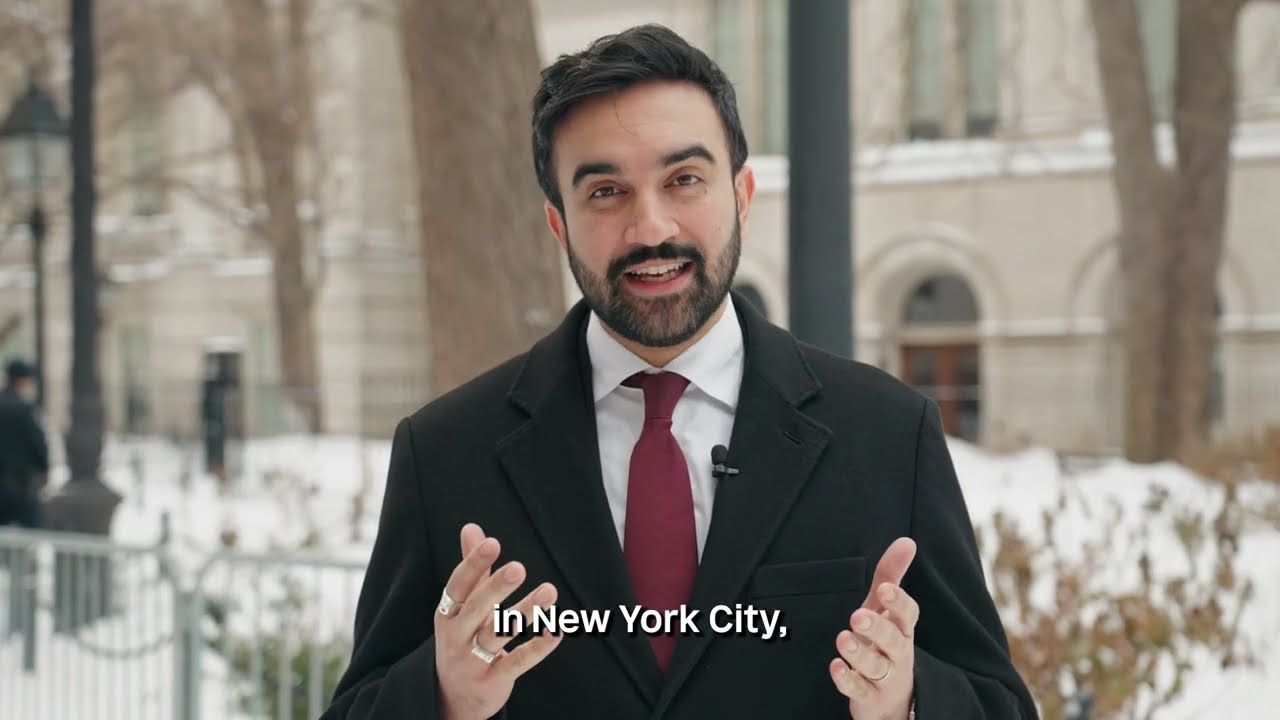
t’s a highly partisan commentary video by Benny Johnson about the March 7 protest outside Gracie Mansion and the later arrest of two men accused of throwing improvised explosive devices there. In the clip, Johnson argues that Mayor Zohran Mamdani focused too much on condemning the anti-Muslim protest as “white supremacy” and not enough on condemning the alleged ISIS-inspired attackers. That framing is based on a real mayoral statement and press conference, but the video is presented as polemic, not neutral reporting.
The underlying event itself is real. Federal prosecutors say Emir Balat, 18, and Ibrahim Kayumi, 19, traveled from Pennsylvania and allegedly threw homemade bombs containing explosive material and shrapnel at an anti-Islam protest outside Gracie Mansion. The DOJ says they were inspired by ISIS and charged them with terrorism-related offenses, including attempting to provide material support to ISIS and using a weapon of mass destruction. Reuters likewise reports the devices contained TATP and that no one was injured because police intervened quickly.
What Benny is reacting to is also real: in the mayor’s March 8 statement, Mamdani said, “white supremacist Jake Lang organized a protest outside Gracie Mansion rooted in bigotry and racism,” and then said the attempted use of an explosive device was “criminal” and “reprehensible.” In the March 9 press conference, Mamdani again called the protest “rooted in white supremacy,” but he also explicitly said the two men “are suspected of coming here to commit an act of terrorism” and that the devices were IEDs made to “injure, maim or worse.”
So the video’s basic message is: “Mamdani blamed white supremacy / Islamophobia instead of clearly focusing on Islamist terrorism.” That is an interpretation, not a full description. A more accurate summary would be: Mamdani condemned both the anti-Muslim protest and the bomb attack, though critics argue his first public reaction emphasized the protest’s bigotry more than the attackers’ ISIS link. Later that same day, after charges were announced, he called it a “heinous act of terrorism” and said the suspects had proclaimed allegiance to ISIS.
A few things in Benny’s clip are rhetoric rather than established fact. Calling the rally simply a “peaceful protest” leaves out that Reuters described it as a far-right anti-Muslim demonstration with provocative anti-Muslim symbols, and there were also counterprotesters and other arrests. Also, the video uses insult-heavy language and repeatedly misspeaks Mamdani’s name, which tells you the goal is persuasion and outrage, not balance.
So, in plain English: the video says Mamdani responded to an alleged ISIS-inspired bomb attack by talking about white supremacy and Islamophobia, and Benny uses that to argue the mayor is morally and politically unfit. The incident is real; the video’s presentation is aggressively slanted. If you want, I can also give you a clean neutral summary for an article or a fact-check version point by point.
During a Senate Homeland Security Committee hearing, Sen. Josh Hawley (R-MO) called on the Department of Justice to investigate and prosecute what he described as ‘dark money’ networks. Hawley named billionaire-linked networks tied to George Soros and Neville Roy Singham, urging federal action to hold these organisations accountable.
Sen. Josh Hawley used a Senate homeland-security hearing this week to press a familiar Washington theme—follow the money—but in a setting that fused immigration unrest, nonprofit finance and allegations of foreign influence into a single prosecutorial pitch.
In the clip circulating online under the headline “‘Soros, Singham networks funding…’: Hawley ‘exposes’ dark money groups in Minnesota at fiery hearing,” Hawley (R., Mo.) argued that recent anti-ICE protests in Minnesota were less “spontaneous” than “highly organized,” and he urged the Justice Department to “untangle” what he called a “dark money” web and bring prosecutions where possible.
“A broad ecosystem”—and a number: $60 million
The exchange turns on testimony from Seamus Bruner of the Government Accountability Institute, whom Hawley cited as an investigator of nonprofit funding networks. Bruner told senators he had “tracked over $60 million” in payments—derived from IRS Form 990 disclosures—to “approximately 14 groups” that he said were active “on the ground” in Minnesota.
Hawley seized on the figure to argue that a large, multi-entity funding architecture sits behind street-level protest activity—an architecture he described as opaque by design because nonprofit pass-through structures can make it difficult to identify original sources of funds.
Who did the witness name?
In the portion of the hearing highlighted in Hawley’s office release, Bruner listed a range of organizations and advocacy groups he said showed up in his Minnesota-focused mapping, including the ACLU (which he described as providing legal defense and training support) and other national and local groups. Among those he named were Democracy Forward, TakeAction Minnesota, Indivisible, the National Lawyers Guild, CTUL, CAIR-Minnesota, Minnesota 350, and Voices for Racial Justice.
Bruner characterized this as an “ecosystem” rather than a single organization directing events—mixing legal support, organizing capacity and communications infrastructure.
The funding theory: “networks” and pass-through pipes
Pressed on where the money comes from, Bruner pointed to what he called major “networks,” including the Soros/Open Society sphere, the Arabella funding network and the Neville Roy Singham funding network, along with other large philanthropic channels. The alleged mechanism, he suggested, is straightforward: money moves through donor-advised funds and nonprofit intermediaries and arrives as large checks to local entities.
Hawley framed that pattern as a law-enforcement problem, not just a political-finance debate, arguing that if money is financing illegal conduct—assaults on officers, property damage or interference with law enforcement—then prosecutions should follow.
“Foreign money” as the accelerant
The hearing clip also elevates a second, more explosive claim: that some of the money behind U.S. protests may be foreign-linked. Bruner repeatedly invoked Singham—describing him as an American citizen living in China with pro-CCP sympathies—and also referenced Swiss billionaire Hansjörg Wyss in connection with Arabella-aligned vehicles, echoing prior media reporting he cited. Hawley used the allegations to argue that foreign influence should strip away any deference typically afforded to domestic political speech.
The backdrop: Minnesota as a national flashpoint
Hawley’s hearing moment is landing amid a larger national fight over the Trump administration’s immigration enforcement surge in Minnesota, which triggered mass demonstrations and intense scrutiny after the fatal shootings of two U.S. citizens during enforcement actions—events that have fueled political backlash and multiple congressional inquiries.
That context matters because it helps explain why Minnesota, rather than a border state, has become the stage for an argument about nonprofit money and protest logistics: the state has been treated by both parties as a test case for where immigration enforcement ends and civil unrest begins.
What the hearing does—and doesn’t—establish
The testimony Hawley highlighted relies on two different kinds of claims that often get blurred in political media:
Accounting claims (Form 990-based mapping of grants and payments among nonprofits) can illuminate financial relationships and the size of funding streams.
Operational claims (that specific dollars funded riots, violence, or coordinated interference with law enforcement) require additional proof tying funding to specific actions and intent.
In other words, tracing grants to organizations is not the same as proving direction of illegal conduct—something Hawley effectively acknowledged by making DOJ action the endpoint of his argument: investigate first, prosecute where the facts allow.
Date: February 10, 2026
1) Setting and what Hawley was trying to establish
In a Homeland Security Subcommittee hearing chaired by Sen. Josh Hawley, the line of questioning pivots from broad program fraud to public disorder/anti-ICE unrest in Minnesota and the claim that it was not spontaneous, but organized and financially supported through “dark money” nonprofit networks.
Hawley’s objective in this segment is basically a chain:
(a) protests/riots in Minnesota show signs of coordination → (b) coordination suggests infrastructure (training, legal support, comms, logistics) → (c) infrastructure requires funding → (d) funding allegedly traces back to large donor networks (some described as foreign-linked) → (e) therefore DOJ should investigate and, where possible, prosecute.
That “DOJ investigation + prosecution” demand is Hawley’s closing theme in the press release and the hearing clip.
2) What the “on-the-ground” witness claimed about organization and tactics
A) “Highly organized and coordinated”
Minnesota State Sen. Mark Koran (as described in the press release) answers Hawley’s “spontaneous vs organized” question by saying the activity is “highly organized and coordinated,” with a mix of national and professional agitation groups plus local reporting that “30,000 observers” were trained to insert themselves into protests.
B) Tactics alleged
Koran describes (as allegations/observations) a package of tactics:
Doxxing (described as “highly coordinated”)
Violence against federal agents (including severe injury claims)
Projectiles (frozen bottles, stones, etc.)
Direct interference with law enforcement operations
C) Alleged involvement of state/local officials
Koran also claims some elected officials in the Minneapolis area were “involved,” including participation in chats and at least one named state representative (as transcribed in your text). This is presented as assertion, not proven finding, in the clip.
3) The nonprofit-funding witness: what he says he tracked and what that means
Hawley then turns to Seamus Bruner (Government Accountability Institute), introduced as someone who tracks nonprofit funding networks, and asks the core question: “What organizations have been active on the ground in Minnesota?”
Bruner’s central funding claims are:
He says he tracked “over $60 million” (based on IRS Form 990 disclosures) to ~14 groups tied to Minnesota protest activity.
He says the money originates through large donor/funding “networks,” naming:
Soros network (often shorthand for Open Society–linked giving)
Arabella funding network
Neville Roy Singham funding network
and “many others” (he also references large philanthropic networks generally)
He characterizes the structure as multi-entity pass-through funding that can obscure the original donor (“washed through multiple times”), then lands as large checks to organizations operating “on the ground.”
Important framing: in this hearing segment, these are testimony-level assertions about flows and purpose (protest/riot support), not adjudicated conclusions.
4) “What organizations have been active on the ground in Minnesota?” (the named list)
From your transcript (and consistent with Hawley’s office summary that Bruner listed Minnesota-active groups), the witness explicitly names the following as part of the Minnesota ecosystem he says received funding:
ACLU (described as providing legal defense and facilitating trainings)
Democracy Forward
TakeAction Minnesota (he singles this out as receiving over $10 million from large NGO networks)
Indivisible
National Lawyers Guild
CTUL (Centro de Trabajadores Unidos en Lucha)
CAIR-Minnesota (Council on American-Islamic Relations, Minnesota)
Minnesota 350
Voices for Racial Justice
He presents this as a non-exhaustive list (“on and on”) within the broader “~14 groups” and “$60 million” claim.
5) How “dark money” and “foreign money” are used in the argument
In the clip, “dark money” is used in the colloquial political sense: money routed through nonprofit entities and pass-through structures that may not clearly identify original donors (especially depending on entity type and reporting). Bruner claims the structure makes it difficult to see “ultimate” donors and says this is intentionally opaque.
Then the exchange escalates into “foreign money” concerns. Bruner claims the most concerning aspect is foreign-linked funding, and the discussion focuses heavily on Neville Roy Singham and also mentions Swiss billionaire Hansjörg Wyss as a funder of Arabella-aligned vehicles (in the witness’s telling).
New York City is recruiting lifeguards now (yes, in winter) to prepare for the summer season and keep pools and beaches safer. Qualifying tests are held across all five boroughs through the winter, and February 28, 2026 is the last day to register. To qualify, applicants must be at least 16 by July 18, 2026, pass a vision exam (with specific minimum vision standards), and complete a 50-yard swim in 50 seconds or less using proper form. City officials say more lifeguards means more open swim time, more lessons, and a safer, more enjoyable summer for everyone. Registration and details are on NYC Parks’ Lifeguard Qualifying .
On February 5, 2026, the amendment was brought up for a vote. Every Democratic member of the New York State Senate voted against the proposal, so it failed.
Once upon a winter day in New York State, a State Senator named Mark Walczyk had an idea to help everyday people. Many families were struggling with very high utility bills — the cost of keeping their lights on and homes warm was putting a strain on their wallets. NYsenate.gov
Senator Walczyk thought, “There’s money that’s been set aside but not used. What if we returned that money to people so their bills could be a little lower?” So he proposed a plan to take $2 billion of unused funds and use it to give credits on utility bills, which could help families pay less. nysenate.gov/
But when it was time for the measure to be voted on in the New York State Senate, something surprising happened. Every Democratic Senator said no to the plan. They all voted against it — even though it was meant to take effect right away and help with the high costs people were facing. nysenate.gov/
Senator Walczyk was disappointed. He said that this was a missed chance to help New Yorkers struggling with energy costs. And that’s how the day’s big idea to lower energy bills ended — not with a yes, but with a big no in the Senate.
What the Proposed Measure Would Do
The proposal was offered as an amendment on the floor of the New York State Senate by Republican senators including Mark Walczyk and Tom O’Mara.
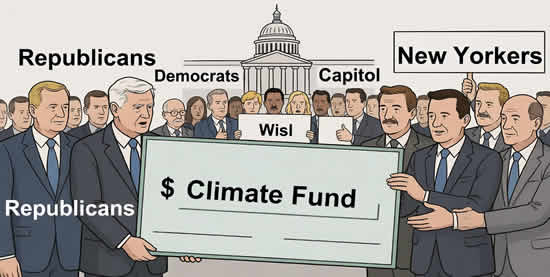
It aimed to provide immediate relief for New Yorkers facing high utility bills by allowing unused funds in the New York State Energy Research and Development Authority’s (NYSERDA) Climate Investment Account to be returned directly to utility ratepayers as bill credits. Around $2 billion was cited as available from previously collected surcharges that hadn’t yet been spent.
Sponsors argued these funds were already paid by ratepayers through charges on their utility bills and could be used to offset steep increases in energy costs many households face.
Why Democrats Opposed It
There hasn’t been a detailed official public explanation in the press release itself of Democrats’ specific reasoning for voting against this particular amendment. However, broader reporting on the context around utility-cost policy in Albany shows:
The Democratic majority in the Senate has been advancing a separate legislative package focused on longer-term utility rate reforms — including changes to how utility rates are set and how regulatory authority is exercised — rather than one-time refunds or credits. nysenate.gov/
Democratic leaders have emphasized systemic changes to the rate-setting process through bills meant to increase transparency, strengthen the Public Service Commission’s oversight, and protect consumers over time, rather than simply returning existing funds as credits. timesunion.com
Some analysts and social media discussions note that Democrats may prefer a more comprehensive overhaul of energy policy and rate structures rather than targeted bill credits that Republicans proposed in this amendment.
What connection does this “climate fund” have to reality, and why are people being charged for it?
What is this fund and who manages it? This refers to climate and “green” accounts administered by NYSERDA — the New York State Energy Research and Development Authority. The money is accumulated in various climate and energy programs under the Climate Leadership and Community Protection Act (CLCPA).
Formally, this is not a single “wallet,” but a collection of funds and accounts into which money flows for climate-related goals.
Where does the money come from (the key point)? ❗ These are not abstract grants or “money out of thin air.”
The main sources are:
surcharges and add-ons in electricity and gas bills;
fees imposed on energy companies, which are passed on to consumers;
revenues from emissions allowance trading;
mandatory “climate contributions” built into utility rates.
In simple terms: ordinary residents and businesses pay for it every month through their utility bills.
What is the official purpose of collecting this money?
The stated goals are:
transition to “clean energy”;
reduction of CO₂ emissions;
subsidies for solar panels, heat pumps, and electric vehicles;
grants for “green” projects and NGOs;
funding long-term climate programs through 2030–2040.
On paper, this looks like an investment in the future.
Where does the disconnect with reality arise?
This is where issues of trust and common sense begin:
People pay now, while the benefits are hypothetical and deferred. Bills are rising today. The “climate benefits” are promised in 10–20 years.
The fund is weakly connected to actual bill reductions. In practice, climate programs more often increase utility rates than decrease them.
Money accumulates while the crisis is ignored. When billions of dollars sit unused in accounts, yet people are told, “Be patient, now is not the time to return the money,” that starts to look like bureaucratic absurdity rather than climate policy.
Lack of emergency logic. Climate change is a long-term issue. Rising utility bills are an urgent social problem. Yet authorities consciously place ideology above people’s ability to pay.
Why critics see this fund as disconnected from reality
Because:
the fund does not protect consumers, but uses them as a source of financing;
money is collected mandatorily, but not returned even during crises;
decisions are made by technocrats and politicians, while ordinary ratepayers foot the bill;
climate rhetoric is used as a universal justification for additional charges.
In effect, it looks like this:
“We know you’re struggling, but the climate matters more than your heating bill.”
In its current form, the climate fund:
has a weak connection to people’s everyday reality;
is financed through what amounts to a hidden tax in utility bills;
is treated as untouchable reserve money, even when households are suffocating under rising costs.
That is why the refusal to return at least part of these funds looks less like care for the future and more like indifference to the present.
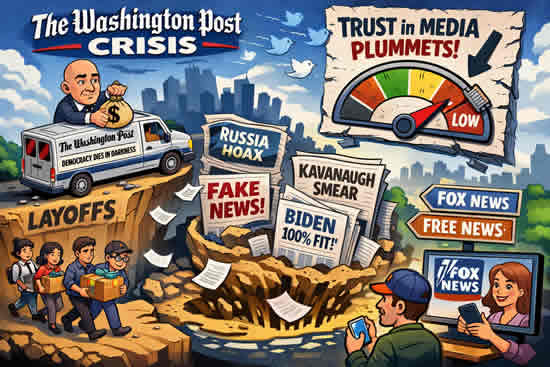
The segment argues that the Washington Post’s reported layoffs under Jeff Bezos reflect a broader collapse in trust and demand for legacy media, with Brianna Lyman claiming readers are abandoning outlets they view as partisan and credibility-damaged by major political narratives (Russia-collusion coverage, Kavanaugh allegations, and optimistic portrayals of Biden’s fitness). She frames the layoffs as a market correction—if a paid product doesn’t deliver value, it fails—rejecting calls for Bezos to subsidize the newsroom indefinitely. The discussion then shifts to Don Lemon, with Lyman arguing “journalism” is not legal immunity if someone obstructs or disrupts a church, and criticizing what she portrays as selective enforcement against conservatives in prior years. Finally, they highlight a U.S. investigation into Nike over alleged discrimination against white workers, using it as an example of DEI-driven corporate practices facing legal and political backlash and reiterating a merit-based hiring standard.
Washington Post layoffs, media trust
Host: I’m thrilled to be joined now by The Federalist’s elections correspondent, Brianna Lyman. Brianna, thanks so much for coming on the program tonight.
Huge news out of Washington: it looks like the paper that devoted itself to the idea of “democracy dies in darkness” is now dying a slow death itself — with publisher Jeff Bezos laying off 300 workers, about a third of the newsroom. What’s your reaction? Because while nobody cheers when a journalist is fired, it seems to me this proves the Washington Post’s business model of anti-Trump “hackery” doesn’t sell anymore. Does it?
Brianna Lyman: No. Right now — at least in the United States — trust in the mainstream media is at a record low, or as I like to call it, the “propaganda press.” And the Washington Post is a case study.
This is an outlet that pushed the Russia-collusion narrative, promoted the Kavanaugh rape smear, and insisted Biden was healthy and fully cognizant — which wasn’t true. Readers have lost trust. And when you’re being charged to read the Washington Post, you realize you’re not getting much for your money when you can go to free sites — you can go to Sky News, Fox News — and access news without the left-wing spin.
A lot of people say Bezos should have dipped into his own money and paid staffers for years. But that’s what happens when the real world collides with liberal fantasies: in a capitalist society, if your product doesn’t sell, you’re done. It’s unfortunate they lost their jobs, but if they have useful skills, they should be able to find new ones.
Host: Exactly. And you mentioned the hoaxes. This paper was used to launder all sorts of “deep state” narratives about Trump. It pushed the Steele dossier — full of claims and alleged lies — in what many saw as an attempt to influence an election. Once a newspaper is trying to be a political player in an election, it’s over, isn’t it?
Brianna Lyman: Yes. The Washington Post presents itself as neutral — “democracy dies in darkness.” But for them, democracy only “dies in darkness” when Republicans are winning.
When a Republican is in office, everything is framed as bad, illegal, unconstitutional. When a Democrat is in office, even when something is illegal or unconstitutional, it gets wiped away or swept under the rug.
Readers don’t want this anymore. They cut sections like books and sports. And people are tired of being told they have to accept ideological narratives in sports — they just want to watch sports. You can go to Fox Sports and they talk about the game, not constant political lectures. The Post could have changed years ago; it didn’t — and now it’s facing the consequences.
A conservative advocacy group criticized LinkedIn after the social media platform temporarily removed a post supporting a Trump-era immigration enforcement policy. LinkedIn later restored the post, saying the removal was an error.
What Happened
According to Fox News, a LinkedIn spokesperson confirmed:
“This was removed in error, and we quickly corrected it.” (Fox News)
The post had been flagged as “hateful speech” by LinkedIn’s moderation system. After review and public backlash, the platform reinstated the post.
Public Reaction
The removal prompted criticism from the conservative advocacy group and some social media users, who called for boycotts of LinkedIn. Inquisitr News reported that many users saw the removal as censorship, even though LinkedIn attributed it to a mistake. (Inquisitr)
Confirmation from Other Outlets
Several other news organizations confirmed the incident:
The Federalist reported LinkedIn quickly corrected the error. (The Federalist)
AOL News noted the post was restored and emphasized that the removal was unintentional. (AOL)
While LinkedIn’s removal of the post drew criticism, the platform confirmed it was a mistake and quickly restored the content. This incident highlights the challenges social media companies face in balancing content moderation with free speech concerns.
Social Media Platforms That Have Removed Posts Supporting Trump’s Policies
Based on official statements and reports from government archives, oversight bodies, and congressional documents, several major social media platforms have removed or restricted content that supported or promoted policies associated with former (and current) President Donald Trump. These actions often involved claims related to election integrity, immigration, or public health policies during his administration, but were frequently justified by platforms under rules against misinformation, incitement to violence, or hate speech. Note that platforms’ official policies emphasize neutral enforcement, though critics, including Trump administration officials, have argued these removals disproportionately targeted conservative viewpoints. Below are key examples from authoritative sources, focusing on platforms beyond LinkedIn (as mentioned in your query snippet).
Twitter (now X): Twitter removed multiple tweets from Trump’s account that supported his policies on election security and postal voting, labeling them as disputed or misleading. For instance, during the 2020 election, tweets falsely suggesting electoral fraud (tied to Trump’s policy stance on voter integrity) were removed or hidden. The platform also permanently suspended Trump’s account on January 8, 2021, citing risks of further violence after the January 6 Capitol events, where posts echoed his policy narratives on election results. Official Twitter statements (via archived government briefings) described these as editorial decisions to prevent harm, not political bias.
Facebook: Facebook removed posts from Trump praising the January 6 events, which supporters framed as backing his immigration and law-and-order policies amid election disputes. These were deleted under the platform’s Community Standards on Dangerous Individuals and Organizations, leading to an indefinite suspension of his account (later set to two years, lifted in 2023). The Oversight Board, an independent body reviewing Facebook decisions, upheld the initial suspension but criticized the indefinite nature as inconsistent with rules. Similar removals affected content supporting Trump’s COVID-19 or election policies deemed misinformation.
Instagram (Meta-owned): As part of the same ecosystem as Facebook, Instagram applied identical restrictions, removing Trump’s posts that glorified the January 6 events (seen by some as supporting his border security and anti-fraud policies). The suspension was extended indefinitely in January 2021 for at least two weeks, later formalized to two years.
YouTube (Google-owned): YouTube suspended Trump’s channel in January 2021 for “content violating policies on incitement, including videos supporting his election-related policies that allegedly risked violence”. The suspension was lifted in March 2023. Google has general policies against incitement to hatred, which have led to removals of content aligned with conservative policy advocacy.
Other platforms like Snapchat, Twitch, and Pinterest have banned Trump-related accounts or content supporting his policies (e.g., on immigration or election fraud), but these are less documented in official government sites and more in oversight reports. Platforms maintain these actions are content-neutral, aimed at curbing harm, but analyses from sources like the White House and Congress suggest asymmetries, with conservative content flagged more often due to higher rates of associated misinformation.
Approaches to Stopping Such Removals
Official sources, including White House executive orders, congressional proposals, and think tank analyses, outline several strategies to address perceived censorship of conservative or Trump-supporting content. These range from legal reforms to promoting transparency, though viewpoints differ: Some conservatives advocate aggressive regulation to limit platform power, while others (including free speech advocates) warn that government intervention could worsen censorship. The U.S. Supreme Court has ruled that platforms have First Amendment rights to moderate content, but government pressure on them can be unconstitutional. Here’s a high-level overview of proposed solutions from balanced sources:
Approach
Description
Key Proponents/Sources
Potential Challenges
Reform Section 230
Amend the Communications Decency Act to strip liability protections from platforms that engage in “editorial” moderation (e.g., removing political content). This would make platforms liable for user content unless they act neutrally, potentially discouraging removals. Bills like the Stop Shielding Culpable Platforms Act aim to clarify this.
Could lead to over-removal of all content to avoid lawsuits, harming free speech overall. brookings.edu
Executive Orders and Federal Accountability
Prohibit federal agencies from pressuring platforms to censor speech. The 2025 White House order requires agencies to report and correct past misconduct, ensuring no taxpayer funds support censorship. It accuses prior administrations of coercing platforms.
Trump Administration (2020 and 2025 orders) whitehouse.gov
Enforcement relies on administration priorities; critics say it risks politicizing speech. npr.org/
Transparency and Due Process Requirements
Mandate platforms to disclose moderation policies, provide appeals for removals, and report annually on actions (e.g., how many conservative posts were removed). Legislation could require public reports on government-platform communications.
Platforms resist full disclosure; may not stop removals but increases accountability.
Promote Competition and Alternatives
Encourage new platforms (e.g., Truth Social, Parler) via antitrust actions or reduced barriers, allowing users to migrate to less-moderated spaces. Avoid nondiscrimination mandates that force platforms to host all content.
New platforms struggle with scale and app store restrictions. washingtonpost.com
Multistakeholder Guidelines
Create international forums (e.g., proposed International Forum on Content Moderation) for voluntary standards on handling political speech, including definitions of harmful content and appeals processes.
In this video, Amir Tsarfati interviews Rawan Osman, who shares her personal journey from being raised in a culture of antisemitism to becoming a courageous voice against it.
Here’s a breakdown of the key points:
Rawan’s Background (2:00): Rawan was born in Damascus and raised in Lebanon, attending a French Catholic school. She grew up in a society that, despite being generally tolerant, harbored a deep-seated hatred for Jews, Zionists, and Israelis (5:55). She admits to having been a strong supporter of Hezbollah, viewing them as liberators against Israeli occupation (6:25).
Indoctrination and Misinformation (7:10): Rawan explains that she was taught to hate Jews without understanding the full historical context. She learned a simplified version of history where Israel was the aggressor, omitting details about Palestinian groups’ actions that led to Israeli military responses in Lebanon (7:10). She also describes how Christian antisemitism was subtly instilled through the school curriculum and films like “The Passion of the Christ” (8:26).
The Problem with Education (9:49): Rawan highlights that the Lebanese curriculum presents a biased narrative of “Palestine,” portraying Theodor Herzl as the antagonist who invented Zionism to take land from Palestinians (9:49). This narrative led to the internalization that “Palestine was a country” with indigenous people, and that supporting the “underdog” against the “Jew” was the morally correct stance (10:43).
Her Epiphany in Europe (11:07): Rawan’s perspective began to shift when she moved to Europe in her mid-20s and found herself living in a Jewish quarter in Strasbourg, France (11:07). Her initial panic attack upon seeing religious Jews made her question why she harbored such fear and hatred towards people she had never interacted with (12:22). This realization led her to re-examine the history of the region.
Relearning History and Jewish Identity (12:57): Through her research, Rawan discovered that Jews are indigenous to the Middle East, challenging the narrative that they originated solely from Eastern Europe (12:57). She also realized that modern nation-states in the Middle East are relatively new, making the categorical rejection of Israel illogical (13:23). She was “disappointed” to learn that her “side” was the aggressor and had brainwashed people with hatred (13:48). She concludes that the problem has always been with the Jews themselves, not just the state of Israel (18:18).
Antisemitism and Muslim Supremacy (18:43): Rawan argues that Israel’s existence as the first Jewish state challenges Muslim supremacy, as Jews were the first minority to demand self-governance and equality (18:43). She explains that in Islam, land once governed by Muslims cannot be lost, making Israel’s existence unacceptable to some (20:49).
The Global Reach of Antisemitism (22:07): She discusses the 1929 Hebron massacre as an example of pre-state anti-Jewish violence, leading Jews to leave Arab countries out of fear (22:07). Rawan notes the widespread nature of antisemitism in the Arab world, citing examples like Hitler’s Mein Kampf being found in Gaza and stores named “Hitler” in the West Bank (27:10). She highlights that October 7th revealed the extent of this global problem, where world sympathy for Israel quickly turned into condemnation (30:03).
Hope for the Future (47:56): Despite the challenges, Rawan expresses optimism, driven by her newfound faith and identification with Judaism (47:56). She believes that while the West is turning against Israel, support will emerge from the Arab world, as people realize their own economic and social problems are not caused by Israel or Jews (49:16). She points to countries like the UAE and Morocco as examples of nations that have blessed Israel and consequently experienced blessings (49:40).
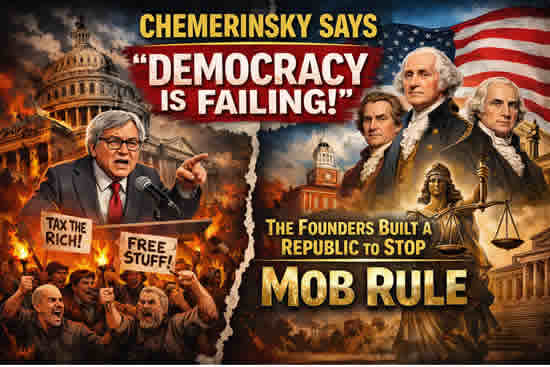
Erwin Chemerinsky—Dean of UC Berkeley School of Law and one of the country’s best-known constitutional law scholars—has a blunt thesis: the United States is facing a crisis of legitimacy and institutional design that could make democratic self-government unsustainable. He lays out that argument in his 2024 book, No Democracy Lasts Forever: How the Constitution Threatens the United States, and in a widely circulated Berkeley Law alumni talk that frames the book as a warning flare for the American system.
That warning has sparked an equally blunt rebuttal from many critics: the United States was never designed to be a “pure democracy” governed by simple majorities. It was designed as a constitutional republic—a representative system constrained by a written constitution—precisely to protect individuals from two perennial dangers: tyranny from above (abuse by rulers) and tyranny from below (majority faction turning politics into legalized coercion).
This debate isn’t an academic parlor game. It’s now moving to a major public stage in New York.
What Chemerinsky argues in No Democracy Lasts Forever
Chemerinsky’s core claim is that American democracy is under severe stress because public confidence in institutions has collapsed and political polarization has hardened into something closer to mutual illegitimacy. In the Berkeley book talk, he argues the crisis is not just cultural—it is structural.
Among the structural issues he highlights:
The Electoral College: He argues it can produce presidents who lose the national popular vote and that winner-take-all allocation in most states amplifies that risk.
The U.S. Senate: Equal representation for states regardless of population, he argues, violates democratic intuitions about political equality and entrenches “minority rule.”
Gerrymandering and representation: He contends partisan map-drawing has made the House less responsive, and that legal constraints limit effective remedies.
The Supreme Court’s role and tenure: He criticizes life tenure as placing too much power in too few hands for too long, and describes the Court as a central actor in democratic backsliding.
Money in politics: He argues that the scale and opacity of campaign spending corrodes public trust and democratic legitimacy.
Chemerinsky also proposes remedies—some statutory, some constitutional—and, in the longer arc, suggests Americans should at least begin thinking about what a modern constitutional replacement process might look like (even if not imminent).
The controversy: “Democracy is failing” vs. “A republic with guardrails is the point”
The sharpest disagreement is not whether the country is polarized. It is what standard should be used to evaluate constitutional design.
Chemerinsky often describes the U.S. as a “constitutional democracy” and measures legitimacy against a majoritarian benchmark: outcomes should track popular majorities more consistently, and institutions that systematically distort majority rule are treated as core democratic defects.
Critics respond that this framing smuggles in a premise the Founders explicitly resisted: that “more direct democracy” is inherently better.
1) The Constitution guarantees “republican” government—not direct majoritarian rule. Article IV, Section 4 requires the United States to guarantee each state a “Republican Form of Government.” Whatever else Americans argue about, the constitutional text chooses “republican” as the baseline civic architecture.
2) Madison’s warning: “pure democracies” can be violent and unstable. In Federalist No. 10, Madison draws a famous contrast between a republic and what he calls “such democracies,” warning they have historically been “spectacles of turbulence and contention” and incompatible with personal security and the rights of property.
This is a foundational insight for critics: the system was designed not to maximize majority power, but to control the predictable pathologies of majority power.
3) The “two tyrannies” problem: protect society from rulers and from majorities. Federalist No. 51 states the principle in plain language: it is vital “in a republic” not only to guard society against oppression by its rulers, but also to guard “one part of the society against the injustice of the other part,” because if a majority unites around a common interest, the rights of the minority will be insecure.
This is the conceptual backbone of the “constitutional republic” critique of Chemerinsky: many so-called “anti-democratic” features are better understood as anti-tyrannical guardrails—constraints that prevent elections from becoming a moral permission slip to punish disfavored groups.
4) Courts are not meant to be majoritarian institutions. Chemerinsky’s critique of judicial power and long tenure often collides with Hamilton’s argument in Federalist No. 78 that life tenure “during good behavior” is a barrier against despotism in a monarchy—and, in a republic, a barrier against “encroachments and oppressions of the representative body.”
In this view, the judiciary’s legitimacy is not measured by popularity; it is measured by fidelity to higher law—especially when popular majorities demand shortcuts.
A key clarification that strengthens the critique
Even many constitutional conservatives concede an important nuance: the Constitution does not literally contain the phrase “constitutional republic.” The more precise claim is that the U.S. is a representative republic operating under a written constitution, and that “democracy” (as used in modern speech) should be understood as representative democracy, not pure direct democracy.
This matters rhetorically. It allows critics to challenge Chemerinsky’s framing without making an easily refutable claim like “America isn’t a democracy at all.” The stronger, more defensible line is: America is not a pure democracy—and it was never intended to be; it is a constitutional republic built to protect liberty against both top-down tyranny and majority faction.
Coming up in NYC: Brennan Center Jorde Symposium, Feb. 5
This dispute over constitutional legitimacy will intersect with an in-person NYU event next month.
On Thursday, February 5, 2026, the Brennan Center for Justice will host the Jorde Symposium: “Against Constitutional Theory” at NYU School of Law (Greenberg Lounge), 40 Washington Square South, New York, NY. The program runs 4:00–5:50 p.m. ET, followed by a reception 5:50–6:30 p.m.
Erwin Chemerinsky is the featured lecturer. Commentators include Leah Litman (University of Michigan Law School) and Sherif Girgis (University of Notre Dame Law School). The event is open to the public but requires RSVP, and is listed as free.
For anyone tracking the national argument over “democracy,” constitutional limits, and the role of courts, this is one of the most substantive public constitutional law events on the New York calendar—especially because it puts Chemerinsky’s broader book thesis in conversation with scholars who do not share all of his premises.
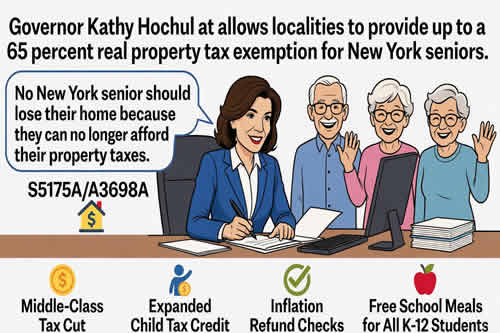
New York Gov. Kathy Hochul signed legislation allowing local governments to offer property-tax exemptions of up to 65% for eligible senior homeowners, raising the previous cap from 50% for the first time in decades. Under the measure, known as S5175A/A3698A, municipalities can set income limits and other criteria to determine who qualifies, with state officials estimating potential savings of about $300 a year for the average senior on a fixed income. The change is aimed at helping roughly 1.8 million older New Yorkers remain in their homes amid rising housing costs and inflation, and comes as part of a broader affordability push that includes middle-class tax cuts, expanded child tax credits, inflation rebate checks and free school meals for all K–12 students.
Governor Hochul Authorizes Real Property Tax Exemptions for New York Seniors
Governor Kathy Hochul signed legislation that enhanced real property tax exemptions for New York seniors. Legislation S5175A/A3698A allows localities to provide a real property tax exemption for senior citizens who meet the income eligibility limits, among other criteria, up to 65 percent percent of the assessed valuation of their properties. This legislation builds on the Governor’s affordability agenda, which included tax cuts for middle-class New Yorkers.
“No New York senior should lose their home because they can no longer afford their property taxes,” Governor Hochul said. “By signing this legislation, we are working to make New York more affordable for our seniors on fixed incomes and empowering them to age in place, at home, in the communities they know and love.”
The bill will give localities the option to offer real property tax exemptions of up to 65 percent to seniors living below the maximum income eligibility level set by the locality. Prior to, the maximum percentage of exemption local governments have been able to offer senior citizens was set at 50 percent and has not been raised in decades. Increasing the exemption from 50 percent to 65 percent could translate into savings of up to $300 annually for the average senior.
New York State Office for the Aging (NYSOFA) Acting Director Greg Olsen said, “Governor Hochul is coming through yet again on making New York more affordable for individuals and their families. Property taxes, especially for those on fixed incomes, can often be difficult to afford. With more than 1.8 million older adults who own their own homes, this important law will continue to help older adults remain in the homes and communities of their choice and keeping their vast contributions within New York State.”
State Senator Leroy Comrie said, “Seniors have faced rising housing costs and inflation— oftentimes living on fixed income. Signing S5175A into law is an important step toward restoring real affordability for older adults across New York. This law allows localities to offer up to a 65 percent discount to eligible seniors so long-time homeowners can remain in their communities with dignity and security. I thank Governor Hochul, my colleagues and especially Assemblymember David Weprin for partnering to deliver meaningful support for the New Yorkers who helped build this state.”
Assemblymember David Weprin said, “I’m grateful for Governor Kathy Hochul’s commitment to improving affordability for all New Yorkers, including our senior citizen homeowners. By advancing this bill into law, we will provide relief from the burden of increasing real property taxes and ensure stability for elderly homeowners on low fixed incomes. I look forward to continued partnership with Governor Hochul and my fellow elected leaders to advance this critical affordability agenda.”
This legislation builds on Governor Hochul’s affordability agenda, which includes:
Middle-Class Tax Cut: Approximately 8.3 million New Yorkers will benefit from decreased tax rates, bringing middle-class taxes to their lowest levels in 70 years.
Child Tax Credit Expansion: The Child Tax Credit is increasing to up to $1,000 per child under the age of four and up to $500 for school-aged children, starting in 2026.
Inflation Refund Checks: Eligible New Yorkers have received up to $200 per person or $400 per family, reaching 8.2 million people.
Free School Meals: All K-12 students now have access to free breakfast and lunch, saving families up to $1,600 per child annually.
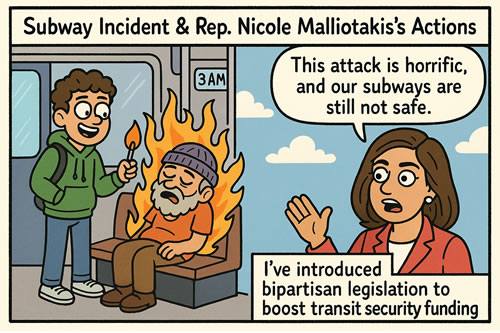
A shocking attack in the New York City subway has raised new fears about rider safety. Police say 18-year-old Manhattan resident Hiram Carrero allegedly set a sleeping homeless man on fire in a No. 3 train car around 3 a.m. The incident happened near Times Square/Penn Station. The 56-year-old victim suffered serious burns but is expected to survive, according to the NYPD.
The suspect, who was seen in surveillance video, was later perp walked out of the 9th Precinct after his arrest. Carrero has been identified by police and is being charged with attempted murder, three counts of assault, arson, and reckless endangerment. The case has quickly become another example used in the debate over crime and safety in the NYC subway system.
New York Congresswoman Nicole Malliotakis called the attack “horrific” and says it proves that the subway is still not truly safe. She notes that the NYPD is thousands of officers below past staffing levels and argues that more police are needed on trains and platforms. In Congress, Malliotakis is pushing a bipartisan transit security bill to increase federal funding for subway safety, including more officers, better lighting, more cameras, and upgraded surveillance systems to protect riders and the city’s most vulnerable residents.