
“Albany will kill the goose that laid the golden egg which made New York the foremost industrial state.”
— New York Herald, April 19, 1919
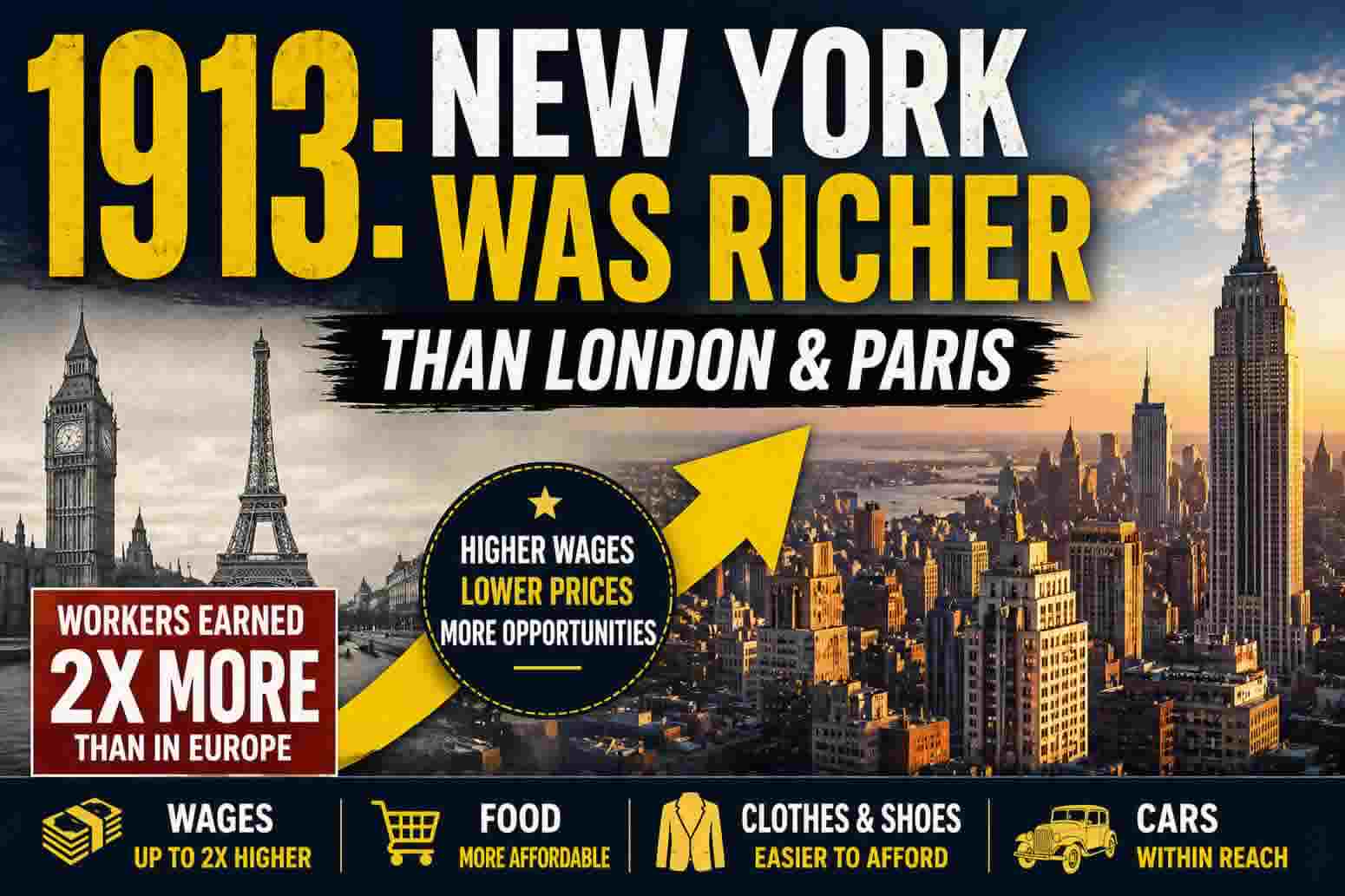
In the early 1900s, ordinary workers in New York often earned significantly more than their counterparts in London and Paris, while many basic goods were similarly priced or cheaper. Over the past century, that gap has narrowed, turning New York from a clearly dominant economic center into one of several competing global cities.

When New York Led the World
At the start of the 20th century, New York was not just a large city—it was a global economic engine:
- A hub for manufacturing, shipping, and finance
- A gateway for immigration and labor
- A center of rapid technological adoption
- A city defining modern architecture and urban growth
But its real advantage wasn’t just scale or skyline. It was something more tangible:
👉 The purchasing power of the average worker
What Workers Actually Earned (c. 1910–1913)
Across multiple historical datasets, a consistent pattern emerges:
- New York / U.S.: ~$18–25 per week
- London: ~$10–14 per week (converted)
- Paris: ~$8–12 per week
👉 In practical terms, a worker in New York could earn 50% to 100% more than a similar worker in Europe.
What That Meant in Real Life
The key difference wasn’t just income—it was what income could buy.
Food & Basics
- Milk: ~8.9¢ per quart in the U.S.
- Potatoes: ~1.5–2¢ per pound
- Beef: ~15–24¢ per pound
Prices in London and Paris were often similar—or even higher relative to wages.
👉 Result: Food consumed a smaller share of income in New York
Clothing & Daily Goods
- Men’s suit: ~$10–20 in the U.S.
- Shoes: ~$2–4
In Europe, similar goods often required more working days to afford.
🚗 Access to Technology
The most striking example:
- Ford Model T (1913): ~$526–$801
In the United States, the automobile was becoming a mass product.
In Europe, it remained largely a luxury item.
👉 New York wasn’t just richer—it was faster at turning innovation into everyday life.
🧠 Why New York Had the Edge
This advantage came from a powerful combination:
- High productivity
- Large domestic market
- Industrial scale
- Continuous inflow of labor and capital
- Relatively low and simpler tax and regulatory burden (compared to today)
👉 The economy could expand faster than it was constrained
⚖️ The 1919 Warning in Context
The New York Herald editorial didn’t claim New York would collapse overnight.
It raised a broader concern:
What happens when a government begins to treat a successful economy as an unlimited source of revenue?
At the time, New York State was introducing a state income tax, adding to a new federal tax system established in 1913.
🌍 A Century Later: What Changed?
Today, New York remains one of the world’s leading cities—but its position is no longer uncontested.
Then:
- Clear wage advantage
- Lower relative cost of living
- Limited global competition
Now:
- High wages, but also very high costs (especially housing)
- Multiple global rivals: London, Singapore, Shanghai, Dubai
- Much narrower gap in purchasing power
👉 New York didn’t collapse.
👉 But it stopped being untouchable.
The Shift in Perspective
The debate today is no longer:
“Will New York survive?”
It is:
“Can New York maintain its competitive edge in a globalized world?”
🔥 Key Takeaway
New York’s early success was not built on one policy or one moment.
It was built on a system where:
- growth outpaced constraint
- wages outpaced costs
- opportunity scaled quickly
The 1919 warning was not a precise prediction.
But it captured a long-term tension that still exists today:
👉 How much pressure can a successful economy absorb before it begins to lose its advantage?
Alex Portelli For Congress – NY19
Let’s never forget the New Yorker who wrote in 1919 that if New York State started down the path of progressivism (in this particular op-ed he was warning what would happen if New York implemented a State Income Tax), then Albany would “kill the goose that laid the golden egg which has made New York the foremost industrial state.”
Never in New York history was a man so correct with their prediction.

We must return to the economic and tax principles that made our state and country prosper.
📚 Sources and Data
The figures in this article are based on early 20th century official statistics and historical cost-of-living studies comparing the United States, the United Kingdom, and France.
-
U.S. Bureau of Labor Statistics (BLS) —
historical food prices for 1913, including milk, potatoes, flour, and beef.
BLS: Average Food Prices — 1913 -
UK Board of Trade Reports (1908–1911) —
wages, rents, and cost-of-living comparisons between American and British cities.
Cost of Living in American Towns — Internet Archive -
British Parliamentary Debates (Hansard) —
historical bread and wheat price comparisons for Britain and France.
Hansard: Wheat and Bread Prices -
Ford Model T historical pricing —
early 1910s vehicle prices and affordability trends.
Ford Model T Historical Prices
Note: All prices are approximate and converted to U.S. dollars or cents where necessary. Historical prices varied by city, product quality, season, and methodology.
Midtown Tribune Independent USA news from New York
Ask Midtown Tribune about this story
Answers are grounded first in this article. Search all Midtown Tribune reporting from the main AI Search page.
AI-generated summary. Verify important details in the linked original articles.