Governor Kathy Hochul joined Catholic Charities’ annual Thanksgiving celebration to help distribute turkeys alongside Cardinal Timothy Dolan and local elected officials, emphasizing her faith-driven commitment to serving “the least of my brothers and sisters.” She highlighted the hardship faced by New Yorkers when SNAP food benefits were recently used as “political collateral damage,” noting the state stepped in with $100 million for struggling food banks so no one would be denied access to food. Hochul praised Catholic Charities’ volunteers, called for year-round solidarity with families in need, and underscored that New Yorkers stand together in times of hardship. She also urged gratitude and greater support for veterans, many of whom face homelessness and food insecurity despite having served their country.
A rush transcript of the Governor’s remarks is available below:
Thank you, brother, good morning everyone. I want to wish all of you a very Happy Thanksgiving season and recognize our elected officials. We have Assemblymember Jordan Wright here, and I wanna give a special shout out to Monsignor Sullivan and the incredible work that he has done for so many years with Catholic Charities. Catholic Charities as an organization that I know very well, my father was a Catholic Charities Captain.
So every Lenten season, he would take his little daughter Kathy to go knock on doors and ask for money to raise and support those who have less than all of us. And that is the teachings of my faith that lead me to where I am today in this position as Governor, that sense of moral responsibility to others to do unto others as you would have them do unto you.
But also I take special note today of Matthew 25. When we think about the Lord telling us that what you do for the least of my brothers you’re doing for me. Today we’re helping some of our brothers and sisters, and life is sometimes hard for people and we have to make sure that we never forget them — not just during the holidays my friends, but year round. And it is a shame, It’s a shame the stress that our people were under over the last month when their SNAP benefits, their food benefits were being held as political collateral damage — to hurt people and make them suffer enough. We stood out here, we had to spend millions, a hundred million dollars to go to food banks that were already struggling. But no one ever should have been denied even for a second, the knowledge that food would be there during a shutdown — never in our history has that happened.
So I come here today with a heart full of gratitude for all of the volunteers, Catholic Charities, the people who are here today. We’re here to lift you up to say, we see you, we understand you. As I said, life can be hard sometimes, but I believe to our core we’re better than that — we’re New Yorkers, we stand together, we help each other in our time of need.
That is how I was raised as a social justice Catholic. That is how I know everyone in New York feels not just during this holiday time, but year round. So just want to say thank you and never forget also to thank those who served in our military. Many of them are homeless and they’re struggling as well, and that is not the return from putting their lives on the line to save our country and to support our values as Americans. They deserve better than that. So again to our veterans, if there’s anyone here — a heart full of gratitude for me on behalf of 20 million New Yorkers as well.
New York Steps Up as Federal Supportive Housing Funding Declines, Protecting Vulnerable New Yorkers Amid National Cuts
State Funding Will Create 645 Units of Permanent Supportive, Transitional, and Emergency Housing in the Capital District, Central New York, Finger Lakes, Long Island, Mohawk Valley, New York City, Southern Tier, and Western New York
Projects Include Funding for Housing with On-Site Support Services to Assist Formerly Homeless Veterans, Older Adults, Survivors of Domestic Violence, and Individuals Living with Serious Mental Illness and/or Substance Use Disorders and Their Families
Governor Kathy Hochul today announced more than $125 million has been awarded to 13 projects that will create 645 units and nearly 1,000 beds of permanent supportive, transitional, and emergency housing in the Capital District, Central New York, Finger Lakes, Long Island, Mohawk Valley, New York City, Southern Tier, and Western New York for individuals and families who have experienced homelessness.
“Creating new supportive housing, which combines affordable housing and services, is a fundamental part of our work to address the housing and homelessness crisis in our state,” Governor Hochul said. “This investment will help families and individuals who have experienced homelessness across our state remain stably housed while supporting strong neighborhoods and a brighter future for all New Yorkers.”
The grants — awarded through a competitive process by the Office of Temporary and Disability Assistance’s (OTDA) Homeless Housing and Assistance Program (HHAP) — are an important component of Governor Hochul’s $25 billion comprehensive Housing Plan that will help create or preserve 100,000 affordable homes across New York State, including 10,000 with support services for vulnerable populations. The 13 projects awarded funding will provide housing with on-site support services for individuals and families who have experienced homelessness, including veterans, frail elderly, survivors of domestic violence, and those living with serious mental illness and/or substance use disorders.
With these awards, HHAP has committed all of the $125 million in funding provided to the program in the SFY 2026 budget for the creation of new permanent supportive housing. HHAP is still accepting applications for $25 million in additional funding Governor Hochul secured in the SFY 2026 budget for the preservation and stabilization of existing supportive housing units constructed with funding from HHAP, as well as $1 million for emergency shelter repairs.
The projects awarded funding include:
Capital District
DePaul Properties, Inc. – $9.5 million to develop 34 units/72 beds of permanent supportive housing in Schenectady to house individuals and families who have experienced homelessness, including survivors of domestic violence, adults age 55 and older, persons with mental illness, and young adults. This is part of a larger project, Schenectady Community Action Program (SCAP) Campus Apartments, which also includes 26 affordable units in what will be the new construction of a four-story building, plus a new two-story building with a daycare and community support services.
Central New York
The Rescue Mission – $15 million to construct a new, 80-unit emergency shelter in Auburn, Cayuga County, with an additional eight units of permanent supportive housing for those who have experienced homelessness. The project, the Auburn Rescue Mission Emergency Shelter and Permanent Supportive Apartments, includes the new construction of a three-story, all-electric building with separate entrances and spaces for the permanent and emergency tenants, support services space, laundry, and common room. The new shelter will replace and expand an existing shelter.
Finger Lakes
Finger Lakes Area Counseling & Recovery Agency (FLACRA) – $2.5 million to develop five units and nine beds of permanent supportive housing in Waterloo, Seneca County, for individuals and families with a head of household diagnosed with substance use disorder. This project, FLACRA Supportive Housing Waterloo, involves the construction of three new buildings on two sites, which will include one three-bedroom, single-family home and two townhome style buildings with two one-bedroom apartments in each.
Long Island
Concern Housing – $14.9 million to develop 88 units of permanent supportive housing in Brentwood, Suffolk County, for individuals with mental illness. This is part of a larger project, Joseph’s Village, that includes the rehabilitation of three buildings on the Sisters of Saint Joseph Campus, which will have an additional 88 affordable units. The buildings will be all-electric and meet the New York State Climate Leadership and Community Protection Act.
Mohawk Valley
People First – $5.1 million to develop 19 units of permanent supportive housing in Utica, Oneida County, for individuals over age 55 and young adults, as part of a larger project that includes an additional 83 affordable units. THRIVE Cornhill will include the construction of two new, four-story, wood-frame, all-electric buildings. Building one will include 57 one-bedroom and 21 two-bedroom units and amenities, including a community room, computer lab, laundry room, and fitness center. Building two will contain commercial space on the ground floor and 24 apartments with 6,500 square feet of common space on the upper floors.
New York City
New Destiny Housing Corporation – $12 million to develop 97 units/278 beds of permanent supportive housing in Brooklyn, including 34 one-bedroom units for formerly homeless individuals and 63 units/244 beds for formerly homeless families that include members who are survivors of domestic violence. The project, Atlantic Avenue West, involves the new construction of a 14-story all-electric building with a total of 162 units/452 beds. The building will also include program offices, security desk, laundry room, library, playroom, fitness room, and other amenities.
CAMBA Housing Ventures, Inc. – $12.5 million to develop 73 units/101 beds of permanent supportive housing in Brooklyn for individuals who are, or families that include someone who is, over age 55 who have experienced homelessness. The project, Kingsborough Seniors, includes a total of 171 units/233 beds and includes the construction of a new 15-story building with amenities such as a computer room, bicycle parking, a fitness center, multiple outdoor terraces, public art throughout the building, rooftop garden, a walking loop, an activity terrace, and a grandparents’ room for residents to host intergenerational gatherings.
WellLife Network, Inc. – $15 million to develop 88 units of permanent supportive housing in Brooklyn for individuals and families who have experienced chronic homelessness or are living with mental illness. Osborn Street Apartments will include a total of 146 units/249 beds of affordable housing in a newly constructed, nine-story, all-electric building with program offices, a recreation room, exercise room, children’s play area, and laundry rooms.
West Side Federation for Senior and Supportive Housing, Inc. – $5.9 million to develop 40 units of permanent supportive housing in the Upper West Side of Manhattan for individuals age 55 and older who have experienced chronic homelessness. The newly constructed 12-story passive housing building, at 105 W 108th Street, will feature a total of 84 affordable units, a community room, support services offices, and a rear yard.
Southern Tier
Greater Opportunities for Broome and Chenango, Inc. – $8.3 million for the substantial rehabilitation and new construction of two residential buildings in Binghamton that will preserve 14 existing units and provide 7 new units of permanent supportive housing and a total of 69 beds across the two three-story buildings. Griswold Street Apartments will transition from natural gas to fully electric building systems that will provide heat and central air conditioning.
Western New York
Eagle Star Housing, Inc. – $6.5 million for the new construction of a one-story building in Cheektowaga, Erie County, with 20 units/beds of transitional housing for homeless veterans. The new building, the Cheektowaga Veterans’ Home, will preserve 16 beds and add four new beds. It is designed to look and function like a house, with central gathering areas for living, dining, and cooking.
DePaul Properties, Inc. – $15 million to develop 60 units/103 beds of permanent supportive housing in Wheatfield, Niagara County, for families and individuals, including older adults and veterans who have experienced homelessness or mental illness. The newly constructed, three-story Granary Apartments will also include an additional 20 affordable units for people with mental illness. The building will be all-electric and is designed to be solar-ready.
Citizen’s Opportunity for Development and Equality, (CODE) Inc. – $3.2 million to develop 12 units of permanent supportive housing in Jamestown for individuals with mental illness or those who have experienced long-term homelessness. The project, Blooming Gardens, includes the new construction and the substantial rehabilitation of 18 buildings across 12 sites, with a total of 48 units and 140 beds. All-electric systems will be utilized to eliminate the use of fossil fuels for heating, cooling, and common living needs.
New York State Office of Temporary and Disability Assistance Commissioner Barbara C. Guinn said, “Under Governor Hochul’s leadership, New York State has made landmark investments to expand the supply of permanent supportive housing options across the state, recognizing that stable housing is the foundation for healthier lives and stronger communities. When completed, these projects will create much-needed permanent supportive, transitional, and emergency housing across New York State that will provide hundreds of vulnerable New Yorkers who have experienced homelessness with the secure housing and targeted services they need to achieve stability, live independently, and thrive.”
New York State Homes and Community Renewal Commissioner RuthAnne Visnauskas said, “These investments in homeless housing across New York are a critical step toward providing safe, stable homes for our most vulnerable residents. By creating 645 units of permanent supportive and emergency housing, we are addressing the immediate needs of individuals and families experiencing homelessness. This $125 million investment also helps offer tailored support services to help veterans, survivors of domestic violence, older adults, and those with mental health or substance use challenges thrive. Thank you to Governor Hochul for this commitment to building a stronger, more inclusive New York.”
New York State Office of Mental Health Commissioner Dr. Ann Sullivan said, “Attaining stable housing is critical for individuals experiencing mental health or other challenges on their recovery journey. Thanks to Governor Hochul’s ongoing investments in mental health initiatives and supportive housing, more veterans, older adults, survivors of domestic violence, and individuals facing mental health and/or substance use disorder challenges and their families are able to live and thrive in their community. This housing plan will provide a strong foundation for individuals and families across New York State to prosper.”
New York State Energy Research and Development Authority President and CEO Doreen M. Harris said, “These statewide awards are providing a critical funding infusion to expand housing for our most vulnerable populations. By investing in projects like these, we are expanding opportunities for all New Yorkers to live in healthy, comfortable, and energy efficient homes while ensuring they have better quality of life as part of their community.”
New York State Department of Veterans’ Services Commissioner Viviana M. DeCohen said, “Governor Hochul’s continued commitment to serving all who served is transforming lives across New York State. Through her leadership and vision, and under Commissioner Guinn’s outstanding stewardship of the Homeless Housing and Assistance Program, these vital investments are creating more than just housing — they are restoring dignity, stability, and hope to all who served and their families. The Eagle Star Housing initiative in particular is one that reflects what we know to be true: when New Yorkers come together with compassion and purpose, we ensure that no one who served is left without a safe, secure place to call home.”
Dormitory Authority of the State of New York (DASNY) President & CEO Robert J. Rodriguez said, “DASNY is proud to support the Granary Apartments project in Niagara County, which will create 80 units of safe, affordable housing, including 60 units of permanent supportive housing for veterans, older adults, and individuals who have experienced homelessness. Projects like this strengthen communities and help our most vulnerable neighbors rebuild their lives with dignity and stability. We thank Governor Hochul for her leadership in addressing homelessness across New York State.”
Empire State Development President, CEO and Commissioner Hope Knight said, “Creating safe, supportive homes for older adults and young people is essential to building stronger, more resilient communities across New York. The THRIVE Cornhill project represents a significant investment in Utica’s future—expanding access to affordable, all-electric housing and integrating on-site services that promote stability, independence, and long-term well-being. Projects like this demonstrate how state resources can be leveraged to meet community needs while advancing sustainability and equity in housing development.”
State Senator Roxanne J. Persaud said, “Governor Hochul’s continued investment in affordable housing demonstrates a commitment to ensuring that vulnerable New Yorkers have access to safe, stable housing. By directing more than $125 million toward nearly 1,000 supportive and emergency beds, we are providing survivors of domestic violence, older adults, and individuals facing homelessness with the resources they need to rebuild their lives and thrive in New York. I commend Governor Hochul and OTDA for selecting the partner who will advance these vital projects at this critical time, thereby strengthening our communities.”
State Senator Brian Kavanagh said, “Today’s allocation of over $125 million to build new permanent supportive housing across New York is an important part of our efforts to tackle the intersecting crises of housing unaffordability, lack of essential services, and homelessness. Supportive, transitional, and emergency housing all play a crucial role in our communities, providing a safe and stable environment for those in need, and ensuring access to services and resources that help individuals and families rebuild their lives. These investments reflect our shared commitment to affordable, sustainable housing as the foundation of stronger communities. I thank Governor Kathy Hochul, Senate Leader Andrea Stewart-Cousins, Speaker Carl Heastie and our colleagues in the legislature for working to include funds in the State budget, and Commissioner Barbara Guinn and everyone at OTDA for their work in ensuring these critical resources reach every corner of our state. I look forward to continuing our work to expand housing opportunities for all New Yorkers.”
State Senator Samra Brouk said, “Our most underserved community members–including veterans, survivors of domestic violence, and individuals with serious mental illness–need our support to heal and thrive. I applaud Governor Hochul for investing in the preservation and stability of supportive housing units throughout New York State to help individuals and families who have experienced homelessness live with safety and dignity.”
Assemblymember Linda B. Rosenthal said, “Supportive housing is a lifeline for vulnerable New Yorkers, providing them a safe place to live and connecting them with invaluable services. This $125 million investment in supportive housing will soon bring relief to hundreds of homeless and at-risk individuals around the state, including here on the Upper West Side through a grant to the West Side Federation for Senior and Supportive Housing. I applaud Governor Hochul for today’s announcement and look forward to continuing our work to provide safe and affordable housing to all New Yorkers.”
Mohawk Valley Regional Economic Development Council Co-Chairs Larry Gilroy and Dr. Marion Terenzio said, “We’re proud to see this investment in permanent supportive housing come to Utica. THRIVE Cornhill will provide safe, stable homes for 19 of our most vulnerable neighbors while creating a vibrant mixed-use development that benefits the entire Cornhill neighborhood and strengthens our regional economy.”
DePaul President Mark Fuller said, “The support of Governor Hochul, the Office of Temporary and Disability Assistance’s Homeless Housing and Assistance Program, community partners and funders, have been integral in ensuring the construction of the Granary Apartments in Wheatfield and the Schenectady Community Action Program Campus Apartments. DePaul looks forward to the opportunity to uplift vulnerable populations in Niagara and Schenectady counties, providing the housing stability and support services needed for individuals to live with dignity and hope.”
Rescue Mission Chief Executive Officer Dan Sieburg said, “We are grateful to the New York State Office of Temporary and Disability Assistance for this transformative $15 million investment to address the growing need for emergency housing in Cayuga County. The Rescue Mission is committed to putting love into action by providing shelter, stability, and support to those experiencing homelessness. This new 80-bed emergency shelter and eight permanent supportive housing units in Auburn, developed in partnership with Housing Visions Unlimited, will expand our capacity to serve individuals in crisis and help them build pathways toward lasting independence.”
Finger Lakes Area Counseling and Recovery Agency President and Chief Executive Officer Jennifer Carlson said, “We are deeply grateful to the Homeless Housing and Assistance Program (HHAP) for awarding funding for FLACRA’s Waterloo Housing Project. This incredible investment will provide the Seneca County community with five new apartment units for families and individuals—creating safe, stable, and affordable housing that supports recovery and self-sufficiency. This project represents the power of innovative partnerships, bringing together FLACRA, the Finger Lakes Land Bank, our development partners MM Development Advisors, Hamilton Stern Construction and IN/EX Architecture, local stakeholders, and community partners. Together with HHAP, we are building supportive, recovery-focused housing that advances our mission of serving the community through whole-person care and building lasting hope across the Finger Lakes. We are proud to be part of this collaborative effort to strengthen our rural communities and create new opportunities for all.”
Concern Housing Executive Director Ralph Fasano said, “We are deeply grateful to Governor Hochul, OTDA Commissioner Barbara Guinn, and the HHAP staff for their confidence in Concern Housing and their continued commitment to addressing the housing crisis. The HHAP award for Joseph’s Village in Brentwood will allow us to restore and repurpose the historic 100+ year-old buildings of the Sisters of St. Joseph into 176 units of supportive and affordable housing. This collaboration honors the legacy of the Sisters while creating a vibrant community for individuals and families in need of a safe, dignified place to call home.”
People First Executive Director Robert R. Calli said, “The Thrive/Impact Cornhill redevelopment project represents a unique opportunity to enhance the quality of life within an integral neighborhood of the city of Utica. With the significant financial award approved by OTDA and HHAC, the ability to impact lives and change mindsets within our community now becomes a reality.”
New Destiny Chief Executive Officer Nicole Branca said, “This HHAP award will allow New Destiny and our development partner, The Albanese Organization, to develop a life-saving building in the Cypress Hills area of Brooklyn.Domestic violence is the leading cause of family homelessness in our city but building projects like this will help change that reality. Atlantic Avenue West will include 97 new homes specifically marked for domestic violence survivors and their children coming from shelters. We thank Governor Hochul, OTDA, and all our government partners on the Homeless Housing and Assistance Corporation for enabling New Destiny to continue building much needed permanent housing for survivors.”
CAMBA/CAMBA Housing Ventures President and CEO Valerie Barton-Richardson said, “CAMBA Housing Ventures (CHV) is deeply honored to have been awarded competitive HHAP financing from the New York State Office of Temporary and Disability Assistance for Kingsborough Seniors. HHAP’s critical financing will support our standard of developing high-quality, sustainable, supportive and affordable housing coupled with CAMBA’s onsite integrated services that help vulnerable New Yorkers live with stability and dignity. A NYCHA-awarded site, Kingsborough Seniors furthers our model of developing on underutilized public land, and will provide 244 total units for formerly unhoused and low-income seniors with community facility space to foster connection, independence, and opportunity. Impactful developments such as Kingsborough Seniors are made stronger with successful partners like OTDA.”
WellLife Network Chief Executive Officer Sherry Tucker said, “WellLife Network is proud to partner with New York State OTDA on this vital Brooklyn housing initiative. With this HHAP award, we will expand affordable housing and supportive services that prevent homelessness and help residents remain safe, stable, and connected to their community. Together, we are strengthening the Brownsville community and ensuring more New Yorkers have a place they can truly call home.”
West Side Federation for Senior and Supportive Housing Executive Director Paul R. Freitag said, “WSFSSH was delighted to receive an HHAP award for the second phase of our WSFSSH at West 108th Street redevelopment project. The building will include significant energy efficiency features to achieve Passive-House certification and WSFSSH will provide a comprehensive array of senior-focused social services. Thanks to HHAC’s award, 83 extremely low-income older New Yorkers — 40 of which have histories of homelessness — will have a community where they can thrive.”
Greater Opportunities for Broome and Chenango Chief Executive Officer Mark Silvanic said, “On behalf of Greater Opportunities for Broome and Chenango, we are incredibly thankful to HHAP for the recent award that will fund the renovation and expansion of two of our properties in Binghamton, New York. This support is instrumental in making our vision a reality. Without the backing of funders like HHAP, the battle against homelessness would be nearly impossible. We are excited to see the positive impact these improvements will have on our community and the lives of those we serve.”
Eagle Star Housing Executive Director Zach Fuller said, “We are honored to receive this award from New York State and HHAP in support of our mission to serve homeless Veterans. Thanks to this funding, Eagle Star Housing will construct a new transitional housing facility in Cheektowaga, housing 20 beds and expanding access to compassionate, high-quality housing. We’re proud to partner with HHAP on this vital initiative and deeply grateful to everyone at HHAP and OTDA for their unwavering commitment to uplifting those who have served our country. Together, we’re building a stronger, more supportive community for our Veterans.”
Citizen’s Opportunity for Development and Equality Executive Director Christopher Jock said, “CODE Inc. is deeply appreciative of the support provided through the Homeless Housing and Assistance Program. The HHAP award is a vital component in making the Blooming Gardens project a reality, enabling us to create safe, affordable, and supportive housing for individuals and families in need. This investment underscores New York State’s continued commitment to addressing homelessness and strengthening communities across the state.”
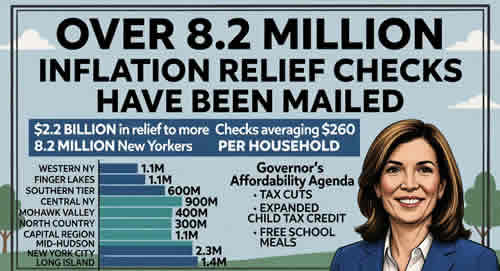
With Over 8.2 Million Inflation Refund Checks Out the Door, Governor Fulfills Her Commitment to Putting More Money in New Yorkers’ Pockets
Governor Kathy Hochul today announced that 8.2 million checks have now been mailed to eligible New Yorkers under the state’s first-ever Inflation Refund Check program.
“Today marks the day that over 8.2 million inflation refund checks have been mailed out, putting money back into the pockets of individuals across the state,” Governor Hochul said. “We followed through on our commitment to deliver meaningful relief to hard-working New Yorkers, and will continue, every day, to look for additional opportunities to deal with the nation’s ongoing affordability challenge.”
Governor Hochul secured the Inflation Refund Check initiative in the FY 2026 State Budget. It’s the largest program of its kind in state history — providing $2.2 billion in direct, unrestricted financial aid to more than 8.2 million New Yorkers.
Over the last two months, inflation refund checks of up to $400 have been mailed to those who meet eligibility criteria. The main phase of large-scale check mailing is now complete. However, checks will continue to be mailed in small numbers in the weeks ahead as the State Tax Department determines that additional taxpayers are eligible.
Here’s a breakout of the number of checks and amounts going to each region of the state:
Inflation Rebate Check – Enacted Budget
Beneficiaries
Total Benefit ($M)
Western NY
585,000
152.7
Finger Lakes
513,000
134.3
Southern Tier
251,000
66.7
Central New York
321,000
83.8
Mohawk Valley
198,000
52.4
North Country
156,000
42.4
Capital Region
475,000
122.8
Mid-Hudson
924,000
234.2
New York City
3,536,000
828.8
Long Island
1,251,000
316.4
All
8,210,000
2,035
Inflation Refund Checks are a key element of the Governor’s Affordability Agenda. Other elements include:
Cutting taxes for the middle class to their lowest levels in 70 years;
Expanding New York’s Child Tax Credit to up to $1,000 per child, and;
Ensuring universal free school meals to save families around $1,600 per child.
– New York City Mayor Eric Adams and Queens Borough President Donovan Richards today announced the “Queens Holocaust Memorial,” a new public site to honor the memory of the six million Jewish people murdered in the Holocaust as well as the survivors who rebuilt their lives in New York City. The memorial will be located on the grounds of Queens Borough Hall and serve as a permanent site of remembrance, education, and unity. The city and the Office of the Queens Borough President have allocated a total of $3 million to support the project’s development; the New York City Department of Citywide Administrative Services (DCAS) will oversee the site designation and coordination with community stakeholders and civic leaders. The City will advance a formal design process to build a commemorative garden and public artwork. The artist selection process will be led by the New York City Department of Cultural Affairs’ “Percent for Art” program in consultation with artists, historians, and Holocaust survivors.
“It is not enough to say ‘never again’ — we have to live it with our actions too. By preserving the stories of both victims and survivors, by creating a permanent space for remembrance and reflection, by promoting understanding and solidarity across generations, this memorial will live out the meaning of ‘never again,’” said Mayor Adams. “As our city and our country confront the rising tide of antisemitism, our administration will not remain silent. We will use our office to call out hate wherever we find it, encourage compassion wherever we need it, and create a city where everyone can live side by side in harmony.”
“No matter how much time passes since the evils of the Holocaust, New York City’s commitment to the pledge of ‘Never Again’ must never waver. That is why, in the face of rising tides of heinous anti-Semitism and Holocaust denial across our society, I could not be prouder to lead this effort alongside the administration and the Queens’ Jewish community in creating this critically important memorial here at Queens Borough Hall,” said Queens Borough President Donovan Richards Jr. “The Queens Holocaust Memorial will not only pay a touching tribute to the six million innocent Jews murdered by the Nazis and the survivors who settled in our borough afterward, but it will also serve as daily inspiration for our fight to forge a future free of anti-Semitism. I thank all our city and community partners for their commitment to see this memorial through.”
“When hate crimes, vandalism, and extremist rhetoric targeting Jewish communities are happening both nationally and globally, this memorial will stand not only as a powerful testament to those lost and to those who rebuilt, but also as a rebuke to intolerance and a reminder of our imperative to confront hatred with moral clarity,” said Moshe Davis, executive director, Mayor’s Office to Combat Antisemitism.
“This Holocaust Memorial Garden we begin to build today, is a reminder of what can happen if we forget the past. It will also serve to keep our focus on the present, while we hope for our future,” said Michael Nussbaum, chairman, Holocaust Memorial Garden. “The Memorial Garden will be a place where anyone can come to reflect and seek peace.”
New York City is home to more Holocaust survivors than any other city in the world. Following the liberation of the concentration camps, thousands of survivors came to New York, many settling in Queens, where they rebuilt their lives, raised families, established businesses, enriched the city’s cultural institutions, and helped make New York a global center of Jewish life.
The memorial was originally proposed by the Queens Jewish Community Council in partnership with local civic and faith leaders. The City of New York will formally designate and dedicate the site for the purpose of a Holocaust Memorial through a DCAS assignment letter. The Queens Jewish Community Council will lead additional fundraising efforts to support the design and construction of the commemorative artwork. When complete, the Queens Holocaust Memorial will be the first major Holocaust memorial in Queens, joining other sites of remembrance throughout New York City. The memorial site will host Holocaust remembrance ceremonies, educational programs for students, and community gatherings that promote understanding and solidarity across generations and communities.
“I have seen how education helps young people understand the world around them and recognize the dangers of prejudice and intolerance. This memorial garden will give students and families a place to learn, reflect, and confront the realities of antisemitism and other forms of hate crimes,” said Toby Stavisky, New York State senator. “Michael Nussbaum and I both began our careers as social studies teachers, and we know how important it is to reach children early. That’s why I committed $1 million in capital funding to help bring this project to life. This garden will serve as a living classroom and a reminder that understanding our history is essential to ensuring that ‘never again’ is not forgotten.”
“This Holocaust Memorial in Queens honors the profound anguish and undeniable truth of actual genocide that tore families and communities apart. But it also reflects the extraordinary resilience of those who survived. Of people who carried unimaginable pain yet still chose hope, rebuilding, and the promise of a new future,” said Sam Berger, New York State assemblymember. “Many Holocaust survivors, my grandparents among them, came to Forest Hills seeking safety, dignity, and a chance to start again. They didn’t just rebuild their own lives. They helped build Queens. Their strength, their values, and their determination are woven into the rich and diverse history of this borough. They opened businesses, raised families, contributed to our civic life, and helped create the vibrant community we are proud to call home.
“Trauma leaves its mark, but it does not have to define us,” continued Berger. “This memorial stands as a reminder of the past we must never forget, and as a testament to the enduring spirit of those who transformed their suffering into a legacy of resilience, community, and hope.”
“The Queens Holocaust Memorial Garden will create a lasting place of reflection and remembrance for the Jewish community in Queens. This garden will stand in honor of the six million Jews who were systematically persecuted and murdered, as well as the millions of non-Jewish civilians, soldiers, and prisoners of war who also perished across Europe,” said Melinda Katz, district attorney of Queens. As time passes and we lose more Holocaust survivors—those who witnessed these atrocities firsthand—it becomes our collective responsibility to preserve their stories and protect the truth. I thank Mayor Eric Adams, Queens Borough President Donovan Richards and Memorial Garden Chairman Michael Nussbaum for their commitment in bringing this meaningful project to life. This memorial will serve as a powerful reminder of the consequences of unchecked hatred to ensure that history never repeats itself.”
“This Holocaust Memorial Garden is symbolic of the times we live in. A garden shows the beauty that surrounds us, while the memorial honors the memories of those who were brutally murdered during the Holocaust. It is vital to continue to honor the memory of the Holocaust, while also providing support to the remaining 14,700 survivors who live in New York City,” said Masha Pearl, executive director of The Blue Card. “This is a beautiful creation, and we are honored to take part in this memorial. Thank you to Mayor Eric Adams and Queens Borough President Donovan Richards for making this vision a reality.”
New York City Mayor Eric Adams and NYC Talent Executive Director Doug Lipari announced two major Project Labor Agreements (PLAs) with the Building & Construction Trades Council of Greater New York and Vicinity, covering more than $7 billion in city capital projects to build and renovate libraries, recreation centers, clean energy systems, water treatment facilities, and other critical infrastructure. The PLAs lock in fair wages, union benefits, and strong safety standards while including community hiring requirements that prioritize residents of NYCHA housing and low-income neighborhoods, helping connect underserved New Yorkers to good-paying union careers. Nearly 100 city procurements totaling over $7.5 billion have already been released with community hiring goals, and a new memorandum of understanding with BCTC and the Building Trade Employers’ Association will recruit 700 pre-apprentices from public housing and disadvantaged communities into free pre-apprenticeship programs that feed directly into union apprenticeships. This initiative advances Mayor Adams’ “moonshot” goal of connecting 30,000 New Yorkers to apprenticeships by 2030, strengthens the city’s construction workforce pipeline, and ensures that New Yorkers who build the city’s future infrastructure also gain long-term pathways to the middle class.
Mayor Adams Announces New Project Labor Agreements Covering More Than $7 Billion in City Projects to Build Critical Infrastructure and Deliver Good-Paying, Union Careers
– New York City Mayor Eric Adams and New York City Office of Talent and Workforce Development (NYC Talent) Executive Director Doug Lipari today announced two Project Labor Agreements (PLA) with the Building & Construction Trades Council of Greater New York and Vicinity (BCTC). These PLAs — which cover more than $7 billion in city capital projects — establish fair wages, union benefits, and safety protections for workers on city projects. They will help connect more underserved New Yorkers to quality union careers and apprenticeship opportunities through community hiring requirements and allow the city to complete capital projects more effectively and efficiently through the use of standardized work rules.
“Under our administration, we haven’t just talked about creating opportunities, we’ve put our money where our mouth is and invested real dollars in real projects and delivered the good-paying jobs New Yorkers need,” said Mayor Adams. “If the city is going to build a new library or recreation center, we want to make sure those jobs pay well during the day and get workers home safe at night. With more than $7 billion labor agreements, we’ll do both — all while hiring from the local community and completing critical projects faster. That’s a win for everyone involved.”
“Project Labor Agreements are a proven tool for delivering capital projects efficiently, establishing fair wages and working conditions, and creating robust career pathways for New Yorkers,” said Mayor’s Office of Talent and Workforce Development Executive Director Doug Lipari. “These new PLAs reflect the city’s strong partnership with the Building and Construction Trades Council and solidify the city’s dedication to the future construction workforce through Community Hiring.”
The newly signed PLAs announced today will serve a broad range of city capital projects. The Citywide Renovation and New Construction PLA will apply to new construction, renovation, and rehabilitation of city-owned buildings and structures; for instance, this PLA will apply to projects like construction of recreation centers and solar photovoltaic systems for public schools, as well as renovation of water treatment facilities and libraries like the recently announced renovation of Baisley Park Library in Jamaica, Queens. The PLAs follow last year’s announcement of a new infrastructure design-build PLA and furthers the Adams administration’s commitment to establish work standards for family-sustaining wages and benefits, industry-specific safety standards, and training opportunities.
The PLAs announced today also include community hiring requirements, which allows the city to use its purchasing power to set workforce and hiring goals on city contracts and provide hardworking New Yorkers good-paying union career opportunities that pave a path to the middle class. Since launching, nearly 100 city procurements — totaling more than$7.5 billion — have been released with community hiring goals. These include construction and building services contracts that require a significant portion of labor hours be performed by people who live in New York City Housing Authority housing or in a ZIP code where at least 15 percent of the population lives below the federal poverty threshold.
Today’s announcement will also create additional apprenticeship opportunities in the construction sector through community hiring requirements and advance Mayor Adams’ 2023 State of the City moonshot goal of connecting 30,000 New Yorkers to apprenticeships by 2030. Through a new memorandum of understanding (MOU), the city, BCTC and the Building Trade Employers’ Association of New York City (BTEA) will work collectively to recruit and fill 700 pre-apprenticeship positions with residents of NYCHA housing and low-income communities. These pre-apprenticeship programs provide free skills and training and offer individuals direct entry into unionized apprenticeship programs. These efforts demonstrate the commitment to invest in the next generation of the City’s construction workforce and provide a pathway for career advancement.
“We are thrilled that city-funded projects are being produced with union labor, safer work requirements, and community hiring that will bring good job opportunities to the underserved while upgrading libraries, recreational centers, and other public works,” said New York City Councilmember Carmen De La Rosa.
“Thank you to President LaBarbera, Paul O’Connor and Santos Rodriguez along with Deputy Mayor Carrion Jr. and the whole mayoral team who worked on this project labor agreement,” said New York CityCouncilmember Julie Won. “As the representative of the council district that is home to UA Local 1 Plumbers, I am always happy to support apprenticeships and the expansion of PLAs in the City, and I will work to make it priority that we get new PLAs all future projects in my district.”
“In order for capital projects to reach their true economic potential, it is critical that they generate family-sustaining careers for hardworking New Yorkers,” said Gary LaBarbera, president, Building and Construction Trades Council of Greater New York. “PLAs like the ones signed help them to do just that and more by establishing fair wages, safety standards, and community hiring initiatives that boost apprenticeship opportunities and open up more pathways to the middle class. We are happy to collaborate with the Mayor’s Office and NYC Talent on these agreements and our members look forward to being catalysts for these important projects that will improve the lives of countless New Yorkers.”
“It is great that New York City and the Building Trades continue their great relationship with the signing of these Project Labor Agreements. These city capital projects will create more opportunities for men and women to become apprentices in our programs. It will provide them with fair wages and union benefits, making their lives better and providing the pathway to the middle class,” said John Jovic, business manager/FST, Local 12 Heat and Frost Insulators. “I would like to thank Building Trades President Gary LaBarbera and his staff, as well as Mayor Adams and his staff for all their hard work in putting these Project Labor Agreements together.”
“Plumbers Local 1 and its 6,000 members are honored to host the signing of this historic PLA with NYC. The phrase ‘The great multiplier is defined as a factor or effect that causes a relatively small initial change to have a larger, widespread impact.’This project labor agreement is exactly that, the great multiplier. It is by no means a small change, it is significant, but its impact on the future of New York City will be even more significant. It will not only upgrade critical infrastructure; it will also build a better New York City and continue to build for years to come.This future will be built by residents of New York City who will be given access into our great labor organizations,” said Paul O’Connor, business manager, United Association of Plumbers Local 1. “To quote George Meany ‘the basic goal of labor will not change. It is-as it has always been, and I’m sure always will be, to better the standards of life for all who work for wages, and to seek decency and justice and dignity for all Americans.’ This quote is as accurate today as it has always been. I want to thank Gary LaBarbera, the mayor, and his staff for securing not only this PLA but a prosperous future for New Yorkers.”
“This Project Labor Agreement is a win for New York City’s working families. It means more good-paying union jobs, stronger apprenticeship opportunities for the next generation, and a commitment to building our city the right way with skill, safety, and dignity,” said Joseph Azzopardi, business manager and secretary-treasurer, District Council No. 9, International Union of Painters and Allied Trades. “I want to thank President Gary LaBarbera for his leadership and partnership, and Mayor Eric Adams for recognizing the value that union labor brings to every project. Together, we’re creating pathways into the trades and ensuring New York’s future is built by the very people who call it home.”
“More than $7 billion in Project Labor Agreements is the kind of big, bold commitment New York needs right now, and continues to prove that building labor in New York City is a solid investment in our future. This deal means faster projects, safer jobs, and fairer wages for the union trades who build our city every day,” said Carlo A. Scissura, Esq., president and CEO, New York Building Congress. “It opens the door for thousands of apprentices to earn and learn on real projects, from recreation centers and libraries to clean energy systems. This is how you grow middle-class careers, modernize critical infrastructure, and prove that public investment and union labor move New York forward together.”
“The 200+ members of the Building Contractors Association have long found that project labor agreements can benefit all parties involved in a construction project,” said John O’Hare, managing director, Building Contractors Association. “When these PLA’s provide training and opportunities for the next generation of building trades tradesmen and tradeswomen, it adds another valuable component to the agreement. We look forward to working with city officials, the affiliated unions of the Building Trades and the communities who will benefit from this massive and important project.”
New York Attorney General Letitia James and a coalition of 20 other state attorneys general won a major court ruling blocking the Trump administration from eliminating four federal agencies that support libraries, museums, minority-owned businesses, workers, and efforts to combat homelessness. A federal judge in Rhode Island granted summary judgment stopping an Executive Order that sought to dismantle the Institute of Museum and Library Services, the Minority Business Development Agency, the Federal Mediation and Conciliation Service, and the U.S. Interagency Council on Homelessness. The court agreed with the attorneys general that the president cannot unilaterally shut down agencies created and funded by Congress, calling the administration’s actions unlawful and barring future attempts to carry out the order. James called the decision a major victory for protecting critical services that communities rely on every day.
Attorney General James Wins Lawsuit Stopping Elimination of Four Vital Federal Agencies
Court Bars Trump Administration from Dismantling Federal Agencies Supporting Libraries, Museums, Minority-Owned Businesses, Workers, and Services for the Unhoused
– New York Attorney General Letitia James today won her lawsuit protecting four federal agencies from being illegally dismantled by the Trump administration. The United States District Court for the District of Rhode Island today granted a motion for summary judgment brought by Attorney General James and a coalition of 20 other attorneys general. In April, Attorney General James co-led the coalition in suing the administration to stop the implementation of an Executive Order that would dismantle the Institute of Museum and Library Services (IMLS), the Minority Business Development Agency (MBDA), the Federal Mediation and Conciliation Service (FMCS), and the U.S. Interagency Council on Homelessness (USICH). The court’s order permanently blocks the administration from eliminating these four agencies.
“The federal government’s illegal attack on these agencies threatened vital resources for workers, small businesses, and the most vulnerable in our communities,” said Attorney General James. “This is a major victory in our ongoing work to defend important services that New Yorkers rely on every day. I will keep fighting to stop the chaos and destruction of this administration’s attempts to dismantle our government.”
In April, Attorney General James and the coalition sued to stop the administration’s elimination of three federal agencies:
IMLS, which supports museums and libraries nationwide through grantmaking, research, and policy development;
MBDA, which promotes the growth and inclusion of minority-owned businesses through federal financial assistance programs; and
FMCS, which promotes the peaceful resolution of labor disputes.
In May, Attorney General James and the coalition secured a preliminary injunction stopping the administration from implementing the Executive Order, which sought to dismantle these three agencies. In June, the coalition filed an amended lawsuit seeking to protect another agency targeted by the same Executive Order, USICH, which coordinates the federal government’s efforts to prevent and end homelessness nationwide.
Attorney General James and the coalition argued in the lawsuit that the Executive Order’s elimination of all four agencies violates the Constitution and the Administrative Procedure Act by attempting to override Congress. The president does not have the power to unilaterally eliminate federal agencies created and funded by Congress, and he cannot arbitrarily and suddenly cease agency programs. In its decision on the motion for summary judgment, the District Court sided with Attorney General James and the coalition, ruling that the administration’s actions were unlawful, and barred the administration from taking any future actions to carry out the Executive Order’s elimination of the four agencies.
This lawsuit is led by Attorney General James and the attorneys general of Rhode Island and Hawaii. Joining the lawsuit are the attorneys general of Arizona, California, Colorado, Connecticut, Delaware, Illinois, Maine, Maryland, Massachusetts, Michigan, Minnesota, Nevada, New Jersey, New Mexico, Oregon, Vermont, Washington, and Wisconsin.
Governor Kathy Hochul today announced that the New York State Police and local law enforcement agencies throughout the state will increase patrols to target impaired and reckless driving during the Thanksgiving travel season. Funded by the Governor’s Traffic Safety Committee (GTSC), the special enforcement period runs from Saturday, November 22 through Sunday, November 30 and also will address other unsafe driving behaviors, including violations of the state’s Move Over Law.
“Thanksgiving is the beginning of the busy holiday season with thousands of people traveling to gather and celebrate with friends and family,” Governor Hochul said. “Those celebrations should not be marred by tragedy caused by impaired or reckless driving on our roadways. I urge drivers to stay alert, stay sober and move over when you see vehicles stopped on the side of the road. I thank our troopers and local law enforcement for spending time away from their loved ones to work on Thanksgiving and throughout the holidays to help keep New York’s roadways safe.”
In addition to increased traffic volume during the Thanksgiving holiday period, it also is a time of the year associated with increased alcohol use. During the 2024 Thanksgiving holiday period, law enforcement officers arrested 1,705 drivers for driving while impaired or intoxicated, and issued 10,078 speeding tickets, and 1,702 tickets for distracted driving.
New York State Department of Motor Vehicles Commissioner and GTSC Chair Mark J.F. Schroeder said, “We want everyone to enjoy the Thanksgiving holiday with their friends and families this year and for years to come. Impaired driving can change the very fabric of a family and alter holiday memories forever. Nobody wants to live with the consequences of poor decisions that could have been easily avoided.”
New York State Police Superintendent Steven G. James said, “Every year, there are preventable tragedies and a wake of victims left behind because of the decisions made by reckless and impaired drivers. As we drive throughout the state to see our family and friends this Thanksgiving holiday, driver safety is absolutely imperative. The New York State Police proudly joins our law enforcement partners in the continued effort to discourage, detect, and apprehend impaired and drunk drivers.”
The State Police will supplement regular patrols statewide through efforts including fixed sobriety checkpoints and utilizing Concealed Identity Traffic Enforcement (CITE) patrol vehicles to better spot distracted drivers and those talking or texting on handheld devices. These unmarked vehicles blend in with everyday traffic but are unmistakable as emergency vehicles once the emergency lighting is activated.
The average drinking and driving arrest costs up to $10,000. Individuals arrested for drunk and drugged driving face the loss of their driver’s license, higher insurance rates, and expenses from attorney fees, fines, car towing and repairs, and lost time at work.
Construction Closures Suspended
To help ease travel during the busy holiday season, lane closures for road and bridge construction projects on New York State highways will be suspended beginning 6 a.m. on Wednesday, November 26 through 6 a.m. on Monday, December 1.
The construction suspension aligns with New York State’s Drivers First Initiative, which prioritizes the convenience of motorists to minimize traffic congestion and travel delays due to road and bridge work. Motorists should be aware some work may continue behind permanent concrete barriers or for emergency repairs.
Text stops, including park-and-ride facilities, rest stops, service areas and parking areas along state highways support the state’s effort to reduce distracted driving.
In advance of the busy travel week for the Thanksgiving holiday, all 27 service areas located on the New York State Thruway are now open. Motorists can view the service areas and plan their stops on the Thruway Authority’s website and on the free mobile app, which is available to download for free on iPhone and Android devices. The app also provides motorists direct access to real-time traffic and navigation assistance while on the go. Motorists can also sign up for TRANSalert emails, which provide the latest conditions along the Thruway.
Travelers can also check NYSDOT’s 511NY before traveling by calling 5-1-1, visiting the 511 website, or downloading the free 511NY mobile app on the App Store or Google Play. The free service allows users to check road conditions, view 2,219 traffic cameras and link to air and transit information. The app features Drive mode, which provides audible alerts along a chosen route while a user is driving, warning them about incidents and construction.
New York State Department of Transportation Commissioner Marie Therese Dominguez said, “The Thanksgiving holiday weekend is one of the most important times of the year for families across New York to gather with their loved ones, and we want to make sure everyone gets to their destinations safely. By lifting construction restrictions during one of the busiest weekends for travel, we’re helping all New Yorkers spend less time in traffic and more time with one another. We urge all motorists to drive carefully this holiday season, and if you do come across one of our crews over the coming weeks, please slow down and give them room to do their jobs safely.”
New York State Thruway Authority Executive Director Frank G. Hoare said, “The Thanksgiving holiday weekend is one of the busiest travel times of the year, and suspending construction activities will help motorists get to their destinations with fewer delays. We urge motorists to make safety a priority-remain alert, don’t drive distracted or impaired, and slow down and move over if it’s safe to do so for all vehicles on the side of the road. We thank our partners at New York State Police Troop T for patrolling the Thruway and keeping motorists safe.”
Chautauqua County Sheriff and President of the NYS Sheriffs’ Association James Quattrone said, “The Thanksgiving holiday is a great opportunity to spend time with family and friends. It is also a time when some people may drive impaired which puts themselves and others in danger. Law enforcement will be on the lookout for impaired and aggressive drivers. The Sheriffs of New York State want you to enjoy the long holiday weekend, be safe, courteous drivers, and have a plan to not drive impaired.”
New York State Association of Chiefs of Police President and Mount Pleasant Police Department Paul Oliva said, “As we enter the season of giving thanks for our blessings, local law enforcement will be out conducting Impaired Driver and Excessive Speed engagement details, ensuring that travel on our roadways is safe for everyone. Please drive attentively so all can make their destinations to enjoy the holiday weekend with family and friends.”
The Governor’s Traffic Safety Committee and the New York State STOP-DWI Foundation remind motorists that their “Have a Plan” mobile app, is available for Apple, Android and Windows smartphones. The app enables New Yorkers to locate and call a taxi or rideshare service and program a designated driver list. It also provides information on DWI laws and penalties and provides a way to report a suspected impaired driver.
On MS NOW’s All In, New York Gov. Kathy Hochul said the President’s meeting with Zohran Mamdani showed New York City is “in good hands” with a leader focused on public safety and affordability, making federal steps like sending in the National Guard unnecessary as crime drops and subways get safer. She said she’ll partner with the mayor-elect to build more housing, expand childcare and push down utility costs, arguing voters are “exhausted” and want leaders who understand their struggles. Hochul also blasted Rep. Elise Stefanik’s attacks on Mamdani as extreme and dangerous, and said as leader of the state Democratic Party she backed Mamdani early because New York City is the economic engine of the state and the nation.
Governor Hochul Is a Guest on “All In” With Chris Hayes on MS NOW
Governor Hochul: “[We have to] set the tone to let the President know that the city is in good hands. That we have a mayor who is vested in its success and keeping people safe and being laser focused on affordability. And so once they kind of came to those terms, I think we are in a much better place. And, we’ll just continue focusing on New York and our people as I will.”
Hochul: “I want to make sure that we get over the finish line. Building more housing. I’ve been talking about this for years. We can focus on childcare to help families that are struggling. We can do what we can to drive down utility costs, because that’s what the voters are expecting. They’re exhausted, they’re tired, they’re looking for real leadership of people who understand what they’re going through.”
Earlier tonight, Governor Hochul was a guest on “All In” with Chris Hayes on MS NOW.
A rush transcript of the Governor’s remarks is available below:
Chris Hayes, MS NOW: Governor, it’s good to have you, and I have to ask you what — was that the way that you saw this going?
Governor Hochul: Well, I’ve had meetings with the President and the White House as well, so, I wasn’t terribly surprised. I know the mayor very well. I believe that he demonstrated credible leadership by willing to go into the White House and have this conversation. And so it was probably a lot friendlier than people expected, but they’re both people. I had a sense they both get along in this context, when they’re talking about issues where there’s a common bond and a common interest, which appears to be affordability is something I’ve talked about for a long time.
The mayor has leaned into, in a way that was powerful. And so anyone who wants to work with us, to drive down the cost of living in New York. We’ll have those meetings, we’ll have those conversations and hopefully get things really done.
Chris Hayes, MS NOW: Partly this is optics and partly it’s interpersonal relationships, and partly it is I think the fact the President’s actually in person pretty conflict diverse. But there’s real stakes here. I mean, we have seen the videos and headlines out of Los Angeles, out of Chicago, out of Charlotte —- border patrol wrestling people to the ground, breaking people’s windows, children running from church, U.S. citizens having people with helicopters repel down their buildings, right?
So far, we have not seen that level of targeting of the City of New York by the federal DHS. Do you think today’s meeting is a welcome development in forestalling or avoiding that kind of faith?
Governor Hochul: Absolutely. First of all, this was an important takeaway. This was my hope that the President would see in Zohran Mamdani — someone who can lead the city, who is focused on public safety, who is working on affordability and quality of life issues and to give the President who is a New Yorker, who cares about the city, the confidence to know that he can lead. And I will continue to be his partner and make sure he’s successful.
But I also had a conversation with the President a few months ago, about it was unnecessary to send the National Guard to New York. Our crime rates are going down. We’ve worked hard on this. Our subways are safer than they’ve been in decades. So I said to the President, “You don’t need to send the National Guard in. We have 35,000 sworn members of the NYPD who work hard every day to protect our city. But if we need help, Mr. President, we’ll give you a call.” And he hasn’t called. We’re fine. I haven’t had to talk to him about that.
So I think between that, and also this really important meeting, set the tone to let the President know that the city is in good hands. That we have a mayor who is vested in its success and keeping people safe and being laser focused on affordability. And so once they kind of came to those terms, I think we are in a much better place. And, we’ll just continue focusing on New York and our people as I will. And the President has certainly has other issues to be concerned about, rather than sending troops into our streets.
Chris Hayes, MS NOW: A lot of people have noted political observers that one of the political casualties of today was Elise Stefanik, the New York member of Congress, who has announced she will be running against you for governor. And part of the reason is that she has — out of the gate — basically tried to tie you to Zohran Mamdani. She’s also keeps calling him a ‘jihadist,’ which I personally find really gross, bigoted, and objectionable. This was — he was asked about that and he swatted it away. He said, he doesn’t see it that way.
I want to read you her statement today after the meeting. “We all want New York City to succeed, but we’ll have to agree to disagree on this one. If he walks like a jihadist, if he talks like a jihadist, if he campaigns like a jihadist. If he supports jihadist, he’s a jihadist, and he’s Kathy Hochul’s jihadist.” Do you have a response to that?
Governor Hochul: She’s full of shit. I’m sorry. I mean, she really is. I mean, this is such an extreme position. Such an extreme position. She’s even more extreme than Donald Trump. I didn’t think that was possible. But she’s succeeded in proving that today she’s out-MAGA’d Donald Trump, the founder of the MAGA Movement.
So I hope she’s proud of herself, continuing to spew hateful thoughts and deeds and instead — and trying to create more violence in our political rhetoric. I think it’s disgusting, it’s abhorent, but that’s who she is, and people are seeing this, and even the President — realize that’s even too far for him.
Chris Hayes, MS NOW: On the politics of this as well, you were fairly early in endorsing Zohran Mamdani after he won the primary. Others took much longer like Hakeem Jeffries — notably the Senate minority leader, Chuck Schumer, who of course represents the State of New York in the US Senate, has never endorsed him. Given the fact that even Donald Trump seemed amenable to working with Mamdani and seemed charmed by him. Does it make the Senate Minority Leader’s lack of endorsement, kind of stand out as even more strange?
Governor Hochul: No, I won’t comment on that because everyone does what they need to do, but for me, it was important to show as the leader of the Democratic Party in the State of New York, this was our Democratic nominee, and we all should be interested, invested, and committed to his success. Because New York City is the economic engine of not just our state, but the entire nation. So never root against New York City. And I’ve pledged to work with the mayor, the new Mayor-Elect.
We’ve had many conversations and meetings that are extremely productive. And again, I want to make sure that we get over the finish line. Building more housing. I’ve been talking about this for years. We can focus on childcare to help families that are struggling. We can do what we can to drive down utility costs, because that’s what the voters are expecting. They’re exhausted, they’re tired, they’re looking for real leadership of people who understand what they’re going through.
I do for my own life story, I see people going through this now. I know it’s real and that’s what we can do in New York. So I think it’s going to be a new era, a new chapter for New York City, and I’m really excited to continue partnering with the mayor — the Mayor-Elect.
Chris Hayes, MS NOW: All right, Governor Kathy Hochul from Albany. Thank you very much. Appreciate it.
New York Gov. Kathy Hochul is blasting the Trump administration, saying the White House is threatening to pull hundreds of millions of dollars in rural broadband funding from upstate communities because the state passed tough new rules on artificial intelligence. Hochul says the AI safeguards are designed to protect kids, workers and consumers, and accuses Washington of siding with big corporations that don’t want to take basic steps to prevent AI-related harm. Calling the move “unacceptable,” she vows to keep fighting for working families and to keep New York at the forefront of “responsible AI” policy.
Statement from Governor Kathy Hochul
“We passed some of the nation’s strongest AI safeguards to protect kids, workers and consumers. Now, the White House is threatening to withhold hundreds of millions of dollars in broadband funding meant for rural upstate communities, all to shield big corporations from taking basic steps to prevent potential harm from AI.
“This is unacceptable. In New York, we protect working families and set the standard for the nation. I will continue to fight to ensure our state remains a global leader in responsible AI.”
ALBANY, N.Y. — New York Gov. Kathy Hochul and state Education Commissioner Betty Rosa fired back Wednesday at President-elect Donald Trump’s push to eliminate the U.S. Department of Education, calling the move “catastrophic” and a “direct attack” on the state’s schools. In a sharply worded joint statement, the Democratic leaders warned that breaking up the federal agency and shifting its duties elsewhere would put millions of New York students at risk and disrupt everything from special education services to civil rights enforcement in classrooms. “We won’t go down without a fight – not when our kids are on the line,” they declared, vowing to defend public education against what they described as an attempt to dismantle the nation’s school system.
Joint Statement from Governor Kathy Hochul and State Education Commissioner Betty Rosa
“The Trump administration’s decision to tear apart the Department of Education carries catastrophic consequences for education nationwide. By outsourcing the Department’s responsibilities to other federal agencies, the administration is moving closer to its misguided goal of dismantling our education system, and in doing so, threatens to upend New York’s school system, putting millions of students’ educations at risk. Make no mistake, this maneuver is a direct attack on New York teachers, students, and families and its effects will be felt in schools statewide.
“New York is committed to standing up for our students and ensuring their futures remain front and center. We won’t go down without a fight – not when our kids are on the line.”