
The Jewish people are often spoken of as a single group, but in reality, Jewish history is a tapestry of migrations, exiles, conversions, and centuries-long separations. These events produced a wide range of Jewish ethnocultural groups, each with its own customs, languages, and—importantly—genetic signatures.
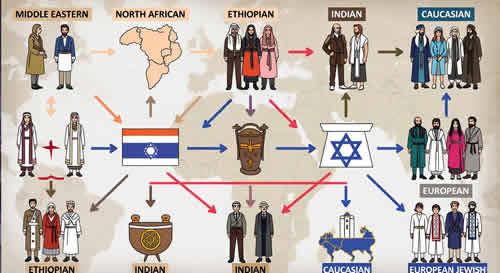
Modern genetic research has shown that while many Jewish communities share ancient Middle Eastern ancestry, different Jewish ethnic groups exhibit clear DNA differences that reflect their unique journeys across time and geography. Below is a fascinating look at how genetics helps us understand the story of Jewish diversity.
Shared Origins, Different Paths: Why Jewish DNA Is Not All the Same
Most Jewish groups retain a significant component of Levantine ancestry, tracing back to ancient Israelites. Yet over thousands of years, Jews settled in Mesopotamia, Persia, North Africa, the Caucasus, Europe, India, and even Ethiopia and China. Each community experienced:
- isolation
- intermarriage with local populations
- religious conversions
- genetic bottlenecks
- unique migrations
These shaped distinct genetic profiles. As a result, there is no single “Jewish DNA,” but rather multiple genetic patterns within the global Jewish population.
Genetic Differences Among Major Jewish Ethnic Groups
1. Middle Eastern Jews (Mizrahi)
Mizrahi communities—including Iranian, Iraqi, Syrian, Kurdish, Georgian, Yemeni, and Bukharan Jews—generally show strong Middle Eastern genetic continuity. Despite shared ancient ancestry, each subgroup has its own DNA profile formed through centuries of local history.
For example:
- Iranian and Iraqi Jews are genetically very close to each other but distinct from Yemenite or North African Jews.
- Yemenite Jews show unique markers likely influenced by ancient South Arabian populations.
- Bukharan Jews have Middle Eastern roots but also Central Asian admixture.
These differences create identifiable genetic clusters within the broader Middle Eastern Jewish family.
2. North African Jews
Moroccan, Algerian, Tunisian, Libyan, and Egyptian Jews form their own genetic cluster, separate from both Middle Eastern Mizrahim and European Jews.
- Moroccan Jews show mixtures of ancient Israelite, Berber, and Spanish/Portuguese Jewish ancestry.
- Libyan Jews are genetically more isolated, with distinct patterns reflecting long periods of endogamy.
North African Jewish DNA is internally diverse—but still distinct from neighboring non-Jewish populations.
3. Ethiopian Jews (Beta Israel)
Ethiopian Jews stand out genetically more than almost any other Jewish group.
- Their DNA shows strong Ethiopian highland ancestry, especially in maternal lineages.
- Yet there are hints of very ancient Near-Eastern admixture, possibly consistent with ancient Judaic influence.
Their distinct DNA tells a story of a long-isolated community with deep regional roots.
4. Indian Jews (Bene Israel, Cochin, and Baghdadi Jews)
Indian Jewish communities are among the world’s most genetically fascinating.
• Bene Israel
Show a clear mix of Jewish Middle Eastern ancestry and local Indian ancestry, reflecting ancient admixture followed by 2,000 years of endogamy.
• Cochin Jews
Blend Jewish Middle Eastern ancestry with South Indian ancestry, forming a unique genetic identity in the Kerala region.
• Baghdadi Jews
Descend mostly from Iraqi and Syrian Jews who migrated to India much later (18–19th century), so genetically they resemble Middle Eastern Jews more than Indian Jews.
5. Caucasus Jews (Mountain Jews, Georgian Jews, Krymchaks)
Mountain Jews (Juhuro)
Have a strong Middle Eastern core but also Caucasian admixture, producing one of the most distinctive Jewish genetic profiles.
Georgian Jews
Genetically closer to local Georgian populations, reflecting a 2,000-year presence in the region.
Krymchaks
Show a mixture of Middle Eastern Jewish ancestry and Crimean-Tatar influences.
6. Romaniote and Italian Jews
These ancient European Jewish communities are genetically distinct from both Ashkenazi and Sephardic Jews.
- Romaniote Jews of Greece show long continuity in the Balkans, with moderate Levantine and Mediterranean admixture.
- Italian Jews (Italkim) predate both Sephardim and Ashkenazim and form their own genetic category, combining ancient Jewish ancestry with Italian lineages.
What These DNA Differences Mean
1. Jewish identity has never been biologically uniform.
Each Jewish community carries a blend of ancient Israelite ancestry and the genetic signature of the region where it lived.
2. Many groups show strong Middle Eastern paternal ancestry, indicating continuity of male-line descent from ancient Hebrew populations.
3. Maternal ancestry varies widely, reflecting local converts, intermarriage, and unique historical events (for example, Ethiopian Jews carry mostly African mtDNA; Ashkenazim have mainly European mtDNA).
4. Jewish groups form identifiable genetic clusters, confirming that Ashkenazi, Sephardi, Mizrahi, Ethiopian, Indian, Caucasian, and North African Jews each have distinct genetic histories.
Conclusion: Jewish DNA Is a Mosaic of Many Histories
Genetic research beautifully illustrates what history already tells us: the Jewish people are not a single biological unit but a network of diverse communities, each shaped by its own migrations, neighbors, and centuries-long traditions.
From the mountains of Dagestan to the deserts of Yemen, from the shores of Morocco to the villages of Ethiopia and the coast of India—Jewish DNA tells a global story. These differences do not divide the Jewish people; instead, they highlight the cultural and historical richness of a people whose identity survived and evolved across continents for thousands of years.
Here’s a concise list of groups many people refer to:
Middle Eastern / Mizrahi
- Iranian (Persian)
- Iraqi (Babylonian)
- Syrian
- Yemenite
- Kurdish
- Georgian
- Bukharan
- Egyptian
- Libyan
- Tunisian
- Algerian
- Moroccan
Caucasus
- Mountain Jews (Juhuro)
- Krymchaks
- Karaites (religious identity debated)
African
- Ethiopian Beta Israel
- Falash Mura
- Abayudaya (modern)
South & East Asia
- Cochin Jews
- Bene Israel
- Baghdadi Jews of India
- Bnei Menashe
- Kaifeng Jews
Europe (non-Ashkenazi/Sephardi)
- Italian Jews (Italkim)
- Romaniote Jews
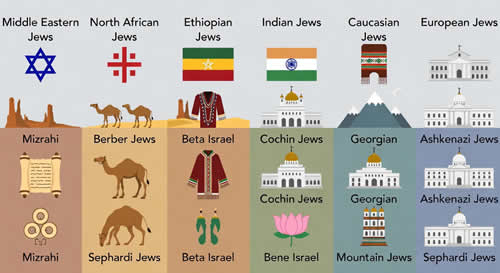
Summary of Genetics & Linguistic Features of Major Jewish Ethnic Groups
Below is a concise table-style narrative covering each major group.
Middle Eastern / Mizrahi Jews
1. Iranian (Persian) Jews
Genetics:
- Strong continuity with ancient Middle Eastern ancestry
- Minor admixture with Persian populations
- Distinct from both Ashkenazi and Iraqi Jews despite shared roots
Language:
- Historically Judeo-Persian (Persian with Hebrew elements)
- Also Judeo-Tat in some subgroups
2. Iraqi (Babylonian) Jews
Genetics:
- Strong Levantine/Mesopotamian ancestry
- One of the closest groups to ancient Near Eastern genetic profiles
Language:
- Judeo-Arabic and Judeo-Aramaic
- Aramaic dialects persisted until the 20th century
3. Syrian Jews (Halabi & Shami)
Genetics:
- Middle Eastern core with moderate Levantine admixture
- Distinct from both Ashkenazi and neighboring Arab populations
Language:
- Mostly Judeo-Arabic
4. Yemeni (Teimani) Jews
Genetics:
- Unique cluster within Jewish genetics
- Some influence from ancient South Arabian populations
- Very high endogamy
Language:
- Judeo-Arabic
- Distinct pronunciation of Hebrew
5. Kurdish Jews
Genetics:
- Strong Middle Eastern ancestry with genetic continuity to ancient Israelites
- Very low admixture
Language:
- Lishan Didan (Jewish Neo-Aramaic dialect)
6. Georgian Jews
Genetics:
- Mixed Middle Eastern and Georgian ancestry
- Very old, isolated community
Language:
- Judaeo-Georgian
7. Bukharan Jews
Genetics:
- Middle Eastern Jewish core with Central Asian admixture
- Unique genetic cluster
Language:
- Bukhori (Judeo-Tajik)
North African Jews (Maghrebi)
8. Moroccan Jews
Genetics:
- Mixed Levantine, Berber, and Iberian Jewish ancestry
- Distinct from local non-Jewish Moroccans
Language:
- Judeo-Arabic
- Haketía (a Judeo-Spanish dialect in northern Morocco)
9. Algerian & Tunisian Jews
Genetics:
- Similar to Moroccan Jews but more North-African admixture
- Still form a separate Jewish cluster
Language:
- Judeo-Arabic
10. Libyan Jews
Genetics:
- Highly endogamous, forming a unique cluster
- Some of the most genetically distinct North African Jews
Language:
- Judeo-Arabic
Caucasus Jews
11. Mountain Jews (Juhuro)
Genetics:
- Middle Eastern Jewish ancestry with Caucasus admixture
- Highly endogamous
Language:
- Juhuri (Judeo-Tat), a Persian-based language
12. Krymchaks
Genetics:
- Blend of Near Eastern Jewish and Crimean-Tatar ancestry
Language:
- Krymchak, related to Crimean Tatar with Hebrew elements
13. Georgian Jews
(Already listed under Mizrahi but also grouped here)
African Jewish Groups
14. Ethiopian Jews (Beta Israel)
Genetics:
- Primarily East African highland ancestry
- Some signatures consistent with ancient Near-Eastern influence
- Most genetically distinct Jewish group
Language:
- Ge’ez in liturgy
- Amharic / Tigrinya historically
15. Ethiopian Falash Mura
Genetics:
- Same as Beta Israel due to shared ancestry
- Some later admixture with Christian Ethiopians
Language:
- Same as Beta Israel
Indian Jewish Groups
16. Bene Israel
Genetics:
- Roughly 50/50 Jewish Middle Eastern + Indian ancestry
- Long-term endogamy after admixture
Language:
- Marathi (local language)
- No distinctive Judeo-language
17. Cochin Jews
Genetics:
- Mixture of Middle Eastern Jewish and South Indian ancestry
- Distinct from Bene Israel
Language:
- Judeo-Malayalam
18. Baghdadi Jews (India, Myanmar, Singapore)
Genetics:
- Middle Eastern ancestry similar to Iraqi Jews
- Minimal local admixture
Language:
- Judeo-Arabic
European (Non-Ashkenazi) Groups
19. Romaniote Jews
Genetics:
- Mediterranean + Middle Eastern ancestry
- Very old Jewish community predating Sephardim
Language:
- Judeo-Greek (Yevanic)
20. Italian Jews (Italkim)
Genetics:
- One of the oldest European Jewish groups
- Mix of ancient Jewish + Roman/Italian ancestry
- Distinct from both Ashkenazi and Sephardi
Language:
- Judeo-Italian (Italkian)
Asian Jewish Groups
21. Kaifeng Jews (China)
Genetics:
- Originally Middle Eastern in medieval times
- Heavy admixture with local Han Chinese populations
Language:
- Spoke Chinese
- No unique Judeo-language preserved
Ultra-Summary for Fast Use
Genetic Patterns Across Groups
- Middle Eastern core: Strong in Mizrahi, many North African, Caucasus, and Italian/Greek Jews
- High admixture: Indian Jews, Ethiopian Jews, Kaifeng Jews
- Highly isolated: Mountain Jews, Libyan Jews, Georgian Jews, Yemenite Jews
- Most distinct genetically: Ethiopian Jews, Kaifeng Jews
Linguistic Patterns Across Groups
- Judeo-Arabic: Widespread across Middle East & North Africa
- Judeo-Iranian / Judeo-Tat: Iran & Caucasus
- Judeo-Aramaic: Iraq, Kurdistan
- Judeo-Romance languages: Italy, Greece
- Judeo-Indian languages: Malayalam (Cochin)
- Local languages: Bene Israel (Marathi), Ethiopian Jews (Amharic/Tigrinya), Kaifeng Jews (Chinese)