
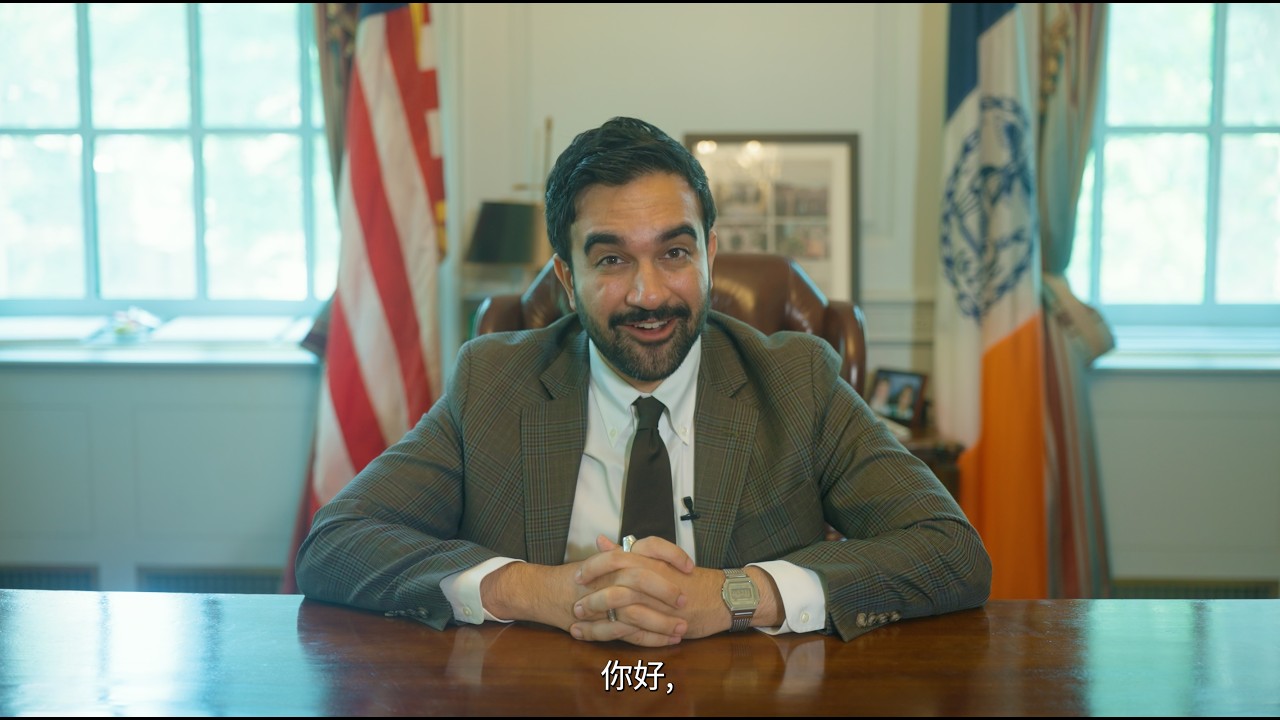
NEW YORK — Mayor Zohran Mamdani’s administration has launched a new lottery offering New York City high school students more than 2,000 free Broadway tickets. The program is real, the tickets are real, and the administration is promoting it through multilingual messaging, including videos in Bengali and Chinese.
According to the official announcement from the NYC Mayor’s Office, students in grades 9 through 12 can enter the lottery for tickets to seven Broadway productions.
Every student who enters also receives a free two-month membership in the nonprofit Theatre Development Fund, or TDF. That membership provides access to discounted Broadway, Off-Broadway and other performances, with many tickets available in the $20–$40 range, according to TDF.
There is nothing unusual about government promoting access to the arts.
But the campaign raises a broader question: How much government infrastructure should New York maintain to communicate even routine promotional programs in multiple languages?
Broadway Access Did Not Begin With Mamdani
The Mamdani-TDF lottery itself is new.
But affordable access to Broadway for students and lower-income audiences existed decades before Mamdani entered City Hall.
The nonprofit Theatre Development Fund was established in 1968.
According to the Mayor’s Office announcement, TDF has provided access to free or reduced-cost theater tickets to nearly 70 million people since its creation.
TDF’s educational programs also existed long before the current administration. According to TDF, its school programs reach more than 11,000 New York City public-school students each year.
TDF additionally works with more than 150 community organizations, reaching approximately 18,000 people across the tristate area.
So it would be inaccurate to suggest that New York City students suddenly gained access to Broadway because of the Mamdani administration.
What City Hall has introduced is a new citywide ticket lottery and promotional campaign layered onto an already extensive theater-access system.
More Than 2,000 Tickets
According to NYC.gov, the lottery provides more than 2,000 free tickets to seven productions:
- Buena Vista Social Club
- In the Heights
- School Girls; Or, The African Mean Girls Play
- Stranger Things: The First Shadow
- The Lost Boys
- The Great Gatsby
- Two Strangers (Carry a Cake Across New York)
Selected students may claim up to two free tickets.
City Hall also says the initiative is connected to the administration’s broader support for arts and culture, including approximately $323 million for the Department of Cultural Affairs.
But one important number is missing.
The Mayor’s announcement does not specify the direct taxpayer cost of the 2,000-plus Broadway tickets.
It also does not disclose a separate cost for producing the multilingual promotional videos or administering this particular lottery.
Therefore, it would be inaccurate to say that New York taxpayers simply “bought 2,000 Broadway tickets.”
The public information currently available does not establish that.
New York City’s 10-Language System
The multilingual videos did not originate with Mamdani.
New York City has maintained an extensive language-access system for years.
Under Local Law 30, covered city agencies must provide commonly distributed documents in 10 designated citywide languages in addition to English:
Spanish, Chinese, Russian, Bengali, Haitian Creole, Korean, Arabic, Urdu, French and Polish.
The law also requires covered agencies providing direct public services to make telephone interpretation available in at least 100 languages.
According to the city’s Language Access Plan, the system exists because New York contains one of the most linguistically diverse populations in the country.
This policy clearly predates Mamdani.
The question raised by the new Broadway campaign is therefore not whether Mamdani invented multilingual government.
He did not.
The more interesting question is how extensively his administration intends to use that system for ordinary political and promotional communication.
Speaking Another Language Does Not Mean Not Speaking English
Numbers are especially important in this debate.
Approximately half of New York City’s residents speak a language other than English at home.
But that does not mean half of New Yorkers cannot understand English.
According to a 2025 report from the New York City Public Advocate, approximately one-quarter of New Yorkers have limited English proficiency.
That is a very large population and explains why translation is essential for services involving health, education, legal rights, public safety and other critical government functions.
But it also demonstrates an important distinction:
Speaking Chinese, Bengali, Russian or Spanish at home is not the same thing as being unable to communicate in English.
That distinction matters when discussing whether multilingual communication should be treated as an essential accessibility service or as the default format for virtually every government announcement.
Nearly 99% of NYC School Households Covered by 13 Languages
New York City Public Schools operates its own extensive translation system.
According to the NYC Public Schools Language Access Policy, the school system identifies 12 major languages for translation:
Albanian, Arabic, Bangla, Chinese, French, Haitian Creole, Korean, Russian, Spanish, Ukrainian, Urdu and Uzbek.
Together with English, NYC Public Schools says those languages cover nearly 99% of student households.
For essential educational information, that level of access has an obvious practical justification.
The Broadway campaign presents a somewhat different policy issue because it is not an emergency notice, academic requirement, immigration document or public-health warning.
It is an advertisement for free theater tickets.
Translation and Interpretation Cost Money
Language access is not free.
In December 2022, the New York City Council stated that New York City could spend approximately $19 million in a typical year on translation and interpretation services.
That number is important — but it must be used accurately.
The $19 million is not Mamdani’s spending.
The figure was reported years before he became mayor and refers to the broader citywide system of translation and interpretation.
It also should not be presented as the cost of producing these Broadway videos.
The City Council subsequently called for additional language-access investments.
In 2023, the Council proposed approximately $13.7 million for expanded language-access initiatives, including $5 million for a community interpreter bank and language-services worker cooperatives. See the City Council announcement.
Separately, NYC Public Schools’ FY2026 budget included approximately $4 million for Immigrant Family Engagement, which included language access and translated communications to families, according to the New York City Council.
Those figures represent different programs and budget categories.
They should not simply be added together and described as one giant “translation budget.”
But they demonstrate something important:
Multilingual government requires staffing, contractors, technology, administration and taxpayer funding.
The Real Debate: Access or Bureaucratic Expansion?
Few people would seriously argue against translation when someone needs to understand emergency instructions, medical information, school requirements or legal documents.
The more difficult question is where government draws the line.
Should City Hall reproduce ordinary promotional messages in an increasing number of languages?
Should the Mayor personally record promotional videos for different linguistic groups?
Or should English remain the common language for general citywide communication, with translations available where they provide a genuine public-service benefit?
New York has always been multilingual.
Generations of immigrants maintained their native languages, newspapers, churches, synagogues, businesses and cultural institutions.
At the same time, English provided a common means of communication between communities that otherwise had little linguistically in common.
Language access and a common civic language do not necessarily contradict each other.
But maintaining the balance is a legitimate public-policy question.
What Is Confirmed
The Mamdani administration and TDF created a new lottery providing more than 2,000 Broadway tickets to NYC high-school students.
Confirmed source: NYC Mayor’s Office
TDF already operated extensive student theater-access programs and currently reaches more than 11,000 NYC public-school students annually.
Confirmed source: Theatre Development Fund
New York City’s language-access framework includes 10 designated citywide languages in addition to English.
Confirmed source: NYC Language Access
Covered agencies must provide telephone interpretation in at least 100 languages.
Confirmed source: NYC Local Law 30 information
The City Council previously estimated that NYC spends approximately $19 million in a typical year on translation and interpretation.
Confirmed source: New York City Council
What City Hall Has Not Disclosed
The official Broadway announcement does not disclose:
- the direct taxpayer cost, if any, of the 2,000-plus tickets;
- how much ticket value was donated or absorbed by Broadway producers or TDF;
- the administrative cost of operating the lottery;
- the production cost of the multilingual videos;
- the total government staff time associated with promoting the program.
Those numbers would allow taxpayers to judge the program more precisely.
Until City Hall provides them, claims about the specific cost of the Broadway promotion should be treated cautiously.
The facts support a more limited conclusion:
Mamdani did not invent Broadway access for students, and he did not create New York City’s multilingual government system.
But his administration is using both — and the broader question of how much multilingual bureaucracy New York needs remains legitimate.
Midtown Tribune — News Analysis & Commentary
Sources
- NYC Mayor’s Office — Mayor Mamdani and TDF Announce Thousands of Free and Low-Cost Broadway Tickets
- Theatre Development Fund — Official Website
- TDF — Information on Programs Serving NYC Public-School Students
- NYC Civic Engagement Commission — Language Access Plan
- NYC Mayor’s Office of Immigrant Affairs — Local Law 30 Language Access Requirements
- NYC Public Advocate — Language Access Report
- NYC Public Schools — Language Access Policy
- New York City Council — Translation and Interpretation Spending
- New York City Council — Proposed Language Access Investments
- New York City Council — FY2026 Immigrant Family Engagement and Language Access Funding
Ask Midtown Tribune about this story
Answers are grounded first in this article. Search all Midtown Tribune reporting from the main AI Search page.
AI-generated summary. Verify important details in the linked original articles.