
Video: Mayor Zohran Mamdani Holds Press Conference to Make an Announcement.
Description will be added later.
My patterns
Drag and drop patterns into the canvas.
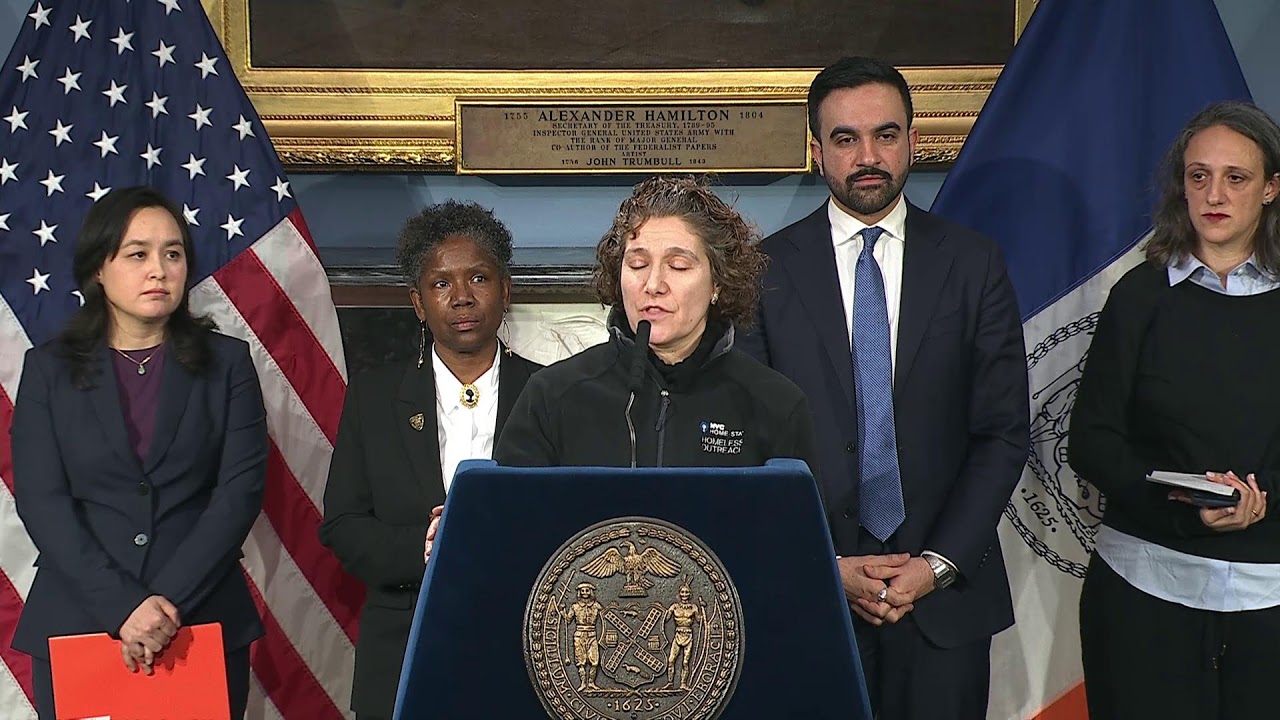
Video: Mayor Zohran Mamdani Holds Press Conference to Make an Announcement.
Description will be added later.
Drag and drop patterns into the canvas.
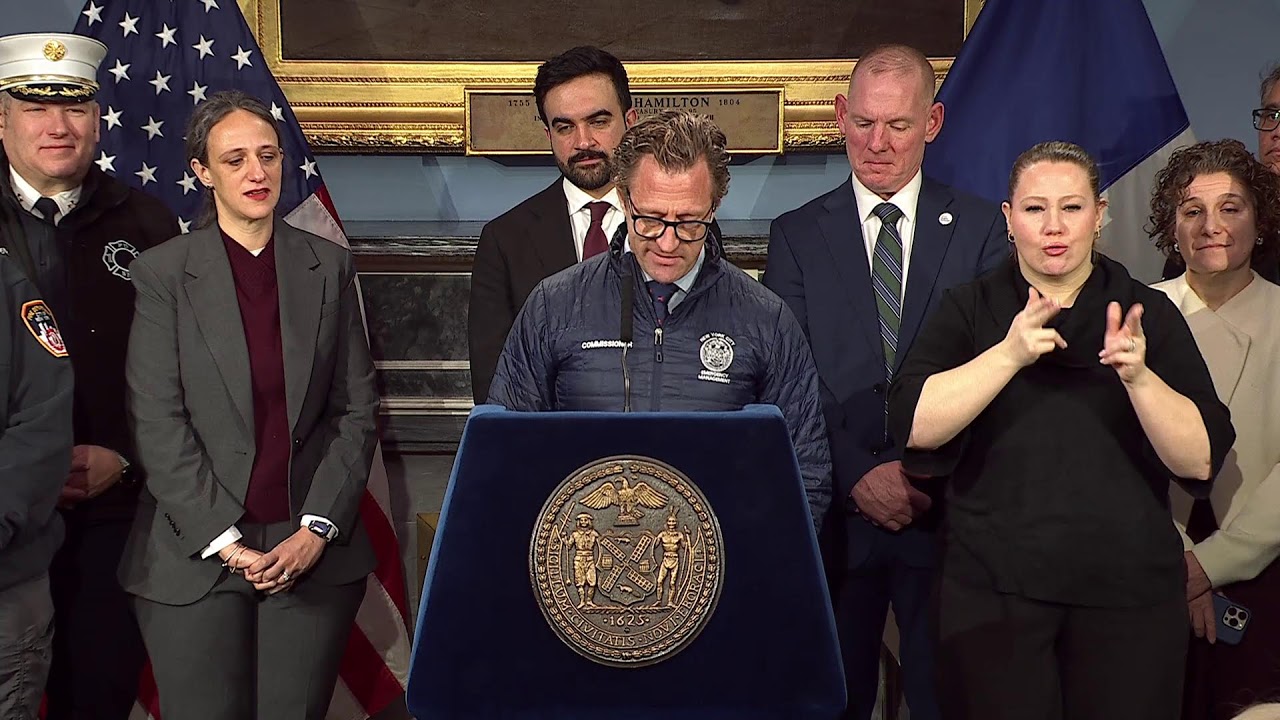
Video: Mayor Zohran Mamdani Holds Press Conference to Provide Winter Weather Updates.
Description will be added later.
Drag and drop patterns into the canvas.
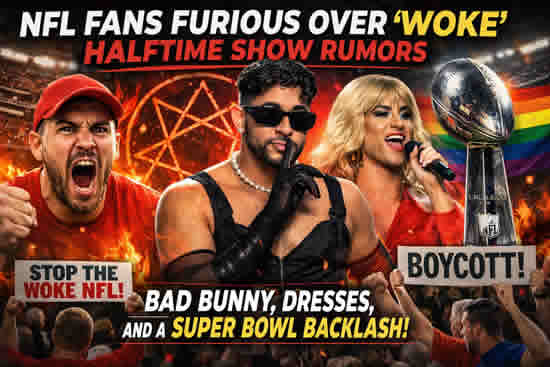
In a new segment, conservative commentator Benny Johnson argues that America’s biggest sports leagues are paying a price for turning marquee moments into political flashpoints. He points to recent viewership softness in the NFL and NBA and claims fans are increasingly rejecting what he frames as “message-first” programming—especially around the Super Bowl halftime show.
The video centers on Bad Bunny’s upcoming Super Bowl LX halftime performance (February 8, 2026, Levi’s Stadium) and a wave of online backlash tied to rumors about a provocative wardrobe choice and an LGBTQ-themed tribute—claims Johnson attributes to entertainment reporting and “inside sources,” while urging viewers to see the controversy as part of a broader cultural campaign. Separately, he highlights conservative responses and boycott talk, including discussion of federal security and immigration enforcement at the event.
Why it matters: The episode captures a widening debate about whether leagues should keep major broadcasts strictly entertainment-focused—or continue leaning into cultural and political messaging, even at the risk of alienating parts of the audience. Bad Bunny’s selection as headliner is confirmed by the NFL, but specific outfit details and the most sensational allegations remain unverified in official statements.
Sources:
Benny Johnson , Midtown Tribune news

Viral video posted on January 25, 2026 by commentator Benny Johnson claims that journalist-activist James O’Keefe was “hunted” in downtown Minneapolis while covering unrest tied to anti-ICE protests. In the clip, Johnson frames Minneapolis as the epicenter of a broader confrontation over federal immigration enforcement and portrays the city as a testing ground for organized street pressure against federal authorities and independent media.
Central to the video are O’Keefe’s own allegations: he says he and his team were surrounded by a crowd, pelted with ice bottles, followed to their hotel, and threatened via text message with a one-hour ultimatum to leave the city. O’Keefe also claims the group tracking them had access to unusually detailed vehicle information—down to a license plate—and suggests coordination that goes beyond spontaneous protest activity. The video further implies local or state-level complicity, though it provides no independently verified proof of official involvement beyond the commentary and screenshots shown.
The claims arrive amid a documented surge of tension in Minneapolis following deadly encounters involving federal immigration agents. Major outlets have reported on the killing of ICU nurse Alex Pretti on January 24, 2026, after which protests intensified, and on earlier clashes and legal battles over how federal agents have interacted with demonstrators and observers in the Twin Cities.
At this stage, the video’s most serious allegations—an organized attempt on O’Keefe’s life, coordinated “autonomous zones,” and state-enabled tracking—should be treated as unverified claims pending corroboration from law enforcement records, additional video evidence, or independent reporting. What is clear is that Minneapolis is experiencing a highly volatile moment, with escalating protests, competing narratives about public safety, and intensifying disputes between federal operations and local/state leaders.
Source:
Benny Johnson video , Midtown Tribune news
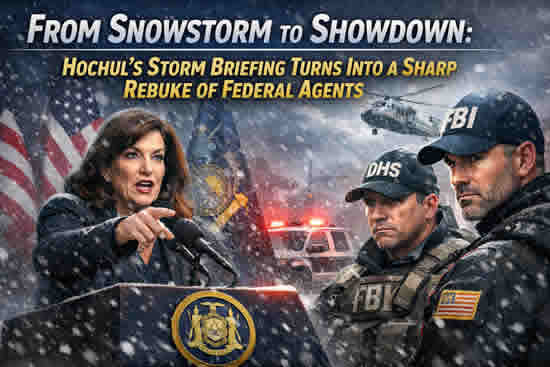
New York faced a major winter storm on January 25, 2026. Speaking from the state’s Emergency Operations Center in Albany, Governor Kathy Hochul warned that the weather would be dangerous—deep snow, extreme cold, and icy conditions.
She called it an “Arctic siege” and said the cold could be life-threatening. Snow started early in Long Island and New York City, then spread north across the state.
Hochul said the state had already declared an emergency and expanded its response:
Officials warned that the heaviest snow would hit later in the day and overnight. In New York City and Long Island, snow could mix with sleet and freezing rain, making roads and sidewalks more dangerous.
Hochul’s main message was simple: if you can stay home, stay home. She urged employers to allow remote work when possible.
Hochul said the mayor announced that New York City schools would switch to remote learning for the next day.
Public transit was expected to continue running on a weekend schedule, but officials said plans could change depending on conditions.
The governor also shared basic safety advice:
Near the end, Hochul shifted from weather to politics. She spoke about a reported incident in Minneapolis involving federal immigration agents and the death of a man she identified as Alex Prey.
Hochul said the incident showed a pattern of dangerous federal actions. She called for leadership changes at the federal level and said states should be able to fully investigate when civilians are harmed.
This briefing became two stories in one:
For most New Yorkers, the immediate takeaway remained clear: limit travel, prepare for extreme cold, and follow official alerts.
Sources: Big New York news BigNY,com , Midtown Tribune news

In this video, Amir Tsarfati interviews Rawan Osman, who shares her personal journey from being raised in a culture of antisemitism to becoming a courageous voice against it.
Here’s a breakdown of the key points:

The video, titled “Dangerous anti-ICE rhetoric from Mayor Frey & Gov Walz hasn’t protected anyone, only fueled chaos,” discusses the stance of Mayor Frey and Governor Walz against cooperation with ICE and other federal agencies.

New York City Mayor Zohran Mamdani, joined by NYC Emergency Management (NYCEM) and other officials, held a press conference on January 25, 2026, to update the public on the city’s response to a major snowstorm and sustained cold temperatures.
Key points from the press conference include:

The video provides an overview of New York City’s preparations for an incoming winter storm expected to bring 8 to 9 inches of snow (0:00-0:06).
Key preparations and public advisories include:
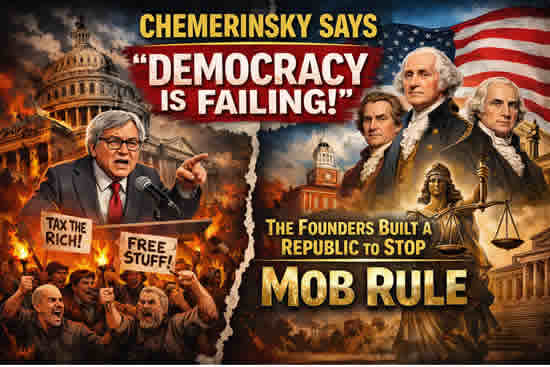
Erwin Chemerinsky—Dean of UC Berkeley School of Law and one of the country’s best-known constitutional law scholars—has a blunt thesis: the United States is facing a crisis of legitimacy and institutional design that could make democratic self-government unsustainable. He lays out that argument in his 2024 book, No Democracy Lasts Forever: How the Constitution Threatens the United States, and in a widely circulated Berkeley Law alumni talk that frames the book as a warning flare for the American system.
That warning has sparked an equally blunt rebuttal from many critics: the United States was never designed to be a “pure democracy” governed by simple majorities. It was designed as a constitutional republic—a representative system constrained by a written constitution—precisely to protect individuals from two perennial dangers: tyranny from above (abuse by rulers) and tyranny from below (majority faction turning politics into legalized coercion).
This debate isn’t an academic parlor game. It’s now moving to a major public stage in New York.
Chemerinsky’s core claim is that American democracy is under severe stress because public confidence in institutions has collapsed and political polarization has hardened into something closer to mutual illegitimacy. In the Berkeley book talk, he argues the crisis is not just cultural—it is structural.
Among the structural issues he highlights:
Chemerinsky also proposes remedies—some statutory, some constitutional—and, in the longer arc, suggests Americans should at least begin thinking about what a modern constitutional replacement process might look like (even if not imminent).
The sharpest disagreement is not whether the country is polarized. It is what standard should be used to evaluate constitutional design.
Chemerinsky often describes the U.S. as a “constitutional democracy” and measures legitimacy against a majoritarian benchmark: outcomes should track popular majorities more consistently, and institutions that systematically distort majority rule are treated as core democratic defects.
Critics respond that this framing smuggles in a premise the Founders explicitly resisted: that “more direct democracy” is inherently better.
1) The Constitution guarantees “republican” government—not direct majoritarian rule.
Article IV, Section 4 requires the United States to guarantee each state a “Republican Form of Government.” Whatever else Americans argue about, the constitutional text chooses “republican” as the baseline civic architecture.
2) Madison’s warning: “pure democracies” can be violent and unstable.
In Federalist No. 10, Madison draws a famous contrast between a republic and what he calls “such democracies,” warning they have historically been “spectacles of turbulence and contention” and incompatible with personal security and the rights of property.
This is a foundational insight for critics: the system was designed not to maximize majority power, but to control the predictable pathologies of majority power.
3) The “two tyrannies” problem: protect society from rulers and from majorities.
Federalist No. 51 states the principle in plain language: it is vital “in a republic” not only to guard society against oppression by its rulers, but also to guard “one part of the society against the injustice of the other part,” because if a majority unites around a common interest, the rights of the minority will be insecure.
This is the conceptual backbone of the “constitutional republic” critique of Chemerinsky: many so-called “anti-democratic” features are better understood as anti-tyrannical guardrails—constraints that prevent elections from becoming a moral permission slip to punish disfavored groups.
4) Courts are not meant to be majoritarian institutions.
Chemerinsky’s critique of judicial power and long tenure often collides with Hamilton’s argument in Federalist No. 78 that life tenure “during good behavior” is a barrier against despotism in a monarchy—and, in a republic, a barrier against “encroachments and oppressions of the representative body.”
In this view, the judiciary’s legitimacy is not measured by popularity; it is measured by fidelity to higher law—especially when popular majorities demand shortcuts.
Even many constitutional conservatives concede an important nuance: the Constitution does not literally contain the phrase “constitutional republic.” The more precise claim is that the U.S. is a representative republic operating under a written constitution, and that “democracy” (as used in modern speech) should be understood as representative democracy, not pure direct democracy.
This matters rhetorically. It allows critics to challenge Chemerinsky’s framing without making an easily refutable claim like “America isn’t a democracy at all.” The stronger, more defensible line is: America is not a pure democracy—and it was never intended to be; it is a constitutional republic built to protect liberty against both top-down tyranny and majority faction.
This dispute over constitutional legitimacy will intersect with an in-person NYU event next month.
On Thursday, February 5, 2026, the Brennan Center for Justice will host the Jorde Symposium: “Against Constitutional Theory” at NYU School of Law (Greenberg Lounge), 40 Washington Square South, New York, NY.
The program runs 4:00–5:50 p.m. ET, followed by a reception 5:50–6:30 p.m.
Erwin Chemerinsky is the featured lecturer. Commentators include Leah Litman (University of Michigan Law School) and Sherif Girgis (University of Notre Dame Law School). The event is open to the public but requires RSVP, and is listed as free.
For anyone tracking the national argument over “democracy,” constitutional limits, and the role of courts, this is one of the most substantive public constitutional law events on the New York calendar—especially because it puts Chemerinsky’s broader book thesis in conversation with scholars who do not share all of his premises.