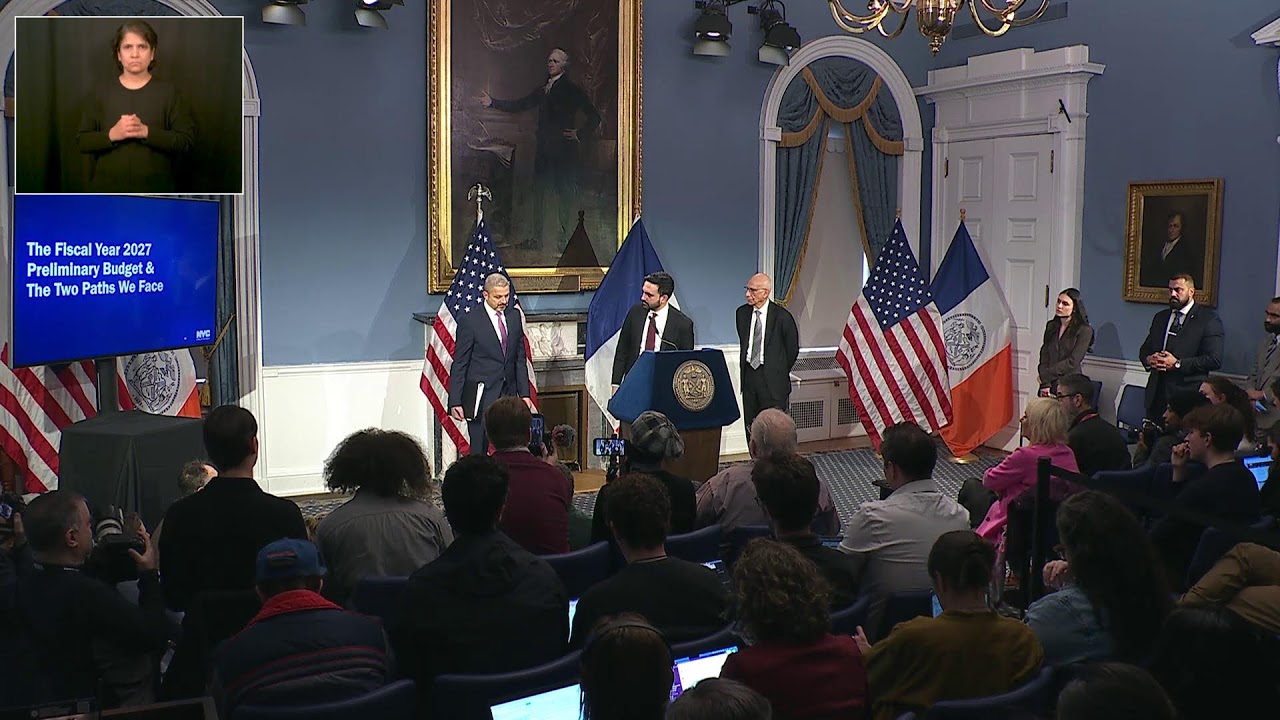
Mayor Mamdani delivered the Fiscal Year 2027 Preliminary Budget (1:41) on February 17, 2026, from City Hall in Manhattan, New York. The presentation detailed the city’s financial challenges and proposed solutions.
Addressing the Inherited Budget Crisis (1:41-2:27): The administration inherited a historic budget gap (2:06), initially projected at $12 billion (2:23) by the previous Mayor Adams’ administration, which had significantly understated the deficits (5:11). The Mayor stated that this deficit was primarily due to the underbudgeting of key areas (6:34):
- Cash assistance
- Rental assistance
- Shelter costs
- Healthcare
- Special education Carter cases
- Fair Fares program
Strategies to Reduce the Deficit (2:09-11:00): The administration implemented several aggressive measures to lower the deficit from $12 billion to $5.4 billion (2:23):
- Aggressive Savings Plan (2:09): This plan involves daily incorporation of updated revenue and bonus estimates, and the deployment of in-year reserves.
- Wall Street Profits (7:22): The city incorporated higher-than-expected revenues from record-high Wall Street profits, adding:
- $2.4 billion for fiscal year 2026 (7:38)
- $4.9 billion for fiscal year 2027 (7:42)
- Chief Savings Officers (CSOs) (8:13): An executive order established a CSO in every city agency, tasked with identifying savings (8:23) by:
- Consolidating redundancies (8:28).
- In-sourcing programs previously outsourced to consultants (8:31).
- Eliminating extraneous programs (8:34). CSOs are mandated to issue public reports by March 20th and provide updated assessments every six months (8:37). They have clear goals of achieving 1.5% in savings in fiscal year 2026 and 2.5% in fiscal year 2027 (8:47).
- Other Savings Avenues (8:57):
- Reducing Current Vacancies (9:02) and removing hiring constraints (9:04).
- Hiring 50 new auditors at the Department of Finance, projected to generate $100 million in new revenue per year (9:09).
- Adding 200 lawyers to the Law Department to reduce tort liability, anticipating $125 million in savings in fiscal year 2027 alone (9:16).
- State Aid (9:56): Governor Hochul announced a $1.5 billion contribution in state aid (10:00), which includes:
- $150 million per year by reversing the distressed hospital sales tax intercept (10:17).
- $60 million per year by reversing a public health cost shift (10:24).
- $300 million per year invested in youth programming (10:29).
- $500 million in one-time unrestricted state aid (10:32).
- An additional $97 million in recurring aid from the state school aid formula (10:43).
Two Paths to Bridge the Gap (2:47-4:02, 11:03-11:34): The Mayor outlined two distinct paths for bridging the remaining $5.4 billion deficit:
- Path One: Sustainable and Fair (2:50): This involves ending the drain on the city and raising taxes on the richest New Yorkers (2:56) (those earning over $1 million a year) and the most profitable corporations (2:58). This path would repair the structural imbalance where NYC contributes 54.5% to the state’s revenue but receives only 40.5% in return (26:46).
- Path Two: Harmful and Last Resort (3:22): If path one is not taken, the city would be forced to raise property taxes (3:35) and raid reserves (3:38). The proposed property tax increase, if implemented, would be 9.5% (24:55), impacting all four classes of properties (23:30).
Preliminary Budget Details and Investments (13:31-16:45): The preliminary budget is balanced at $122 billion in fiscal year 2026 and $127 billion in fiscal year 2027 (13:40).
- Spending Breakdown by Agency (13:50):
- 40% of funding to the Department of Education (DOE).
- 26% to social services.
- 12% to uniformed agencies.
- 22% to other agencies.
- Increased Expenses (14:15): City expenses are increasing by over $14 billion to fund previously unbudgeted needs from the Adams administration (14:20), including $7.5 billion for six underbudgeted areas and $5.85 billion for other unfunded needs (14:24).
- New Programmatic Spending (14:47): Only 4% ($576 million) of city dollars represent new programmatic spending (14:47), which includes:
- Opening warming centers (15:00).
- Increasing snow removal budgets (15:00).
- Investing in clinical and behavioral health services (15:16).
- Tripling funding for emergency food programs (15:38).
- Capital Plan (15:51): A $13 billion preliminary 5-year capital plan (16:01) includes major investments in:
- Transportation.
- Environmental protection.
- Housing.
- Schools.
- NYCHA developments: $662 million in fiscal year 2027 to boost renovations, and over $38 million to install heat pumps in 700+ housing units in the Rockaways (16:17).
- Bellevue Hospital: Over $48 million to expand the adult comprehensive psychiatric emergency program (16:34).
Commitment to Affordability Agenda (52:20-53:44): Despite the fiscal crisis, the Mayor reiterated commitment to key campaign promises:
- Universal Childcare: Delivering universal childcare (52:39) including fixing 3K and providing free childcare for 2-year-olds (52:51), starting with 2,000 seats this year and expanding to 12,000 seats next year (52:58).
- Free Buses: Continuing efforts to make buses faster and free (53:08).
The Mayor emphasized that the preliminary budget reflects the second path out of necessity, but the administration will work to ensure the final budget reflects the first path of taxing the wealthy and ending the drain on the city (17:05).
City Hall, Blue Room Manhattan, NY
February 17, 2026