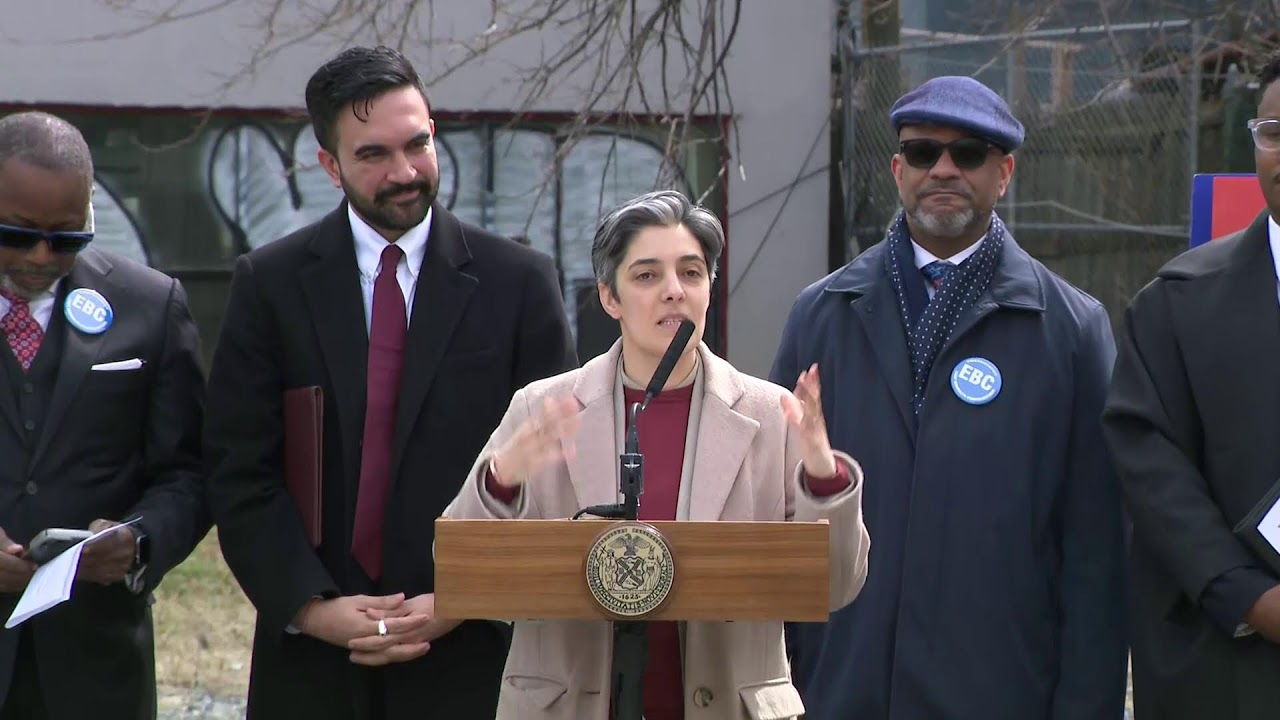

Video: Rental Ripoffs Brooklyn: Your Stories, Your Rights, Your City.
Description will be added later.
My patterns
Drag and drop patterns into the canvas.

Video: Rental Ripoffs Brooklyn: Your Stories, Your Rights, Your City.
Description will be added later.
Drag and drop patterns into the canvas.

Video: Mayor Mamdani Hosts Iftar for City Workers.
Description will be added later.
Drag and drop patterns into the canvas.

New York City’s Emergency Executive Order No. 1.13 extends the long-running Department of Correction emergency for another five days, continuing a legal framework that has been in place since 2021 while officials work on a compliance plan. At the same time, the order begins scaling back some of the emergency suspensions by immediately restoring certain DOC staffing and residency-related legal requirements that had previously been waived. In effect, the city is keeping the correctional emergency in place for now, but signaling a gradual return to normal legal compliance instead of allowing all past exemptions to continue unchanged.

WHEREAS, pursuant to a state of emergency first declared by Emergency Executive Order No. 241, dated September 15, 2021, and subsequent orders extending such state of emergency, compliance by the Department of Correction (DOC) with various laws and regulations has not been required; and
WHEREAS, such orders issued prior to January 5, 2026 did not provide or require a plan for actions that would enable DOC to come into compliance with applicable laws and regulations for which compliance is not required as a result of such orders; and
WHEREAS, the state of emergency first declared in 2021 continues for the present pending the expedited development and implementation of such plan;
NOW, THEREFORE, pursuant to the powers vested in me as Mayor of the City of New York, by the laws of the State of New York and the City of New York, including but not limited to the New York Executive Law, the New York City Charter and the Administrative Code of the City of New York, and the common law authority to protect the public in the event of an emergency, it is hereby ordered:
Section 1. Section 1 of Emergency Executive Order No. 1.12, dated March 6, 2026, is hereby extended for five (5) days, except that:
§ 2. DOC, in consultation with the Law Department, shall regularly update the Mayor regarding additional suspensions that can be lapsed to comply with the implementation action plan developed pursuant to Section 2 of Emergency Executive Order 1, dated January 5, 2026, and with applicable laws and regulations that presently do not apply pursuant to Emergency Executive Orders.
§ 3. This Emergency Executive Order shall take effect immediately and shall remain in effect for five (5) days unless it is terminated or modified at an earlier date.
_________________________
Zohran Kwame Mamdani
Mayor
March 11, 2026 Manhattan , NY
Sources: nyc.gov , Midtown Tribune news

Video: Mayor Mamdani Holds Press Conference to Make an Announcement.
Description will be added later.
Drag and drop patterns into the canvas.

Video: Mayor Mamdani Attends Rental Ripoff Hearing in the Bronx.
Description will be added later.
Drag and drop patterns into the canvas.

Video: Building Power with Chinatown’s Tenant Organizers.
Description will be added later.
Drag and drop patterns into the canvas.

White House Says Trump’s Iran Campaign Is Ahead of Schedule, Pushes ‘Save America Act’ at Press Briefing
At a White House briefing, Press Secretary Karoline Leavitt outlined President Trump’s upcoming schedule and delivered an extensive update on both foreign policy and domestic priorities.
She said President Trump will travel Wednesday to Ohio and Kentucky, where he will promote what the administration describes as economic victories and efforts to lower prices for working Americans. According to the White House, Trump will visit Thermo Fisher Scientific in Ohio and speak at Vers Logistics in Kentucky. On Thursday, the president and the First Lady are expected to host a Women’s History Month event in the East Room, and on Friday Trump is scheduled to sign several executive orders.
A major focus of the briefing was Operation Epic Fury, the U.S. military campaign against Iran. Leavitt said the operation is progressing faster than expected and described it as a major success so far. She claimed that more than 5,000 enemy targets have already been struck, while Iranian ballistic missile attacks have fallen by more than 90 percent and drone attacks by about 85 percent since the operation began. She also said the Iranian navy has been severely degraded, with more than 50 vessels destroyed, including what she described as a major drone carrier ship.
According to the White House, the administration’s objectives remain unchanged: destroy Iran’s ballistic missile capabilities, eliminate its missile-production infrastructure, weaken its regional proxies, and ensure that Iran never acquires a nuclear weapon. Leavitt said Trump remains confident these goals can be achieved quickly and said the operation will end only when the president decides Iran no longer poses a credible threat to the United States and its allies.
On energy and oil markets, Leavitt acknowledged temporary disruptions tied to the conflict, especially around the Strait of Hormuz. She said the administration has offered political-risk insurance to tankers in the Gulf, temporarily waived certain oil-related sanctions, and is prepared to use the U.S. Navy to escort vessels if necessary. She argued that recent increases in oil and gas prices are temporary and predicted that energy prices could eventually fall below pre-conflict levels once the operation’s objectives are met.
Leavitt also shifted to domestic policy, urging Congress to pass what she called the “Save America Act,” which she described as one of the administration’s top legislative priorities. She said the bill would require voter ID, proof of citizenship to register to vote, restrictions on universal mail-in voting while preserving some absentee-ballot exceptions, a permanent ban on men competing in women’s sports, and a ban on gender-transition surgeries for minors. She framed the legislation as a common-sense measure to protect election integrity and called on both Republicans and Democrats to support it.
During the question-and-answer session, Leavitt rejected Democratic claims that the voting provisions would disenfranchise married women who changed their names. She said already registered voters would not be affected and argued that those who need to update documents can do so through existing state procedures.
She also addressed funding problems affecting the Department of Homeland Security, saying Trump wants agencies such as TSA, FEMA, and the Coast Guard fully funded and reopened. Speaking about federal workers and travelers affected by the disruption, she blamed Democrats in Congress and urged Americans to pressure lawmakers to restore funding.
On the military timeline, Leavitt said the original estimate for Operation Epic Fury was four to six weeks, but claimed U.S. forces are moving ahead of schedule. Asked whether “boots on the ground” remain possible, she said Trump does not rule out options as commander-in-chief, but declined to confirm any specific plans. She also avoided directly endorsing the idea of regime change in Iran, while suggesting it would obviously be better for the United States and its allies not to have a radical regime in power there.
Leavitt confirmed that the U.S. Navy has not yet escorted any tankers, despite an earlier social-media post from the energy secretary suggesting otherwise. She said that post was quickly deleted and referred further questions to the Department of Energy.
Asked about reports that around 150 U.S. service members have been injured, Leavitt said that figure sounded plausible but deferred precise casualty numbers to the Pentagon. She also declined to provide specifics on potential sanctions changes, including questions about Venezuela and Russia, saying discussions are ongoing.
Other topics raised during the briefing included Russia’s contacts with Iran, Pakistan’s possible role in the conflict, the status of an investigation into a strike on an Iranian school, Cuba’s economic crisis, the new “Shield of the Americas” coalition focused on countering cartels, homeland-security threat levels, and the recent attempted bombing in New York City. Leavitt described the New York attack as despicable and said the FBI, Justice Department, and Southern District of New York are pursuing charges.
Toward the end of the briefing, Leavitt highlighted new tax data, saying millions of Americans are already seeing benefits from Trump’s recently passed tax package. She said the average federal tax refund is now above $3,700 and pointed to millions of returns claiming new tax breaks, including deductions related to tips, overtime, seniors, and car-loan interest.
Overall, the White House used the briefing to present a message of confidence: that Trump’s Iran operation is advancing faster than planned, that temporary market disruptions are under control, and that Congress should urgently move on the administration’s domestic agenda, especially the Save America Act.
SourcesL The White House , Midtown Tribune news
The U.S. Supreme Court has issued a unanimous 9–0 decision in Urias-Orellana v. Bondi, a ruling that could make it significantly harder for asylum seekers to overturn denials in federal court. In an opinion written by Justice Ketanji Brown Jackson and released on March 4, 2026, the Court held that federal courts of appeals must apply the deferential “substantial evidence” standard when reviewing an immigration agency’s conclusion that an applicant’s experiences do not legally amount to persecution.
The case arose from an asylum claim filed by a family from El Salvador. An immigration judge found the lead petitioner’s testimony credible but still concluded that the evidence did not establish either past persecution or a well-founded fear of future persecution under U.S. asylum law. The Board of Immigration Appeals agreed, and the U.S. Court of Appeals for the First Circuit also upheld that result. The Supreme Court then took the case to decide what standard appellate courts must use when reviewing that type of determination.
At the center of the dispute was a narrow but important legal question: when an immigration judge and the Board of Immigration Appeals conclude that a given set of facts does not rise to the level of “persecution,” should a federal appeals court review that conclusion deferentially, or should it reconsider the issue from scratch? The Supreme Court answered that question in favor of deference. It ruled that courts of appeals must review both the agency’s factual findings and its application of the Immigration and Nationality Act to those facts under the substantial-evidence standard, rather than conducting a fresh, independent review.
That standard matters because it gives immigration adjudicators a strong advantage once a case reaches federal appellate review. Under substantial-evidence review, an asylum applicant does not win simply by showing that another judge might have ruled differently. Instead, the applicant must show that the record compels the opposite conclusion — in other words, that any reasonable adjudicator would have been forced to find persecution. The Court said that this framework is grounded in the Immigration and Nationality Act and in prior Supreme Court precedent.
In practical terms, the ruling strengthens the hand of the immigration system in asylum disputes and narrows the room for successful appeals in federal court. It does not eliminate judicial review, and it does not mean asylum claims can no longer be challenged. But it does mean that once an immigration judge and the BIA have rejected a claim, federal appeals courts will have less freedom to second-guess that determination. That is why the ruling is already being viewed as a meaningful victory for the federal government in immigration litigation.
The legal question in Urias-Orellana was technical, but the political implications are easy to see. Supporters of stricter immigration enforcement are likely to view the ruling as a step toward faster and more predictable removal proceedings, especially in cases where asylum claims are denied at the agency level. Immigration advocates, by contrast, are likely to see it as another decision that raises the bar for vulnerable migrants seeking protection in the United States. That tension helps explain why a fairly technical administrative-law ruling is getting broader attention well beyond legal circles. This political reaction is an inference from the decision’s likely effects, rather than language used by the Court itself.
It is also important to be precise about what the Supreme Court did not do. The justices did not announce a wholesale shutdown of asylum claims, and they did not rule that all federal courts are cut out of immigration review. The decision specifically addressed the standard that federal courts of appeals must use when reviewing a BIA determination about whether undisputed facts amount to persecution. That makes the ruling significant, but narrower than some political commentators are portraying it.
For media audiences, the case offers two separate stories. One is the legal story: the Supreme Court unanimously clarified that asylum-related persecution determinations receive deferential review in the federal appellate system. The second is the political story: the ruling is likely to be used as evidence by supporters of tougher immigration enforcement that the courts are aligning more closely with executive enforcement priorities. Both stories are real, but they are not identical — and the difference matters.
Sourcesl
The Andrew Branca Show Midtown Tribune


In a March 10, 2026 White House article, the Trump administration presented a running list of major U.S. investment announcements made during President Trump’s second term, arguing that his economic agenda is driving a surge in domestic manufacturing, technology, energy, and pharmaceutical expansion. The list includes massive commitments from companies such as Apple, Meta, NVIDIA, Amazon, TSMC, Google, Hyundai, Eli Lilly, and many others, with projects tied to artificial intelligence infrastructure, semiconductor production, data centers, drug manufacturing, steel, energy, and logistics. The article also cites large investment pledges from foreign governments including the UAE, Qatar, Japan, Saudi Arabia, South Korea, and Bahrain, framing the overall wave of commitments as evidence of renewed confidence in the U.S. economy and a broader push to bring production, jobs, and strategic industries back to America.
Since President Donald J. Trump took office, his unwavering commitment to revitalizing American industry has spurred trillions of dollars of investments in U.S. manufacturing, production, and innovation — and the list only continues to grow.
Here is a non-comprehensive running list of new U.S.-based investments in President Trump’s second term:
That doesn’t even include the U.S. investments pledged by foreign countries:
Last updated on March 10, 2026
The White House
March 10, 2026
Sources: whitehouse.gov , Midtown Tribune news


t’s a highly partisan commentary video by Benny Johnson about the March 7 protest outside Gracie Mansion and the later arrest of two men accused of throwing improvised explosive devices there. In the clip, Johnson argues that Mayor Zohran Mamdani focused too much on condemning the anti-Muslim protest as “white supremacy” and not enough on condemning the alleged ISIS-inspired attackers. That framing is based on a real mayoral statement and press conference, but the video is presented as polemic, not neutral reporting.
The underlying event itself is real. Federal prosecutors say Emir Balat, 18, and Ibrahim Kayumi, 19, traveled from Pennsylvania and allegedly threw homemade bombs containing explosive material and shrapnel at an anti-Islam protest outside Gracie Mansion. The DOJ says they were inspired by ISIS and charged them with terrorism-related offenses, including attempting to provide material support to ISIS and using a weapon of mass destruction. Reuters likewise reports the devices contained TATP and that no one was injured because police intervened quickly.
What Benny is reacting to is also real: in the mayor’s March 8 statement, Mamdani said, “white supremacist Jake Lang organized a protest outside Gracie Mansion rooted in bigotry and racism,” and then said the attempted use of an explosive device was “criminal” and “reprehensible.” In the March 9 press conference, Mamdani again called the protest “rooted in white supremacy,” but he also explicitly said the two men “are suspected of coming here to commit an act of terrorism” and that the devices were IEDs made to “injure, maim or worse.”
So the video’s basic message is: “Mamdani blamed white supremacy / Islamophobia instead of clearly focusing on Islamist terrorism.” That is an interpretation, not a full description. A more accurate summary would be: Mamdani condemned both the anti-Muslim protest and the bomb attack, though critics argue his first public reaction emphasized the protest’s bigotry more than the attackers’ ISIS link. Later that same day, after charges were announced, he called it a “heinous act of terrorism” and said the suspects had proclaimed allegiance to ISIS.
A few things in Benny’s clip are rhetoric rather than established fact. Calling the rally simply a “peaceful protest” leaves out that Reuters described it as a far-right anti-Muslim demonstration with provocative anti-Muslim symbols, and there were also counterprotesters and other arrests. Also, the video uses insult-heavy language and repeatedly misspeaks Mamdani’s name, which tells you the goal is persuasion and outrage, not balance.
So, in plain English: the video says Mamdani responded to an alleged ISIS-inspired bomb attack by talking about white supremacy and Islamophobia, and Benny uses that to argue the mayor is morally and politically unfit. The incident is real; the video’s presentation is aggressively slanted. If you want, I can also give you a clean neutral summary for an article or a fact-check version point by point.