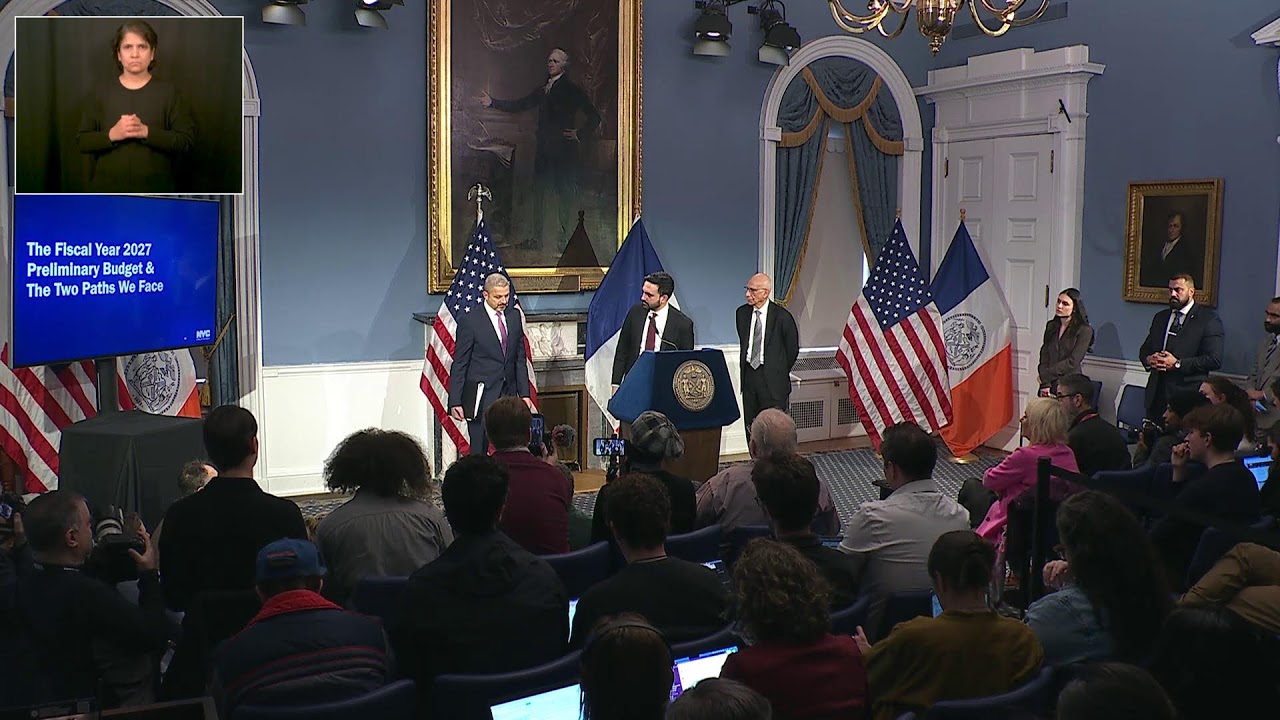
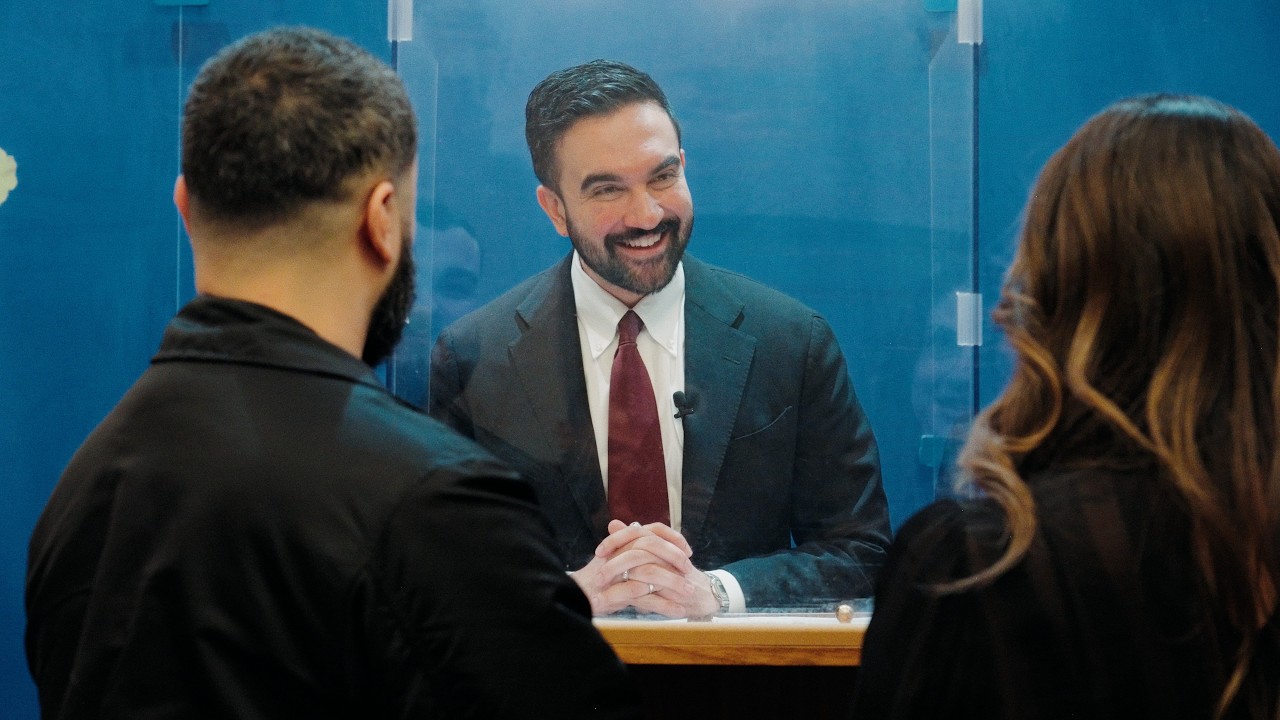
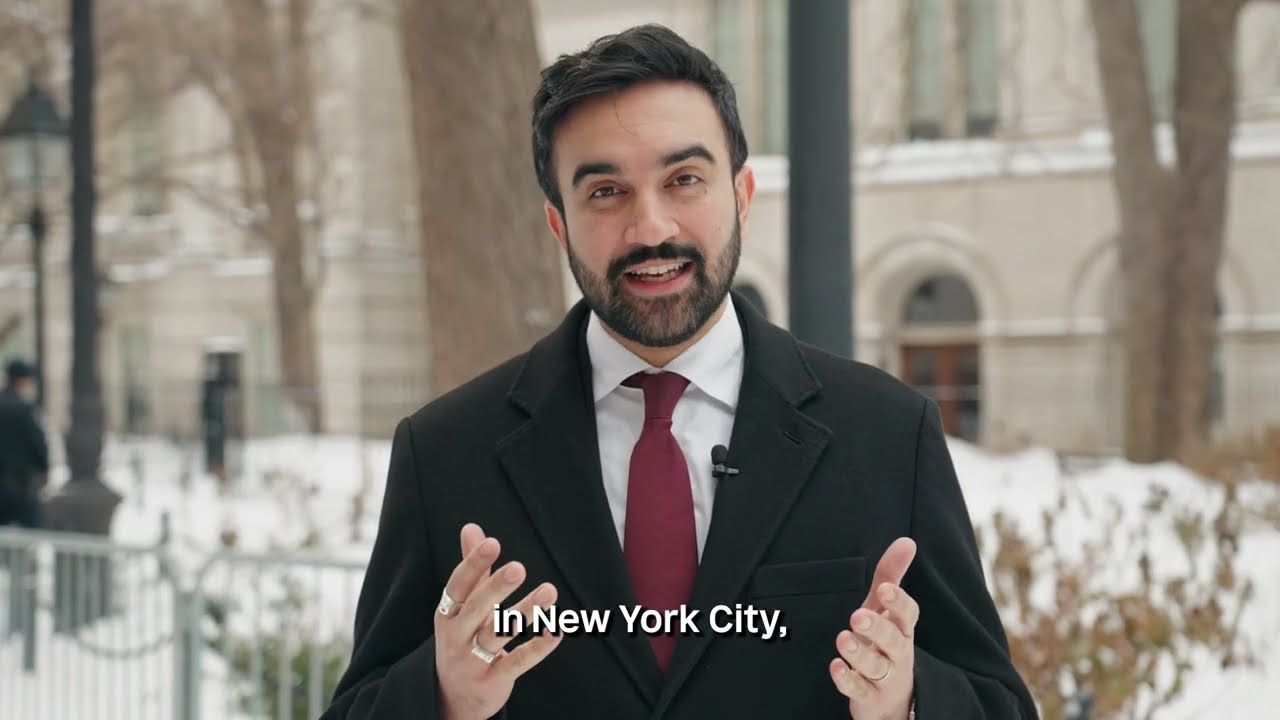
Mayor Mamdani delivered the Fiscal Year 2027 Preliminary Budget (1:41) on February 17, 2026, from City Hall in Manhattan, New York. The presentation detailed the city’s financial challenges and proposed solutions.
Addressing the Inherited Budget Crisis (1:41-2:27): The administration inherited a historic budget gap (2:06), initially projected at $12 billion (2:23) by the previous Mayor Adams’ administration, which had significantly understated the deficits (5:11). The Mayor stated that this deficit was primarily due to the underbudgeting of key areas (6:34):
Strategies to Reduce the Deficit (2:09-11:00): The administration implemented several aggressive measures to lower the deficit from $12 billion to $5.4 billion (2:23):
Aggressive Savings Plan (2:09): This plan involves daily incorporation of updated revenue and bonus estimates, and the deployment of in-year reserves.
Wall Street Profits (7:22): The city incorporated higher-than-expected revenues from record-high Wall Street profits, adding:
$2.4 billion for fiscal year 2026 (7:38)
$4.9 billion for fiscal year 2027 (7:42)
Chief Savings Officers (CSOs) (8:13): An executive order established a CSO in every city agency, tasked with identifying savings (8:23) by:
Consolidating redundancies (8:28).
In-sourcing programs previously outsourced to consultants (8:31).
Eliminating extraneous programs (8:34). CSOs are mandated to issue public reports by March 20th and provide updated assessments every six months (8:37). They have clear goals of achieving 1.5% in savings in fiscal year 2026 and 2.5% in fiscal year 2027 (8:47).
Other Savings Avenues (8:57):
Reducing Current Vacancies (9:02) and removing hiring constraints (9:04).
Hiring 50 new auditors at the Department of Finance, projected to generate $100 million in new revenue per year (9:09).
Adding 200 lawyers to the Law Department to reduce tort liability, anticipating $125 million in savings in fiscal year 2027 alone (9:16).
State Aid (9:56): Governor Hochul announced a $1.5 billion contribution in state aid (10:00), which includes:
$150 million per year by reversing the distressed hospital sales tax intercept (10:17).
$60 million per year by reversing a public health cost shift (10:24).
$300 million per year invested in youth programming (10:29).
$500 million in one-time unrestricted state aid (10:32).
An additional $97 million in recurring aid from the state school aid formula (10:43).
Two Paths to Bridge the Gap (2:47-4:02, 11:03-11:34): The Mayor outlined two distinct paths for bridging the remaining $5.4 billion deficit:
Path One: Sustainable and Fair (2:50): This involves ending the drain on the city and raising taxes on the richest New Yorkers (2:56) (those earning over $1 million a year) and the most profitable corporations (2:58). This path would repair the structural imbalance where NYC contributes 54.5% to the state’s revenue but receives only 40.5% in return (26:46).
Path Two: Harmful and Last Resort (3:22): If path one is not taken, the city would be forced to raise property taxes (3:35) and raid reserves (3:38). The proposed property tax increase, if implemented, would be 9.5% (24:55), impacting all four classes of properties (23:30).
Preliminary Budget Details and Investments (13:31-16:45): The preliminary budget is balanced at $122 billion in fiscal year 2026 and $127 billion in fiscal year 2027 (13:40).
Spending Breakdown by Agency (13:50):
40% of funding to the Department of Education (DOE).
26% to social services.
12% to uniformed agencies.
22% to other agencies.
Increased Expenses (14:15): City expenses are increasing by over $14 billion to fund previously unbudgeted needs from the Adams administration (14:20), including $7.5 billion for six underbudgeted areas and $5.85 billion for other unfunded needs (14:24).
New Programmatic Spending (14:47): Only 4% ($576 million) of city dollars represent new programmatic spending (14:47), which includes:
Opening warming centers (15:00).
Increasing snow removal budgets (15:00).
Investing in clinical and behavioral health services (15:16).
Tripling funding for emergency food programs (15:38).
Capital Plan (15:51): A $13 billion preliminary 5-year capital plan (16:01) includes major investments in:
Transportation.
Environmental protection.
Housing.
Schools.
NYCHA developments: $662 million in fiscal year 2027 to boost renovations, and over $38 million to install heat pumps in 700+ housing units in the Rockaways (16:17).
Bellevue Hospital: Over $48 million to expand the adult comprehensive psychiatric emergency program (16:34).
Commitment to Affordability Agenda (52:20-53:44): Despite the fiscal crisis, the Mayor reiterated commitment to key campaign promises:
Universal Childcare: Delivering universal childcare (52:39) including fixing 3K and providing free childcare for 2-year-olds (52:51), starting with 2,000 seats this year and expanding to 12,000 seats next year (52:58).
Free Buses: Continuing efforts to make buses faster and free (53:08).
The Mayor emphasized that the preliminary budget reflects the second path out of necessity, but the administration will work to ensure the final budget reflects the first path of taxing the wealthy and ending the drain on the city (17:05).
City Hall, Blue Room Manhattan, NY February 17, 2026
Five DOS programs, one mission: making sure New Yorkers know about the resources available to them. From the Office for New Americans, Consumer Protection, Faith to our Cultural Commissions, our DOS programs showed up at Caucus weekend to support community voices across the state.
What the Message Refers To
The New York State Department of State (DOS) shared a message highlighting five DOS programs that engaged with communities during Caucus weekend to raise awareness of state resources. This appeared on the agency’s social media platforms (e.g., Instagram and Facebook) and emphasizes outreach efforts by multiple DOS divisions aimed at connecting New Yorkers with critical services.
🧭 The Five DOS Program Areas Highlighted
While the exact five programs aren’t listed in the social post itself, the departments referenced generally include the following DOS divisions that routinely conduct outreach and resource promotion:
Office for New Americans (ONA)
Provides free services to immigrants statewide, including citizenship help, English learning, workforce supports, legal consultations, and connections to community partners. ONA operates Opportunity Centers and the New Americans Hotline (1-800-566-7636).
Division of Consumer Protection
Offers consumer education, a helpline (1-800-697-1220), complaint mediation, fraud and scam awareness, and marketplace protection services to New Yorkers.
Supports faith-based and nonprofit organizations with information, state grant access, coalition building, and community capacity efforts.
Cultural Commissions & Community Programs
DOS oversees various commissions (such as heritage or arts and cultural advisory bodies) that support cultural initiatives and community voices statewide (mentioned in the outreach messaging). [implicit from social post]
Other DOS Outreach & Community Resource Efforts
These may include broader DOS community services like the Know Your Resources, Know Your Rights guide (a statewide resource accessible to all residents), address confidentiality services, and multilingual support links.
📢 Purpose of the Outreach at Caucus Weekend
The DOS outreach at Caucus weekend was meant to:
Connect New Yorkers with state services — ensuring people know how to access programs on consumer protection, immigrants’ rights and services, support for faith and nonprofit sectors, and cultural engagement.
Support community voices across the state — engaging with diverse populations and promoting resource awareness among constituents and advocates (including legislators attending the caucus events).
📍 Why This Matters
The initiative reflects an active push by the Department of State to make government services more visible, accessible, and understandable — especially for immigrants, low-income consumers, nonprofit partners, and culturally diverse communities throughout New York
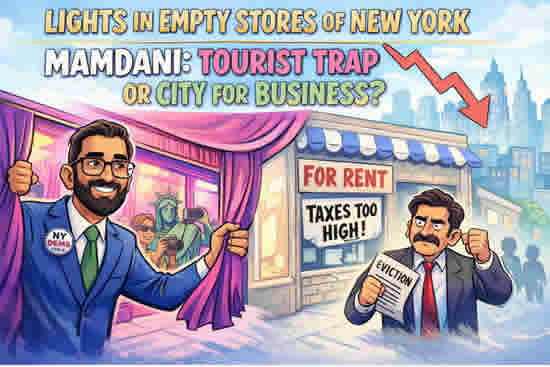
News 12 Brooklyn’s Post: The former Macy’s building in Downtown Brooklyn is lit up again, now glowing with vibrant fuchsia and purple lights as part of an installation called “In Every Transition, A Pattern” by Masary Studios.
Funded through a city program that awarded 13 public realm grants totaling just over $1 million, the project aims to reactivate commercial corridors and is a welcome change for some residents.
City and business leaders say the display is meant not only to beautify the vacant storefront, but also to boost foot traffic and support local businesses along Fulton Street.
Opinion: Maybe instead of handing out millions in taxpayer money to “friendly” nonprofits to create the illusion of a comeback, the city should cut—or even suspend—property taxes for both residents and businesses (yes, like “horrible Trump” has suggested) and make rent in that building affordable for real stores. What we’re getting now isn’t revitalization—it’s glowing, empty windows: retail ghosts.
At this point, it feels less like rebuilding and more like turning New York into a Potemkin showcase—lights on in vacant buildings to convince “tourists from the West” that progressive socialism is thriving.
NYC Council Members Allegedly Said Trump Is a Pedophile and Labeled the GOP “Fascist.” Will Republicans Sue Them?
A protest rally titled “Hands Off Our History” was held at 9:30 a.m. on February 12, 2026, at the Stonewall National Monument in New York City. Organized by NYC Council LGBTQIA+ Caucus co-chairs Council Member Erik Bottcher and Council Member Chi Ossé (who represents the 36th District), the event protested the Trump administration’s removal of the rainbow Pride flag from the monument.
Multiple speakers, including NYC council members (e.g., Chi Ossé, Crystal Hudson, Tiffany Cabán, Julie Menin), assembly members (e.g., Tony Simone, Deborah Glick, Grace Lee, Alex Bores), and allies like Manhattan Borough President Brad Hoylman-Sigal, condemn the action as an attempt to erase LGBTQ+ history and visibility. They describe it as part of broader attacks on queer rights, reproductive rights, immigrants, and civil liberties. Key themes and statements include:
Accusations that Donald Trump is a “pedophile” (explicitly stated by Chi Ossé and echoed by others like Tony Simone, who calls him the “pedophile-in-chief”) and that his administration is using distractions to cover up crimes. Labeling the Republican Party as “fascist” and the Trump regime as authoritarian, petty, and divisive. Emphasis on Stonewall’s historical significance as the birthplace of the modern LGBTQ+ rights movement (referencing the 1969 riots as resistance). Calls for unity among queer people, allies, and marginalized groups, with chants like “We’re here, we’re queer, and we’re not going anywhere.” Plans to re-raise the pride flag at 4 PM that same day, defying the federal government. The rally frames the flag removal as symbolic of larger efforts to undo progress in civil rights, and speakers urge ongoing resistance and joy in the face of oppression. Regarding whether the GOP (Republican Party) will sue Chi Ossé or other speakers: As of now (just hours after the rally), there is no public indication or announcement of any lawsuit from the GOP, Trump, or related entities in response to these statements. Defamation claims over calling someone a pedophile or fascist could theoretically be pursued, especially against public figures, but would require proving actual malice (knowing falsehood or reckless disregard for the truth) under U.S. law (e.g., New York Times v. Sullivan standard). Political parties like the GOP rarely file such suits directly; it’s more common for individuals like Trump to do so personally (he has a history of defamation lawsuits, though many fail). Given the recency of the event and the protected nature of political speech at protests, any legal action remains speculative and unlikely to be immediate. If new developments emerge later today or beyond, they would likely appear in news reports.
Good morning. Good morning, Bill. Is everyone ready? You don’t look very cold at all.
Good morning, everyone. Good morning. I don’t think we’re loud enough.
Good morning, everyone. Good morning. We are here at a cold 930 in the morning because this is just not right.
The federal administration would rather erase us than build us up and show what America truly is. And given that, I’d like to pass this off to my co-chair, the amazing council member, Chiyo Se. Thank you so much.
Good morning, everyone. Good morning, everyone. You know, I can go on and on about what Stonewall means and what our history means, but Donald Trump and the Republicans and the fascist party simply don’t give a fuck.
What I will go in on is that Donald Trump is worried about the wrong letters in the alphabet. He’s worried about L. He’s worried about G. He’s worried about B. He’s worried about T. He should be worried about P, pedophiles. This is all a distraction.
This is all a distraction from the fact that we have a pedophile in the White House. He is trying to infringe upon our rights as queer people to distract from the fact that he is a criminal and that he is covering up the crimes that him and his friends have committed. So while we can stand here, and also I will say, and I’m not encouraging anyone to do this as an elected official, but the most Stonewall thing that we could possibly do is put that flag up ourselves instead of waiting for the president.
But no one listen to me when I say that. As co-chair of the LGBTQ caucus, it is our responsibility to protect our history, to protect our people. That’s something that we will continue to do day in and day out.
This is not policy. This is personal. And we will continue to stand up, to make noise, and to put pressure on our pedophile of the United States and making sure that he cannot destroy what we all have created.
Thank you very much. And I will pass it off to one of the former co-chairs of the LGBTQ caucus of the New York City Council, Council Member Crystal Hudson. Thank you.
Thank you so much and good morning, everyone. I’m Crystal Hudson. I represent a district in Brooklyn.
But I’m also proud to have been a co-chair of the LGBTQIA plus caucus in the New York City Council. I want to start by saying we’re here, we’re queer, and we’re not going anywhere. I want to note that this is Black History Month.
Black history is queer history the same way queer history is black history. Our history cannot and will not be erased. We are much stronger than that.
So let’s say it together. We’re here. We’re queer.
Okay, hold on, together. We’re here. We’re queer.
And we’re not going anywhere. And now I’d like to introduce my former co-chair of the caucus, Tiffany Caban. What’s up, y’all? My name is Tiffany Caban, and I’m one very proud queer council member from Queens.
We got the queens in Queens. And I just, you know, I was having a conversation earlier where we’re constantly asking each other, like, how are you doing? How’s your heart? And while these moments are difficult and they’re frustrating and they’re angering, the thing that filled my body in that moment was to say I feel loved and I feel held down by my family that’s here with me. And my hope is that I am showing up in a way where you feel loved and feel held down because we got us.
Trump is trying to undo every piece of progress over the last century. And it’s not just the wins that are secured by our movement for queer liberation, but he’s trying to redo segregation. He’s trying to undo gains in reproductive rights and gender justice.
The list goes on. And one way, and we’re seeing an example of this behind us, one way is by trying to destroy our collective memory and our historical touchstones. But our roots are alive.
We are the living proof that our roots are alive. Plants don’t live without their roots. You can try to take our touchstones, but that will not make us go away.
We won’t be silenced, and we will not forget. We’re not going back. And we’re going to reclaim our touchstones and our monuments.
And we’re going to fight like hell to continue the fight for liberation, the fight for dignity, the fight for joy, the fight for freedom. So we got us. And like my colleague said, we’re here, we’re queer, and we’re not going anywhere.
Thank you. Next up, I’d like to bring Assemblymember Tony Simone. Good morning, everyone.
I’m Assemblymember Tony Simone. I just want to first say a message to the queer LGBTQ questioning kids and children out there. You are part of the human family.
Don’t let them tell you different. I was lucky enough to grow up, and my parents accepted me, but so many more in this world are not. And now we have a president of the United States, the pedophile-in-chief, who wants to distract us.
And as Harvey Milk used to say, is when leaders can’t solve real problems, they manufacture an enemy. They target the other. They divide us so they can cling to power.
We’ve seen it in the past year. And I know so many of us are angry, so many of us are sad, but you must remember to have gay joy as well. And I’m also, like many others, fired up because there’s no way we will stand for this.
We’ve been here before. You tried to not acknowledge us in the past. You had a different name.
You had different minions around you. But here we are again. And your minions, like Stephen Miller and all the idiots that follow you like a cult, a message to you.
We rose up before. Stonewall was not just a parade. It was a protest.
It was resistance. It was a riot. It was our trans kids of color, along with their allies, in a gay bar who refused to take it anymore.
They had the police baton them. Is that the word? Beat them. Throw them down.
But they refused it. They resisted. And here we are again.
And I have a message to our allies and the few left moderate Republicans. We need you by our side because first they come for the immigrants, like you’ve seen in our streets with the secret police. And now they’re coming for us.
The flag is more than a piece of cloth. It’s a symbol of how diverse we are. The colors stand for joy and harmony.
Even the pink color that’s not on the flag anymore once even stood for sex positivity. But they don’t want to acknowledge that. They want to erase us.
We’re not going anywhere. We will grow in numbers. Get off your couches.
We need to rise up in this nation. LGBT allies, immigrants, the other, those that they’re trying to suppress for their fascism. Because at the end, we are many more of us than there are of you.
And this is our America too. And by God, that flag will go back up. For every flag you take down, ten more will go up.
And now I’d like to bring up the Speaker of the City Council, Julie Menon. Thank you so much. Well, first of all, I want to thank our incredible co-chairs, Justin Sanchez and Chi Osei.
I want to thank them for organizing this. We stand united to demand the return of this flag. This rainbow flag represents love.
It represents inclusion. It represents tolerance. It represents everything that our city stands for.
And when that first brick was thrown in 1969, that caused hope to ripple across our city and across our country for the LGBTQ community. So yesterday, I want to thank Councilmember Sanchez and Councilmember Osei because we sent a letter to the National Park Service to demand the return of the flag. Now, if you think about it, the fact that we even need to be here today is outrageous.
It’s unconscionable. It’s unacceptable. This is an effort by the Trump administration to erase the LGBTQ community, and we will not stand for it.
So we are here with a loud and clear voice to say, return the flag. Are we going to say, return the flag? Return the flag. Return the flag.
We are about to celebrate the 250th anniversary of the founding of this country. How can we be celebrating this anniversary when this flag has been taken? And it was taken in the middle of the night. There was no discussion.
There was no warning. It was taken. And that is why we are here today, this incredible coalition.
I want to thank all the elected officials. I know many of my colleagues who are here. Thank you for being here.
We will not rest. We’re going to speak out. You will see us here every single day until the flag is returned.
Thank you. I’m going to take a moment of personal privilege. I came out the closet 10 years ago.
10 years ago, I would never have thought that I’d be leading the LGBTQIA plus caucus of the city of New York, standing alongside so many elected officials, our Speaker of the City Council, as we fight back together in unity. But my story is not unique. It’s a story of so many kids from Brooklyn, from the Bronx, from all over our city, that don’t know if they see a city, a state, a country that is reflected in them and requires leaders like us to stand up and fight back together to show community what is possible when we unite as one body, rather than fighting amongst each other, but uniting against the bigger fights that rather divide us apart.
And one of those leaders that has recently been elected to the state Senate is here with us today. And I’d like to bring up Senator Eric Boucher. Former co-chair of the LGBTQ caucus in the city council.
Thank you, Councilmember Sanchez. Thank you, Councilmember Osei and all my former colleagues at the city council who are here. I want to give a big, big thanks, especially to all the straight allies who are here.
It’s so incredibly meaningful to have you standing with our community. That means so much. It’s so critically important.
This is not a fight that we have asked for, but this is a fight that we will win. Because we have been subject to persecution for thousands of years. We have always persisted.
In the end, we always win. And that is what is going to happen here. This American flag was put up yesterday.
And that was simply a… What they’re trying to do is set us up to take down the American flag and pit the rainbow flag against the American flag. We’re not going to do that. We’re not going to do that.
Because the rainbow flag is completely compatible with the American flag. Because our movement, the LGBTQ rights movement, is an American civil rights movement. Our country was born out of a struggle for liberation, a struggle against persecution.
Our movement is another chapter in the history of our country. Our country that is flawed in so many ways. But we are part of a story.
Part of a story of seeking that perfect union. Where all people are treated truly equal. And that’s what our movement is about.
And all we’ve ever wanted to do is just live our lives. That’s all we want to do is live our lives. They’re coming after us.
They’re coming into our monument. Taking down our flag. Trying to provoke us.
Trying to erase us. Because make no mistake, they do wish that we didn’t exist. They do wish that we didn’t exist.
But guess what? We’re here. We’re queer. We’re here.
We ain’t going anywhere. We’re putting that flag up today. At four o’clock.
We’ll see you here. We speak a lot about trailblazers in our community. But there is one trailblazer that has defined LGBTQ rights and the fight in this city.
And that is the Honorable, the Assemblymember, Deborah Glick. Woo! Thank you so much for being in the district. Let’s be clear.
This is a petty, mean-spirited, and cruel regime. This is a regime that has at its heart hatred and a desire to divide people, create chaos, to distract all of us from the way in which they are building an authoritarian regime right in front of us. It is happening.
This is just one symbol of their attempt to tell a community that they are going to come after us and chase us into the shadows from which we emerge. We are not going back. We have fought other attempts to make us feel small, make us feel the other, make us feel that we don’t matter, that we don’t count.
But we know the truth. They’re scared. They see their numbers cratering.
So they want to go after marginal groups, whether it’s immigrants, whether it’s the LGBTQ community. It is what we learned, and maybe not enough people learned history. But in the last century, in Germany, they put the Jews as the other, demonized them.
And the result was that people were afraid for themselves. So they were happy to have someone else taken away, just as people in some communities are happy to have immigrants taken away, because at least it’s not them. We have to stand together against this rolling fascist regime.
And we are here today to say this community, this community will not stand for it. Thank you. Thank you.
And there is a leader who has defied the odds and who represents the largest constituency, our Manhattan Borough President, Brad Hoylman Siegel. Thank you, Councilman. Hello, Speaker.
Hello, colleagues. What an inspiring morning to wake up to. I’m Brad Hoylman Siegel, the 28th Manhattan Borough President and the first LGBTQ Borough President.
You know, today is Abraham Lincoln’s birthday. And Abraham Lincoln famously once said, a house divided against itself cannot stand. And we are here because we are not a house divided.
We are a house united. We are united. Thank you.
We are united across communities, across the city and state of New York. And we are here to say that our presence, our presence, our queer history, our LGBTQ history, our transgender history is American history. And the history that happened here back in June 1969 will never be forgotten.
It is history that sparked the international human rights movement for LGBTQ people. We honor it here. We are on hallowed ground.
We speak united in that Donald Trump and his minions in Washington cannot and will not erase us. Am I right about that? So today, so today at 4 p.m., we will be gathering again here. And I hope many of you will join us.
And we will re-raise our pride flag in the memory of those whose shoulders we stand on, who fought for LGBTQ equality and who point the direction forward for generations of queer Americans. Thank you very much, council members. And we would not be here as a community or can stand as strong as we can without the help of our allies.
And I’d like to bring up Assemblymember Alex Boris. Good morning. I’m doing great.
How are you? I’m pissed off, though. That’s how I am. The Trump regime is doubling down on their prime direction with their prime directive, which is oppression.
They are making active choices. They’re not doing this passively. It is an active choice to take down this flag.
It is an active choice to get rid of all references to trans people on government websites. And we have a word for those choices. And the word is erasure.
They are trying to erase this community. They are trying to erase history. But what Donald Trump can’t understand or won’t understand is that LGBT history is New York City history.
LGBT history is American history. And nothing he can say or do or change will ever change that fact. So, yes, Stonewall was resistance.
Yes, Stonewall was a riot. And we will resist this regime trying to erase this community. We stand with each other and we stand in defiance of this active attack.
Thank you. I’d like to now bring up Assemblymember Grace Lee. Good morning.
Today we stand here at Stonewall, the birthplace of a movement that fought to refuse erasure and fought for our dignity. This pride flag is more than a cloth. It is a symbol of the LGBTQ community’s history, their resistance, and their resilience against discrimination and injustice.
We know this fight isn’t new. It began right here in 1969 and it continues today. We will not let those stories be rewritten.
We will not let the visibility of the LGBTQ community be taken away. We are here to say pride is not optional. Pride is not something that can be taken down.
The flag will rise again. Thank you. And now I’d like to bring up my city council colleagues, Virginia Maloney and Sylvina Brooks Powers.
Good morning, everyone. I mean, I think it was said earlier today that in 2026, we shouldn’t be here today for an issue such as this. But what we see is a continuance of an administration working to divide a nation.
We must understand that while we may not personally identify as LGBTQ+, we need to stand in solidarity with each other. Today, it’s our friends. Tomorrow, it could be us.
We see an administration that has attacked black and brown people, that has vilified diversity. We have seen an administration that has harassed the immigrant community. And now we have seen, as the assemblywoman said earlier, the most pettiest action of all, the removal of a symbolic flag.
Look around. We are that flag. We reflect a beautiful mosaic here in New York City.
I am so grateful to have been born in New York, to be able to know diversity, to be able to love people where they are. And I am a proud ally. And I will stand shoulder to shoulder with the community.
And we demand that that flag is placed back up, because we will not erase anyone in New York City, because that’s not the city that we are. Thank you. Thank you.
I am proud to be standing here with all of my colleagues across government and with the LGBTQ caucus to say that we will not tolerate these hateful actions by the Trump administration. We are on hallowed ground, and we are standing here united to fight back. And we will be here at 4 p.m. to put that flag back up.
Thank you for all your support. I want to thank everyone for coming here today. You know, this is just the start of a big movement together, where we join hands and show not only this city, this state, and this country what the LGBTQIA plus community is all about.
And we will see you here at 4 o’clock when we show the federal administration. You can take down our flag, but we’ll put that shit right back up.
(Transcribed by TurboScribe.ai. Go Unlimited to remove this message.)
New York City is recruiting lifeguards now (yes, in winter) to prepare for the summer season and keep pools and beaches safer. Qualifying tests are held across all five boroughs through the winter, and February 28, 2026 is the last day to register. To qualify, applicants must be at least 16 by July 18, 2026, pass a vision exam (with specific minimum vision standards), and complete a 50-yard swim in 50 seconds or less using proper form. City officials say more lifeguards means more open swim time, more lessons, and a safer, more enjoyable summer for everyone. Registration and details are on NYC Parks’ Lifeguard Qualifying .