
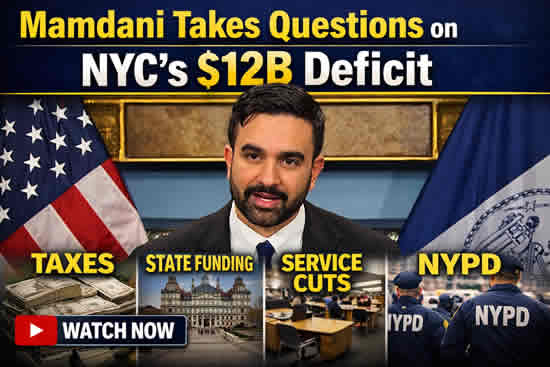
NEW YORK (Jan. 28, 2026) — New York City Mayor Mamdani laid out what he called a fiscal crisis “greater than the Great Recession,” saying the city is staring at a $12 billion budget deficit and promising an “all-of-the-above” response: aggressive efficiencies, new revenue from the wealthiest New Yorkers and major corporations, and a reset of the city’s fiscal relationship with Albany.
Speaking during a City Hall press conference, Mamdani repeatedly drew a bright line between “savings and efficiencies” and “austerity,” arguing New Yorkers should not be asked to accept degraded public services because of what he described as years of budget mismanagement.
What Mamdani says caused the $12B gap
Mamdani blamed the prior administration for what he described as “gross fiscal mismanagement,” alleging that real program costs were not transparently reflected and that expenses were pushed “off the books.” He told reporters his team is now “going through every single dollar” the city spends and that spending must be defensible.
“If it cannot be defended,” he said in substance, “it’s not a dollar that should be spent.”
CityFHEPS costs and the legal fight over eligibility
Asked specifically about CityFHEPS—a housing voucher program whose costs have been criticized as rapidly expanding—Mamdani said his administration requested more time to work on a settlement in the CityFHEPS case. He framed the goal as balancing medium- and long-term housing access with a sustained and balanced budget.
On whether City Hall would continue litigation to stop an expansion of eligibility, Mamdani said those talks were ongoing, without committing to a final yes-or-no answer.
“Efficiencies, not austerity”: what’s on the table?
Pressed on whether agency cuts, vacancy eliminations, or broad reductions could be coming, Mamdani repeated that he intends to pursue every available efficiency—but not in ways that “come at the expense of working New Yorkers.”
When asked for concrete examples, he offered a small but telling illustration: a city AI chatbot he described as “functionally unusable” that cost roughly $500,000, calling it a sign of money spent without accountability. He emphasized that such examples do not close a $12B gap by themselves, but they point to a broader pattern he claims his team is now auditing.
Taxing the top 1% — and fighting for more from Albany
A major theme of Mamdani’s remarks was revenue.
He argued the city must consider raising taxes on the wealthiest residents and “the most profitable corporations,” and he defended a proposal to increase income taxes on the top 1% of New Yorkers by 2%.
He also pushed back on the idea that wealthier taxpayers would automatically flee, using a simple math example: for $1 million in annual income, a 2% increase equals $20,000 more in taxes—an amount he suggested is unlikely to drive relocation decisions for most high earners.
At the same time, Mamdani said the city needs to “recalibrate” its relationship with New York State. He cited an estimated $8 billion annual gap between what New York City contributes to state revenues and what it receives back, describing the imbalance as having grown over a decade through cost-shifting decisions he attributed largely to the Cuomo era.
Are NYPD cuts on the table?
On public safety spending, Mamdani said he is not entertaining cuts to essential services, including the NYPD. He acknowledged the need for savings and efficiencies (including longstanding attention to overtime spending), but insisted New Yorkers should not be left questioning whether critical city services will be delivered.
Will campaign promises be scaled back?
Asked whether the budget crisis forces him to revise campaign promises—previously estimated to cost about $10 billion—Mamdani said no, arguing the city should not allow past mismanagement to “dull” its ambitions.
He pointed to early progress on universal child care, saying more than $1 billion has already been secured toward that agenda and that his administration intends to “reckon with the mismanagement of the past” while still delivering on core commitments.
Timeline: when the detailed plan arrives
Reporters repeatedly asked for specifics—especially with the budget deadline looming. Mamdani said the city will deliver its preliminary budget on Feb. 17, 2026, and that the document will lay out the detailed steps to address the deficit. He added that City Hall will share additional specifics before then, including updated revenue assumptions tied to Wall Street bonuses and other receipts.
Cold-weather deaths and storm cleanup: other updates
Mamdani also addressed urgent quality-of-life and public health topics:
- Cold-weather deaths: He said there had been no additional outdoor deaths since the prior update, described additional placements into shelter, and noted suspected hypothermia involvement in a majority of the deaths discussed—while stressing the official determination rests with the medical examiner.
- Snow and bus stops: City Hall cited progress on clearing bus stop shelters—about 95% of sheltered stops cleared as of early morning—while noting property owners are responsible for many other areas and that the city is evaluating improvements for future storms.
SRG and protests: disbanding the unit
In a separate exchange, Mamdani reiterated his intent to disband the NYPD’s Strategic Response Group (SRG), saying he does not want a single unit combining counterterrorism responsibilities with policing of First Amendment protests. He said operational conversations with the police commissioner were underway and indicated SRG use would continue until those changes are implemented.
Mamdani’s message was clear: New York City’s $12 billion gap won’t be solved with one lever. He is promising a multi-front strategy—tightened spending discipline, new revenue at the top, and a larger fight over what the city receives from the state—while rejecting the framing that austerity and service cuts are inevitable.
Budget gap, CityFHEPS, and litigation
Q: The controller says CityFHEPS costs ballooned. Will you reflect those costs accurately in the preliminary budget, and will you continue litigation to stop expanding eligibility?
A (Mamdani): He blamed the prior administration for budget and housing/assistance mismanagement, said the city asked for more time to work on a settlement in the CityFHEPS case, and emphasized a goal of balancing housing access with a sustained, balanced budget. On whether eligibility will expand, he said the conversations are ongoing (no firm yes/no yet).
“Efficiencies” vs “austerity” (cost-cutting)
Q: You criticized prior cost-cutting, but you say you’ll find efficiencies. Are agency cuts/eliminating vacancies on the table?
A: He drew a sharp line: savings/efficiencies ≠ austerity. He said they’ll pursue every possible saving but not at the expense of working New Yorkers, and they’re reviewing every dollar—if they can’t defend it, it shouldn’t be spent.
Q (follow-up): Can you name specific efficiencies now, with the budget due soon?
A: He said the next weeks are about assessing full fiscal health, and gave one example of waste: a prior administration AI chatbot that was “functionally unusable” and cost about $500,000—not a gap-closer, but a sign of mismanagement and hidden/ignored true costs.
Bigger strategy: taxes + Albany + internal savings
Q: If you want a “relationship reset” with the state, is it more than two tax increases?
A: Yes—he framed it as a crisis “greater than the Great Recession,” requiring an all-of-the-above approach: internal savings, higher taxes on the wealthiest and most profitable corporations, and recalibrating the NYC–state relationship so the city gets what it’s owed.
Q: Is it wise to call for higher taxes when the Governor isn’t interested—won’t that leave you stuck politically?
A: He argued the city is already stuck because of the deficit, and said they won’t default to making “those with the least” bear the burden. He defended raising the top 1% NYC income tax by 2%, including an anecdote suggesting the increase wouldn’t trigger mass flight (he illustrated it as $20,000 on $1M income). He also said the city will advocate aggressively in Albany rather than staying quiet.
Q: Are you asking Albany to “pick up the tab” for specific programs (e.g., childcare expansion) to fix the imbalance?
A: He said the fix is the city receiving what it is owed, citing an annual imbalance of about $8 billion (what NYC contributes vs. receives). He pointed to Cuomo-era cost shifts as examples of burdens moved from state to city, and implied they’ll seek to reverse that pattern.
Q: Why should the governor give the city more money if you can balance the budget with “efficiencies”? Will the preliminary budget assume $X from the state?
A: He said $12B cannot be solved by efficiencies alone. The solution must combine spending scrutiny plus new revenue and a new fiscal relationship with the state. He wouldn’t preview exact state-line assumptions before releasing the preliminary budget.
Revenue assumptions and “being conservative”
Q: Under Adams, conservative revenue estimates were used to justify cuts; then Wall Street/high-earner receipts came in higher. Are you being conservative now about Wall Street revenue/bonuses?
A: He said they’re encouraged by reports of higher bonuses and increased revenue, but the $12B deficit is too large to be covered by that, so they still need structural solutions.
“Give more details” — timeline and the preliminary budget
Q: You say you’ll be transparent, but you’re not giving practical detail on cuts. What will New Yorkers actually face? And what have your talks with Governor Hochul been like?
A: He said specifics will come with the preliminary budget on February 17, and that between now and then they will share additional specifics on the gap after updated revenues/bonuses, and on the savings they’re pursuing—while stressing they won’t use the crisis to justify pulling back essential services.
On Hochul, he said he’s encouraged by the conversations and the relationship they’re building.
NYPD and public safety
Q: Are NYPD cuts on the table (especially overtime)?
A: He said they are not entertaining cuts; they’re discussing savings/efficiencies without making New Yorkers doubt essential services will be delivered.
Campaign promises vs the deficit
Q: Do you need to revise campaign promises (estimated ~$10B), now with a $12B out-of-balance situation?
A: He said no—they won’t let prior failures “dull” their ambitions. He cited early progress: over $1B secured toward universal childcare (he framed it as achieved very early in the administration). The message: fix past mismanagement, handle the present crisis, and still deliver a future where working New Yorkers aren’t priced out.
Cold-weather deaths update (separate topic)
Q: Any new information on cold-weather deaths?
A: He said no additional outdoor deaths since last update; about 30 additional placements were made since the prior night; they suspect ~7 of 10 deaths had hypothermia as a factor; ~6 of 10 were known to DHS. He emphasized the medical examiner will determine official cause and described the 5–7 day post-autopsy timeline for results.
He also described visiting Bellevue (warming center) and joining outreach workers, sharing an anecdote about an older man’s personal story and praising city workers/outreach teams.
SRG (Strategic Response Group) and protests
Q: Are you asking Albany for the full $8B gap back? And you campaigned on disbanding SRG—would you do it, is it an “inefficiency,” would you replace it?
A: He said he still believes SRG should be disbanded, and he’s in talks with the police commissioner about operational implementation. He framed the rationale primarily as policy/rights, not budget: SRG shouldn’t combine counterterrorism with responses to First Amendment activity.
On the $8B question: he said they’ll share more details on the gap for this fiscal year and next once updated revenues/bonuses are accounted for, but reiterated the “all-of-the-above” approach.
Q (follow-ups): Did you know SRG would be at an anti-ICE protest last night? Are you concerned? Have you told NYPD not to use them at protests “for now”?
A: He said SRG will continue to be used until they implement the operational change. He added NYPD must respond to protests and must do so in ways that respect First Amendment rights. He also said he commends New Yorkers protesting ICE abuses, referencing Minneapolis.
Snowstorm cleanup (off-topic operational question)
Q: Sidewalks/crosswalks/bus stops are still a mess days after the storm. Any new ideas for future storms?
A: He said they’ll keep looking for ways to deliver for all modes of transit. He cited a stat: by 7:10 a.m., DOT cleared 3,227 bus stop shelters (~95% of ~3,400 with shelters). He noted property owners are responsible for many remaining stops and said the city is examining how to increase service levels. He praised city workers and noted the storm was followed by unusually severe cold (the coldest in at least eight years, per his remark).
Was the public misled under Adams?
Q: We used to hear “we must cut,” then Council restored things—was the public misled?
A: He said Adams’s administration misled the public about the scale of the deficit and accused them of pushing real costs “off the books.” He contrasted that with his pledge to be open and honest about the true costs of services and what it will take to fix the problem.
Statewide fairness and progressive taxation
Q (final): The state taxes wealthy NYC people and uses revenue to help poorer upstate cities. Are you saying NYC should keep its wealth and forget the rest of the state?
A: He said it’s important to care for needy New Yorkers statewide, but argued the cost-shifting wasn’t about helping upstate—it was about punishing NYC, describing the growing “chasm” over a decade and expressing hope for a new course.
Sources: NYC.gov , Midtown Tribune new
Midtown Tribune Independent USA news from New York
Ask Midtown Tribune about this story
Answers are grounded first in this article. Search all Midtown Tribune reporting from the main AI Search page.
AI-generated summary. Verify important details in the linked original articles.