
By Midtown Tribune Editorial Board
On July 3, 2026, New York City Mayor Zohran Kwame Mamdani delivered an official address marking America’s 250th birthday. It was supposed to be a speech about the United States at a historic milestone. It became something else: a progressive sermon delivered from City Hall, seated behind George Washington’s desk, surrounded by newly naturalized Americans, and aimed at redefining the American story through immigration, grievance, “supremacy,” ICE, oligarchs, corporate landlords, health insurance companies, bombs, bailouts, and the familiar modern liturgy of permanent national guilt.
To be fair, Mamdani did not entirely forget 1776. He mentioned independence, British colonial rule, George Washington, the Battle of Brooklyn, the Continental Army, and the destruction of King George III’s statue at Bowling Green. The official transcript even uses the phrase “Revolutionary War.” But the phrase “American Revolution” itself does not appear in the official English transcript, and the central meaning of that revolution — citizens overthrowing the rule of a king and building a constitutional republic without nobility, royal privilege, or religious tests — was not the moral center of the speech.
Instead, Mamdani’s speech turned America’s 250th birthday into an immigration-centered morality play. The official transcript moves quickly from Washington and the Declaration to Irish immigrants, Chinese sailors, Jews fleeing pogroms, Italians fleeing poverty, Syrians seeking economic opportunity, the Great Migration, Puerto Ricans after World War II, and arrivals from the West Indies, South Asia, West Africa, and across the world. Mamdani then adds that this is what brought his own family to New York City when he was seven years old.
There is nothing wrong with honoring lawful immigrants. America has done that better than any civilization in human history. But America’s founding document is not a pamphlet from an immigration nonprofit. The Constitution does not begin with “We the Immigrants.” It begins with “We the People of the United States,” and it says the Constitution was established to “secure the Blessings of Liberty to ourselves and our Posterity.” That is not a footnote. That is the first sentence of the Constitution.
The Constitution does give Congress the power “to establish an uniform Rule of Naturalization.” In other words, America created a lawful path for foreigners to become Americans. But that is very different from claiming that immigration itself is the foundation of the republic. The Constitution is built around the American people, citizenship, ordered liberty, self-government, separation of powers, law, posterity, and limits on government. Naturalization is a constitutional power. It is not a replacement for the American founding.
That distinction seemed to disappear in Mamdani’s speech. He told newly naturalized Americans, “You each hold a special power. The power to determine what America means.” It sounds charming until one remembers that the United States already has a constitutional system for deciding what America means: elections, laws, courts, amendments, federalism, and the Constitution itself — which Article VI calls “the supreme Law of the Land.”
Mamdani also declared that America is exceptional because “nothing is fixed into place.” That line may impress a faculty lounge. But a country where nothing is fixed into place is not a constitutional republic. It is a permanent revolution with better catering. The Constitution can be amended, yes, but only through the procedure of Article V — not by poetic rebranding from City Hall.
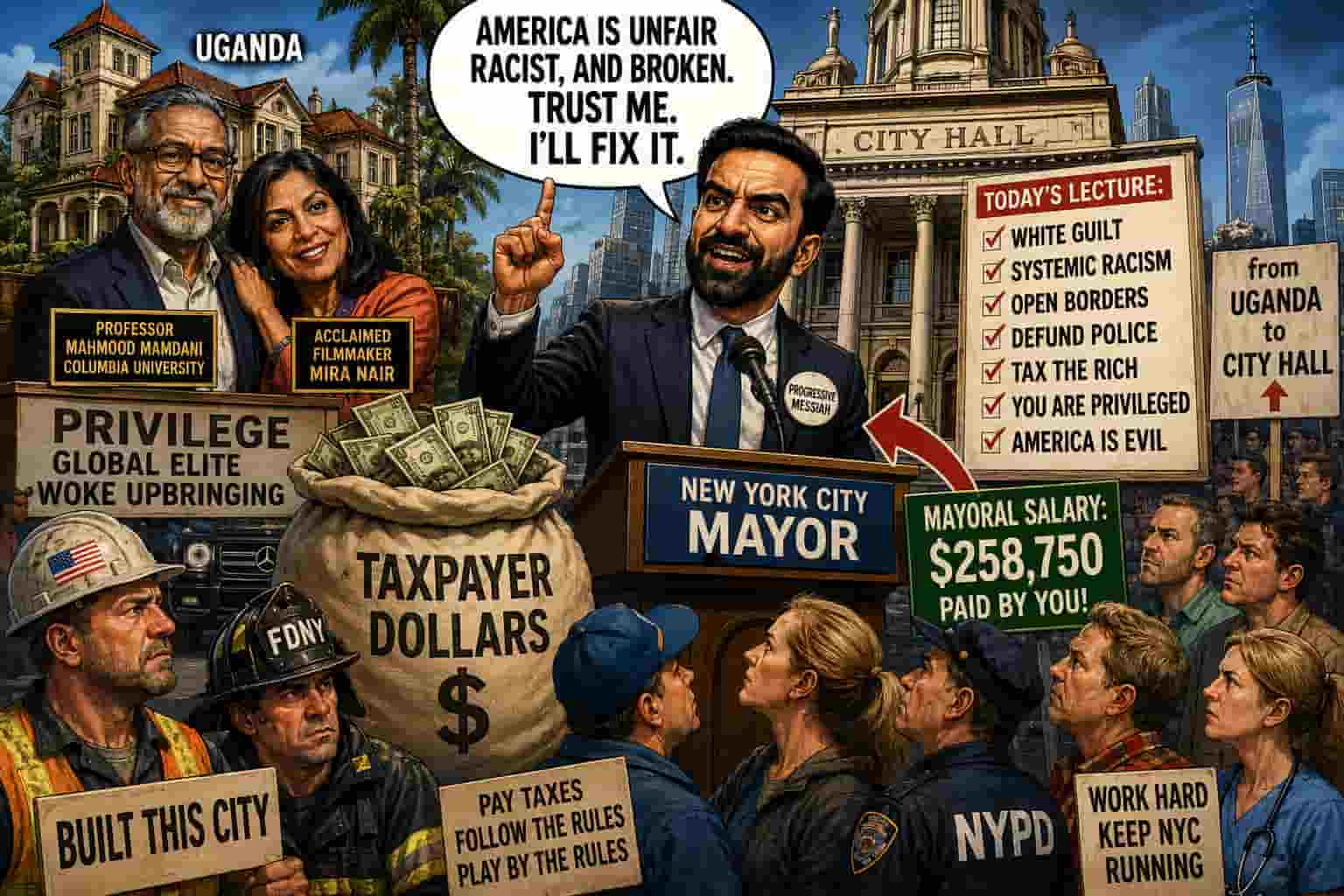
The irony is rich enough to qualify for a city tax surcharge. Mamdani delivered this lecture while holding the office of Mayor of New York City, a position paid by taxpayers. The New York City Charter states plainly that the mayor’s salary is $258,750 a year. That salary is paid not by abstract “equity,” not by slogans, not by “the forces of progress,” but by the working people, homeowners, renters, small businesses, commuters, and taxpayers of New York City.
And Mamdani is not exactly a lunch-bucket outsider lecturing from a factory floor. His father, Mahmood Mamdani, is listed by Columbia University as the Herbert Lehman Professor of Government, MESAAS, International Affairs, and Anthropology; Columbia says he received his Ph.D. from Harvard and specializes in African history and politics, colonialism, civil war, genocide, human rights, and related fields. His mother, Mira Nair, is described by Columbia University’s World Leaders Forum as an internationally renowned filmmaker, educated at Delhi University and Harvard, and winner of the Venice Film Festival’s Golden Lion for Monsoon Wedding.
So the image is not exactly subtle: the son of global academic and cultural elites, elevated by the very Western institutions he now morally audits, sits behind George Washington’s desk and explains to Americans that their country still needs to be corrected — again — by people who speak the language of “progress.”
Mamdani did use the word “liberty.” He quoted the Declaration’s “life, liberty and the pursuit of happiness,” and cited Thomas Paine on “civil and religious liberty.” But in the speech, liberty largely serves as historical decoration before the main course arrives: “supremacy,” “asylum,” “ICE,” “corporate landlords,” “oligarchs,” “monopolies,” “bombs and bailouts,” and “working people demand more.”
That is the great substitution. In the American founding tradition, liberty means freedom from arbitrary power: from kings, titled nobility, state religion, inherited privilege, and government overreach. The Constitution explicitly bars titles of nobility, and Article VI forbids religious tests for public office. The First Amendment protects free exercise of religion, speech, press, assembly, and petition. That is the architecture of American liberty.
But in Mamdani’s telling, liberty is quietly replaced by a progressive version of “freedom” that seems to mean the right to demand more government action, more redistribution, more political correction, and more moral confession from the country that already made his own rise possible. The older American question was: how do we limit power so citizens may live free? The newer progressive question is: how much power can we take in the name of helping people live correctly?
Mamdani’s most revealing line may be this: America is “a place each of us has the power to make.” It sounds democratic. But by the end of the speech, the “us” is doing a lot of work. Is “us” the people of the United States and their posterity, as the Constitution says? Or is “us” every new political coalition that arrives with a grievance, a theory, and a spending plan?
The Constitution is not anti-immigrant. It contains the naturalization power. But the Constitution is also not a sentimental open-ended invitation to redefine America every time a new activist coalition discovers a new vocabulary of accusation. It is a charter of government for the people of the United States and their posterity. That matters. Words matter. Founding documents matter. Especially on a 250th birthday.
Mamdani’s speech also placed Puritans, Sikhs, Quakers, Muslims, and Jewish people into one broad sentence about people sent to America’s shores after being banished for praying the wrong way, worshipping the wrong gods, or angering the wrong people. As rhetoric, it is smooth. As history, it is a blender. Puritans and Quakers belong to early colonial America. Jews were present in New Amsterdam before the United States existed. Muslims were present in early America as well, often through the tragedy of enslaved Africans. Sikh immigration belongs largely to a much later American story. Mamdani’s sentence creates emotional unity by mixing very different eras, legal statuses, and historical experiences into one progressive founding myth.
This is the signature move: take America’s real history, flatten the chronology, keep the guilt, soften the gratitude, and present the result as moral courage. The old Fourth of July celebrated independence from monarchy. The new progressive Fourth of July apparently celebrates the right of elected officials to accuse the country while cashing checks from the country’s taxpayers.
Mamdani did say America is a “grand experiment in self-governance.” Good. That is true. But self-governance is not the same as endless self-accusation. A constitutional republic does not survive by teaching every generation that the country is primarily a crime scene and the taxpayer is primarily a funding source for moral repair. It survives when citizens understand what was built, why it was built, and what must be defended.
The real American Revolution was not a migration festival. It was a political earthquake. Americans rejected monarchy. They rejected royal supremacy. They rejected hereditary rule. They rejected the idea that government legitimacy flows from kings, crowns, aristocrats, or sacred bloodlines. They created a republic in which power comes from the people and is restrained by law. That is why the Constitution bans titles of nobility. That is why it rejects religious tests. That is why the Bill of Rights begins by limiting Congress, not empowering activists.
And that is exactly what Mamdani’s address underplayed. He remembered Washington, but used him as scenery. He remembered the Declaration, but turned it into a mandate for permanent social correction. He remembered “liberty,” but quickly moved to “demand more.” He remembered America’s shores, but forgot that America is not merely a shore. It is a constitutional order.
The most American thing about Mamdani’s speech is that he was allowed to give it. Only a remarkably free society would allow a naturalized politician, the son of elite international intellectuals and artists, to rise through its institutions, become mayor of its largest city, sit behind George Washington’s desk, receive a taxpayer-funded salary, and lecture the country on how deeply flawed it still is. That is not proof of American oppression. That is proof of American tolerance bordering on comedy.
So, happy 250th birthday, America.
You threw off a king, abolished titles of nobility, protected religious liberty, built a constitutional republic, opened a lawful path to citizenship, and gave millions the chance to become Americans.
And for your trouble, from behind George Washington’s desk, you got a lecture.
Not bad for a country that is supposedly still waiting to be taught what freedom means.
Official Sources and Primary Documents
Mayor Mamdani’s Official Speech
-
NYC Mayor’s Office: Remarks as Prepared — Mayor Mamdani Delivers Address Marking America’s 250th Birthday
Primary source for Mamdani’s July 3, 2026 address, including references to George Washington, the Declaration, immigration, “supremacy,” ICE, “life, liberty and the pursuit of happiness,” and his statement that America is a place each inhabitant can shape. -
NYC Mayor’s Office: Spanish Transcript — Mayor Mamdani’s Address for America’s 250th Birthday
Official Spanish version of the same address.
Founding Documents of the United States
-
National Archives: Declaration of Independence — Full Transcript
Primary document for “life, liberty and the pursuit of happiness” and the colonies’ break with the British Crown. -
National Archives: What Does the Declaration of Independence Say?
Official explanation of why the Declaration was written and how it justified separation from Great Britain. -
National Archives: U.S. Constitution — Full Transcript
Primary document for “We the People,” “our Posterity,” naturalization, the Supremacy Clause, separation of powers, and the ban on titles of nobility. -
National Archives: Bill of Rights — Full Transcript
Primary document for freedom of religion, speech, press, assembly, and petition.
Constitutional Clauses Cited in the Article
-
Library of Congress / Constitution Annotated: Preamble
Official constitutional text for “We the People of the United States” and “secure the Blessings of Liberty to ourselves and our Posterity.” -
Library of Congress / Constitution Annotated: Article I
Official constitutional text including Congress’s power to establish a uniform rule of naturalization. -
Library of Congress / Constitution Annotated: Article V — Amendment Process
Official constitutional text showing that the Constitution can be amended only through a defined legal process. -
Library of Congress / Constitution Annotated: Article VI — Supremacy Clause and No Religious Test
Official constitutional text for the Constitution as the supreme law of the land and the ban on religious tests for public office. -
Library of Congress / Constitution Annotated: Titles of Nobility and the Constitution
Official constitutional analysis of the ban on titles of nobility by the United States. -
Library of Congress / Constitution Annotated: First Amendment
Official constitutional text for free exercise of religion, no establishment of religion, free speech, press, assembly, and petition.
New York City Government Sources
-
New York City Charter, Section 4: Election, Term, and Salary of the Mayor
Official city law stating that the mayor’s salary is $258,750 per year. -
NYC DCAS Green Book: Mayors of the City of New York
Official New York City source listing the mayors of New York City. -
NYC Parks: Bowling Green History — King George III Statue
Official city history source for the statue of King George III at Bowling Green.
George Washington, the Declaration in New York, and the Revolution
-
Library of Congress: Declaring Independence — The Declaration Reaches New York
Official Library of Congress source on the Declaration of Independence being read in New York in July 1776. -
George Washington’s Mount Vernon: Battle of Brooklyn
Primary historical institution source on the Battle of Brooklyn and Washington’s retreat.
Immigration, Naturalization, and Historical Context
-
National Archives: Chinese Exclusion Act of 1882
Official source for federal immigration exclusion law referenced in discussions of immigration restrictions. -
National Archives: Immigration Act of 1924
Official source on federal immigration quota policy in the 20th century. -
U.S. Citizenship and Immigration Services: Citizenship and Naturalization
Official federal source explaining the legal process by which immigrants become U.S. citizens.
Religious Liberty and Early Religious Communities in America
-
National Park Service: Roger Williams and Islam
Official National Park Service source on early American religious thought and Islam. -
National Park Service: Roger Williams and Enslaved Muslims
Official source explaining that early Muslims in America often arrived through the tragedy of enslavement. -
Smithsonian National Museum of African American History and Culture: African Muslims in Early America
Smithsonian source on African Muslims in early America. -
NYC Landmarks Preservation Commission: Early Jewish History in New Amsterdam / New York
Official NYC source documenting early Jewish presence in New Amsterdam and New York.
Biographical Primary Sources
-
Columbia University: Mahmood Mamdani Faculty Profile
Primary institutional source for Mahmood Mamdani’s Columbia University position and academic biography. -
Columbia University World Leaders Forum: Mira Nair Biography
Primary institutional source for Mira Nair’s biography, education, and film career.
Economic and Social Claims Mentioned in Mamdani’s Speech
-
U.S. Department of Agriculture: Food Security in the U.S. — Key Statistics and Graphics
Official federal statistics on food insecurity in U.S. households, including households with children. -
U.S. Immigration and Customs Enforcement: Enforcement and Removal Operations
Official federal source on ICE’s immigration enforcement mission.
Ask Midtown Tribune about this story
Answers are grounded first in this article. Search all Midtown Tribune reporting from the main AI Search page.
AI-generated summary. Verify important details in the linked original articles.