
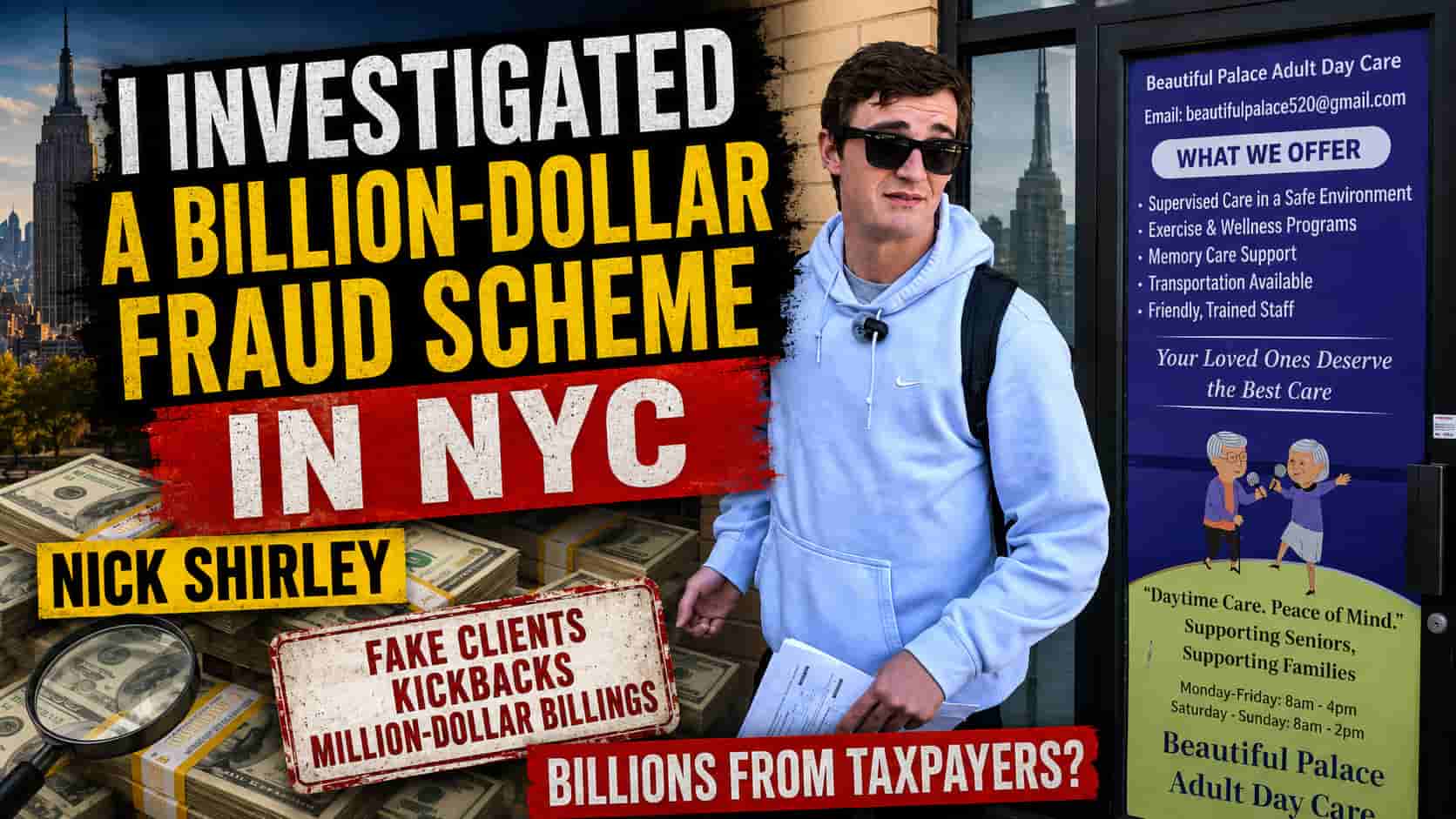
A viral investigation alleges that some taxpayer-funded senior day care providers may be using cash incentives to recruit Medicaid recipients. The claims have not yet been established in court, but recent federal prosecutions show that similar schemes are real—and costly.
Independent journalist Nick Shirley has brought renewed attention to New York City’s rapidly expanding network of taxpayer-funded adult day care providers, alleging that some facilities may be recruiting Medicaid recipients through cash payments and other improper incentives.
In a widely circulated video, Shirley visits adult day care centers and medical-equipment businesses in New York City with Dr. Mehmet Oz, the current administrator of the Centers for Medicare & Medicaid Services, or CMS. Oz oversees the federal agency responsible for Medicare, Medicaid and several other major health programs.
The video presents serious questions about unusually large patient counts, millions of dollars in government payments and allegations that some facilities offer money to elderly participants or intermediaries in exchange for enrollment and attendance.
Those claims deserve scrutiny. They must also be described accurately: a viral investigation is not an indictment, and an accusation is not a conviction.
Fox News, which interviewed Shirley about the video, explicitly stated that it had not independently confirmed his reporting.
Thousands of Clients at a Small Facility?
Shirley said his investigation began in Flushing, Queens, after representatives of one adult day care business allegedly told him that competitors were taking away clients by offering kickbacks.
He later claimed that one relatively small location was associated with more than 7,000 patients and as much as $12 million in billing. During the television interview, he argued that the number appeared physically implausible for the size of the facility.
That allegation cannot be confirmed merely by standing outside a building. A center’s reported enrollment may cover a long period, multiple programs or clients who attend on different days. A reliable audit would require access to Medicaid claims, attendance records, individual care plans, transportation logs and evidence that each billed service was actually delivered.
Still, when a small provider reports thousands of participants and receives millions of dollars from a public health program, regulators have a legitimate reason to examine the records.
What Is the Alleged Kickback Arrangement?
According to Shirley, some adult day care operators or marketers may offer elderly Medicaid recipients money for attending a center or referring friends.
Under the alleged model, a provider receives Medicaid-related revenue after enrolling a beneficiary. A portion of that revenue is then returned to the beneficiary or recruiter as an incentive.
Federal law prohibits knowingly offering, paying, soliciting or receiving remuneration to induce or reward referrals for services paid for by a federal health care program. The prohibition can apply to patient referrals as well as referrals made by medical professionals or commercial intermediaries.
Not every benefit given to a senior constitutes an illegal kickback. Transportation, meals and certain properly structured services may be permissible. Criminal liability generally depends on the purpose of the payment, the applicable regulations and whether the benefit was intended to generate federally funded business.
That distinction matters. It is not enough to show that a center gave something of value to a participant. Investigators must establish that the payment was improperly connected to enrollment, referrals or federally reimbursed services.
Adult Day Care Is More Than Recreation
Critics of these programs sometimes describe them as taxpayer-funded places where seniors play games, dance or practice tai chi. That characterization is incomplete.
Properly operated adult day care programs can serve elderly and disabled people who need supervision, social support, transportation, assistance with daily activities or coordination of care. For families trying to keep an aging relative at home rather than in an institution, these programs can provide meaningful support.
The policy question is therefore not whether seniors should be allowed to exercise, socialize or play dominoes.
The real questions are whether participants were eligible, whether the services were medically or functionally justified, whether the reported attendance was genuine and whether taxpayers were billed for care that was never delivered.
Similar New York Schemes Have Already Produced Federal Cases
Although Shirley’s specific allegations remain unproven, the type of conduct he describes has already appeared in federal criminal cases involving New York adult day care businesses.
In October 2024, federal prosecutors charged eight people in an alleged $68 million scheme involving two Brooklyn social adult day care centers and a home health care intermediary. Prosecutors alleged that marketers were paid for referring Medicaid recipients and that some recipients received kickbacks connected to services that were not provided.
In August 2025, Zakia Khan, who owned adult day care businesses in Coney Island, pleaded guilty to leading that $68 million scheme. The Justice Department said the operation used bribes and kickbacks to obtain Medicaid-funded business.
In January 2026, two additional defendants pleaded guilty to conspiring to defraud Medicaid through kickbacks tied to services that were not provided at Brooklyn adult day care centers and a home health care company.
A separate case announced in February 2026 involved two Queens men accused of participating in an alleged $120 million adult day care and pharmacy fraud operation. Federal prosecutors alleged that illegal cash kickbacks were paid to Medicaid recipients to encourage enrollment. Those defendants are presumed innocent unless proven guilty.
The Justice Department has also previously charged Flushing defendants in an alleged scheme involving more than $8.3 million in Medicaid claims for adult day care services that prosecutors said were not provided and were generated through kickbacks and bribes.
These cases do not prove every allegation in Shirley’s video. They do establish that adult day care kickback and false-billing schemes are not merely theoretical.
What About the “Billions” Figure?
The viral coverage claims that New York City adult day care businesses may have generated more than $2 billion in recent years.
That figure should not be described as $2 billion in fraud unless authorities establish that the underlying payments were improper.
Total program spending can include lawful services provided to thousands of eligible seniors. To determine how much money, if any, was obtained fraudulently, auditors would need to separate legitimate claims from medically unnecessary services, fabricated attendance, duplicate billing and claims generated through prohibited incentives.
The appropriate questions include:
How many unique beneficiaries were served?
How many days did each person attend?
What services were documented?
Were claims supported by care plans and attendance records?
Were the same beneficiaries billed through multiple providers?
Did marketers or participants receive payments linked to referrals?
Were medical-equipment claims connected to actual patient needs?
Until those records are examined, the phrase “billion-dollar fraud scheme” remains an allegation and a description of the investigation—not a judicial finding.
Why Dr. Oz’s Presence Matters
Dr. Oz’s participation gives the video greater significance than a conventional street investigation.
As CMS administrator, he leads the federal agency that oversees programs involving trillions of dollars in health care spending and works with states to protect Medicare and Medicaid from fraud, waste and abuse.
His appearance at the locations does not mean CMS has formally determined that any named business committed fraud. But it suggests that the issues raised in the video may receive attention from federal regulators.
A responsible investigation would involve CMS, the New York State Medicaid Inspector General, state health authorities and federal law enforcement. It should follow the billing data rather than rely solely on visual impressions or confrontations at a business entrance.
Protecting Both Taxpayers and Legitimate Providers
Fraud in programs serving elderly and disabled people causes more than a financial loss.
It can divert money from patients who genuinely need home care, rehabilitation, transportation, nursing assistance or supervision. It can also damage legitimate adult day care providers that follow the rules but cannot compete with businesses allegedly offering cash for enrollment.
The answer is not to assume that every senior center is fraudulent. Nor is it acceptable to dismiss credible warning signs because the underlying program serves a sympathetic population.
New York taxpayers are entitled to know whether Medicaid money is paying for documented care—or financing recruitment payments, invented attendance and services that never occurred.
Nick Shirley’s video does not settle that question. It does something else: it places the question directly before the agencies with the authority to obtain records, conduct audits, suspend improper payments and bring cases when the evidence supports them.
The next step should not be another viral argument. It should be a transparent, evidence-based investigation.
Editorial note: Allegations concerning specific businesses or individuals should not be treated as findings of guilt. Criminal charges are accusations, and defendants are presumed innocent unless and until convicted.
#crime #NickShirley #Shirley
Official Sources and Documents
- U.S. Department of Justice: Eight Charged in an Alleged $68 Million Social Adult Day Care and Home Health Care Scheme — federal prosecutors alleged that marketers received illegal payments for referring Medicaid recipients and paid kickbacks to beneficiaries.
- U.S. Attorney’s Office: Brooklyn Woman Pleads Guilty to Leading a $68 Million Adult Day Care Fraud Scheme — an official account of the guilty plea involving two Brooklyn social adult day care businesses.
- U.S. Attorney’s Office: Two Individuals Plead Guilty in the $68 Million Brooklyn Adult Day Care Case — prosecutors said the defendants used kickbacks and bribes connected to Medicaid-funded services.
- U.S. Department of Justice: Two Queens Men Charged in an Alleged $120 Million Adult Day Care and Pharmacy Fraud Scheme — the case involves allegations of fraudulent claims and cash kickbacks to Medicare and Medicaid beneficiaries.
- HHS Office of Inspector General: Federal Fraud and Abuse Laws — the official explanation of the Anti-Kickback Statute, False Claims Act and related federal health care laws.
- HHS-OIG: Official Questions and Answers on Federal Fraud and Abuse Authorities — guidance explaining that the Anti-Kickback Statute generally prohibits payments exchanged for referrals or other federal health care program business.
- HHS-OIG: Anti-Kickback Statute Safe Harbor Regulations — official information about regulatory protections for certain properly structured arrangements.
- New York State Department of Health: Social Adult Day Care Compliance — state requirements and compliance materials for Social Adult Day Care providers working with Managed Long Term Care plans.
- New York State Department of Health: Adult Day Health Care — an official description of eligibility and services available through New York’s Adult Day Health Care program.
- New York State Department of Health: About Managed Long Term Care — background on the state system through which many long-term-care and social day care services are organized.
- New York State Social Adult Day Care Oversight and Contact Information — state contact information and annual self-evaluation requirements for Social Adult Day Care providers.
- New York State Office of the Medicaid Inspector General — the state agency responsible for protecting the integrity of New York’s Medicaid program through audits, investigations and recovery actions.
- Report Suspected Medicaid Fraud to New York State — the official OMIG form for reporting suspected fraud, waste, abuse or improper billing.
Legal notice: Criminal charges are allegations, not findings of guilt. Defendants are presumed innocent unless and until proven guilty in court. The official cases listed above demonstrate that adult day care kickbacks and false Medicaid billing have been investigated and prosecuted in New York, but they do not independently prove every allegation made in Nick Shirley’s video.
Ask Midtown Tribune about this story
Answers are grounded first in this article. Search all Midtown Tribune reporting from the main AI Search page.
AI-generated summary. Verify important details in the linked original articles.