
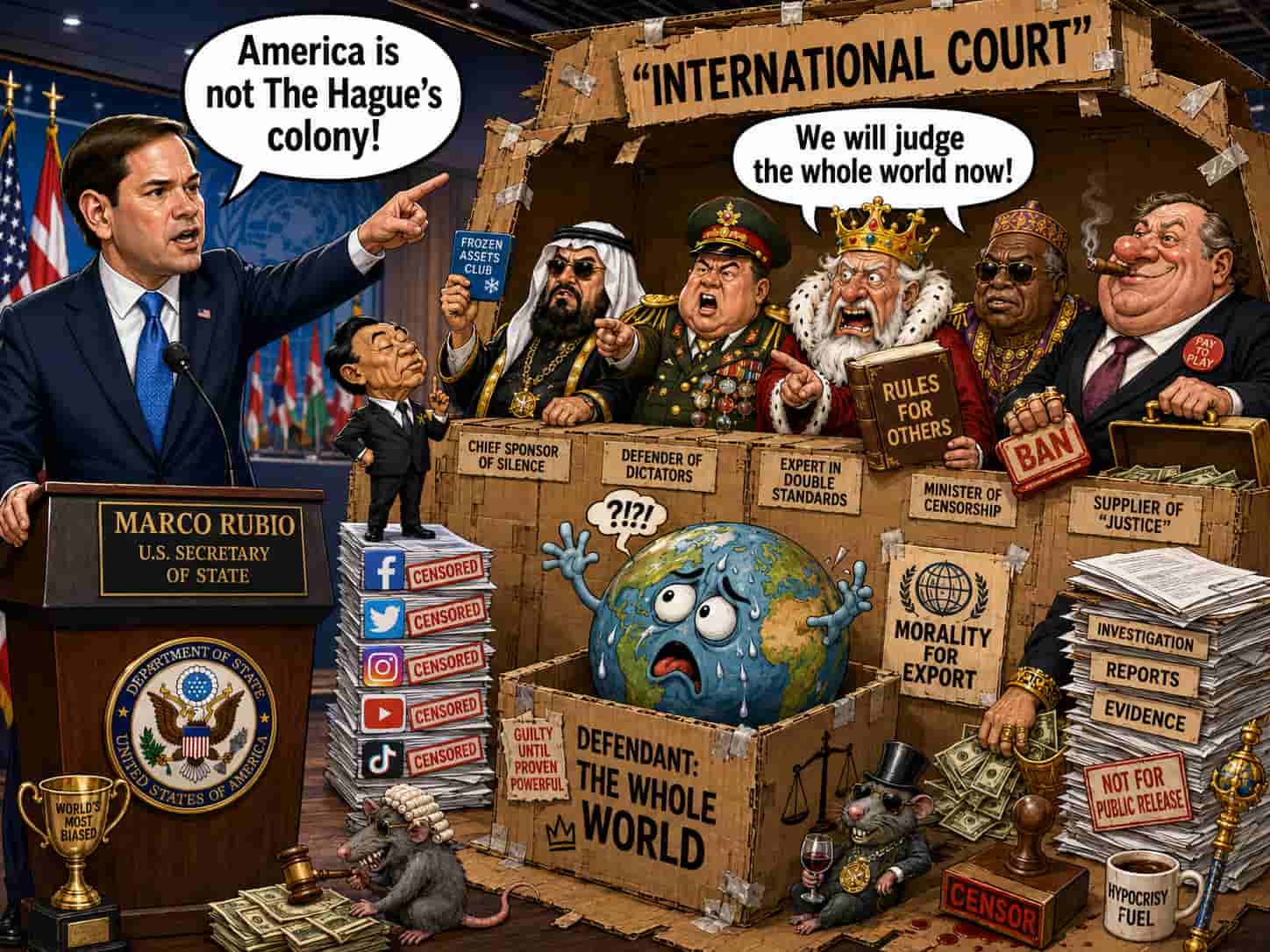
Secretary Rubio asserts that the International Criminal Court represents a direct threat to American sovereignty and the nation’s foundational legal principles. He argues that the tribunal has evolved from a limited fallback system into an unaccountable global body staffed by bureaucrats who lack the consent of the American people.
By claiming jurisdiction over domestic matters, the ICC reportedly endangers military personnel, border agents, and law enforcement officers who are simply performing their duties. Rubio invokes the Declaration of Independence to emphasize that Americans should only be judged by their peers under national laws rather than by foreign judges located overseas. He concludes by promising that the administration will vigorously defend self-governance and resist any attempts by international organizations to bypass the country’s independent legal system.
U.S. Department of State Official video
Unable to Protect Their Own Citizens — Yet Ready to Judge the Entire World
The International Criminal Court appears increasingly unwilling to remain merely a court created by the countries that joined the Rome Statute. It now claims authority that can reach citizens of nations that never accepted its rule.
The United States is not alone in refusing to surrender its sovereignty to The Hague.
China, India, Russia, Israel, Turkey, Saudi Arabia, Indonesia, Pakistan, Iran, Egypt, Iraq, North Korea and several other countries are not parties to the Rome Statute. Some never joined it; others signed but never ratified it or later made clear that they did not intend to become parties.
Together, these countries represent billions of people.
Yet the institution continues to call itself the International Criminal Court, as though a treaty accepted by 125 governments had somehow become a constitution for the entire planet.
It apparently does not matter whether a country recognizes the Court.
It does not matter whether its citizens consented to such authority.
The Hague has decided that everyone may eventually become its defendant.
Secretary of State Marco Rubio has now drawn attention to the obvious defect in this arrangement: the United States never transferred authority over Americans to foreign prosecutors and judges.
American law states the principle even more directly. A treaty binds its parties; it does not impose obligations upon nations that did not consent to it. Congress has expressly declared that the United States is not bound by the Rome Statute and does not recognize ICC jurisdiction over American nationals.
Consent, however, is inconvenient for international bureaucracy.
The comedy becomes darker when one looks at some of the governments participating in this self-appointed moral tribunal.
Countries that imprison people for prohibited social-media posts, freeze protesters’ financial accounts, restrict political and religious expression, and struggle to protect their own citizens from organized criminal networks have assembled a court to lecture the rest of humanity about rights, justice and lawful government.
First, fail to put your own house in order.
Then establish an “international court.”
Finally, appoint yourself the conscience of the planet.
The American Revolution replaced the subject with the citizen. It helped establish a political order in which government is limited, courts derive authority from law, and officials remain accountable to the people.
The new international bureaucracy proposes the reverse arrangement: turn the citizen back into the subject of a distant institution whose officials he never elected and cannot remove.
Rubio’s warning also raises a practical question: what consequences will now follow for officials of this self-appointed global court?
The answer may be more substantial than another diplomatic protest.
President Donald Trump’s existing executive order permits the United States to block property and financial interests belonging to foreign persons involved in unauthorized ICC investigations or prosecutions of protected Americans and allied nationals. It also allows the suspension of entry into the United States for ICC officials, employees, agents and, in some circumstances, members of their immediate families.
That means “American resolve” can translate into frozen assets, blocked transactions, visa restrictions and sanctions against those assisting unauthorized cases.
The ICC may issue documents bearing official seals.
But seals do not create sovereignty.
Americans will answer to American courts, under the Constitution and laws of the United States—not to foreign officials who have decided that the whole world belongs in their defendants’ box.
America is not The Hague’s colony. And the world is not its property.
Ask Midtown Tribune about this story
Answers are grounded first in this article. Search all Midtown Tribune reporting from the main AI Search page.
AI-generated summary. Verify important details in the linked original articles.