
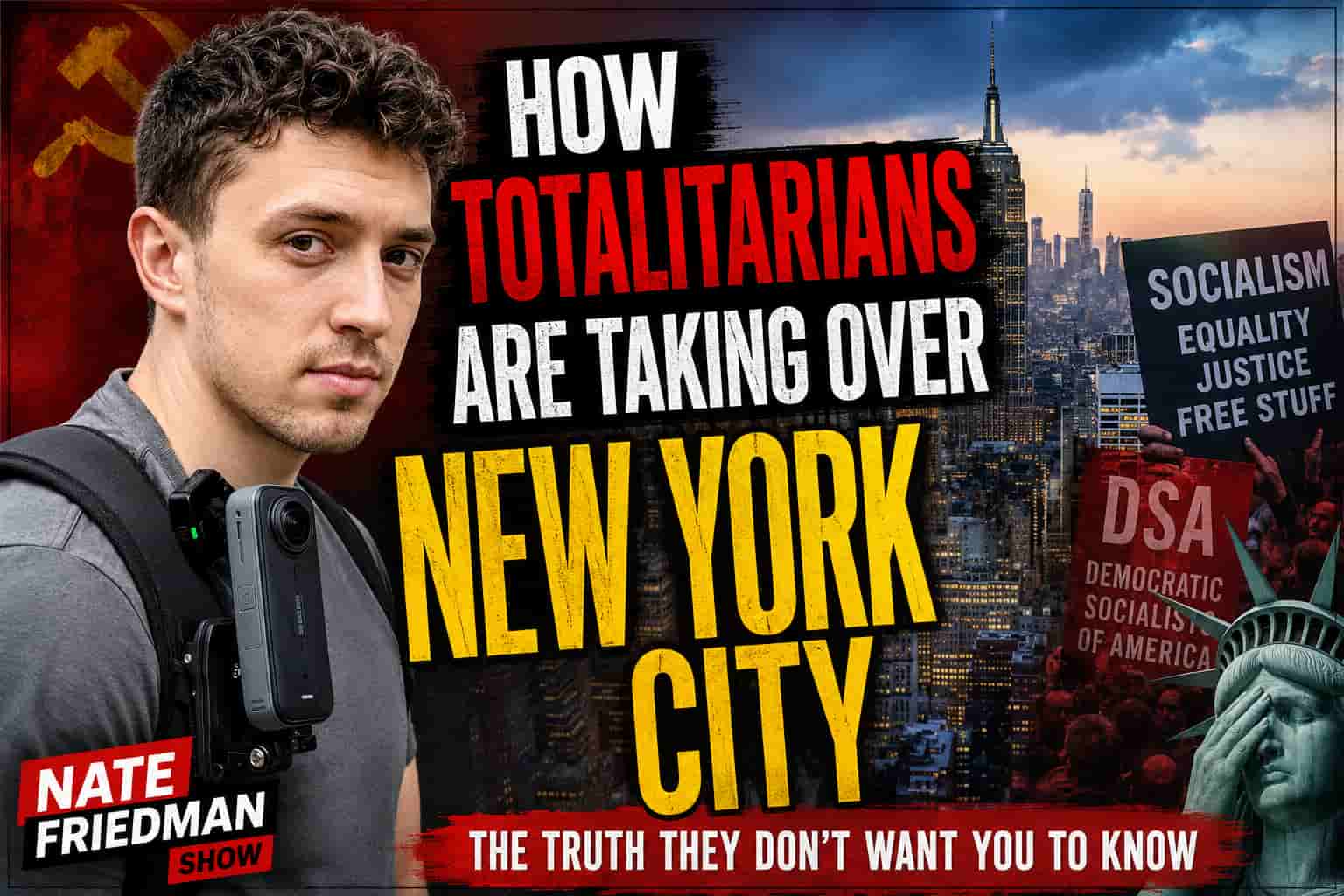
Nate Friedman visits Little Morocco and discovers that socialism now means football, friendship, frozen rent—and apparently never having to ask who pays the bill
Opinion and Satire
New York City has survived British occupation, the Draft Riots, Tammany Hall, bankruptcy, crime waves, hurricanes, blackouts, and tourists standing motionless in the middle of the sidewalk.
But now the city faces a new historic challenge: young activists who believe socialism means watching soccer with friends.
In his July 15 video, “I Exposed the Communist Takeover of New York City,” journalist and YouTube host Nate Friedman visits the Little Morocco section of Astoria during a World Cup gathering. While everyone else is watching football, Friedman asks the question naturally occupying every sports fan’s mind:
Socialism or capitalism?
The resulting interviews are not exactly a seminar at the University of Chicago. They are closer to an economic philosophy class being conducted outside a café after the professor has gone home.
One young woman admits that she does not know much about socialism. But she knows that the socialists she has met are “really cool.”
And there it is—the entire modern political campaign condensed into one sentence.
No economic models. No examination of incentives. No discussion of productivity, property rights, shortages, taxation, or whether the government has ever successfully repaired the escalator at your subway station.
The candidates are cool.
The posters are attractive.
The slogans are short.
What more could democracy possibly require?
The exchanges and political claims discussed throughout Friedman’s report appear in the supplied transcript of the video.
Socialism: Now With Coffee and Football
A Democratic Socialists of America activist interviewed by Friedman offers an especially cheerful definition of socialism.
Socialism, he explains, is community. It is drinking coffee with strangers, sitting in the street, watching sports together and hugging people during the World Cup.
This is excellent news.
For more than a century, scholars wasted enormous quantities of paper arguing about public ownership, central planning, class conflict and the abolition of capitalism. Apparently, socialism was just a block party.
Under this definition, every Italian grandmother who puts folding chairs on the sidewalk has been operating a revolutionary cell since 1957.
The activist’s description is emotionally attractive because it transforms an economic system into a social feeling. Capitalism becomes loneliness, landlords and expensive apples. Socialism becomes friendship, free events and a mayor who cares.
Nobody wants to vote for “complex trade-offs involving supply constraints.”
People will vote for “community.”
The difficulty begins when the coffee shop receives its property-tax bill.
The Democratic Party’s New Renovation Contractors
The most politically significant moment comes when the DSA activist explains that forming a separate socialist party is not realistic. Instead, socialists work through the Democratic Party and hope to transform it into a working-class party.
That is not a conspiracy theory whispered in a basement. DSA describes itself as a political and activist organization rather than a separate party, while NYC-DSA openly says it is building socialist political power throughout the five boroughs.
In other words, DSA is not breaking into the Democratic Party through a window.
It has entered through the front door, brought campaign volunteers, registered voters and started measuring the curtains.
The strategy is perfectly understandable. Why construct a new political party when an existing party already provides ballot access, voter databases, campaign infrastructure and elected officials?
It is political recycling.
The Democratic Party supplies the container. DSA supplies the new label.
Please Do Not Call the Program Radical Until You Read It
Critics sometimes exaggerate political platforms. Fortunately, DSA has made exaggeration unnecessary.
Its official 2026 program calls for drafting a new constitution and creating a democratic socialist republic. It proposes replacing the president and Supreme Court with institutions subordinate to Congress, abolishing the Senate, establishing public ownership of the largest corporations and essential industries, abolishing ICE and granting amnesty to immigrants regardless of legal status.
This is the part where supporters normally explain that critics are creating panic over harmless Scandinavian-style social democracy.
Denmark, however, has not abolished its parliament’s upper chamber because someone on TikTok disliked billionaires.
These are not merely proposals for slightly larger school-lunch portions.
They represent a comprehensive redesign of America’s constitutional and economic system.
DSA is entitled to advocate for that program. Americans are equally entitled to read it before being told it is just about neighbors sharing coffee.
Government Grocery Stores: Because the DMV Was Such a Success
Mayor Zohran Mamdani’s municipal grocery initiative also appears prominently in Friedman’s report.
The city has allocated $70 million in capital funding to develop five sites, one in each borough. The first city-owned grocery location is expected to open in late 2027, while the La Marqueta site in East Harlem is scheduled for 2029. The city will cover costs including land, rent and construction, while a private contractor will operate the stores and be required to pass savings to customers on selected staples.
Supporters call this a “public option.”
That phrase is important. “Government grocery store” sounds like a place where you wait three hours for a banana and then discover you completed the wrong form.
“Public option” sounds modern, friendly and possibly equipped with artisanal hummus.
The theory is that eliminating certain overhead costs will allow the stores to offer lower prices. The unresolved question is whether a privately owned supermarket can meaningfully compete against a store whose landlord, financier and regulator are all the same municipal government.
It is like entering a boxing match where your opponent owns the arena, appoints the referee and sends you the property-tax assessment.
In Friedman’s funniest exchange, a street vendor declares himself opposed to capitalism while selling a shirt for $60. Asked whether he would accept a government-mandated price of $40, he refuses.
This is perhaps the most honest economic lesson in the entire video:
Price controls are wonderful—on someone else’s merchandise.
Freeze the Rent, Thaw the Building Later
New York’s Rent Guidelines Board voted in June to freeze increases on both one- and two-year rent-stabilized lease renewals beginning between October 1, 2026, and September 30, 2027. The policy covers the city’s rent-stabilized sector, not every apartment in New York.
The city’s Independent Budget Office estimates that New York has roughly 928,000 rent-stabilized apartments in approximately 43,000 buildings. Many of those buildings are old: among pre-1974 stabilized properties, the median construction year is 1924.
Freezing rent is politically brilliant because the benefit is immediate and visible.
The tenant receives a renewal lease and sees zero.
The building receives an insurance bill, a repair estimate, a water charge and a boiler older than television—and also sees zero, but in a different emotional context.
That does not prove a rent freeze will automatically destroy housing. Nor does it establish Friedman’s speculative argument that government will eventually seize distressed properties.
It does demonstrate the basic problem of political pricing: costs do not freeze merely because a board votes unanimously while television cameras are present.
Concrete does not accept campaign promises.
Plumbers rarely work for community spirit.
The Real Political Advantage
Friedman’s title uses the dramatic language of a “communist takeover.” His report is openly argumentative, and several conclusions go beyond what the interviews alone can establish.
A handful of street conversations cannot prove what every New Yorker believes. Religion, ethnicity, age and neighborhood cannot by themselves explain a citywide election. And supporting rent regulation does not automatically make someone a totalitarian.
But the video captures something real.
The socialist movement has developed a highly effective political language.
It does not begin with nationalization.
It begins with affordability.
It does not begin with constitutional restructuring.
It begins with free buses.
It does not begin with abolishing the Senate.
It begins with: “Wouldn’t it be nice if groceries cost less?”
By the time anyone opens the official program, the campaign has already offered friendship, dignity, justice, protection and a folding chair at the World Cup watch party.
Opponents, meanwhile, often respond with a 47-page lecture about marginal tax rates.
Then they wonder why they lost the primary.
New York’s Great Political Bargain
The modern socialist sales pitch is not:
“Give the state greater control over property, pricing and economic decisions.”
It is:
“Would you like cheaper apples?”
Of course people would like cheaper apples.
They would also like lower rent, higher wages, shorter workweeks, free transportation, excellent schools, universal health care and a subway system where nobody is performing an unsolicited drum solo at 2 a.m.
The political question is not whether these things sound pleasant.
The question is whether the promises create more housing, food, transportation and prosperity—or merely create more agencies responsible for explaining why none of them arrived on schedule.
New York may not yet be experiencing a literal communist takeover.
But it is unquestionably conducting a fascinating municipal experiment:
Can the government make everything cheaper by spending more taxpayer money on it?
The answer should arrive sometime after the first city grocery store opens.
Provided construction is not delayed.
And provided the Department of Buildings approves the bananas.
Official Sources and Primary Documents
The links below allow readers to examine the original video, the Democratic Socialists of America’s own political program, official election records, and New York City documents concerning public grocery stores and rent regulation.
-
Original Nate Friedman report:
“I Exposed the Communist Takeover of New York City”
The complete video discussed in this article. -
Democratic Socialists of America — official political program:
Workers Deserve More: A Democratic Socialist Program
DSA’s own platform covering public ownership, constitutional restructuring, immigration, policing, housing, labor and other national policies. -
New York City Democratic Socialists of America:
Official NYC-DSA Website
The organization describes its campaigns, endorsed candidates, political objectives and organizing activities in New York City. -
NYC-DSA statement on its 2026 primary victories:
“Massive Victory Elects New York State’s Largest Bloc of Socialist State Legislators”
NYC-DSA’s official account of the organization’s June 2026 election results. -
NYC Board of Elections — 2026 primary results:
Official Election Results Summary
Official vote totals and contest results published by the Board of Elections in the City of New York. -
NYC Board of Elections — official candidate lists:
2026 Primary Election Candidate Lists
Official contest and candidate information for the June 23, 2026 primary election. -
New York City’s public grocery-store initiative:
Mayor Mamdani Announces La Marqueta as the First Identified Site
The city’s announcement describing the planned five-store program, its first identified location and the allocated capital funding. -
Second city grocery-store location:
The Peninsula in the Bronx Selected as the Second Site
Official details about the planned Hunts Point store and the structure of the NYC Groceries Project. -
New York City Rent Guidelines Board:
Official Rent Guidelines Board Website
Official rent orders, explanatory statements, research reports, meeting records and rules for rent-stabilized leases. -
Mayor’s statement on the 2026 rent-freeze vote:
Mayor Mamdani’s Statement on the Rent Guidelines Board’s Final Vote
The official City Hall statement concerning the freeze on one- and two-year rent-stabilized lease renewals. -
Official NYC rent-increase guidance:
NYC 311 — Rent Increases
City guidance explaining which leases are governed by Rent Guidelines Board orders and when the adopted rates apply. -
Independent analysis of rent-stabilized housing:
NYC Independent Budget Office — Current State of Rent-Stabilized Housing
Official independent research on the size, age, condition and financial characteristics of the city’s rent-stabilized housing stock.
This article contains commentary and satire. Readers are encouraged to review the original video and primary documents and reach their own conclusions.
Ask Midtown Tribune about this story
Answers are grounded first in this article. Search all Midtown Tribune reporting from the main AI Search page.
AI-generated summary. Verify important details in the linked original articles.