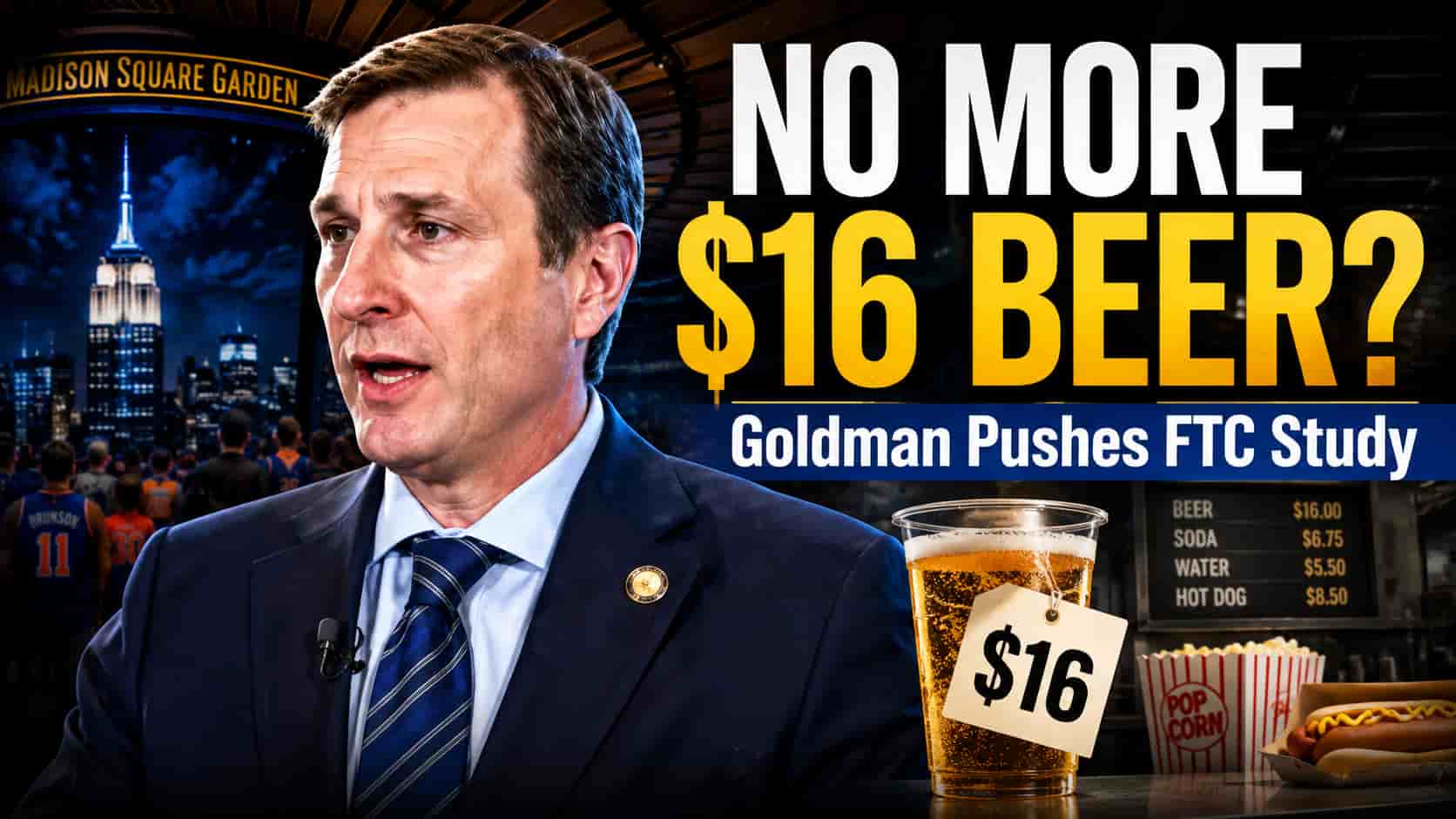
Rep. Dan Goldman’s HOTDOG Act would require a federal study of food and beverage pricing at sports arenas supported by public subsidies. The proposal, however, would not immediately cap prices or make concessions cheaper.
NEW YORK — Going to a professional sporting event has become an increasingly expensive form of family entertainment. The ticket is often only the beginning. Fans must also pay for transportation, parking, merchandise and food and drinks sold inside the venue—where a beer may cost $16.
U.S. Rep. Dan Goldman, a Democrat representing parts of Manhattan and Brooklyn, wants the federal government to examine whether those concession prices are reasonable, particularly at stadiums and arenas that benefit from public funding or tax subsidies.
Goldman and Rep. Chris Deluzio of Pennsylvania introduced H.R. 6859, formally titled the Honest Oversight of Ticketed Dining and Onsite Grub Act, or the HOTDOG Act.
The bill was introduced in the House of Representatives on December 18, 2025, and referred to the House Committee on Energy and Commerce. Its stated purpose is to direct the Federal Trade Commission to conduct a nationwide study of concession pricing at certain publicly subsidized venues.
The $16 Beer Behind the Bill
The bill’s official findings identify Madison Square Garden as one of the clearest examples of expensive stadium concessions.
According to the legislation, the average price of a beer at Madison Square Garden is $16—more than twice the average price in New York City and the third-highest average among NBA arenas.
The bill also cites Highmark Stadium, home of the Buffalo Bills, where beer reportedly costs about $10, approximately twice the price charged by a nearby bar.
These figures are congressional findings included in the proposed legislation. They are not the conclusions of an already completed FTC investigation. The purpose of the HOTDOG Act is to order the federal study that would examine the issue more systematically.
Goldman, who describes himself as an enthusiastic Knicks, Rangers and Liberty fan, has argued that attending a game should not require families to accept virtually unlimited markups once they enter an arena.
His office first pressed the FTC in June 2025 to investigate concession prices at stadiums and airports for possible price gouging. The HOTDOG Act attempts to turn that request into a formal statutory mandate.
What the FTC Would Have to Investigate
If enacted, the bill would require the Federal Trade Commission to begin a nationwide study no later than 90 days after the law takes effect.
The study would examine:
- prices charged for food and drinks inside covered venues;
- comparisons with similar products sold in nearby restaurants and bars;
- dynamic pricing;
- service fees;
- promotions and value-menu offers;
- whether concession prices are disclosed online or before customers enter;
- possible price caps and lower-cost menu options.
The FTC would then have one year to submit a report to Congress containing the results and recommendations for legislative, regulatory and industry action.
The bill specifically asks the commission to study whether venues can provide affordable food and beverage options while still covering legitimate operating expenses.
The Bill Covers More Than Direct Federal Funding
Early coverage of the proposal described it as targeting stadiums that had benefited from federal money. The actual legislative text is broader.
A venue could qualify for the study if it was constructed or operated with support from a public subsidy, including:
- a direct government grant;
- a state or local tax credit;
- an economic-development incentive;
- tax-exempt bonds.
The venue must also host professional sports, concerts or comparable ticketed events at least five days per year and sell food or drinks to attendees.
This means the HOTDOG Act would not be limited to federally owned or federally financed facilities. Arenas receiving substantial state or municipal tax benefits could also be included in the study.
Why Madison Square Garden Is Central to the Debate
Madison Square Garden is particularly relevant because it receives one of New York City’s most controversial property-tax exemptions.
The New York City Department of Finance states that Madison Square Garden receives a full real-property-tax exemption under Section 429 of the New York State Real Property Tax Law.
The exemption remains in place as long as the Garden continues to be used by major-league professional basketball and hockey teams for their home games.
For Fiscal Year 2026, the city estimated the value of the Madison Square Garden tax exemption at $43.3 million.
That creates the central political question behind Goldman’s proposal: when taxpayers provide tens of millions of dollars in annual tax benefits to a privately operated arena, should the venue be expected to offer greater pricing transparency—or at least some reasonably priced concession options?
The HOTDOG Act does not answer that question directly. It would require the FTC to collect evidence and recommend what Congress, regulators and the sports industry should do next.
A Separate Effort to End the MSG Tax Exemption
New York State lawmakers have also introduced separate legislation aimed at ending Madison Square Garden’s property-tax exemption.
State Senate Bill S957, sponsored by Sen. Brian Kavanagh, would require the owners of Madison Square Garden to pay real-property taxes. The bill would amend Section 429 of state law and direct revenue generated by ending the exemption toward the Metropolitan Transportation Authority’s finance fund.
As of July 2026, S957 remained in the Senate Local Government Committee and had not been approved by both houses of the Legislature.
That state proposal is legally separate from Goldman’s federal HOTDOG Act. One focuses on whether Madison Square Garden should continue receiving a tax exemption; the other focuses on concession pricing at publicly supported venues nationwide.
What the HOTDOG Act Would Not Do
Despite its memorable name, the HOTDOG Act would not immediately prohibit a $16 beer.
It would not establish a federal maximum price for beer, water, hot dogs or other concession items. It would not require Madison Square Garden or another arena to lower its prices as soon as the legislation is enacted.
Instead, the bill would authorize a study and a report.
Any mandatory price limits, disclosure rules or requirements for lower-cost menu options would likely require additional legislation or regulatory action after the FTC completes its review.
That distinction is important: the proposal is an oversight bill, not an immediate price-control law.
Existing FTC Rules Apply Mainly to Ticket Prices and Fees
The FTC already enforces a Rule on Unfair or Deceptive Fees, which took effect on May 12, 2025.
That rule requires businesses selling live-event tickets and short-term lodging to disclose the total price prominently and upfront. It prohibits bait-and-switch advertising and misleading representations about mandatory fees.
However, the rule does not establish maximum ticket prices, and it does not directly regulate how much a stadium may charge for a beer or hot dog after a customer enters the building.
The HOTDOG Act would expand federal attention from the price of admission to what consumers must pay once they are inside.
Where the Bill Stands
As of July 27, 2026, the official Government Publishing Office record continued to list H.R. 6859 as an introduced House bill referred to the Committee on Energy and Commerce.
It had not passed the House or Senate and had not become law. Therefore, the FTC is not yet legally required to conduct the proposed nationwide concession-pricing study.
Still, the bill raises a question that many fans already understand without a federal investigation:
When taxpayers help support a sports arena, should they also be expected to pay $16 for a beer once they walk through its doors?
Official Sources
- U.S. Government Publishing Office: H.R. 6859 — HOTDOG Act
- Official Full Text of the HOTDOG Act
- Rep. Dan Goldman: Legislation to Address Stadium Concession Prices
- Rep. Chris Deluzio: HOTDOG Act Announcement
- NYC Department of Finance: FY 2026 Annual Report on Tax Expenditures
- New York State Senate: S957 — Madison Square Garden Tax Exemption
- Federal Trade Commission: Rule on Unfair or Deceptive Fees
Midtown Tribune Independent USA news from New York
Ask Midtown Tribune about this story
Answers are grounded first in this article. Search all Midtown Tribune reporting from the main AI Search page.
AI-generated summary. Verify important details in the linked original articles.