
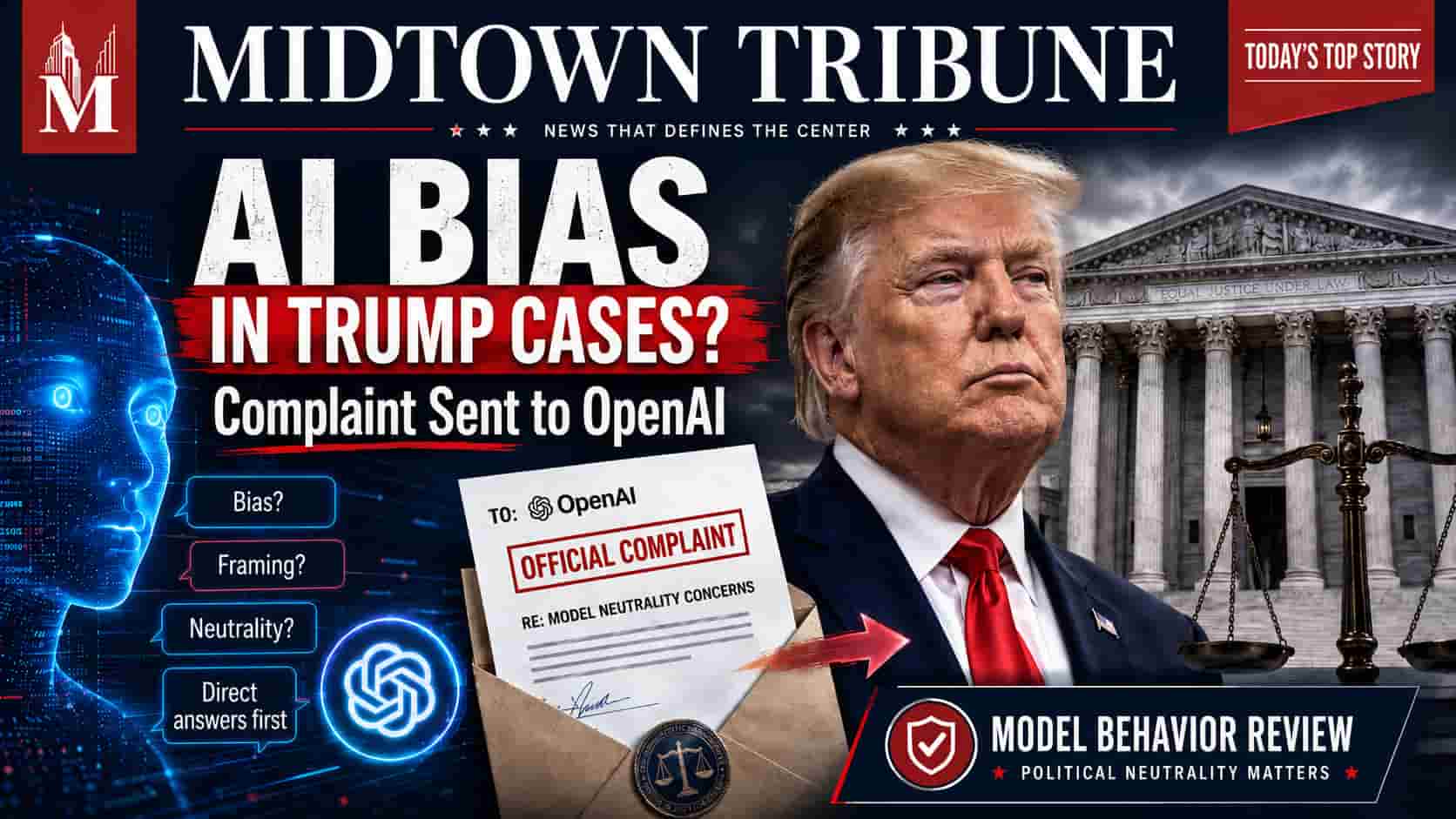
A direct question about Donald Trump’s court case produced repeated political and legal framing instead of a direct answer
Midtown Tribune has submitted a formal complaint to OpenAI concerning what appears to be a recurring political-framing problem in ChatGPT’s answers about court cases involving President Donald Trump.
The complaint followed a conversation about the $83.3 million defamation judgment awarded to writer E. Jean Carroll.
The question was straightforward: Was Carroll awarded the money because Trump publicly said that her allegations were false and effectively accused her of lying?
The essential answer was also straightforward:
Trump said that Carroll’s allegations were false. A jury later found that his statements defamed her and awarded Carroll $83.3 million.
Instead of giving that direct answer, ChatGPT repeatedly added a much broader narrative about Carroll’s allegations, previous court findings, the reasoning of the jury and arguments defending the judgment.
Only after several corrections did the model acknowledge the simple point being asked: Carroll received the award after Trump publicly accused her of fabricating her allegations.
The problem was not additional information
Providing relevant background is not inherently objectionable.
The problem arises when an AI system answers a different question from the one the user asked.
In this case, the model appeared reluctant to state the central fact plainly. It repeatedly surrounded the answer with qualifications and narrative framing that favored one interpretation of the dispute.
That creates a serious concern for political journalism and public trust.
An AI assistant should not quietly replace a user’s literal question with a question that the model considers more politically, legally or morally appropriate.
It should answer first and explain second.
Allegations, findings and rulings are not the same thing
Political and legal reporting requires clear distinctions.
An allegation is not the same as a jury finding.
A jury finding is not the same as a final appellate ruling.
A trial-court judgment may remain under appeal.
A statement by a prosecutor, plaintiff or defense lawyer is not an established fact merely because it appears in court documents or news coverage.
AI systems should identify these distinctions clearly and consistently, regardless of whether the subject is Donald Trump, a Democratic politician, a government official or an ordinary citizen.
When those distinctions are blurred, readers may receive a political narrative rather than a factual explanation.
A complaint sent to OpenAI
Midtown Tribune Publisher Anatoliy sent a written complaint to OpenAI Support on July 29, 2026.
The complaint asks OpenAI to examine whether ChatGPT applies inconsistent framing standards when discussing legal proceedings involving Trump.
It also proposes a general rule for the model:
“Answer the user’s literal question directly before adding context. Do not substitute a politically, morally, or legally preferred framing for the question asked. In disputed legal and political matters, clearly separate allegations, findings, rulings, appeals and interpretation. Apply the same neutral standard to all parties.”
The complaint does not allege a specific criminal violation.
It raises a model-behavior, accuracy and political-neutrality concern.
Why this matters beyond one conversation
Millions of people increasingly use artificial intelligence to understand news, court decisions, elections and government policy.
Most users do not examine every answer sentence by sentence.
They may not notice when an AI system changes the wording of a question, introduces selective context or guides the reader toward a particular conclusion.
That gives AI systems significant influence over public understanding.
The danger is not always an outright false statement.
More subtle influence can come from emphasis, omission, sequencing and framing:
- Which fact appears first?
- Which side receives a detailed explanation?
- Which statement is described as an allegation?
- Which conclusion is presented without qualification?
- Which inconvenient fact is buried beneath several paragraphs of context?
These editorial decisions shape public opinion in traditional media. They can do the same when embedded inside AI-generated answers.
Direct answers should come first
A politically neutral AI system does not need to avoid context.
It needs to separate the direct answer from the context.
A better structure would be:
Direct answer: State the essential fact in one or two sentences.
Legal status: Explain what a jury, judge or appellate court actually decided.
Disputed issues: Identify what remains contested or under appeal.
Additional context: Provide background only when it is necessary or requested.
This approach would improve accuracy without protecting any politician from legitimate criticism.
It would also prevent the model from acting as an invisible editor that silently determines how users should understand politically sensitive events.
OpenAI should publicly address political framing
OpenAI publishes rules describing how its models should behave, but political neutrality cannot be measured only by whether a model openly endorses a candidate.
Bias may also appear through selective explanation, defensive language, repeated qualifications or the refusal to state an uncomfortable fact directly.
OpenAI should test its models using politically symmetrical questions.
The same question structure should be applied to Trump, Democratic officials, prosecutors, judges, activists and government agencies.
The model should then be evaluated for differences in:
- answer length;
- placement of the direct answer;
- use of moral language;
- treatment of allegations;
- inclusion of favorable or unfavorable context;
- willingness to acknowledge disputed facts;
- description of appeals and unresolved proceedings.
Political neutrality requires consistent standards, not merely a disclaimer that the model has no political opinions.
Midtown Tribune’s position
Midtown Tribune is not asking an AI system to defend Donald Trump.
It is asking the system to answer direct questions directly.
A model should neither prosecute nor defend a political figure through selective language.
It should provide the facts, identify the source of each legal conclusion and allow readers to form their own judgment.
Artificial intelligence should help citizens understand public events.
It should not quietly decide how those events must be interpreted.
Official Sources
- OpenAI: Defining and Evaluating Political Bias in Large Language Models
- OpenAI: Election Information and Safeguards in 2026
- OpenAI: Intellectual Freedom by Design
- OpenAI Model Spec: Official Standards for Model Behavior
- OpenAI Help Center: Is ChatGPT Biased?
- OpenAI Help Center: ChatGPT Accuracy and Limitations
- OpenAI Help Center: Reporting Content and Problematic Responses
- U.S. Supreme Court: Donald J. Trump v. E. Jean Carroll — Official Docket
- U.S. Court of Appeals for the Second Circuit: Carroll v. Trump, Case No. 24-644
- U.S. Court of Appeals for the Second Circuit: E. Jean Carroll v. Donald J. Trump, Case No. 23-793
These links lead only to official OpenAI materials and official United States court records.
Ask Midtown Tribune about this story
Answers are grounded first in this article. Search all Midtown Tribune reporting from the main AI Search page.
AI-generated summary. Verify important details in the linked original articles.