
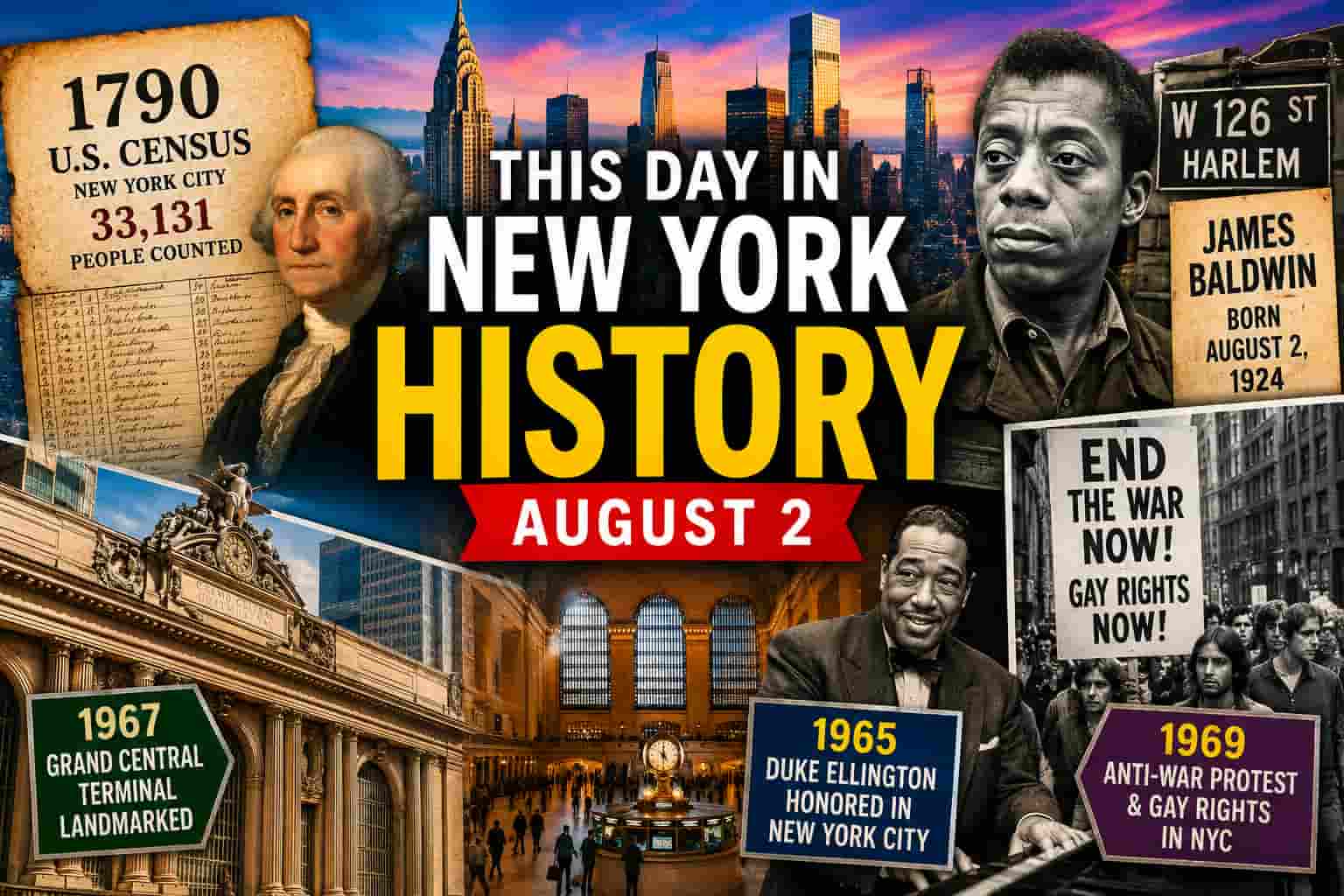
New York’s history is not shaped only by elections, wars, skyscrapers and major construction projects. Sometimes one date connects the first official population count of the young United States, the birth of a legendary writer, the preservation of an architectural masterpiece and the rise of new civil rights movements.
August 2 marks several important moments in New York City history—from the administration of George Washington to the social and cultural transformations of the 1960s.
August 2, 1790: The First United States Census Began
On Monday, August 2, 1790, the United States began conducting its first federal census.
At the time, New York City was still serving as the nation’s capital. President George Washington’s administration was based in the city, and the country had been operating under the new Constitution for only a short time.
Secretary of State Thomas Jefferson supervised the census, while federal marshals and their assistants carried out the count. They traveled from house to house and recorded residents by hand.
The census counted 33,131 people in New York City, making it the largest city in the United States. New York ranked ahead of Philadelphia, Boston, Charleston and Baltimore.
The census was not simply a collection of population statistics. Its results were used to determine how seats in the House of Representatives would be distributed among the states.
That constitutional system continues to influence political representation, government planning and federal funding today.
August 2, 1924: James Baldwin Was Born in Harlem
James Baldwin was born at Harlem Hospital on August 2, 1924.
He became one of the most important American writers, essayists and public intellectuals of the 20th century.
Baldwin grew up in Harlem in a large and financially struggling family. As a young man, he frequently visited branches of the New York Public Library, where reading became an essential part of his intellectual development.
His novels and essays examined race, religion, poverty, sexuality, personal identity and the contradictions of American society.
Harlem was not simply a setting in Baldwin’s work. It shaped his understanding of New York and the United States.
His writing challenged Americans to confront the gap between the country’s democratic promises and the realities experienced by many of its citizens.
Baldwin’s papers are now preserved at the Schomburg Center for Research in Black Culture, only a short distance from the hospital where he was born.
August 2, 1965: New York Honored Duke Ellington
On August 2, 1965, composer, pianist and orchestra leader Duke Ellington received the Bronx Medal.
The award was presented by acting New York City Mayor Paul Screvane.
Ellington was born in Washington, D.C., but New York played a central role in his career. His performances at Harlem’s Cotton Club helped bring jazz to a national audience and established him as one of the most important composers in American music.
Ellington’s career also demonstrated the enormous cultural influence of Harlem during the 20th century.
The Bronx Medal recognized not only the achievements of one musician, but also New York City’s central place in the development of jazz and modern American culture.
August 2, 1967: Grand Central Terminal Received Landmark Protection
On August 2, 1967, the New York City Landmarks Preservation Commission officially designated Grand Central Terminal as a city landmark.
The decision proved essential to the terminal’s survival.
Only a few years earlier, New York had lost the original Pennsylvania Station. The monumental Beaux-Arts building was demolished to make way for Madison Square Garden.
The destruction of Penn Station caused widespread public anger and helped strengthen New York’s architectural preservation movement.
Landmark designation meant that Grand Central’s owners could not demolish or significantly alter the terminal without approval from the city.
The designation later became central to a major legal battle over the future of the building.
In 1978, the United States Supreme Court upheld New York City’s landmark preservation law in a case involving Grand Central Terminal.
Today, Grand Central is one of New York’s most recognizable buildings. Without the protection granted in 1967, the city might have lost it just as it had lost the original Penn Station.
August 2, 1969: An Anti-War Protest Reflected a Changing Civil Rights Movement
On August 2, 1969, demonstrators gathered near West 33rd Street and Seventh Avenue to protest the Vietnam War.
The demonstration took place only weeks after the Stonewall uprising, which became a turning point in the modern gay rights movement.
Photographs preserved in New York City archives show a gay rights sign being displayed during the anti-war protest.
The image is historically significant because it demonstrates how quickly the emerging movement expanded beyond individual bars and neighborhoods and entered broader political demonstrations.
Anti-war events during this period brought together participants from several movements, including student activists, civil rights groups, supporters of the Black Panthers and newly organized gay rights advocates.
Only a little more than a month after Stonewall, demands for equal rights were already becoming part of New York’s wider political conversation.
Why August 2 Matters in New York History
The events associated with August 2 share a common theme: New York is constantly counting, examining, protecting and redefining itself.
In 1790, the city was formally measured through the first federal census.
In 1924, Harlem gave America a writer who would force the country to confront some of its deepest contradictions.
In 1967, New York acted to protect one of its greatest architectural landmarks from destruction.
In 1969, emerging civil rights movements entered the streets and demanded a place in the city’s political life.
New York history is not simply a record of the past. It is an ongoing debate over what the city should preserve, whose voices should be heard and what kind of city it will become next.
Sources and Further Reading
The sources below include government records and official materials published by recognized public institutions.
Government Sources
- U.S. Census Bureau — Government source: Historical facts and population figures from the 1790 United States Census
- U.S. Census Bureau — Government source: Who conducted the first census and New York City’s population of 33,131
- National Archives — Government source: Official records and research guidance for the 1790 Census
- Library of Congress — Government source: Today in History: James Baldwin, born August 2, 1924
- Library of Congress — Government source: This Day in History: James Baldwin
- NYC Landmarks Preservation Commission — Government source: Grand Central Terminal landmark designation report dated August 2, 1967
- NYC Landmarks Preservation Commission — Government source: Official New York City landmark designation reports
- NYC Department of City Planning — Government source: Grand Central Terminal landmark history and development-rights record
- NYC Municipal Archives — Government source: Duke Ellington receives the Bronx Medal on August 2, 1965
- NYC Municipal Archives — Government source: Anti-war rally at West 33rd Street and Seventh Avenue on August 2, 1969
- NYC Municipal Archives — Government source: Archival records of gay-rights participation in the August 2, 1969 protest
Official Institutional Sources
- New York Public Library — Official institutional source: Celebrating 100 Years of James Baldwin
- New York Public Library Archives — Official institutional source: James Baldwin audio collection and biographical history
- New York Public Library — Official institutional source: James Baldwin New York walking tour, including Harlem Hospital
Government sources include federal agencies and New York City agencies, archives and commissions. Official institutional sources include materials published directly by the New York Public Library and its archival divisions.
Ask Midtown Tribune about this story
Answers are grounded first in this article. Search all Midtown Tribune reporting from the main AI Search page.
AI-generated summary. Verify important details in the linked original articles.