
Social media reacts quickly. Official records move more carefully.
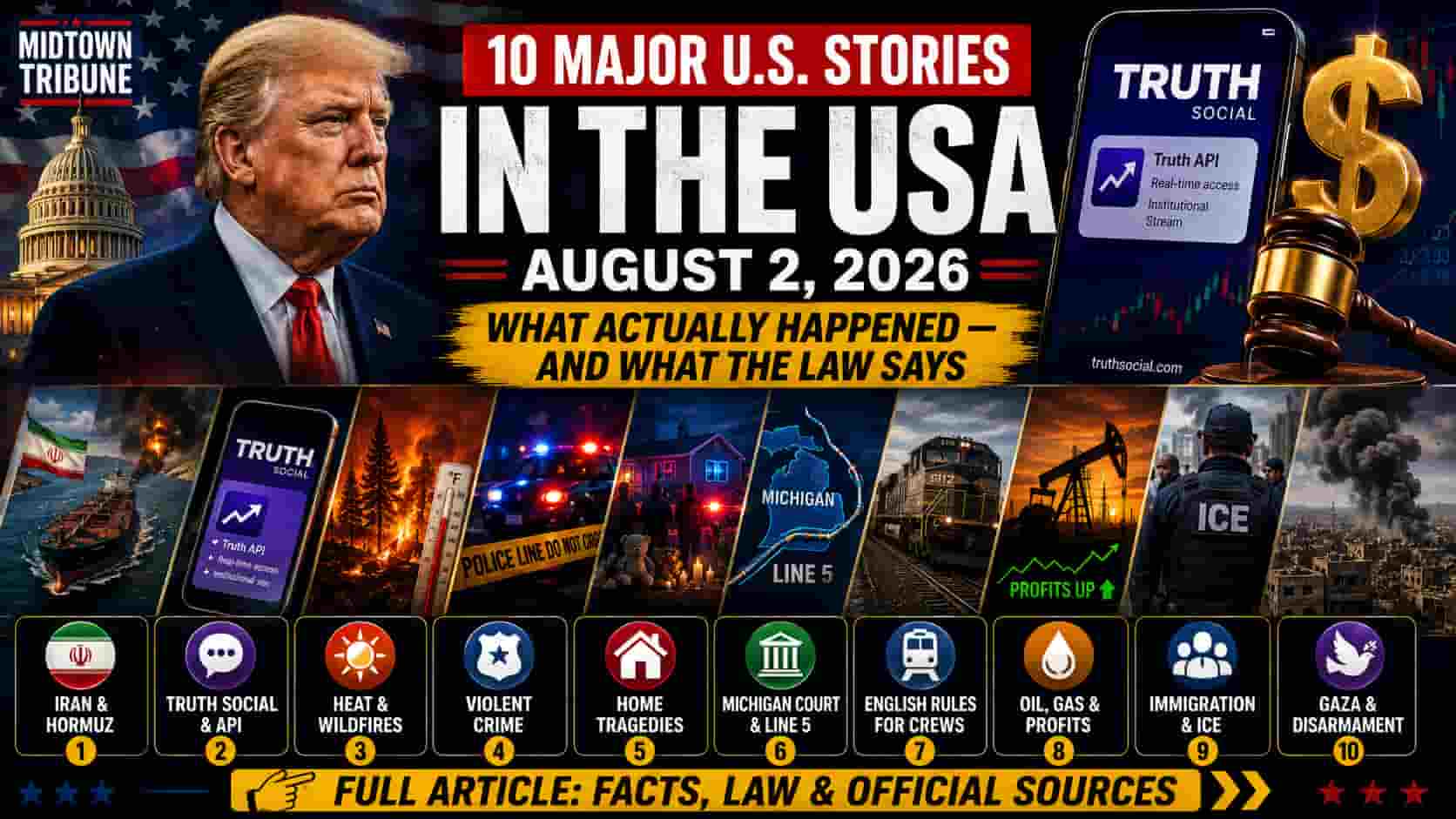
By the afternoon of August 2, Americans were discussing war and diplomacy with Iran, the commercial value of presidential social-media posts, extreme heat and wildfires, violent crime, immigration enforcement, oil prices, railroad safety and the future of a major pipeline beneath the Great Lakes.
But a viral post, a political announcement and a legally binding government action are not the same thing.
Midtown Tribune reviewed the major claims against available government statements, court records, regulatory documents and established principles of U.S. law.
1. Trump pauses additional military action as Iran negotiations continue
One of the largest political discussions of the weekend concerned President Donald Trump’s handling of the conflict with Iran and the security of the Strait of Hormuz.
The White House describes a U.S.-Iran memorandum and the reopening of the Strait of Hormuz as major administration achievements. Official administration materials also describe earlier U.S. military and naval action intended to restore safe passage through the strategic waterway.
The important distinction is that a presidential announcement, a memorandum of understanding and a ratified treaty are not legally identical.
What the law says
The president serves as commander in chief, but Congress holds constitutional authority to declare war, appropriate military funding and establish rules governing the armed forces.
Under the War Powers Resolution, a president must report certain military deployments to Congress. That notification does not automatically provide unlimited authorization for a prolonged war.
The central question is therefore not simply whether military action has paused, but whether the administration has produced an enforceable agreement with clear obligations, verification procedures and consequences for violations.
2. Presidential social-media posts become a commercial financial-data product
Trump Media & Technology Group announced Truth API, a business-to-business data feed offering licensed, real-time access to posts from high-ranking Truth Social accounts.
According to the company’s official filing with the Securities and Exchange Commission, Truth API was expected to become available to institutional customers beginning August 1, 2026. The company said it had already signed customers before the launch.
The service has attracted attention because presidential posts can affect stocks, oil prices, currencies and other markets.
Earlier SEC filings also described contractual provisions concerning President Trump’s use of Truth Social, including circumstances governing the timing of posts on other platforms.
Is the service illegal?
Not by itself.
Financial-data companies routinely sell rapid access to news releases, regulatory filings and machine-readable information.
A legal problem could arise if evidence showed that:
- certain customers received material nonpublic government information;
- official decisions were intentionally provided to paying customers before the public;
- posts were used to manipulate securities prices;
- confidential information was used for insider trading;
- government authority was exercised primarily to generate private financial gain.
No such violation should be treated as established without evidence and an official investigation.
The broader public-policy question is whether market-sensitive presidential announcements should be commercially distributed through a private company connected to the president.
3. Extreme heat and dangerous wildfire conditions spread across the West
Photos and videos of flames, smoke and dangerously dry terrain circulated widely across social media.
The National Weather Service reported that heat was building across the West while extremely critical fire-weather conditions threatened portions of the Northwest. Official forecasts referenced dangerous heat, low humidity, strong winds and Particularly Dangerous Situation Red Flag Warnings in affected regions.
The National Interagency Fire Center also reported multiple active fires threatening residences, transportation routes and energy infrastructure, with evacuations and closures in effect in parts of the West.
What an official warning means
A National Weather Service warning is not necessarily an evacuation order.
Mandatory evacuation decisions are generally issued by governors, sheriffs, fire officials or local emergency-management agencies.
Federal disaster assistance also does not automatically follow every wildfire or viral video. Many FEMA programs require a state request, a damage assessment and, in some cases, a presidential emergency or major-disaster declaration.
The key issue is whether state and local systems are prepared for simultaneous heat, drought, wildfire, smoke and infrastructure emergencies.
4. Violent crime again dominates national discussion
Reports of shootings and other mass-casualty incidents generated intense discussion during the weekend.
In the first hours after a violent incident, social media often moves faster than police investigators. Initial claims about the number of attackers, motive, weapon ownership or the relationship between victims and suspects may later change.
When does a shooting become a federal case?
Most murder prosecutions begin under state law.
Federal jurisdiction may exist when a crime involves:
- federal property or federal personnel;
- interstate criminal activity;
- violations of federal firearms laws;
- terrorism;
- organized crime;
- a federally prosecutable hate crime;
- trafficking or other conduct specifically covered by federal statutes.
An event being described as a “mass shooting” does not automatically transfer the entire prosecution to the federal government.
Until charges are filed and proven, a suspect retains the presumption of innocence.
5. Deaths inside homes raise questions about prior warning signs
Another category of stories receiving heavy attention involved multiple deaths discovered in residential properties, sometimes following fires or reports of gunshot wounds.
These cases produce immediate speculation about domestic violence, murder-suicide, child endangerment or an attempt to destroy evidence.
But investigators must first determine:
- the cause and manner of every death;
- whether the fire was accidental or intentionally set;
- whether an accelerant was used;
- who owned any recovered weapon;
- the sequence of the deaths;
- whether police, courts or child-protection agencies had prior contact with the household.
A fire scene containing gunshot victims does not, by itself, establish who committed the crime or why.
The most important public-policy question is whether government agencies received credible warning signs before the tragedy and whether existing law gave them sufficient authority to intervene.
6. Michigan’s Line 5 pipeline dispute remains a major legal and environmental fight
The Line 5 dispute concerns Enbridge’s proposal to replace and relocate part of its petroleum pipeline inside a tunnel beneath the Straits of Mackinac.
The Michigan Supreme Court has been considering litigation involving the Michigan Public Service Commission’s approval process and the extent of the state’s responsibilities when reviewing the project. Official case records identify questions involving environmental review, regulatory authority and the protection of public resources in the Great Lakes.
What a court ruling may mean
A ruling against a permit does not necessarily amount to a permanent ban on the project.
A court may:
- return the matter to the regulatory commission;
- require additional environmental analysis;
- find that the wrong legal procedure was used;
- require review by another state agency;
- clarify which risks the commission must consider.
Supporters argue that a tunnel would be safer than the existing underwater pipeline. Opponents argue that the project creates unacceptable environmental risks and requires broader review under the public-trust doctrine.
The core question is which institution should make the final decision: an energy regulator, an environmental agency, the courts or the elected legislature.
7. English-language requirements for cross-border transportation workers
English-language proficiency requirements for commercial drivers and cross-border transportation workers have become another politically charged issue.
The Department of Transportation has argued that English proficiency can be a safety requirement because transportation workers must understand signs, communicate with law-enforcement officers and complete required reports. The 2026 National Freight Strategic Plan also identifies English proficiency as a transportation-safety consideration.
Questions involving Mexican locomotive engineers and conductors have previously produced federal litigation concerning Federal Railroad Administration policies and the certification of foreign crews operating in the United States.
What the law requires
The Federal Railroad Administration may regulate the qualifications of locomotive engineers and railroad operations inside the United States.
However, a political statement does not always create an immediately enforceable nationwide rule.
Depending on the legal mechanism used, the government may need to:
- publish a proposed or final regulation;
- provide notice and an opportunity for public comment;
- explain the connection between the rule and transportation safety;
- address existing international transportation agreements;
- apply the requirement consistently.
The central dispute is whether a particular language standard is a documented safety measure or an unnecessarily broad barrier to cross-border commerce.
8. Oil-company profits, gasoline prices and the Strait of Hormuz
Americans continue to debate high energy-company profits while consumers face elevated fuel and transportation costs.
The U.S. Energy Information Administration identifies the Strait of Hormuz as one of the world’s most important oil-transit chokepoints. Disruptions can influence crude-oil supplies, shipping costs, insurance rates and gasoline prices around the world.
EIA’s current short-term outlook forecasts U.S. gasoline prices averaging approximately $3.80 per gallon during the third quarter of 2026, down from more than $4.20 in the second quarter. The agency attributes the expected decline largely to lower crude-oil prices, while warning that low inventories and higher refining and retail margins may continue supporting prices.
EIA also reported that the resumption of oil flows through the Strait reduced expected disruptions to Middle Eastern production.
Are large profits illegal?
No. High profits, even during a crisis, are not automatically evidence of criminal conduct.
A legal violation would require evidence of conduct such as:
- price fixing;
- collusion among competitors;
- market manipulation;
- fraud;
- sanctions violations;
- false financial reporting;
- insider trading.
Public anger about profits is a legitimate political issue, but it is not a substitute for proof of an antitrust, securities or criminal violation.
9. Immigration enforcement remains politically powerful and legally controversial
Immigration enforcement continues to be one of the administration’s strongest political issues.
ICE has expanded personnel and detention operations, while official agency materials describe immigration detention as a civil system managed by Enforcement and Removal Operations.
At the same time, confrontations involving immigration officers continue to generate disputes over the use of force, warrants, detention conditions and federal accountability.
What the Constitution still requires
A person suspected of violating immigration law continues to have constitutional protections.
Immigration violations do not give officers unlimited authority to use force.
In reviewing a fatal or serious incident, investigators must examine:
- whether the person presented an immediate threat;
- whether the degree of force was proportionate;
- whether officers followed agency policy;
- whether a warrant was legally required;
- whether video evidence exists;
- whether an independent investigation will occur.
ICE detention standards also contain formal rules governing confinement and the calculated use of force against detainees.
The key question is whether the federal government can enforce immigration law aggressively while still providing transparent and independent review of officers’ conduct.
10. Gaza negotiations and renewed discussion of Hamas disarmament
Reports concerning a possible Gaza settlement and the future disarmament of Hamas have attracted significant international attention.
For the United States, the legal and diplomatic framework remains complicated. The State Department continues to treat Hamas as a terrorist organization, while federal appropriations restrictions generally prohibit U.S. assistance from benefiting Hamas. Official U.S. materials also emphasize hostage recovery and the goal of preventing Hamas from governing Gaza.
A promise to disarm is not the same as disarmament
Any workable agreement would need to specify:
- who signs it;
- which weapons must be surrendered;
- who verifies compliance;
- what happens to tunnels and military infrastructure;
- who governs Gaza;
- how hostages and prisoners are handled;
- what international forces are authorized to do;
- what happens if either side violates the agreement.
The president can conduct diplomacy and direct U.S. foreign policy, but Congress may still control funding, sanctions and any extended commitment of American military personnel.
The central question is not merely whether Hamas has accepted the idea of disarmament, but who would verify and enforce it.
What August 2 tells us about modern American news
The most important feature of the day is the intersection of war, private business, law and social media.
A presidential post can now potentially:
- communicate a military decision;
- move oil prices;
- influence publicly traded securities;
- shape international negotiations;
- become paid content distributed by a private company.
That creates a fundamental question for American government:
Where does a president’s personal social-media post end and an official act of the United States begin?
American law does not prohibit elected officials from using private platforms.
But when military operations, diplomatic agreements or market-sensitive government decisions are announced through social media, the public has a legitimate interest in:
- equal access to official information;
- preservation of presidential records;
- disclosure of financial conflicts;
- congressional oversight;
- judicial review;
- a clear separation between public authority and private profit.
Social media shows what attracted attention.
Official records show what government agencies actually did.
The law determines who had the power to do it.
Official Government and Legal Sources
The following government records, court materials, regulatory filings and official data were used to verify the facts and legal background discussed in this article.
1. Iran, the Strait of Hormuz and Presidential War Powers
- The White House — Administration achievements involving Iran and the Strait of Hormuz “`
- The White House — Official statement on U.S. action involving the Strait of Hormuz
- Congress.gov — War Powers Resolution
- Constitution Annotated — Presidential commander-in-chief authority
- Constitution Annotated — Congressional war, military and funding powers “`
2. Truth Social, Truth API and SEC Filings
- U.S. Securities and Exchange Commission — Trump Media announcement of Truth API “`
- SEC — Trump Media annual report
- SEC — Filing describing Donald Trump’s social-media posting arrangements
- SEC — Official explanation of insider-trading law
- SEC — Market structure, securities trading and regulatory information “`
3. Extreme Heat, Wildfires and Federal Disaster Assistance
- National Weather Service — National fire-weather forecasts and warnings “`
- NOAA Storm Prediction Center — Fire-weather outlooks
- National Interagency Fire Center — National fire news and incident information
- National Interagency Coordination Center — National incident-management situation report
- FEMA — How federal disasters are declared
- FEMA — Individual assistance after a federally declared disaster “`
4. Violent Crime, Firearms and Federal Jurisdiction
- U.S. Department of Justice — Federal and state criminal jurisdiction “`
- FBI — Active-shooter safety and response resources
- Bureau of Alcohol, Tobacco, Firearms and Explosives — Federal firearms enforcement
- FBI Crime Data Explorer — Official U.S. crime statistics
- Department of Justice — Federal hate-crime laws and enforcement “`
5. Child Protection and Domestic-Violence Investigations
- U.S. Children’s Bureau — How child abuse and neglect are reported “`
- Department of Justice Office on Violence Against Women — Domestic-violence laws and resources
- U.S. Fire Administration — Residential-fire investigation and prevention information “`
6. Enbridge Line 5 and the Great Lakes
- Michigan Supreme Court — For Love of Water v. Michigan Public Service Commission “`
- Michigan Public Service Commission — Line 5 tunnel siting decision
- Michigan Department of Environment, Great Lakes, and Energy — Line 5 project information
- Official industry regulatory background concerning Line 5 “`
7. English Proficiency for Cross-Border Rail Crews
- U.S. Department of Transportation — English-language enforcement for southern-border rail crews “`
- Federal Railroad Administration — Railroad safety and regulatory information
- Federal Railroad Administration — Official letter concerning Mexican cross-border crews
- Electronic Code of Federal Regulations — Federal railroad regulations
- Federal regulations governing locomotive-engineer qualification and certification “`
8. Oil Prices, Gasoline and the Strait of Hormuz
- U.S. Energy Information Administration — Forecast following the reopening of the Strait of Hormuz “`
- EIA — World oil-transit chokepoints and the Strait of Hormuz
- EIA — Petroleum-market effects of Middle East disruptions
- EIA — Short-Term Energy Outlook
- EIA — Weekly U.S. retail gasoline prices
- Federal Trade Commission — Sherman Antitrust Act
- Department of Justice Antitrust Division — Price fixing, collusion and competition law “`
9. Immigration Enforcement, Detention and Use of Force
- U.S. Immigration and Customs Enforcement — Official detention information “`
- ICE — Enforcement, removal and detention statistics
- ICE — Detention-management standards and policies
- ICE National Detention Standards — Use of force and restraints
- Department of Homeland Security — Department-wide use-of-force policy
- Department of Justice Civil Rights Division
- Executive Office for Immigration Review — Immigration-court information “`
10. Gaza, Hamas and International Security
- U.S. Department of State — Foreign Terrorist Organizations “`
- Department of State — Israel, the West Bank and Gaza
- Congressional Research Service — Israel and Hamas conflict: U.S. policy considerations
- United Nations Security Council — Official resolutions
- United Nations — Security Council documents concerning the Israeli-Palestinian conflict “`
Ask Midtown Tribune about this story
Answers are grounded first in this article. Search all Midtown Tribune reporting from the main AI Search page.
AI-generated summary. Verify important details in the linked original articles.