
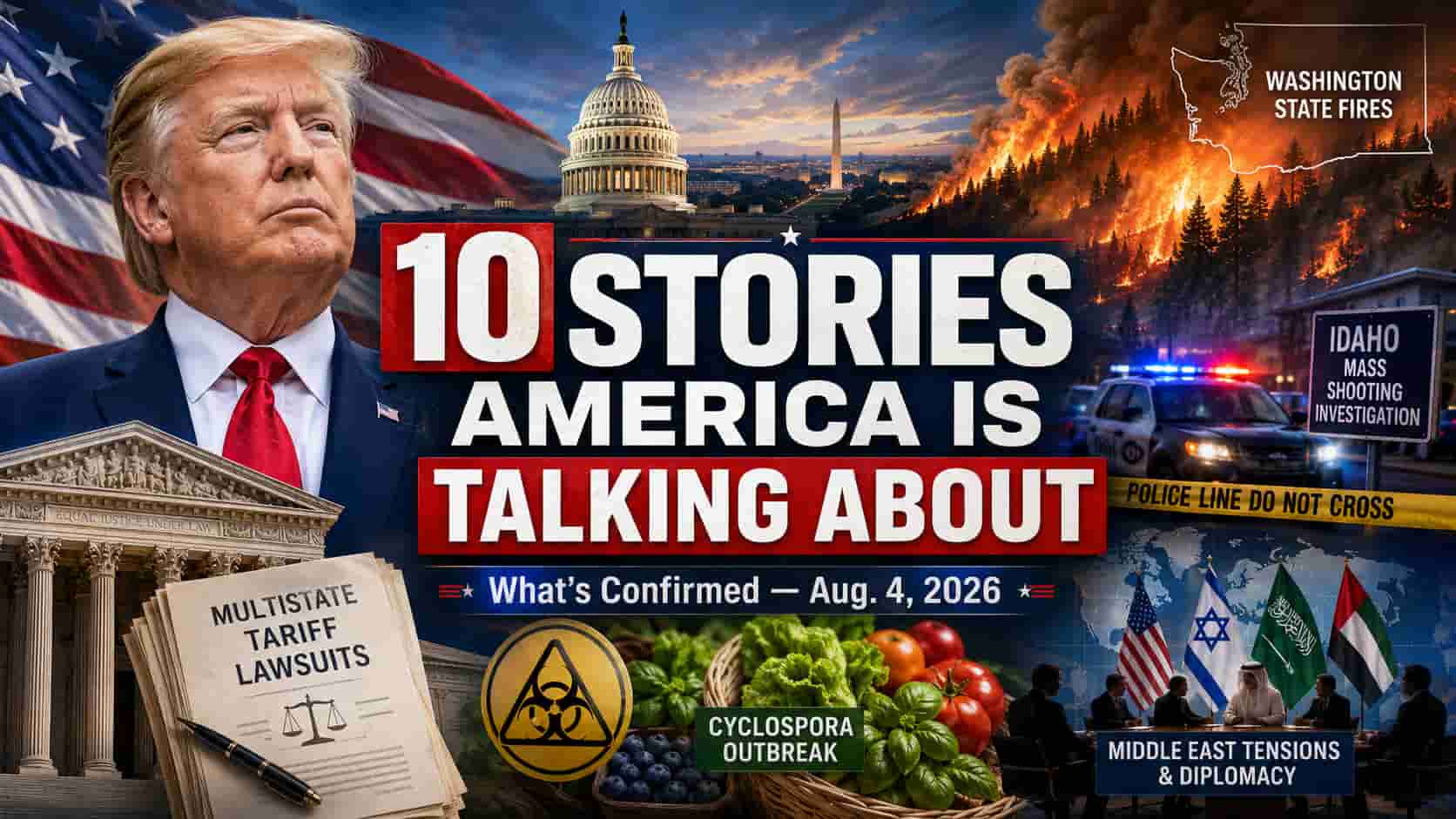
From disputed Iran negotiations and sweeping new tariffs to Washington wildfires, a deadly Idaho shooting and a major foodborne-illness outbreak
America begins Tuesday, August 4, 2026, with an unusually crowded news cycle.
President Donald Trump says negotiations with Iran represent Tehran’s “last chance.” Twenty-five states are challenging the administration’s latest tariffs. Tens of thousands of residents have fled wildfires near Spokane, Washington. Health authorities are investigating thousands of Cyclospora infections, while a congressional ethics report has created a new political crisis on Capitol Hill.
But a headline, allegation or political statement is not the same thing as a verified fact.
Midtown Tribune reviewed the stories receiving significant national attention and compared the claims with White House materials, court filings, federal agencies, congressional documents and state and local government reports.
This is an editorial snapshot of the national conversation as of approximately 3 a.m. Eastern Time on August 4—not a mathematical ranking of social-media activity.
1. Trump calls possible Iran negotiations Tehran’s “last chance”
President Trump said Monday that negotiations with Iran were underway and described the diplomatic effort as Tehran’s “last chance” to reach an agreement and avoid another escalation in American military strikes.
The White House confirms that Trump spoke publicly from the Oval Office on August 3. Major news organizations reported his comments about Iran, the country’s nuclear program and reopening the Strait of Hormuz.
However, Iranian officials said there were no current negotiations with the United States. Iran’s Foreign Ministry said its diplomatic discussions were focused on Oman and a possible temporary safe route through the Strait of Hormuz.
No joint statement, meeting schedule, signed framework or final agreement between Washington and Tehran had been publicly released by early Tuesday.
What is confirmed: Trump publicly described negotiations as underway and called them Iran’s last chance.
What is not confirmed: That direct U.S.–Iran negotiations have formally begun or that a new agreement has been reached.
2. Twenty-five states sue over Trump’s latest tariffs
A coalition of 25 states filed a lawsuit in the U.S. Court of International Trade challenging the administration’s latest round of tariffs.
The disputed tariffs impose rates of 10 percent or 12.5 percent on imports from the European Union and nearly 60 other countries. The administration says the measures are connected to failures to combat forced labor in international supply chains.
The states argue that the forced-labor investigation was used as a pretext to recreate broader tariffs previously rejected by federal courts. The complaint alleges that the administration exceeded its authority under Section 301 of the Trade Act and violated the Administrative Procedure Act.
The official complaint was filed on August 3 and runs more than 400 pages.
What is confirmed: The lawsuit, the participating states and the new tariff rates.
What is not confirmed: That the tariffs are illegal. That is the states’ legal position, and the court has not yet ruled on the new case.
3. Wildfires near Spokane destroy hundreds of buildings and force mass evacuations
Three major wildfires near Spokane, Washington, have destroyed at least 700 buildings and forced approximately 64,000 people to evacuate, according to preliminary figures reported by officials and Reuters. More structures may have been damaged, but assessment teams have not yet reached every affected area.
Governor Bob Ferguson declared a statewide wildfire emergency and imposed a burn ban. The governor’s official wildfire resource page confirms active evacuation zones, emergency shelters, road restrictions and a coordinated state response.
A man has been arrested and accused of first-degree arson in connection with the Old Trails Fire, one of the fires burning near Spokane. An arrest or criminal charge does not establish guilt, and authorities have not accused him of starting every fire in the region.
What is confirmed: The emergency declaration, widespread evacuations, major structural destruction and the arrest of an arson suspect.
What remains preliminary: The final number of destroyed homes, total financial losses and the suspect’s responsibility.
4. Three victims killed in an Idaho In-N-Out shooting
A gunman opened fire at an In-N-Out Burger in Twin Falls, Idaho, killing three victims and wounding seven others.
The City of Twin Falls officially confirmed the casualty numbers. Police say the 24-year-old gunman acted alone and later died from a self-inflicted gunshot wound. The FBI has deployed investigators, victim-services specialists and evidence-response personnel to assist local authorities.
Authorities also credited an off-duty law-enforcement officer and an armed civilian with distracting the attacker and potentially preventing additional casualties.
Investigators had not established a public motive by early Tuesday. Police and the FBI continue to seek photographs, videos and witness information.
What is confirmed: Three victims were killed, seven people were wounded, the shooter died and investigators believe he acted alone.
What is not confirmed: The motive. Political or ideological explanations circulating online remain speculation unless supported by investigators.
5. Michigan reports two deaths among people with cyclosporiasis
Michigan health officials reported two deaths involving people who contracted cyclosporiasis, an intestinal illness caused by the Cyclospora parasite.
Both individuals had significant underlying medical conditions. State officials said the infection and associated dehydration may have affected their health, but they did not say Cyclospora was necessarily the sole cause of death.
The Centers for Disease Control and Prevention acknowledged the two Michigan deaths and said federal figures would be updated. The CDC is investigating a multistate cluster involving 1,947 people who reported exposure connected to Taco Bell restaurants in nine states. At least 98 people in that cluster were hospitalized.
The Food and Drug Administration linked that portion of the outbreak to recalled iceberg lettuce supplied by Taylor Farms de Mexico. However, CDC officials stress that additional Cyclospora illnesses across the country may be connected to other, still-unidentified sources.
What is confirmed: The two Michigan deaths, the lettuce recall and the federal investigation.
What is not confirmed: That every reported U.S. Cyclospora case originated from the same lettuce supplier or restaurant chain.
6. Todd Blanche’s attorney-general nomination moves forward after disputed fund is rescinded
Acting Attorney General Todd Blanche formally rescinded a Justice Department order that had established a $1.776 billion “Anti-Weaponization Fund.”
The Justice Department’s August 2 order says the fund “shall have no force or effect.” It also states that no members were appointed, no money was transferred, no claims process was established and no payments were made.
Republican Senators John Cornyn and Thom Tillis subsequently announced that they had reached an agreement with Blanche concerning the fund and a related IRS settlement. Their support removes a significant obstacle to advancing his nomination.
President Trump formally nominated Blanche to become attorney general on June 8. He is currently serving as acting attorney general but has not yet received final Senate confirmation for the permanent position.
What is confirmed: The original fund order was formally rescinded, and Cornyn and Tillis announced an agreement with Blanche.
What is not yet complete: Blanche has not been confirmed by the full Senate.
7. Jack Smith is invited to testify before the Senate Judiciary Committee
Senate Judiciary Committee Chairman Chuck Grassley invited former Special Counsel Jack Smith to testify before the committee on September 22.
The hearing is expected to focus on Smith’s investigations of Donald Trump and the collection of telephone records connected to members of Congress.
Separately, House Judiciary Committee Republicans referred materials to the Justice Department alleging that Smith may have made false statements during a December 2025 deposition. The committee asked the Justice Department to investigate a possible violation of federal law.
A congressional referral is not a criminal charge, indictment or judicial finding. Smith’s attorneys dispute the accusation and say he testified truthfully.
What is confirmed: Smith was invited to appear before the Senate committee, and the House Judiciary Committee submitted a criminal referral.
What is not confirmed: That Smith committed a crime or knowingly gave false testimony.
8. States challenge expanded sharing of welfare recipients’ personal information
A multistate coalition filed a federal lawsuit challenging changes to the government’s Temporary Assistance for Needy Families data system.
The new federal notice authorizes broader uses and disclosures of information contained in TANF records. That information can include names, addresses, Social Security numbers, dates of birth, citizenship or immigration status, income, employment information and data about children.
The states argue that the new policy could allow sensitive information to be shared with the Department of Homeland Security and other government or private entities without sufficiently defined limits.
The administration maintains that data sharing can support program integrity, eligibility verification, law enforcement and other authorized government functions.
What is confirmed: The federal records notice and the states’ August 3 lawsuit.
What is not confirmed: That the policy violates federal law. A court has not yet decided the case.
9. Salvadoran detainee dies after a medical emergency at Delaney Hall
Immigration and Customs Enforcement reported that Edwin Lopez-Cornejo, a 41-year-old citizen of El Salvador, died after experiencing a medical emergency while detained at the Delaney Hall facility in Newark, New Jersey.
ICE said he received medical attention and was later pronounced dead. The agency’s notice confirms the death and says the appropriate authorities were notified.
The official release does not establish a final cause of death or determine whether conditions at the facility contributed to it.
What is confirmed: Lopez-Cornejo died while in ICE custody following a reported medical emergency.
What is not confirmed: The definitive medical cause of death or whether the detention facility bears legal responsibility.
10. House Ethics Committee recommends censuring Representative Chuck Edwards
The House Ethics Committee released a report concerning Republican Representative Chuck Edwards of North Carolina.
The committee said it reviewed nearly 1,500 pages of documents and conducted 16 witness interviews. It concluded that Edwards engaged in persistent unprofessional and inappropriate behavior toward two young female staff members and failed to follow the spirit of House rules concerning unwanted advances and workplace conduct. The committee recommended that the House censure him.
Edwards disputes significant portions of the report. His formal response emphasizes that the committee did not find that he explicitly propositioned a staff member, engaged in a sexual relationship with an employee or violated federal sexual-harassment law.
A recommendation from the Ethics Committee does not automatically impose censure. The full House would need to act.
What is confirmed: The bipartisan committee released the report and recommended censure.
What is not yet decided: Whether the House will approve the recommended sanction.
The bottom line
Most of the major stories receiving attention on the morning of August 4 are based on real events and official documents.
But several widely repeated conclusions go beyond the available evidence:
- Statements about negotiations with Iran do not prove that formal direct talks are taking place.
- A lawsuit against tariffs or data-sharing rules does not prove those policies are illegal.
- An arrest in connection with a wildfire does not establish guilt.
- A congressional criminal referral is not a criminal conviction.
- A committee recommendation is not the same as a final vote by the House.
The central lesson is straightforward: the underlying event may be confirmed while the loudest political interpretation remains unproven.
Official and Government Sources
Primary documents and official government updates related to the major U.S. stories discussed on the morning of August 4, 2026.
-
The White House — President Trump’s August 3 Oval Office remarks
Official White House video of the president’s remarks and executive-order signing. -
California Attorney General — Multistate lawsuit challenging the latest tariffs
Official announcement describing the lawsuit filed by a coalition of 25 states. -
U.S. Court of International Trade — States’ tariff complaint
The complete federal court complaint filed on August 3, 2026. -
Washington Governor’s Office — Wildfire emergency resources
Official evacuation, shelter, emergency-management and wildfire information. -
City of Twin Falls — Official statement on the In-N-Out shooting
City confirmation of the victims killed and injured in the shooting. -
FBI — Federal response to the Twin Falls shooting
Official FBI statement and request for information from witnesses and victims. -
Michigan Department of Health and Human Services — Cyclospora outbreak
Official Michigan case information, including the two reported deaths. -
CDC — Multistate Cyclospora outbreak linked to iceberg lettuce
Federal case totals, hospitalizations and public-health guidance. -
FDA — Investigation of the nine-state Cyclospora outbreak
Federal investigation and information about the recalled iceberg lettuce. -
Department of Justice — Order rescinding the Anti-Weaponization Fund
The official order signed by Acting Attorney General Todd Blanche. -
U.S. Senator John Cornyn — Agreement with Todd Blanche
Official statement from Senators Cornyn and Tillis concerning Blanche’s nomination. -
The White House — Todd Blanche nomination
Official submission of Blanche’s nomination for attorney general to the Senate. -
U.S. Senator Chuck Grassley — Jack Smith testimony invitation
Official information concerning the planned September 22 Senate testimony. -
House Judiciary Committee — Referral concerning Jack Smith
The committee’s letter asking the Justice Department to investigate its allegations. -
California Attorney General — Lawsuit over TANF recipient data
Official announcement of the multistate data-privacy lawsuit. -
Federal Register — TANF data system notice
Federal notice describing the information maintained and potential routine uses. -
ICE — Death following a medical emergency at Delaney Hall
Official ICE statement concerning the death of Edwin Lopez-Cornejo. -
House Ethics Committee — Representative Chuck Edwards
Official committee statement and access to the investigative report.
Official documents may be updated as investigations, court proceedings and congressional actions continue.
Ask Midtown Tribune about this story
Answers are grounded first in this article. Search all Midtown Tribune reporting from the main AI Search page.
AI-generated summary. Verify important details in the linked original articles.