
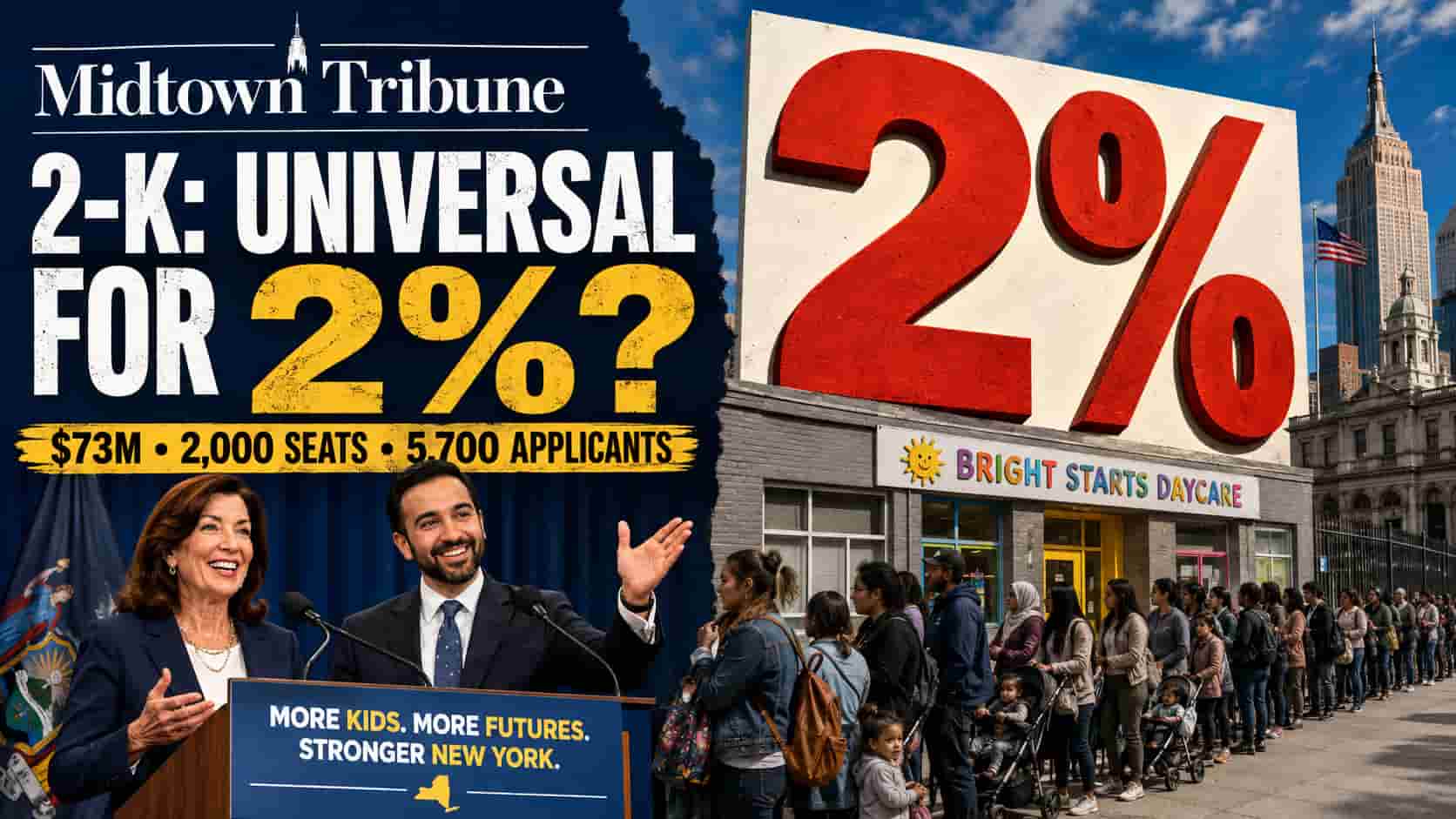
Hochul and Mamdani celebrate 2,000 offers as a milestone toward universal child care—but the first phase covers roughly 2 percent of New York City’s 2024 birth cohort and carries an initial state allocation of about $36,500 per seat.
By Midtown Tribune Editorial Staff | August 6, 2026
In New York’s latest exercise in government arithmetic, approximately 2 percent can be presented as a major step toward “universal” coverage, a $36,500 public allocation can be described simply as “free,” and the other 98 percent of children can participate by watching the press conference.
Governor Kathy Hochul and Mayor Zohran Mamdani announced that more than 2,000 children received offers to join New York City’s inaugural 2-K program. The state has allocated $73 million to establish the first approximately 2,000 seats, while more than 5,700 families submitted applications. State investment is expected to rise to $425 million in 2027.
For the families receiving seats, this can be valuable assistance. Child care in New York City is extraordinarily expensive, and the city says each participating family could save an average of approximately $26,000 per year.
But assistance for a limited group of families and a genuinely universal program are not the same thing.
That distinction appears to have become inconvenient.
The New York Definition of “Universal”
New York City Health Department provisional data show 100,213 births in the city during 2024:
- 24,518 in the first quarter;
- 24,559 in the second;
- 25,713 in the third; and
- 25,423 in the fourth.
The Health Department warns that provisional figures can change as records are processed. The number of births occurring in the city is also not a perfect count of two-year-olds currently living in New York: some children move, some city residents are born elsewhere, and not every family will seek public child care. It is therefore a broad demographic benchmark, not a precise eligibility count.
Still, the comparison illustrates the scale.
Two thousand seats equal approximately 1.996 percent of the 100,213-child birth cohort.
Put differently, for every child receiving one of the initial 2-K seats, approximately 49 other children from the same birth-year benchmark are outside the first phase.
In ordinary English, this would be called a small pilot program.
In government English, it is a “major milestone” toward universality.
The official city announcement is more candid about the timeline: the program will begin with 2,000 seats and is supposed to reach full universality within four years. The administration says that by the end of Mamdani’s first term, every family wanting a seat will have access to one.
That means the current program is not universal. It is the opening round of a promised future program that may eventually become universal.
For the moment, the word describes the ambition—not the service actually available.
More Than 5,700 Applications for Just Over 2,000 Seats
Mayor Mamdani cited the 5,700-plus applications as evidence of overwhelming demand.
He is correct about the demand.
But the same numbers also demonstrate overwhelming shortage.
With just over 2,000 seats and more than 5,700 applications, only roughly one-third of applicants received initial offers. Approximately two-thirds did not.
The city says families without an initial offer will receive information about waitlist options and may continue joining waitlists as additional places become available.
This produces a familiar government arrangement:
- Announce a benefit for everyone.
- Provide it initially to a selected minority.
- Place the rest on a waiting list.
- Cite the waiting list as proof that the program is popular.
- Hold a celebration.
The first 2-K class may be free at the point of use, but access is currently rationed by the number and location of government-supported seats.
That is not universal child care. It is a heavily oversubscribed opening phase.
The $36,500 “Free” Seat
The state allocated $73 million to establish approximately 2,000 seats.
The arithmetic is straightforward:
$73,000,000 ÷ 2,000 = $36,500 per announced seat.
This figure should not automatically be interpreted as the amount paid directly to a child care provider for one child. The allocation may include startup costs, administration, facilities, equipment, training, outreach, application systems and other expenditures.
But that is precisely why the state should release a detailed breakdown.
The Governor’s announcement identifies the total appropriation and the number of seats, but it does not explain how much will reach providers, how much is one-time startup spending, how much is recurring operating spending or how much will be consumed by administration.
The city says a free 2-K seat will save a family an average of $26,000 annually. Meanwhile, the initial public allocation works out to approximately $36,500 per seat.
That does not by itself prove waste: the two figures may measure different things and cover different periods or expenses. But a $10,500 difference is large enough to deserve more than a slogan.
The New York City Comptroller previously reported that the 2024 market rate for center-based toddler care was approximately $23,400 annually, while average center-based infant and toddler care reached approximately $26,000.
Again, this is not a perfect apples-to-apples comparison. A new public program may carry startup expenses and impose different staffing, service and operating requirements.
But taxpayers are entitled to know which fruit they are purchasing.
“Free” Means Someone Else Receives the Invoice
The program is free for parents whose children receive seats. It is not free to the public.
The invoice is distributed through the state budget.
That includes taxpayers raising children who did not receive a place, families already paying privately for care, people with no children and businesses whose taxes help finance the system.
This does not automatically make public child care a bad policy. Government routinely spreads the cost of public services across the broader population.
But political language should remain honest.
“Free child care” means taxpayer-funded child care provided without a direct charge to selected participating families.
It does not mean the service has no cost.
And when only a small percentage of an age group receives the initial benefit, the arrangement is especially difficult to call universal.
One family receives a publicly funded seat. Roughly 49 same-age peers remain outside the first phase, while their families continue helping finance the broader government system.
That is an experiment in redistribution and rationing—not yet universal access.
Next Year: From Roughly 2 Percent to Roughly 12 Percent
The administration plans to expand the program to approximately 12,000 children across all five boroughs by fall 2027. State investment is expected to increase to $425 million.
Using the 2024 birth cohort as the same rough benchmark, 12,000 seats would cover approximately 12 percent of that age group.
That would be a substantial expansion from the first year.
It would still leave nearly 88 percent outside the program under that broad comparison.
The projected arithmetic also remains remarkably consistent:
$425,000,000 ÷ 12,000 = approximately $35,417 per seat.
Therefore, expanding the program sixfold does not appear—based on the headline figures—to produce a dramatic reduction in average public allocation per seat.
Perhaps the $425 million includes services or infrastructure not reflected in a simple seat calculation. Perhaps the administration expects more than 12,000 places. Perhaps part of the money supports other programs.
Those are reasonable possibilities.
They are also reasons for the Governor’s Office to release an actual budget breakdown.
A Real Problem Does Not Make Every Solution Efficient
New York City unquestionably has a child care affordability crisis.
The Comptroller found that child care costs place severe pressure on working families, that many eligible families do not receive subsidized care and that the private annual cost of care can reach $26,000. Universal high-quality child care could increase parents’ ability to work and produce significant economic benefits.
Those facts make careful policy more important—not less.
A genuine solution requires enough providers, sustainable financing, transparent reimbursement rates, measurable quality standards and access that is not limited to a small group selected from an oversubscribed pool.
Helping 2,000 families is worthwhile.
Calling assistance to 2,000 families “universal” before tens of thousands of other families can obtain the same benefit is political marketing.
The Questions Hochul’s Office Should Answer
Midtown Tribune submitted a written press inquiry to Governor Hochul’s office on August 5 seeking an on-the-record response concerning:
- the official number of eligible children;
- the number of applicants receiving no initial placement;
- the selection and priority criteria;
- the number of children placed on waitlists;
- a detailed breakdown of the $73 million allocation;
- the recurring annual operating cost per occupied seat;
- the contracts and reimbursement rates paid to providers;
- the planned use of the projected $425 million;
- the number of seats expected each year; and
- the date on which every eligible family requesting a place is expected to receive one.
The administration deserves credit for directing attention and money toward a genuine problem.
It also owes the public an explanation of how the money is being spent and why a program reaching a small fraction of children is being wrapped in the language of universal government provision.
For approximately 2,000 families, the inaugural 2-K offers may represent a significant victory.
For the remaining families, the current benefit consists mainly of a promise, a waitlist and an invitation to applaud the milestone.
In Albany’s new arithmetic, that is apparently close enough to universal.
Official Sources and Supporting Documents
The factual figures, government descriptions, eligibility rules, and budget calculations discussed in this article are based on the following official New York State and New York City sources.
-
NYC Mayor’s Office — August 4, 2026:
Mayor Mamdani and Governor Hochul Extend 2-K Offers to More Than 2,000 Children
The official announcement states that more than 5,700 families applied for just over 2,000 seats. It also says that a seat is expected to save participating families an average of $26,000 per year, that 82 percent of initial recipients received one of their top three choices, and that 99 percent of offers were for a program listed on the family’s application. -
Governor Kathy Hochul’s Office:
Governor Hochul and Mayor Mamdani Extend 2-K Offers to More Than 2,000 Children
The Governor’s announcement confirms more than 2,000 offers, more than 5,700 applications, an initial State investment of $73 million, and an expected increase in State investment to $425 million in 2027. -
NYC Public Schools — Official 2-K Admissions Page:
2-K Eligibility, Applications, Offers, Priorities, and Waitlists
NYC Public Schools states that all New York City children born in 2024 may apply. It also explains that families may apply to programs across the city, while children receive priority in their home district and placement remains dependent on available seats. -
NYC Mayor’s Office — Initial Program Locations:
First Communities Selected for the 2-K Launch
The City describes the first approximately 2,000 seats as the opening phase of the program and says the initiative is expected to expand to approximately 12,000 children across the five boroughs by fall 2027. -
Governor Kathy Hochul’s Office — Initial Funding:
Major Milestone Toward Launching Free Child Care for Two-Year-Olds
The State identifies a $73 million allocation to establish the first 2,000 2-K seats and describes the program as part of a larger plan to expand child-care access. -
New York City Council — Fiscal 2027 Department of Education Budget Analysis:
Department of Education Fiscal 2027 Preliminary Budget Report
The Council’s report calls the initiative a “2-K pilot.” It identifies $73 million in State funding for 2,000 seats in Fiscal 2027 and $425 million for 12,000 seats in Fiscal 2028. The report also states that funding beyond the program’s second year was not included in the preliminary financial plan. -
NYC Comptroller — Child-Care Costs:
Child Care Affordability and the Benefits of Universal Provision
The Comptroller reports that average center-based care for infants and toddlers cost approximately $26,000 annually in 2024, while family-based care averaged approximately $18,200. The report also documents the broader shortage of affordable and publicly supported child care. -
NYC Mayor’s Office — Participating Providers:
Mayor Announces the First 2-K Providers
The City announced more than 550 center-based and home-based providers in School Districts 6, 10, 18, 23, and 27 for the inaugural application period. -
NYC Health — Birth Data:
Provisional Birth and Death Data
The Health Department publishes provisional quarterly birth data and warns that the reported figures may change as additional records are processed. Birth totals should therefore be identified as provisional when used for demographic comparisons. -
Official Event Video:
Governor Hochul and Mayor Mamdani Announce the 2-K Offers
Video of the public announcement referenced in this report.
Calculations Used in This Article
Initial allocation per announced seat:
$73,000,000 divided by 2,000 seats equals approximately
$36,500 per seat.
Projected Fiscal 2028 allocation per announced seat:
$425,000,000 divided by 12,000 seats equals approximately
$35,417 per seat.
These calculations show the average public allocation associated with the announced number of seats. They do not establish the amount paid directly to an individual provider or the program’s recurring operating cost per enrolled child. The published totals may include startup, administrative, staffing, facilities, training, technology, outreach, and other expenses.
Midtown Tribune submitted written questions to Governor Hochul’s Press Office requesting a detailed expenditure breakdown, selection criteria, waitlist data, provider reimbursement information, and a timetable for offering a seat to every eligible family that requests one. This report will be updated if a substantive response is received.
Ask Midtown Tribune about this story
Answers are grounded first in this article. Search all Midtown Tribune reporting from the main AI Search page.
AI-generated summary. Verify important details in the linked original articles.