
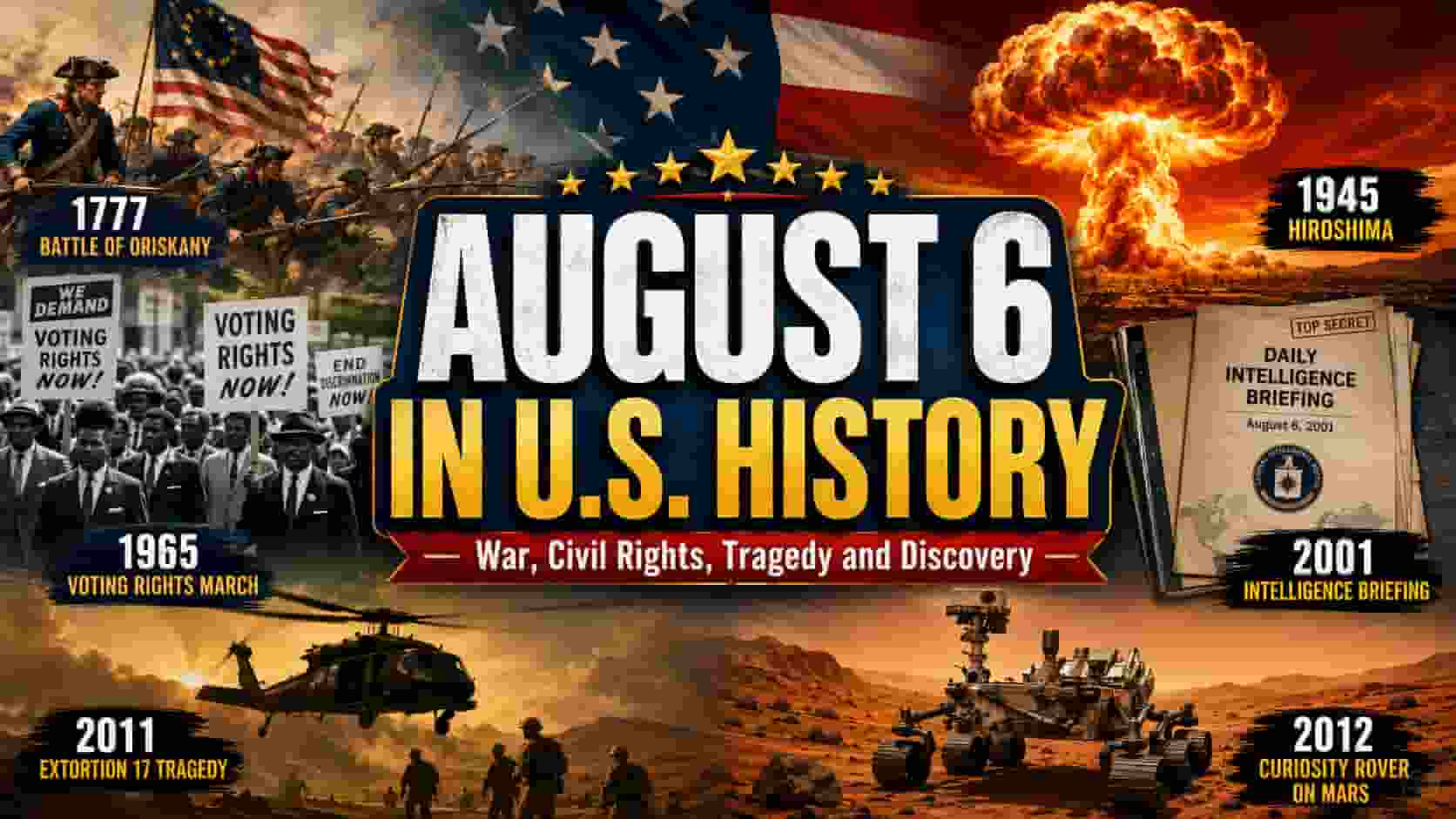
From a bloody Revolutionary War battle in New York to the Voting Rights Act, the atomic age and NASA’s successful Mars landing, August 6 marks several turning points in American history. What many people do not know: Hiroshima was a major Japanese military center and the headquarters of the Second General Army—and days later, the Soviet Union entered the war against Japan.
1777: The Battle of Oriskany in New York
On August 6, 1777, American militia forces fought one of the bloodiest battles of the Revolutionary War near present-day Oriskany, New York.
Approximately 800 members of the Tryon County militia, commanded by General Nicholas Herkimer, were marching to relieve the besieged Fort Schuyler, also known as Fort Stanwix. They were ambushed by a force that included British-allied Loyalists and Native American warriors.
Herkimer was seriously wounded but continued directing his men during the fighting. The battle became part of the larger campaign that ultimately disrupted Britain’s attempt to seize control of New York and divide New England from the other American colonies.
1861: The First Confiscation Act Became Law
On August 6, 1861, President Abraham Lincoln signed the First Confiscation Act during the opening months of the Civil War.
The law authorized the federal government to seize property being used to support the Confederate rebellion. That definition included enslaved people forced to work for Confederate military purposes.
The act did not abolish slavery throughout the country, but it represented an important early federal step toward weakening the institution and redefining the war as a struggle involving both national unity and emancipation.
1945: The United States Dropped an Atomic Bomb on Hiroshima
1945: Hiroshima Was Also a Major Japanese Military Headquarters
At approximately 8:15 a.m. local time on August 6, 1945, the American B-29 bomber Enola Gay dropped the uranium atomic bomb known as Little Boy on Hiroshima, Japan.
It was the first use of an atomic weapon in warfare. Tens of thousands of people, most of them civilians, were killed immediately, while many others later died from burns, injuries and radiation exposure.
One fact often omitted from simplified accounts is that Hiroshima was not selected at random and was not merely a civilian population center. It was an important Japanese military, communications and transportation hub. The city contained the headquarters of Japan’s Second General Army, which was responsible for coordinating the defense of southern Japan against an expected Allied invasion. Hiroshima also included major military facilities and the nearby Ujina port, an important embarkation and logistics center used to move troops and supplies.
This military role does not diminish the enormous civilian suffering caused by the bombing. It does, however, provide essential historical context for understanding why Hiroshima appeared on the American target list.
Another decisive development followed almost immediately. On August 8, 1945, two days after the Hiroshima bombing, the Soviet Union declared war on Japan. Soviet forces began their large-scale offensive against Japanese-held Manchuria shortly after midnight on August 9 — three days after Hiroshima and on the same day that the United States dropped a second atomic bomb on Nagasaki.
The Soviet attack shattered Japan’s remaining hopes that Moscow might mediate a negotiated settlement. Japan now faced atomic destruction from the United States, the rapid collapse of its forces in Manchuria and the prospect of Soviet advances into additional Japanese-held territory.
1965: President Johnson Signed the Voting Rights Act
On August 6, 1965, President Lyndon B. Johnson signed the Voting Rights Act into law.
The legislation was enacted after years of civil-rights activism and national outrage over violence against voting-rights demonstrators, particularly during the Selma campaign in Alabama.
The law prohibited racial discrimination in voting, challenged the use of literacy tests and authorized federal intervention in jurisdictions where state and local practices had prevented Black citizens from registering or voting.
Civil-rights leaders including Martin Luther King Jr. and Rosa Parks attended the signing ceremony. The law became one of the most consequential pieces of civil-rights legislation in American history.
1971: The Senate Began Its First Official August Recess
On August 6, 1971, the United States Senate began its first officially established August recess.
The break followed the Legislative Reorganization Act of 1970, which provided for a summer recess during odd-numbered years. Before that reform, congressional sessions often continued through Washington’s hottest months with no formally scheduled summer break.
The August recess later became a regular part of the congressional calendar, allowing senators to return to their states, meet constituents and conduct work outside Washington.
2001: A Presidential Briefing Warned About Bin Laden’s Intentions
On August 6, 2001, President George W. Bush received a classified Presidential Daily Brief titled “Bin Ladin Determined to Strike in US.”
The briefing reviewed intelligence concerning al-Qaeda’s interest in conducting attacks inside the United States. It mentioned possible hijackings, suspicious surveillance of federal buildings and investigations involving individuals believed to have connections to extremist organizations.
However, the document did not identify the date, location or specific operational plan for the September 11 attacks. It later became a major focus of the investigation into how intelligence agencies and senior officials assessed the terrorist threat before 9/11.
2011: The Extortion 17 Tragedy in Afghanistan
On August 6, 2011, a U.S. military CH-47 Chinook helicopter with the call sign Extortion 17 was shot down in Afghanistan.
Thirty American service members and eight Afghans were killed. The American fatalities included Navy SEALs, other special-operations personnel and members of the helicopter crew.
It was one of the deadliest single incidents for American forces during the war in Afghanistan and the largest single loss of life in the history of U.S. Naval Special Warfare.
2012: NASA’s Curiosity Rover Landed on Mars
During the early hours of August 6, 2012, Eastern time, NASA’s Curiosity rover successfully landed inside Mars’ Gale Crater.
The landing used an unprecedented system known as the “sky crane.” A rocket-powered descent vehicle hovered above the Martian surface and lowered the rover on cables before flying away.
The mission was designed to determine whether Mars had ever possessed environmental conditions capable of supporting microbial life. Curiosity later found chemical and mineral evidence showing that parts of ancient Mars once had potentially habitable environments.
One Date, Many Chapters of American History
August 6 reflects sharply different sides of the American experience.
It is associated with the struggle for independence, the first federal actions against slavery, the arrival of the atomic age and the long campaign for equal voting rights. It also recalls warnings that preceded a national tragedy, the sacrifice of American service members and a technological achievement on another planet.
Together, these events demonstrate how a single date can connect war, law, civil rights, national security and scientific exploration across more than two centuries of United States history.
Official U.S. Government Sources
The historical events described in this article are documented by the National Archives, National Park Service, U.S. Senate, U.S. military, presidential libraries, and NASA.
- National Park Service — The Battle at Oriskany, August 6, 1777
- National Park Service — Oriskany Battlefield State Historic Site
- U.S. Senate — The Confiscation Acts of 1861 and 1862
- U.S. Senate Historical Office — Civil War Chronology and the First Confiscation Act
- National Archives — The Atomic Bombings of Hiroshima and Nagasaki
- National Archives Museum — Hiroshima and Nagasaki Historical Exhibit
- U.S. Army Official History — Hiroshima and Japan’s Second General Army Headquarters
- U.S. Department of Energy — Manhattan Project History and Preservation
- Harry S. Truman Presidential Library — The Decision to Drop the Atomic Bomb
- Harry S. Truman Presidential Library — Soviet Declaration of War and the Invasion of Manchuria
- Harry S. Truman Presidential Library — The Soviet Offensive of August 1945
- National Archives — Voting Rights Act of 1965
- National Archives Museum — 60 Years of the Voting Rights Act
- U.S. Senate — The First Official August Recess, August 6, 1971
- White House Archives — August 6, 2001 Presidential Daily Brief
- U.S. Navy — The Extortion 17 Tragedy of August 6, 2011
- Naval Special Warfare Command — Extortion 17 Commemoration
- NASA — Mars Science Laboratory and the Curiosity Rover
- NASA Jet Propulsion Laboratory — Curiosity’s August 2012 Mars Landing
All links lead to official United States government websites or federally maintained historical archives.
Ask Midtown Tribune about this story
Answers are grounded first in this article. Search all Midtown Tribune reporting from the main AI Search page.
AI-generated summary. Verify important details in the linked original articles.