
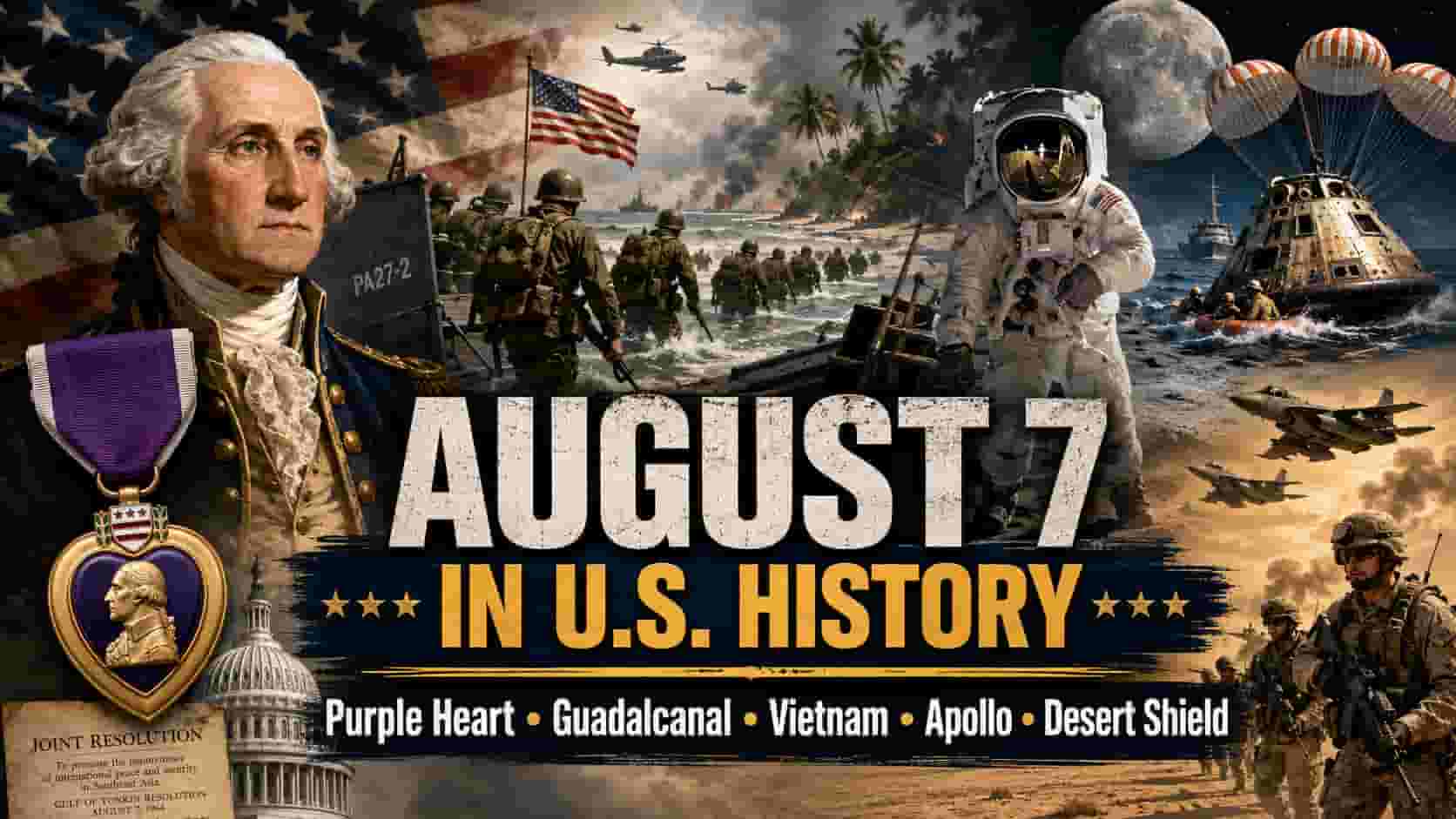
August 7 has repeatedly marked important turning points in American history — from George Washington’s Revolutionary War headquarters to the battlefields of World War II, the Vietnam War, the Moon, the Persian Gulf and the fight against international terrorism.
Here are 10 major events connected to the United States that occurred on August 7.
1. 1782 — George Washington Creates the Predecessor of the Purple Heart
On August 7, 1782, General George Washington issued an order from his headquarters in Newburgh, New York, creating the Badge of Military Merit.
The award featured a heart made of purple cloth or silk and was intended to recognize “singularly meritorious action,” extraordinary fidelity and essential service.
The award became the historical predecessor of today’s Purple Heart, one of America’s most recognized military decorations.
August 7 is now observed as Purple Heart Day, honoring U.S. service members who were wounded or killed as a result of enemy action.
2. 1789 — Congress Establishes the U.S. War Department
Only a few years after independence, the new federal government needed a permanent institution to oversee the nation’s armed forces.
On August 7, 1789, Congress established the War Department.
The department initially supervised military affairs and also had responsibility for naval matters until the separate Department of the Navy was established in 1798.
The War Department remained one of the central institutions of the U.S. government until the post-World War II reorganization of the American defense establishment.
3. 1794 — Washington Acts Against the Whiskey Rebellion
On August 7, 1794, President George Washington issued a proclamation responding to the Whiskey Rebellion, an armed resistance to the federal excise tax on distilled spirits in western Pennsylvania.
The confrontation became an early test of whether the new federal government created by the Constitution actually had the authority and ability to enforce federal law.
Washington ultimately mobilized a large militia force.
The episode demonstrated that the federal government would not allow organized armed resistance to nullify federal law.
4. 1942 — U.S. Marines Land on Guadalcanal
On August 7, 1942, U.S. Marines landed on Guadalcanal and nearby islands in the Solomon Islands, beginning Operation Watchtower.
The U.S. Navy describes Guadalcanal as the first major American land or amphibious offensive of World War II.
The campaign came only eight months after Japan attacked Pearl Harbor.
American forces fought for months to hold Guadalcanal, its strategically important airfield and surrounding islands. The campaign became one of the crucial early turning points in the Pacific War.
5. 1959 — NASA Launches Explorer 6
On August 7, 1959, the United States launched Explorer 6, an early NASA scientific satellite.
Explorer 6 studied radiation, magnetic fields, micrometeorites and other phenomena.
It also carried technology capable of photographing Earth.
One week later, on August 14, Explorer 6 produced what NASA identifies as the first photograph of Earth taken from orbit.
The picture was primitive by modern standards, but it represented another milestone in the rapidly developing American space program.
6. 1961 — Kennedy Establishes Cape Cod National Seashore
On August 7, 1961, President John F. Kennedy signed legislation establishing Cape Cod National Seashore in Massachusetts.
The purpose was to preserve approximately 40 miles of coastline, along with dunes, marshes, ponds, historic landscapes and other natural resources, from large-scale commercial development.
The National Park Service has described the legislation as an important milestone in American conservation history.
7. 1964 — Congress Passes the Gulf of Tonkin Resolution
One of the most consequential congressional decisions of the Vietnam era occurred on August 7, 1964.
Following reported attacks involving U.S. destroyers in the Gulf of Tonkin, Congress overwhelmingly approved the Gulf of Tonkin Resolution.
It authorized President Lyndon B. Johnson to take what the resolution described as “all necessary measures” to defend U.S. forces and prevent further aggression in Southeast Asia.
The measure became a major legal basis for the dramatic expansion of American military involvement in Vietnam.
The historical record later became far more complicated. The National Archives notes that while the August 2 confrontation occurred, later intelligence analysis concluded that the reported second attack on August 4 did not occur as originally described.
Congress eventually repealed the resolution in 1971.
8. 1971 — Apollo 15 Returns From the Moon
On August 7, 1971, Apollo 15 returned safely to Earth, splashing down in the Pacific Ocean.
Astronauts David Scott, James Irwin and Alfred Worden completed one of NASA’s most scientifically ambitious lunar missions.
Apollo 15 was particularly historic because it was the first Apollo mission to use the Lunar Roving Vehicle, allowing astronauts to travel much farther from their landing site on the Moon.
The return itself included a dramatic moment: one of the spacecraft’s three main parachutes failed, but the capsule landed safely using the remaining two.
9. 1990 — Operation Desert Shield Begins
On August 2, 1990, Saddam Hussein’s Iraqi military invaded Kuwait.
Five days later, on August 7, 1990, the United States initiated Operation Desert Shield.
President George H. W. Bush ordered American forces into Saudi Arabia as the United States began assembling an enormous international military coalition.
The immediate objective was to defend Saudi Arabia and prevent further Iraqi expansion.
The buildup eventually transitioned into Operation Desert Storm in January 1991, leading to the liberation of Kuwait.
10. 1998 — Al-Qaeda Bombs Two U.S. Embassies
On August 7, 1998, nearly simultaneous truck bombs exploded outside the American embassies in Nairobi, Kenya, and Dar es Salaam, Tanzania.
According to the FBI, 224 people were killed, including 12 Americans, and more than 4,500 were wounded.
The attacks were carried out by al-Qaeda operatives.
The bombings became one of the most significant terrorist attacks against American targets before September 11, 2001, and triggered an enormous FBI and U.S. government investigation.
Why August 7 Matters
Few dates connect so many different chapters of American history.
On August 7, George Washington created the ancestor of the Purple Heart and later confronted one of the first major challenges to federal authority. Congress established the War Department. American Marines launched a decisive Pacific offensive. Congress made a decision that transformed the Vietnam War.
The date also records achievements of American science and exploration — from Explorer 6 to Apollo 15 — as well as the beginning of Operation Desert Shield and one of the deadliest terrorist attacks ever directed against U.S. diplomatic facilities.
From the American Revolution to the Space Age and the modern fight against terrorism, August 7 has repeatedly become a date on which American history changed direction.
Official U.S. sources
- Purple Heart / Badge of Military Merit — U.S. Army Center of Military History. Washington established the Badge of Military Merit on August 7, 1782.
U.S. Army — History of the Purple Heart - War Department — U.S. National Archives. Congress established the War Department on August 7, 1789.
National Archives — Records of the Secretary of War - Whiskey Rebellion — archived White House historical record / Library of Congress.
White House Archives — August 7, 1794 - Guadalcanal — Naval History and Heritage Command. U.S. Marines landed on August 7, 1942, beginning the first American land offensive of the war.
U.S. Navy — Guadalcanal Campaign - Explorer 6 — NASA. Explorer 6 launched August 7, 1959; NASA records show it later produced the first orbital photograph of Earth.
NASA — Earth Observations Timeline - Cape Cod National Seashore — National Park Service. President Kennedy signed the legislation August 7, 1961.
National Park Service — Cape Cod National Seashore Anniversary - Gulf of Tonkin Resolution — National Archives. Congress passed the resolution August 7, 1964; Johnson signed it August 10.
National Archives — Tonkin Gulf Resolution - Apollo 15 — NASA. Splashdown occurred August 7, 1971.
NASA — Apollo 15 - Operation Desert Shield — U.S. Army / Department of Defense. Official Army history dates the operation from August 7, 1990.
U.S. Army Center of Military History — Desert Shield and Desert Storm - 1998 U.S. Embassy bombings — FBI / Department of State. The FBI records 224 deaths, including 12 Americans, and more than 4,500 wounded.
FBI — East African Embassy Bombings
Ask Midtown Tribune about this story
Answers are grounded first in this article. Search all Midtown Tribune reporting from the main AI Search page.
AI-generated summary. Verify important details in the linked original articles.