
The short answer:
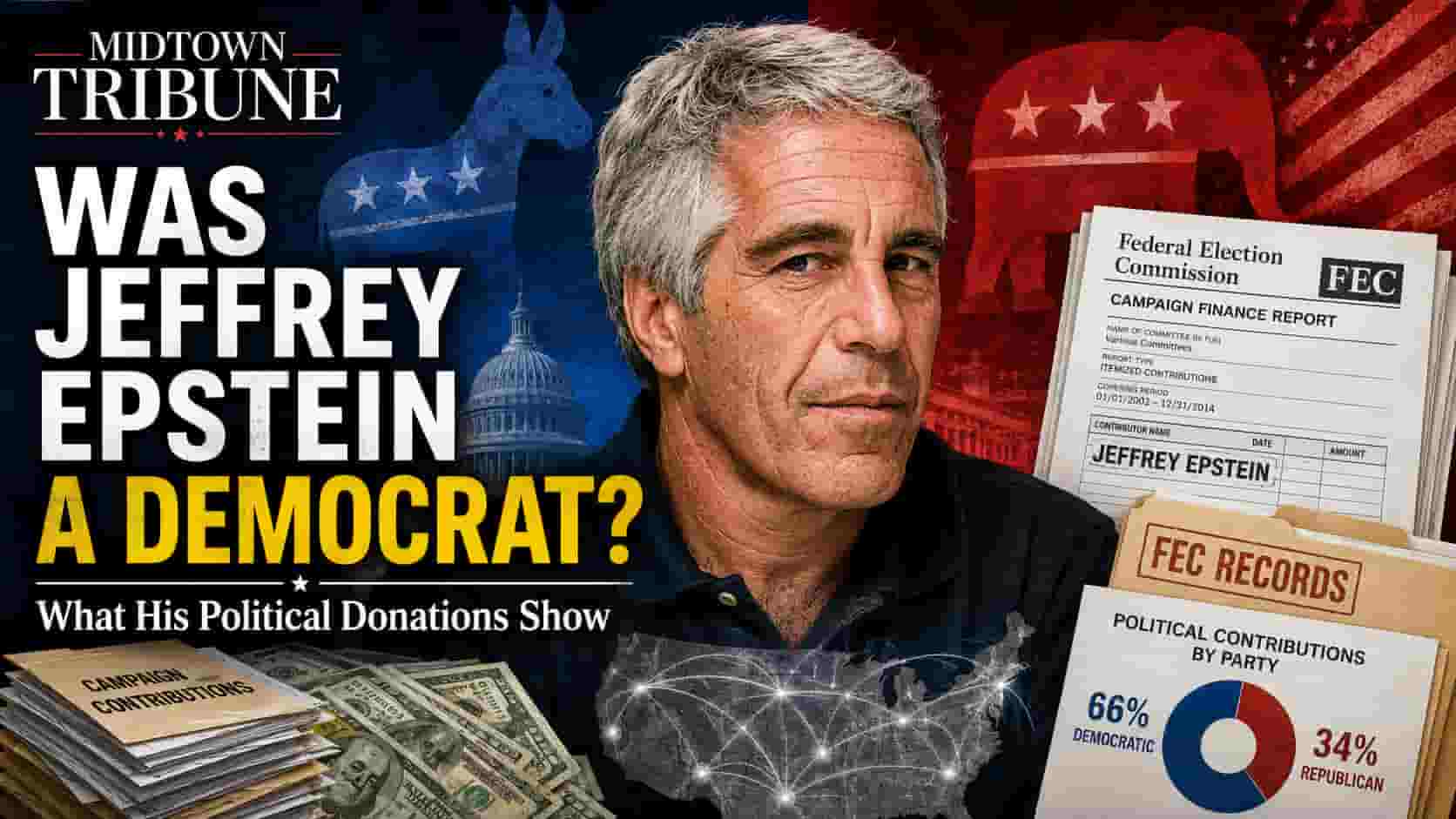
Jeffrey Epstein donated to politicians and political committees connected to both major parties, but his documented pattern of federal political giving leaned substantially toward Democrats and Democratic organizations.
That does not mean every Democrat who received a contribution from Epstein knew about his crimes, had a personal relationship with him, or was involved in any wrongdoing.
It also would be inaccurate to claim that Epstein gave money exclusively to Democrats.
The most reliable way to examine the question is not through photographs, social-media posts or partisan accusations, but through the federal campaign-finance records maintained by the Federal Election Commission.
FEC — Search Individual Political Contributions
What Do the Federal Records Show?
The Federal Election Commission maintains searchable records of contributions reported by federal candidates, political committees and party organizations.
A search under the name Jeffrey Epstein produces historical contribution records spanning multiple election cycles.
Those records show contributions associated with Democratic candidates and organizations, including committees connected with Democratic Senate politics and prominent Democratic politicians.
They also show that Epstein contributed to some Republican candidates.
FEC — Jeffrey Epstein Contribution Search
The important distinction is therefore:
Epstein was not an exclusively Democratic donor — but the overall documented direction of his political giving was much more favorable to Democrats.
Epstein and Democratic Political Committees
Among the Democratic political organizations and candidates historically associated with contributions from Epstein are committees connected with:
- the Democratic Senatorial Campaign Committee;
- Democratic national political activity;
- Hillary Clinton’s 2000 New York Senate campaign effort;
- Chuck Schumer;
- John Kerry;
- Bill Richardson;
- Joe Lieberman;
- and other Democratic candidates.
Readers can independently search these contributions through the FEC database by entering Jeffrey Epstein as the contributor and filtering by recipient.
FEC — Individual Contributions Database
One of the more notable records from the 2000 election period involved New York Senate 2000, a joint fundraising operation associated with Hillary Clinton’s Senate campaign.
The important point is not one particular contribution.
It is the broader pattern: Epstein repeatedly placed money into Democratic political networks over multiple election cycles.
Did Epstein Also Give Money to Republicans?
Yes.
Any article claiming that Epstein only financed Democrats would be incomplete.
Federal records also contain contributions associated with Republican candidates.
For example, an archived FEC enforcement document contains a Jeffrey Epstein contribution entry connected with the campaign of Republican New York Senate candidate Rick Lazio.
FEC — Archived Record Containing Epstein/Lazio Contribution Information
Other Republican politicians have also appeared in historical accounts of Epstein’s political giving.
Therefore the accurate description is not:
“Epstein gave only to Democrats.”
It is:
“Epstein gave to both sides, but his documented political financing was weighted heavily toward Democrats.”
Was Jeffrey Epstein Officially a Democrat?
That is a different question.
A political contribution does not necessarily establish formal party membership.
We should distinguish between:
party registration,
personal ideology, and
where a donor actually sent political money.
The clearest documentary evidence concerns the third category.
His contribution history demonstrates that Epstein participated financially in American politics and that Democratic candidates and committees received a considerably larger share of his documented political support than Republicans.
That is a narrower — and more defensible — conclusion than declaring that every aspect of Epstein’s political identity was Democratic.
What About Bill Clinton?
The Epstein story is often discussed alongside former President Bill Clinton because the two men had documented contact.
But this is where political discussion frequently becomes careless.
A photograph with Epstein does not establish criminal involvement.
A flight with Epstein does not by itself establish participation in his crimes.
A political donation certainly does not establish it either.
If a public figure’s relationship with Epstein is being investigated, the proper questions are specific:
- When did they meet?
- How frequently?
- Where did they travel?
- What did the public figure know at that time?
- Were political donations involved?
- Is there evidence connecting the person to criminal conduct?
Those questions must be answered individually.
The same evidentiary standard should apply whether the politician is a Democrat, Republican or independent.
Money Is More Useful Than Photographs for Answering the Party Question
The Epstein story has produced countless photographs featuring politicians, businessmen, celebrities, academics and other prominent people.
Those images are frequently circulated as supposed proof of political allegiance.
But photographs are a poor way to determine which political party someone financially supported.
Campaign-finance reports provide a much better record.
The FEC database shows:
- who contributed;
- who received the money;
- how much was reported;
- the date of the transaction;
- the election cycle;
- and the receiving political committee.
FEC — How to Research Individual Contributions
For the narrow question “Which party did Epstein support financially?”, those records are more useful than a collection of social photographs.
Does Receiving Epstein’s Money Implicate a Politician?
No.
That point is essential.
A contribution from Jeffrey Epstein does not prove that its recipient:
- knew about Epstein’s sexual crimes;
- visited his private island;
- participated in criminal activity;
- helped Epstein avoid prosecution;
- or had any knowledge of what Epstein was doing privately.
Political committees process enormous numbers of contributions.
Evidence of a campaign-finance transaction establishes a financial contribution.
It does not automatically establish a criminal relationship.
If additional evidence exists regarding a particular individual, that evidence should be examined separately.
Why This Question Matters Now
Epstein has become part of modern partisan warfare.
Republicans point toward his relationships with prominent Democrats.
Democrats point toward his relationships with Republicans and other wealthy public figures.
The result is frequently a contest in which each side selects the photographs or names most damaging to the other.
Federal contribution records allow for a more objective question:
Where did Epstein actually put his political money?
And those records show that while he was willing to contribute across party lines, the stronger documented political-financing relationship was with Democratic candidates and Democratic political organizations.
So Was Epstein a “Democratic Donor”?
That description is reasonable if it is properly qualified.
It would be misleading to say:
“Jeffrey Epstein funded only Democrats.”
He did not.
It would also be misleading to suggest that his giving was evenly divided between the two parties.
The available federal campaign-finance record shows a clear Democratic tilt.
The most accurate formulation is:
Jeffrey Epstein contributed to candidates from both major political parties, but his documented federal political giving favored Democrats and Democratic committees by a substantial margin.
What Is Confirmed
Federal campaign-finance records confirm that:
- Jeffrey Epstein made political contributions over multiple election cycles;
- Democratic candidates and committees were recurring recipients;
- Republican candidates also received contributions;
- the distribution of his documented political giving was not evenly balanced between the two parties.
FEC — Jeffrey Epstein Contribution Records
What the Records Do Not Prove
Campaign-finance records do not prove:
- that a recipient knew of Epstein’s crimes;
- that a recipient participated in those crimes;
- that a contribution purchased political favors;
- that every person named in Epstein-related documents was involved in misconduct.
Those are separate factual questions requiring separate evidence.
The Bottom Line
Which political party did Jeffrey Epstein support?
If the question is about documented political money, the answer is:
Both parties received money from Epstein, but Democrats received substantially more of his documented political support.
That conclusion does not require a partisan theory.
It comes from following the money.
And it should be presented with the equally important qualification that receiving a legal political contribution from Epstein does not, by itself, establish knowledge of or participation in his crimes.
Official Sources
- Federal Election Commission — Jeffrey Epstein Individual Contribution Search
- FEC — How to Research Individual Contributions
- FEC — Campaign Finance Data
- FEC — Political Party Data
- FEC — Archived Enforcement Record Containing Epstein Contribution Entry
Midtown Tribune Editorial Note: This article addresses Jeffrey Epstein’s documented political contributions, not guilt by association. A campaign’s receipt of a contribution does not establish that the recipient knew about Epstein’s criminal conduct or participated in it. The party comparison is based on the direction of documented federal political contributions and should not be interpreted as evidence against an entire political party.
Ask Midtown Tribune about this story
Answers are grounded first in this article. Search all Midtown Tribune reporting from the main AI Search page.
AI-generated summary. Verify important details in the linked original articles.