
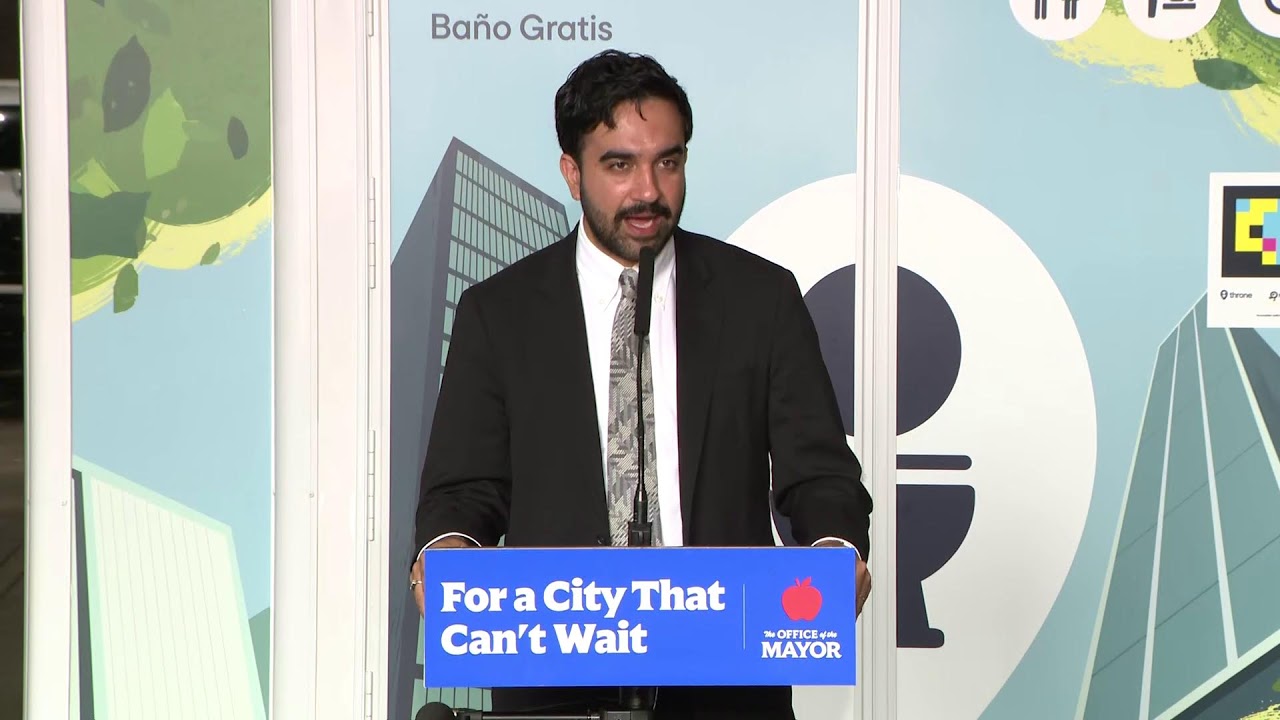
NEW YORK — September 16, 2026 — Mayor Zohran Kwame Mamdani announced the rollout of 17 modular public bathrooms across all five boroughs as part of a one-year, $4 million New York City pilot aimed at expanding access to free public restrooms.
The bathrooms will be installed in public plazas and other high-traffic locations and will be operated and maintained by Throne Labs, a company selected by the New York City Economic Development Corporation through a competitive procurement process.
The announcement was made at the Throne Labs warehouse in Queens alongside Council Member Sandy Nurse, city officials and company executives.
Official NYC Mayor’s Office video:
https://www.youtube.com/watch?v=TieKGgiyyFc
Official NYC Mayor’s Office announcement:
https://www.nyc.gov/mayors-office/news/2026/09/mayor-mamdani-brings-17-new-public-bathrooms-to-neighborhoods-ac
Key Facts
- Program: One-year modular public restroom pilot
- Cost: $4 million
- Number of bathrooms: 17
- Boroughs: All five boroughs
- Operator: Throne Labs
- Hours: 7 a.m. to 10 p.m. daily
- Cost to users: Free
- Accessibility: ADA-accessible
- Features: Running water, flushing toilet, climate control and baby-changing station
- Installation: Beginning in September 2026
- City contractor selection: NYCEDC selected Throne Labs after a competitive RFP process
Where the 17 Bathrooms Will Be Located
According to the Mayor’s Office, the locations include:
Bronx
- Yankee Stadium
- Admiral Farragut Playground
- Mapes Park
- Monsignor Raul Del Valle Square
Brooklyn
- Columbus Park
- Milestone Park
- Fulton Street and Truxton Street
- Avenue C Plaza
Queens
- Astoria Boulevard South and 31st Street
- Northern Boulevard and 31st Street
- Northern Boulevard and 54th Street
- 34th Avenue and 64th Street
Manhattan
- Cooper Square
- Malcolm X Plaza
- Delancey Street and Suffolk Street
- Plaza Alianza Dominicana
Staten Island
- North Shore Esplanade
How the Bathrooms Work
The units are self-contained modular bathrooms.
According to the city, they do not require conventional connections to municipal water, sewer or electric infrastructure. That allows them to be installed, moved or removed more easily than conventional permanent facilities.
Each unit will include:
- a flushing toilet;
- running-water sink;
- heating and air conditioning;
- baby-changing facilities;
- ADA-accessible design;
- touchless features.
Throne Labs will be responsible for cleaning and maintaining the units.
The company and city officials said the bathrooms are expected to be cleaned approximately every 10 to 15 uses depending on demand.
Users Need a Phone or Tap Card to Enter
One issue raised repeatedly by reporters was access.
Users will be able to enter through:
- text message;
- QR code;
- the Throne Bathroom Network app;
- or a physical tap card.
Reporters questioned whether requiring electronic access could create a barrier for homeless New Yorkers or people without working phones.
Mamdani said local organizations would distribute physical tap cards.
The city said signage at each bathroom would identify nearby locations where users can obtain a card, generally within a 10-minute walk.
Why Require Electronic Entry?
Throne Labs officials said the electronic system allows the company to track usage and receive real-time feedback about conditions inside the bathrooms.
Users can report cleanliness problems, which can generate maintenance tickets.
The system also allows the operator to determine how frequently individual locations are being used and adjust cleaning schedules accordingly.
Throne Labs said its system can identify certain prohibited activity, including smoking, and issue warnings associated with a user’s access credentials.
Bathrooms Have a 10-Minute Time Limit
The bathrooms will generally have a 10-minute use limit.
According to Throne Labs representatives at the press conference, users will receive several warnings.
At approximately five minutes, an audio message notifies the user that half of the allotted time has passed.
At eight minutes, another notification warns that the session is approaching its end.
At 10 minutes, lights flash and an audio warning indicates that the door will open.
Company representatives said there is a short final buffer before the door actually opens.
They said the system is intended to discourage extended occupancy while also providing a safety mechanism if someone experiences a medical emergency inside.
Concerns About Drugs, Prostitution and Extended Occupancy
A reporter specifically asked the administration about experiences in other cities where public bathroom facilities have been associated with drug use, prostitution or homeless encampments.
Mamdani said the design and operating system of the Throne units is intended to reduce those risks.
Measures discussed at the press conference included:
- limited occupancy time;
- repeated audio and visual warnings;
- automatic opening after the allotted time;
- frequent cleaning;
- electronic access records;
- smoke detection;
- real-time maintenance reporting.
Throne Labs COO Jessica Heinzelman also said staff would be offered training in the use of naloxone, commonly known by the brand name Narcan.
The company’s claims about its experience in other jurisdictions are company statements and are not independent findings by the City of New York.
17 Bathrooms Are Part of a Much Larger Goal
The city’s bathroom shortage predates the Mamdani administration.
New York City currently has roughly 1,000 to 1,100 publicly accessible restrooms, depending on the dataset and definition used.
In 2025, the City Council enacted Local Law 58 of 2025, creating a long-term public bathroom strategy.
The law establishes a planning goal of at least 2,120 public bathrooms by 2035, with at least half publicly owned.
The legislation was sponsored by Council Member Sandy Nurse and requires city agencies to prepare and periodically update a citywide public bathroom strategy.
Official NYC Council legislation
NYC Council public restroom analysis and map
https://council.nyc.gov/data/public-restroom-analysis
This Did Not Begin With the Mamdani Administration
The city’s effort to increase public bathroom access has developed across multiple mayoral administrations and City Council sessions.
In 2022, Local Law 114 required the city to identify existing public bathroom facilities and identify possible locations for additional facilities across ZIP-code areas.
Official legislation:
https://legistar.council.nyc.gov/View.ashx?GUID=F93723D2-11A9-4B77-87C2-D8F049F6F680&ID=11543784&M=F
In June 2024, Mayor Eric Adams announced the “Ur In Luck” initiative.
That program proposed:
- 46 new public restrooms;
- renovation of 36 existing facilities;
- 14 additional automated public toilets;
- and a Google Maps layer showing public restroom locations.
Official Mayor’s Office announcement:
The Mamdani administration’s modular pilot therefore adds another approach to an existing citywide effort rather than creating New York City’s public bathroom program from scratch.
NYCEDC Selected Throne Labs
NYCEDC announced in June 2026 that Throne Labs had been selected through a competitive Request for Proposals process.
The $4 million contract covers production, delivery, installation, operation and maintenance of 17 modular bathroom units.
Official NYCEDC announcement
NYCEDC described the program as a pilot intended to test whether modular facilities can provide bathroom access more quickly and flexibly than conventional construction.
Mamdani Calls It “Sewer Socialism”
During his remarks, Mamdani linked the bathroom program to what his administration has called “pothole politics” — a focus on basic municipal services.
He also invoked the historical phrase “sewer socialism,” a term historically associated with early-20th-century Milwaukee municipal politics and an emphasis on public infrastructure and basic city services.
Mamdani told reporters:
“Today, we are putting the sewage back in sewer socialism.”
That was the mayor’s own political framing of the policy; the program itself is a city infrastructure and procurement initiative governed by existing New York City law and contracting proc
Could NYC Pay Existing Businesses to Open Their Bathrooms Instead?
The $4 million modular bathroom pilot raises a broader policy question: could New York City expand restroom access more cheaply by paying or providing incentives to restaurants, stores and other businesses that already have functioning bathrooms?
Many New York businesses already maintain bathrooms for employees or customers. Under existing city rules, food-service establishments with 20 or more seats generally must provide toilet facilities for customers, although businesses are not generally required to make those bathrooms available to everyone walking in from the street.
New York City has considered an incentive-based approach before.
In 2017, City Council legislation proposed creating a voluntary public restroom program under which certain retail establishments could receive relief from eligible civil penalties if they agreed to make a restroom available to the general public.
The proposal did not become law, but it demonstrates that using existing private restroom infrastructure in exchange for a city incentive is not a new concept in New York.
A future program could potentially offer participating businesses:
- a city tax credit;
- reimbursement for additional cleaning and supplies;
- fixed annual participation payments;
- relief from certain eligible city fees or penalties;
- security or maintenance assistance;
- inclusion on the city’s official public-restroom map.
Such a system could potentially expand restroom access without requiring the city to install a separate physical facility at every location.
However, it would also raise practical issues.
Businesses would have to manage additional cleaning, security, insurance and customer-flow concerns. Some restaurants have bathrooms located behind kitchens or other restricted areas, making public access impractical or unlawful. The city would also need to establish accessibility standards and ensure participating locations were reliably open during advertised hours.
Another alternative is expanding access to bathrooms the city already owns. City Council legislation has proposed opening suitable restrooms in public-facing municipal buildings during normal operating hours.
The Mamdani administration has said the 17-unit Throne Labs program is a pilot and that the city intends to evaluate multiple approaches to expanding restroom access.
Official Sources
NYC311 — Restaurant Bathroom Rules
https://portal.311.nyc.gov/article/?kanumber=KA-01351
NYC Department of Health — Operating a Restaurant
https://www.nyc.gov/site/doh/business/food-operators/operating-a-restaurant.page
NYC Council — Int. 1501-2017: Restroom Access Incentive Proposal
https://legistar.council.nyc.gov/LegislationDetail.aspx?GUID=1263A64F-73C8-456B-ABF9-B78A2029331E&ID=2984572
NYC Council — Int. 267-2024: Public Access to Bathrooms in City Facilities
https://legistar.council.nyc.gov/LegislationDetail.aspx?GUID=9EEC4845-0D42-4902-9362-C92B255B55EE&ID=6557656
NYC Mayor’s Office — $4 Million Modular Bathroom Pilot
https://www.nyc.gov/mayors-office/news/2026/09/mayor-mamdani-brings-17-new-public-bathrooms-to-neighborhoods-ac
Ask Midtown Tribune about this story
Answers are grounded first in this article. Search all Midtown Tribune reporting from the main AI Search page.
AI-generated summary. Verify important details in the linked original articles.