
Analysis | Midtown Tribune | September 22, 2026
President Donald Trump’s address to the 81st United Nations General Assembly contained warnings about Iran, drug cartels, migration, international institutions and artificial intelligence.
The official White House account of Trump’s September 22 address and the United Nations page for the U.S. address provide the primary-source record of the speech.
But treating the speech simply as a collection of separate policy positions misses the argument connecting them.
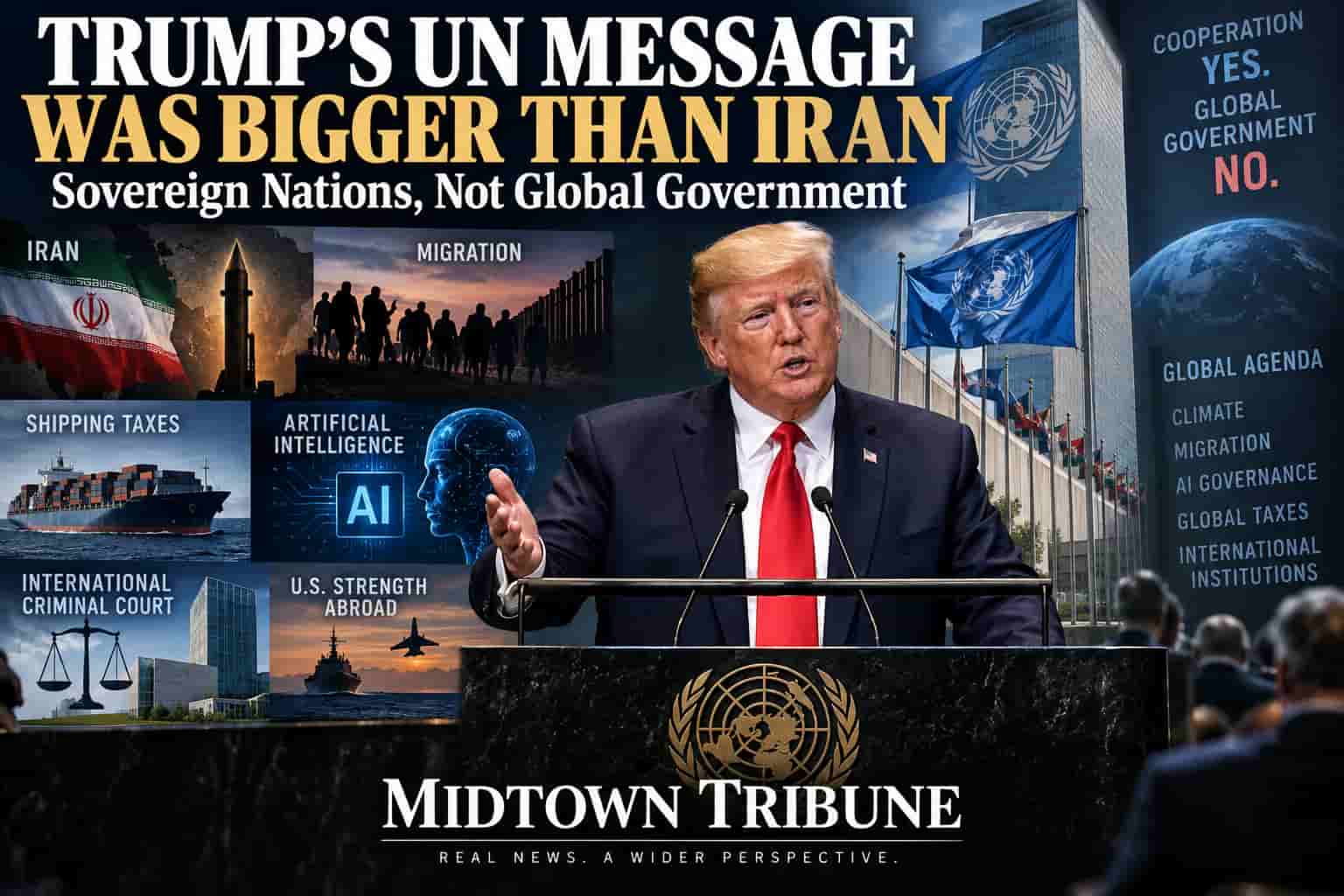
The central theme was national sovereignty: who ultimately has the authority to control borders, impose taxes, regulate emerging technology, use military power and determine the political future of a country.
Trump’s message was not that the United States should withdraw from the world. It was that international cooperation should not evolve into a system in which institutions above the nation-state acquire powers that governments did not directly surrender to them.
That distinction helps explain why migration, a proposed international shipping levy, the International Criminal Court, artificial intelligence and Iran all appeared in the same speech.
The organizing idea: sovereignty
Trump repeatedly returned to the question of whether decisions affecting Americans should ultimately be made by elected national governments or by international institutions.
The clearest formulation came during his criticism of international taxation:
“There is no global government.”
He then said that while he is president there would be no global taxes.
The statement came during his discussion of a proposal being considered through the International Maritime Organization affecting international shipping. The IMO describes its proposed Net-Zero Framework as combining a global fuel standard with a pricing mechanism tied to greenhouse-gas emissions from ships.
This was more than a complaint about one international regulatory proposal.
It established the political framework Trump used for much of the rest of the speech: international organizations may facilitate cooperation between sovereign countries, but in his view they should not become independent sources of governmental authority.
The White House’s official summary of the address similarly described the speech as a rejection of “global control” and a defense of American sovereignty.
That is the administration’s characterization of the speech, rather than an independent conclusion by the United Nations.
Migration was presented as a sovereignty issue
Trump’s treatment of immigration followed the same framework.
In the September 22 UN address, he criticized the United Nations and international institutions for policies he associated with mass migration and argued that nations retain the authority to determine who enters their territory.
His most direct formulation was that there is a right:
“to remain a sovereign nation.”
Whether one agrees with Trump’s broader claims about migration is a separate question.
Analytically, however, the importance of the passage is that he was not presenting immigration only as a crime, employment or border-security issue.
He was placing control of migration inside a larger argument about self-government.
Under that framework, the relevant political question becomes: can an international body establish norms that substantially limit a country’s ability to determine its own immigration policy?
Trump’s answer in the speech was no.
The clash over the future of the United Nations
The contrast with the opening of the 81st General Assembly’s General Debate was unusually sharp.
Earlier in the proceedings, UN Secretary-General António Guterres argued that modern challenges increasingly require international coordination.
Guterres has repeatedly framed war, inequality, climate change and artificial intelligence as international problems requiring multilateral responses through institutions including the United Nations.
Trump did not reject international cooperation itself.
In the same address, he discussed working with other countries and referred positively to some international efforts.
But his model of cooperation was fundamentally different.
The distinction can be summarized this way:
The multilateral model presented by UN leadership emphasizes common international frameworks for problems that cross borders.
Trump’s model emphasizes cooperation among sovereign states while resisting the transfer of core governmental authority above the national level.
That disagreement is broader than any single dispute between Washington and the United Nations.
It is a disagreement over what international institutions should ultimately become.
Artificial intelligence may have been one of the speech’s most consequential sections
One of the least-discussed parts of the address may eventually prove to be one of the most important.
Guterres has made international AI governance a major UN priority.
The Global Digital Compact, adopted by UN member states in 2024, explicitly calls for enhanced international governance of artificial intelligence and for coordination among national and international AI-governance frameworks.
The United Nations subsequently established an Independent International Scientific Panel on Artificial Intelligence and the Global Dialogue on AI Governance.
The first Global Dialogue on AI Governance was held in Geneva on July 6–7, 2026.
At its opening, Guterres argued that AI is transforming economies, work, elections and security, and said governments needed to address that transformation collectively.
Trump used his UN address to draw a different boundary.
According to the White House’s official publication of his remarks, he said:
“The United States totally rejects any attempt to construct a globalist scheme of control for the Artificial Intelligence…”
This exchange exposes a major policy dispute that extends beyond the United Nations.
The question is not simply whether AI should be regulated.
Governments around the world are already regulating or considering regulation of advanced AI systems.
The deeper issue is where regulatory authority should reside.
Should powerful AI systems eventually be governed through internationally negotiated standards and institutions?
Or should sovereign governments retain primary authority and coordinate internationally without transferring ultimate regulatory authority?
Trump placed the United States clearly on the second side of that institutional question in this speech.
Iran was important — but it was not the whole message
Iran received some of the strongest language in Trump’s address.
According to the White House record of the speech, Trump reiterated that he would not allow Iran to obtain a nuclear weapon and presented his administration’s approach as an example of acting against threats before they become more dangerous.
The White House prominently highlighted Iran in its official summary.
But if the speech is reduced to “Trump warns Iran,” much of its broader architecture disappears.
Iran functioned as one example of another recurring Trump argument: governments have an obligation to use national power when they believe essential national interests are threatened.
The same concept appeared in his remarks about the Western Hemisphere, drug cartels and American military power.
The common denominator was again sovereignty — this time the sovereign state’s capacity to protect itself.
Trump was not arguing for isolation
That point matters because sovereignty and isolationism are not synonymous.
Trump explicitly discussed working with other nations.
The White House account quotes him saying:
“Working with many nations in this room, we are solving decades of intractable challenges…”
At the same time, he emphasized the ability of the United States to act independently when the administration believes American interests require it.
The model presented in the speech was therefore not simply:
America versus the world.
It was closer to:
America cooperating with other sovereign nations without accepting a political authority above the American constitutional system.
That distinction changes how several passages in the speech can be understood.
Opposition to an international emissions-pricing system becomes part of the sovereignty argument.
Immigration becomes part of the sovereignty argument.
International AI governance becomes part of the sovereignty argument.
Questions involving the International Criminal Court become part of the sovereignty argument.
And the use of American military power becomes the enforcement side of the same concept.
Two competing visions were visible in the same UN hall
The broader significance of September 22 may therefore lie in the contrast between two models of international order presented during the opening of the 81st UN General Assembly General Debate.
Guterres has argued that increasingly global problems require stronger mechanisms for coordinated international action, including in areas such as artificial intelligence, climate and international security.
The Global Digital Compact provides a concrete example: it calls for international cooperation and greater compatibility among emerging AI-governance frameworks.
Trump argued in his September 22 speech that cooperation must not erase the political independence of the nation-state.
Neither observation requires accepting every factual assertion or policy proposal made by either Trump or UN officials.
But the institutional disagreement itself is important.
As artificial intelligence, migration, climate policy, international taxation and transnational security become increasingly interconnected, the boundary between international cooperation and international governance is likely to remain a major political dispute.
Trump used his 2026 United Nations address to draw his preferred boundary explicitly.
The central message
Seen as a whole, Trump’s speech was therefore larger than Iran, immigration, the United Nations or artificial intelligence considered separately.
Its central argument was that the nation-state — rather than an emerging system of supranational institutions — should remain the primary unit of political authority.
That is why one sentence from the speech is particularly useful for understanding the rest of the address:
“There is no global government.”
The disputes Trump raised were different.
The principle connecting them was the same:
Who governs?
For Trump, the answer presented at the United Nations was the sovereign nation.
Editorial Note
Midtown Tribune distinguishes between statements made by political officials and independently established facts.
Descriptions of President Trump’s positions in this analysis are based primarily on the official White House publication of his September 22, 2026 address and United Nations records concerning the 81st General Assembly.
Descriptions of UN artificial-intelligence policy are based on official United Nations documents, including the Global Digital Compact and materials establishing the Global Dialogue on AI Governance.
Primary Sources
The White House — Office of the President
Donald J. Trump — 45th & 47th President of the United States
The White House — September 22, 2026
President Trump at the United Nations: “While Others Have Talked, I Have Acted”
United Nations General Debate — 81st Session
United States of America — President Donald Trump
United Nations General Assembly — 81st Session
General Debate of the Eighty-First Session of the General Assembly
United Nations General Assembly
High-Level Meetings and General Debate — 81st Session
United Nations — Secretary-General
António Guterres — Official Biography
United Nations — Global Digital Compact
Global Digital Compact — Full Framework
United Nations — Artificial Intelligence Governance
Independent International Scientific Panel on AI and Global Dialogue on AI Governance
United Nations — Global Dialogue on AI Governance
Official Global Dialogue on AI Governance Portal
United Nations — Secretary-General, July 6, 2026
Secretary-General’s Remarks at the Opening of the First Global Dialogue on Artificial Intelligence Governance
International Maritime Organization
The IMO Net-Zero Framework — Official FAQ
International Criminal Court
About the International Criminal Court
Midtown Tribune Independent USA news from New York
Ask Midtown Tribune about this story
Answers are grounded first in this article. Search all Midtown Tribune reporting from the main AI Search page.
AI-generated summary. Verify important details in the linked original articles.