
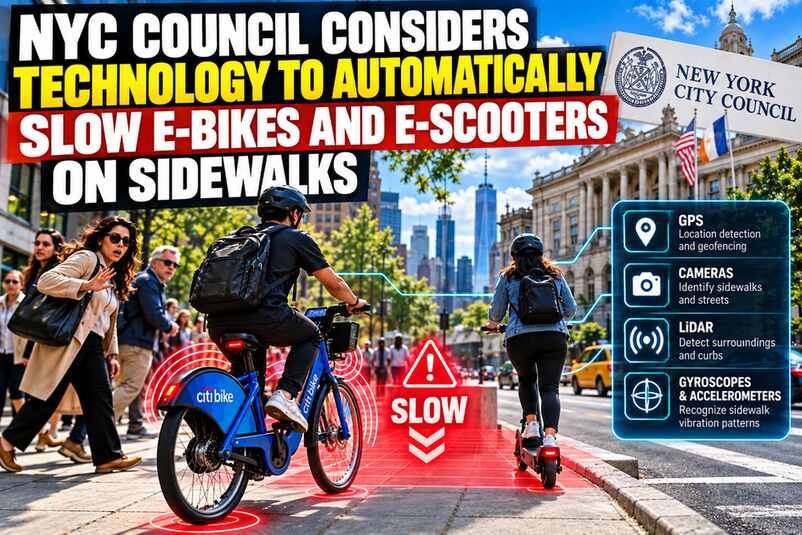
The New York City Council held a major hearing on September 30 examining e-bike and e-scooter safety, including a proposal that would require shared electric bicycles and electric scooters to use technology capable of detecting sidewalk riding and automatically slowing the device to a stop.
The Council reviewed 23 legislative proposals addressing powered micromobility, delivery services, high-speed devices and street safety. The hearing was held jointly by the Committees on Transportation and Infrastructure, Consumer and Worker Protection, and Public Safety.
Official NYC Council announcement:
https://council.nyc.gov/press/2026/09/30/3271/
Official September 30 hearing page:
https://legistar.council.nyc.gov/MeetingDetail.aspx?GUID=0B23AFC5-58EA-43E2-B1D8-2733946D0919&ID=1432073
How Would an E-Bike Know It Is on a Sidewalk?
One of the more technologically significant proposals would require sidewalk riding detection technology on electric bicycles and electric scooters that are part of shared micromobility systems.
The legislation specifically identifies several types of technology that could be used.
Official legislation page:
https://legistar.council.nyc.gov/LegislationDetail.aspx?GUID=199736E6-BAE2-4866-B63B-456AE9D2EEC7&ID=8223676
GPS and Location Technology
The bill permits the use of Global Positioning System, or GPS, and comparable positioning technologies.
A system could determine the location of a bicycle or scooter and compare it with mapped street, bike-lane and sidewalk boundaries.
In practice, this could involve a form of geofencing, where software recognizes that a vehicle has entered a restricted geographic area.
GPS, however, is not the only technology contemplated by the proposal.
LiDAR
The legislation also specifically identifies Light Detection and Ranging, or LiDAR.
LiDAR uses laser pulses to measure distances and create a representation of the surrounding environment.
Such technology could potentially help a vehicle distinguish between roadway space, curbs, pedestrian areas and other elements of the streetscape.
The legislation does not require a particular LiDAR manufacturer or technical implementation.
Camera-Based Detection
Another permitted approach is camera-based detection technology.
A camera combined with image-processing software could potentially identify physical features such as:
- sidewalks;
- curbs;
- bike lanes;
- roadway surfaces;
- pedestrian areas.
The legislation does not specify that a particular artificial-intelligence model must be used. Instead, it allows camera-based systems as one method of detecting sidewalk riding.
Gyroscopes and Accelerometers
The proposal also explicitly allows the use of gyroscopes and accelerometers.
These sensors can detect changes in motion, vibration, tilt and acceleration.
For example, a device moving from a roadway over a curb and onto a sidewalk can experience a recognizable sequence of vibrations and changes in movement.
The bill contemplates technology capable of recognizing patterns of vibration associated with mounting or riding on a sidewalk.
This means the detection system would not necessarily depend on GPS alone. A shared e-bike or scooter could potentially combine multiple sensor inputs to determine whether it has entered a sidewalk.
What Happens After the Sidewalk Is Detected?
The legislation goes beyond simply warning the rider.
Once sidewalk riding is detected, the vehicle would be required to activate a deceleration safety feature.
That feature would gradually reduce the speed of the electric bicycle or scooter until the device comes to a stop.
The restriction would remain in effect until the system determines that the device has completely left the sidewalk.
In simplified form, the system could work like this:
sidewalk detected → automatic speed reduction → gradual stop → normal operation resumes after leaving the sidewalk
The proposal calls for gradual deceleration rather than an immediate locking of the wheels.
Official legislation page:
https://legistar.council.nyc.gov/LegislationDetail.aspx?GUID=199736E6-BAE2-4866-B63B-456AE9D2EEC7&ID=8223676
Would the Rule Apply to Electric Scooters?
Yes.
The legislation specifically covers both:
electric bicycles
and
electric scooters.
However, there is an important limitation.
The requirement applies to devices that are part of self-service share systems.
It does not, in its current form, require every privately owned e-bike or privately owned electric scooter in New York City to be equipped with GPS, cameras, LiDAR or automatic braking technology.
Shared Devices, Not All Privately Owned E-Bikes
The distinction is significant.
The proposal targets operators of shared micromobility systems.
If enacted in its present form, a share-system owner or operator would be responsible for installing and maintaining sidewalk-detection and deceleration technology on covered devices.
Private owners would not automatically be subject to the same equipment mandate.
Operators Would Have to Maintain the Technology
The proposal would require share-system operators not only to install the equipment but also to keep the sidewalk-detection and deceleration systems operational.
The legislative text provides no civil penalty for a first violation, while subsequent violations within a two-year period could result in civil penalties of up to $1,000.
The legislation provides for implementation one year after enactment.
Official bill page:
https://legistar.council.nyc.gov/LegislationDetail.aspx?GUID=199736E6-BAE2-4866-B63B-456AE9D2EEC7&ID=8223676
The Proposal Is Not Yet Law
The September 30 proceeding was a legislative and oversight hearing.
The proposed automatic sidewalk-detection system has not yet become a citywide operating requirement.
The Council said testimony from city agencies, delivery workers, e-bike users, pedestrians and other stakeholders would help determine which parts of the legislative package move forward.
A Much Broader E-Bike Safety Package
The sidewalk-detection proposal was only one part of a much larger package.
The Council also examined legislation dealing with:
- Class 3 e-bikes;
- illegal high-powered micromobility devices;
- licensing and oversight of delivery services;
- delivery-worker safety;
- enforcement technology;
- micromobility crash reporting;
- trade-in programs for higher-powered e-bikes.
One proposal would require the NYPD, working with the Department of Transportation, to use micromobility dynamometers to test motor wattage and maximum assisted speed when police have probable cause to believe a device is illegal.
Another proposal would establish a trade-in program for Class 3 and other higher-powered devices, with a participation goal of at least 10,000 trade-ins, subject to demand and retailer participation.
The Council also considered legislation that would require third-party delivery services to use tracking technology to detect certain unsafe behaviors by delivery workers and issue real-time notifications.
Why the Council Is Acting
According to the City Council, the first six months of 2026 saw 738 injuries and 13 fatalities involving e-bike riders, compared with 601 injuries and 10 fatalities during the same period in 2025.
The Council also estimates that approximately 65,000 delivery workers use e-bikes and other micromobility devices in New York City.
Current city rules impose a 15 mph operating speed limit on e-bikes, e-scooters and pedal-assist commercial bicycles in New York City.
The Council notes that this operating limit is separate from New York State’s classifications based on the maximum speed at which an electric motor can provide assistance.
The Technology Could Change How Sidewalk Rules Are Enforced
The most significant aspect of the sidewalk-detection proposal is that enforcement would no longer depend entirely on police officers observing a violation.
Part of the enforcement mechanism would effectively be built into the vehicle itself.
The legislation allows systems based on:
- GPS and related positioning technology;
- LiDAR;
- cameras;
- gyroscopes;
- accelerometers;
- detection of vibration patterns associated with sidewalk riding.
If a shared e-bike or electric scooter determines that it is being operated on a sidewalk, the vehicle could automatically reduce its speed until it stops.
For now, however, this remains a legislative proposal rather than an operating requirement for all New York City micromobility devices.
Official Sources
New York City Council — September 30 E-Bike Legislative Hearing
https://council.nyc.gov/press/2026/09/30/3271/
NYC Council Legistar — Sidewalk Riding Detection Technology for E-Bikes and E-Scooters
https://legistar.council.nyc.gov/LegislationDetail.aspx?GUID=199736E6-BAE2-4866-B63B-456AE9D2EEC7&ID=8223676
NYC Council — September 30 Transportation and Infrastructure Hearing
https://legistar.council.nyc.gov/MeetingDetail.aspx?GUID=0B23AFC5-58EA-43E2-B1D8-2733946D0919&ID=1432073
New York City Council — Initial Announcement of E-Bike and E-Scooter Safety Review
https://council.nyc.gov/press/2026/08/04/3202/
Midtown Tribune Independent USA news from New York
Ask Midtown Tribune about this story
Answers are grounded first in this article. Search all Midtown Tribune reporting from the main AI Search page.
AI-generated summary. Verify important details in the linked original articles.