
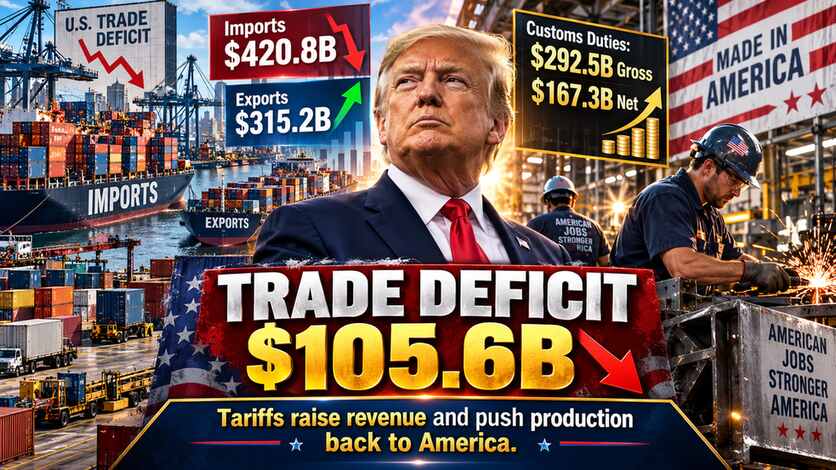
The U.S. trade deficit widened sharply in August 2026 to $105.6 billion as imports reached a record $420.8 billion. At the same time, President Donald Trump’s tariff policy has generated extraordinarily large customs collections and is designed to make imported goods relatively more expensive, creating an economic incentive for companies to build, expand and relocate production in the United States.
The United States imported a record amount of goods and services in August, pushing the monthly trade deficit sharply higher despite the Trump administration’s extensive tariff regime.
The Bureau of Economic Analysis and U.S. Census Bureau reported that the U.S. goods and services deficit reached:
$105.6 billion in August 2026
That was up from a revised $92.8 billion in July, an increase of approximately:
$12.7 billion, or 13.7%.
The reason was straightforward:
Imports grew much faster than exports.
According to federal data, total imports rose 4.3% to a record:
$420.8 billion
Exports increased 1.4% to:
$315.2 billion
The difference produced the $105.6 billion monthly deficit.
Goods Deficit Reached $136.6 Billion
The imbalance was even larger in trade in physical goods.
Imports of goods reached approximately:
$342.2 billion
while goods exports were about:
$205.7 billion.
That produced a goods deficit of roughly:
$136.6 billion
A U.S. services surplus of approximately $31 billion offset part of that gap.
The August increase was driven in part by stronger imports of industrial supplies, crude oil, semiconductors, capital goods and other equipment.
Tariffs Are About More Than Revenue
The tariff debate is often reduced to one question:
How much money is the federal government collecting?
But that is only one part of the policy.
Tariffs are also intended to change the economic calculation facing businesses.
When the government places a tariff on an imported product, that product becomes more expensive relative to goods made domestically.
That can narrow the cost advantage of foreign production.
The result is an economic incentive for companies to:
- build factories in the United States;
- expand existing U.S. plants;
- move production lines from overseas;
- source more components from American suppliers;
- shorten international supply chains.
In other words, tariffs are designed not only to collect money at the border, but also to make domestic production more competitive.
The Office of the U.S. Trade Representative has repeatedly described the administration’s policy in those terms — using tariffs and other trade measures to encourage companies to invest and manufacture on American soil.
Do Tariffs “Force” Manufacturing Back to America?
The more precise word is incentivize rather than force.
A tariff does not physically require a company to open a factory in the United States.
But it changes the economics.
If a company previously manufactured a product overseas because production there was significantly cheaper, a tariff can reduce or eliminate that cost advantage.
At that point, the company may decide that producing in the United States makes more financial sense.
That effect becomes stronger when tariffs are combined with:
- tax incentives;
- lower energy costs;
- faster permitting;
- federal procurement preferences;
- domestic-content requirements;
- investment incentives;
- access to the U.S. consumer market.
The administration’s broader industrial strategy is therefore based on more than tariffs alone.
But tariffs are one of the principal mechanisms used to shift investment decisions toward the United States.
Historical Examples
There are precedents for tariffs influencing where companies manufacture products.
During earlier rounds of U.S. tariffs, several major companies increased domestic production.
The Office of the U.S. Trade Representative has pointed to the washing-machine tariffs imposed in 2018 as one example.
Samsung and LG expanded U.S. production capacity after the trade measures increased the cost of imported machines.
USTR has also cited cases in which international manufacturers announced new U.S. investment while explicitly referring to the changing tariff environment.
Those examples do not prove that every tariff creates a new factory.
But they do show the mechanism the administration is trying to reproduce on a much larger scale.
So Why Are Imports Still at a Record High?
This is where the August figures become especially interesting.
If tariffs are supposed to encourage American production, why did imports rise to a record $420.8 billion?
Because restructuring industrial supply chains takes time.
A company can increase imports immediately.
Building a new factory can take years.
Before a manufacturer can shift production to the United States, it may need to:
- purchase land;
- secure permits;
- construct manufacturing facilities;
- install machinery;
- find suppliers;
- hire and train employees;
- establish logistics networks.
That means tariffs can create an incentive to relocate production long before the trade statistics begin to reflect that shift.
There is also another factor.
Much of the recent increase in imports involves capital goods, industrial equipment, semiconductors and other products connected to business investment.
Some of those imports may actually be used to build new productive capacity inside the United States.
For example, a company constructing a new American factory may initially import specialized machinery from overseas.
That raises imports in the short term while potentially increasing domestic production in the longer term.
How Much Revenue Have Tariffs Generated?
At the same time, the tariff system has generated enormous federal revenue.
Treasury budget data show that through the end of August 2026, the federal government had collected approximately:
$292.5 billion in gross customs duties
That number, however, requires an important qualification.
The government also issued approximately:
$125.2 billion in refunds
That reduced net customs receipts to roughly:
$167.3 billion
So it would be misleading to say tariffs produced $292.5 billion in net federal revenue.
The more accurate description is:
$292.5 billion was collected on a gross basis, while approximately $167.3 billion remained after refunds.
Why Were Refunds So Large?
A major reason is the legal fight over the administration’s tariff authority.
Some tariffs imposed under emergency economic powers faced successful court challenges.
As a result, the federal government has had to refund significant amounts of previously collected duties.
That explains the unusually large gap between gross and net customs revenue.
It also shows why tariff revenue figures must be presented carefully.
A government can collect a tariff first and later be required to return part of that money.
For Comparison: 2025 Customs Revenue
Federal financial statements show that customs duties totaled approximately:
$210.3 billion for the full 2025 fiscal year
The 2026 figures therefore demonstrate how dramatically tariff collections have increased under the administration’s expanded trade measures.
However, comparisons between different years should distinguish between gross collections and net receipts after refunds.
The Trade Deficit and Tariff Revenue Measure Different Things
It is important not to confuse the trade deficit with federal revenue.
The trade deficit measures the difference between what the United States imports and what it exports.
Customs duties are direct payments collected by the federal government on imported products.
The country can therefore run a large trade deficit and still collect substantial tariff revenue.
That is precisely what is happening now.
The United States imported far more than it exported in August.
At the same time, the federal government collected very large amounts of money from those imports.
The Short-Term Paradox
The current situation can look contradictory:
Imports are at a record high.
Tariff revenue is extremely high.
The administration says tariffs are bringing manufacturing back.
All three statements can be true at the same time.
The explanation is largely timing.
Tariffs affect investment decisions immediately, but industrial relocation takes much longer.
A company may announce a U.S. factory today and not begin production for two or three years.
During that transition, imports can remain high.
The Longer-Term Test
The real test of the tariff strategy will not be whether one month produces a large trade deficit.
The more important questions are:
- Are companies building more factories in the United States?
- Is domestic manufacturing capacity increasing?
- Are U.S. supply chains becoming less dependent on foreign producers?
- Is business investment moving toward American production?
- Are manufacturing jobs increasing?
- Does import growth slow once new domestic capacity comes online?
Those trends matter more than any single monthly trade number.
But the Year-to-Date Picture Already Looks Better
The August monthly deficit does not tell the entire story.
According to BEA data, through the first eight months of 2026, the overall U.S. goods and services deficit was approximately:
$138.2 billion lower than during the same period in 2025
That represents an improvement of nearly:
20%
Exports over that period increased by approximately:
$267.7 billion, or 11.8%.
Imports increased by:
$129.5 billion, or 4.4%.
So while August produced a sharp deterioration, the cumulative trade picture for the year remained significantly better than a year earlier.
That distinction matters.
One weak month does not prove the broader trade strategy has failed.
Who Actually Pays the Tariff?
Another point frequently misunderstood in political debate is who directly pays tariffs.
The payment to the U.S. government is made by the American importer.
But that does not mean the importer necessarily absorbs the entire cost.
The economic burden can be distributed across the supply chain.
For example:
- the foreign producer may reduce its price;
- the American importer may accept a lower profit margin;
- retailers may raise prices;
- consumers may pay part of the additional cost.
The final effect depends on competition, supply and demand, and the ability of companies to substitute domestic products.
Tariffs Can Become Stronger as Domestic Alternatives Expand
The effectiveness of tariffs as an industrial policy can also change over time.
If there is no American manufacturer capable of producing a particular product, importers have little choice but to continue buying abroad and paying the tariff.
But if domestic production expands, companies have more alternatives.
At that point, the tariff can become more powerful because businesses can shift orders from foreign suppliers to U.S. manufacturers.
This is why the administration’s manufacturing strategy depends on tariffs working together with investment in domestic capacity.
The Bigger Economic Picture
The latest numbers show why the tariff debate cannot be reduced to a simple question of whether tariffs “work” or “do not work.”
Several things can happen simultaneously.
The United States can:
- collect historically large amounts of customs revenue;
- make imported goods less price-competitive;
- encourage companies to invest in American plants;
- pressure foreign manufacturers to establish U.S. operations;
- gain leverage in trade negotiations;
- and still continue importing record quantities of foreign goods during the transition.
That is what the current data appear to show.
Bottom Line
The U.S. trade deficit surged to:
$105.6 billion in August
Imports reached a record:
$420.8 billion
Exports totaled:
$315.2 billion
At the same time, Treasury had collected approximately:
$292.5 billion in gross customs duties through August 2026
After approximately $125.2 billion in refunds, net customs receipts were around:
$167.3 billion
But tariff policy is not only about those revenues.
Its broader objective is to change the economics of production.
By making imported goods relatively more expensive, tariffs create an incentive for companies to:
build, expand and relocate manufacturing in the United States.
That process does not happen overnight.
The August import record shows that America remains heavily dependent on foreign production.
The year-to-date improvement in the trade deficit, rising customs revenue and new domestic investment will therefore need to be watched together.
The real question is not simply whether America imports too much today.
It is whether the tariff strategy ultimately changes where tomorrow’s factories are built.
Official and Primary Sources
U.S. Bureau of Economic Analysis — U.S. International Trade in Goods and Services, August 2026
https://www.bea.gov/news/2026/us-international-trade-goods-and-services-august-2026
U.S. Bureau of Economic Analysis — International Trade in Goods and Services
https://www.bea.gov/data/intl-trade-investment/international-trade-goods-and-services
U.S. Department of the Treasury — Monthly Treasury Statements
https://fiscal.treasury.gov/reports-statements/mts/
U.S. Department of the Treasury — Financial Report of the U.S. Government
https://fiscal.treasury.gov/reports-statements/financial-report/
Office of the U.S. Trade Representative — Manufacturing and Tariff Policy
https://ustr.gov/
Reuters — U.S. Trade Deficit Widens in August Amid Strong Imports
https://www.reuters.com/business/us-trade-deficit-widens-august-amid-strong-imports-2026-10-06/
Reuters — U.S. Budget Deficit, Customs Receipts and Refunds
https://www.reuters.com/markets/us/us-budget-deficit-shrinks-august-year-to-date-flat-197-trillion-2026-09-11/
Midtown Tribune Independent USA news from New York
Ask Midtown Tribune about this story
Answers are grounded first in this article. Search all Midtown Tribune reporting from the main AI Search page.
AI-generated summary. Verify important details in the linked original articles.