
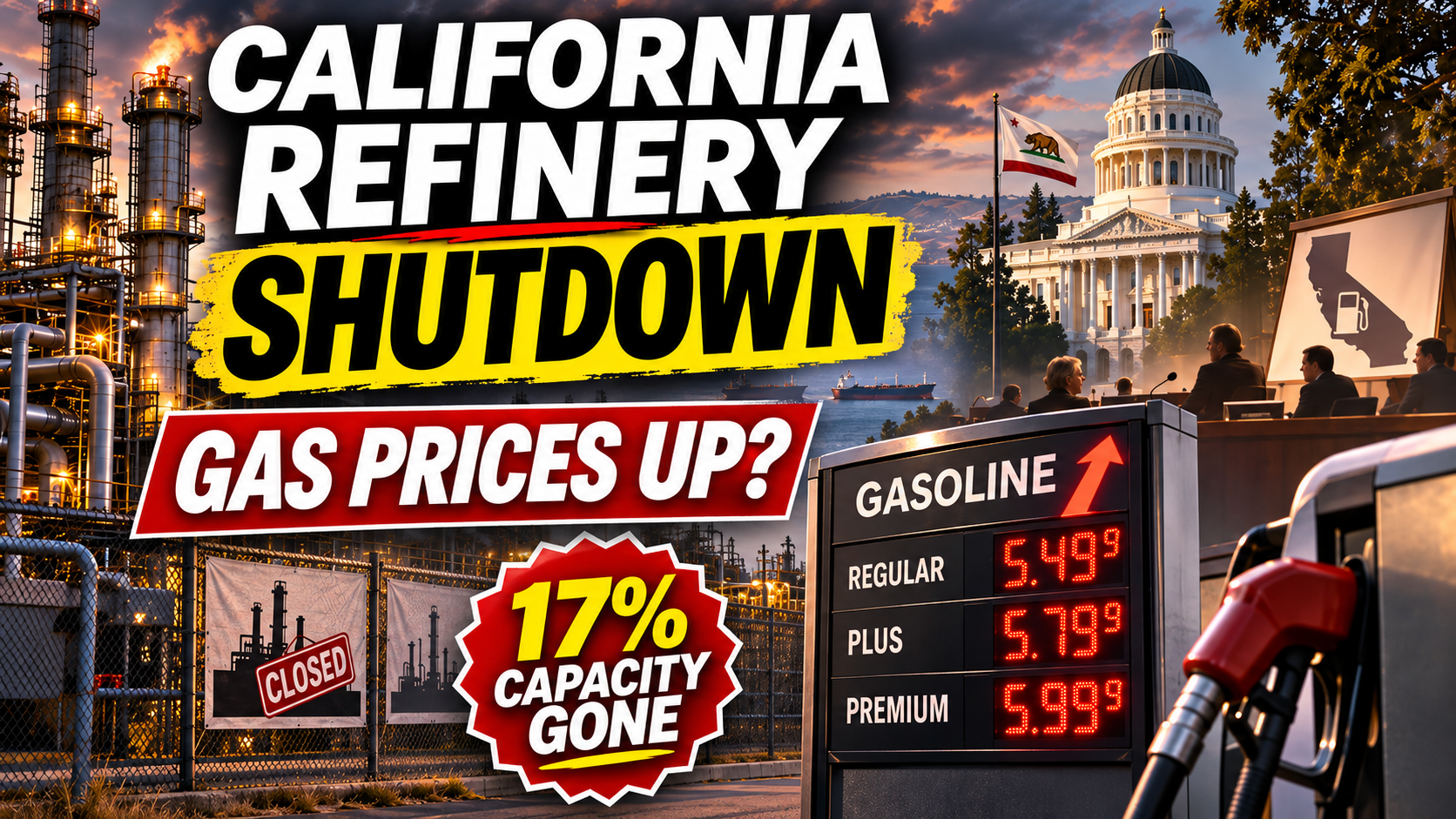
Two major California refineries have stopped processing crude oil. State lawmakers, including Democrats, warned about higher gasoline prices, growing dependence on imports, and the economic consequences. Could Governor Gavin Newsom’s policies have contributed to the closures — and is there evidence of a political strategy targeting President Donald Trump?
November 13, 2026 | Midtown Tribune | U.S. Politics & Economy
California has lost two major oil refineries in less than a year.
Phillips 66 stopped processing crude oil at its Los Angeles-area refinery in October 2025. Valero completed the shutdown of refining operations at its Benicia facility in April 2026.
Together, the facilities represented approximately 284,000 barrels per day of refining capacity — roughly 17% of California’s total capacity at the beginning of 2025.
What makes this story particularly important is that government officials were warned about the potential consequences before both facilities had shut down.
Those warnings did not come exclusively from Republicans or oil industry executives.
Democratic lawmakers also publicly questioned California’s energy regulators about the risk of higher gasoline prices, lost jobs, and increased dependence on imported fuel.
That raises an important question: Did California’s government adequately prepare for the consequences of its own energy policies?
And what evidence, if any, supports the suggestion that these policies were intended to damage President Donald Trump politically?
Two Refineries Shut Down: What Actually Happened?
On October 16, 2024, Phillips 66 announced plans to cease operations at its Los Angeles-area refinery.
The facility had a crude oil processing capacity of approximately 139,000 barrels per day.
The company cited uncertainty surrounding the refinery’s long-term economic viability and changing market conditions.
Refining operations ended in October 2025.
Valero announced in April 2025 that it intended to stop processing crude oil at its Benicia refinery in Northern California.
The facility, with approximately 145,000 barrels per day of capacity, began winding down operations in early 2026 and completed the shutdown in April.
Together, the closures removed roughly 284,000 barrels per day of nominal refining capacity.
The U.S. Energy Information Administration (EIA) estimated that the two refineries accounted for approximately 17% of California’s refining capacity as of the beginning of 2025.
That figure represents lost processing capacity, not necessarily a 17% reduction in gasoline actually available to consumers.
Other refineries can adjust production, while imports can replace some lost domestic supply.
Nevertheless, losing that much local capacity changes the structure and resilience of California’s fuel market.
What Did Governor Newsom’s Administration Know?
The risks were not discovered after the refineries closed.
On July 9, 2025, the EIA published an analysis warning that California’s refinery closures could increase gasoline price volatility along the West Coast.
Even earlier, on June 27, 2025, the California Energy Commission submitted a formal response to Governor Gavin Newsom concerning refinery capacity and future fuel supplies.
The commission warned that replacing locally refined gasoline with imported fuel could introduce additional costs, logistical challenges, and exposure to global supply disruptions.
California’s gasoline market is particularly vulnerable because it is geographically isolated from major refining centers elsewhere in the United States.
Unlike many other states, California cannot simply receive large quantities of gasoline through existing pipelines from Gulf Coast refineries.
The state also requires specialized gasoline formulations to meet its environmental standards.
As a result, replacing local production often requires marine shipments, additional planning, and sufficient port infrastructure.
The central fact is that California’s own energy authorities identified these vulnerabilities before the refinery shutdowns were completed.
That establishes advance knowledge of the risks. It does not, by itself, establish an intention to raise gasoline prices.
California Democrats Warned About $10 Gasoline
On May 28, 2025, the California State Assembly Committee on Utilities and Energy held an oversight hearing examining the state’s oil refining industry.
The hearing featured officials from the California Energy Commission, California Air Resources Board, and the Department of Petroleum Market Oversight.
A KCRA 3 News report by Capitol correspondent Ashley Zavala documented increasingly pointed questions from lawmakers.
Assemblymember Cottie Petrie-Norris warned against a future in which gasoline could reach $10 per gallon.
Democratic Assemblymember David Alvarez raised concerns that state regulatory decisions might have contributed to the very crisis officials were now attempting to manage.
His remarks reflected a broader concern among lawmakers: Had California’s regulatory agencies sufficiently considered the effects of their policies on drivers, workers, and businesses?
These were warnings about possible future outcomes, not claims that gasoline had already reached $10 per gallon.
Importantly, criticism of the state’s approach crossed party lines.
The Import Problem: More Tankers, More Emissions?
The hearing exposed an additional complication in California’s energy strategy.
Officials acknowledged that as local refinery capacity declines, California may need to rely more heavily on imported petroleum products.
That is especially significant for Northern California following the closure of Valero’s Benicia refinery.
Assemblymember Mike Gipson questioned officials about the environmental consequences of increasing marine transportation.
If gasoline previously refined in California must instead arrive on additional ships, would that create more emissions from maritime traffic?
California Air Resources Board officials acknowledged that additional shipping could produce environmental impacts beyond state waters, where California regulators have limited authority.
The situation presents a legitimate policy dilemma.
California aims to reduce pollution associated with petroleum production and consumption.
Yet while millions of residents continue driving gasoline-powered vehicles, reducing in-state refining can shift part of the environmental burden to other jurisdictions.
Fuel may have to be refined elsewhere and transported over longer distances.
That does not automatically mean total emissions will increase.
A scientifically sound comparison would require accounting for emissions from crude oil production, refining, shipping, distribution, and final consumption.
Nevertheless, lawmakers were justified in examining whether environmental policy was shifting pollution rather than eliminating it.
Why Did Phillips 66 and Valero Decide to Leave?
It would be inaccurate to attribute both refinery shutdowns to a single regulation or political decision.
Oil refining is capital-intensive.
Companies must invest in maintenance, environmental compliance, equipment upgrades, worker safety, and modernization.
Their long-term business decisions depend on expected profitability, future fuel demand, crude oil prices, regulatory costs, and competition.
Phillips 66 announced its Los Angeles closure on October 16, 2024 — two days after Governor Newsom signed AB X2-1, legislation intended to expand the state’s ability to address fuel supply disruptions and price spikes.
The timing attracted political attention.
However, the EIA reported comments from Phillips 66 CEO Mark Lashier indicating that the closure was not a direct response to a specific recent California law.
Instead, the company expected the state’s refining environment to become increasingly challenging over time.
This distinction matters.
The announcement’s timing alone does not prove that the October 2024 law caused the refinery to close.
But the cumulative impact of California’s energy policies and regulatory requirements remains a legitimate subject for economic examination.
California’s Own Numbers Reveal a Structural Challenge
The California Energy Commission has acknowledged that gasoline demand is declining as transportation technology changes.
More efficient vehicles, electric cars, and evolving consumer behavior are gradually reducing demand for petroleum-based transportation fuels.
However, refinery capacity can disappear faster than demand falls.
In a 2025 analysis, the commission estimated that gasoline production capacity would decline by approximately 30% between 2019 and 2026, accounting for refinery closures and conversions.
Projected gasoline demand was expected to fall by roughly 17% over a comparable period.
That difference matters.
If local refining capacity contracts more quickly than fuel consumption, California must find alternative sources of supply.
Imports can help meet demand, but they also expose consumers to shipping costs, delays, global disruptions, and the availability of compatible fuel.
The result is not necessarily a shortage.
It is a market with greater dependence on outside suppliers.
Could California Have Prevented the Closures?
The available evidence does not establish that state officials could have kept both refineries operating indefinitely.
That would require knowing the financial conditions under which Phillips 66 and Valero might have continued production.
Those conditions include future capital investments, operating costs, regulatory compliance expenses, expected returns, and long-term gasoline demand.
However, a narrower question deserves investigation:
Did California prepare quickly and effectively enough to replace the refining capacity it knew was disappearing?
The official record provides reasons to examine that question.
In June 2025, the California Energy Commission warned about import limitations and potential supply challenges.
By January 2026, Governor Newsom’s office announced arrangements intended to maintain Valero’s fuel supplies to Northern California following the shutdown of refining operations at Benicia.
Those arrangements demonstrate that state officials took at least some steps to manage the transition.
Whether those measures were adequate must be judged by actual fuel availability, import volumes, inventories, and consumer prices.
What Happened to Gas Prices?
California has historically experienced higher gasoline prices than many other states.
The reasons include state taxes, specialized fuel requirements, logistics, operating costs, and the structure of the regional market.
According to California Energy Commission figures, the state’s average retail gasoline price reached approximately $5.46 per gallon in August 2026.
However, attributing that entire price — or even a specific share of it — to the two refinery closures would be misleading.
Global oil prices, the conflict involving Iran, transportation disruptions, seasonal fuel requirements, and other economic factors also affected energy markets.
To determine how much the closures increased gasoline prices, researchers would need to compare actual market outcomes with a credible counterfactual scenario in which both refineries remained operational.
Without that analysis, the precise price impact cannot be established.
Did Newsom’s Energy Policies Have a Political Purpose Against Trump?
The political theory deserves a chronological examination.
October 16, 2024: Phillips 66 announced plans to close its Los Angeles refinery.
November 5, 2024: Donald Trump won the presidential election.
April 2025: Valero announced plans to stop refining operations at Benicia.
May–July 2025: California lawmakers and federal energy analysts raised concerns about fuel supplies and potential price increases.
October 2025: Phillips 66 ceased refining operations in Los Angeles.
April 2026: Valero completed the shutdown of its Benicia refining units.
This timeline creates a problem for the claim that the closures were designed to prevent Trump’s November 2024 reelection.
Both refineries stopped processing crude oil after he had already won that election.
Moreover, Trump won presidential elections in 2016 and 2024. Under the Twenty-Second Amendment to the U.S. Constitution, he cannot be elected president for a third term.
There is a broader political question: Could higher gasoline prices or economic difficulties influence public perceptions of the Trump administration or congressional elections?
Economic conditions can affect political debates. However, this general possibility does not establish that California’s governor deliberately engineered refinery shutdowns for partisan electoral purposes.
To demonstrate such an intention, investigators would need direct evidence, such as internal communications, policy documents, testimony, or other records showing that political damage to Trump was an objective.
The official materials reviewed for this article do not establish that motive.
The stronger, document-supported issue concerns government accountability for foreseeable economic consequences.
What Should California Officials Explain?
Several questions remain relevant to a public review of the state’s refinery closures.
- What economic impact assessments were conducted before major changes to petroleum industry regulations?
- How did cumulative regulatory costs affect the long-term viability of aging California refineries?
- What alternatives were considered to preserve refining capacity during the energy transition?
- How much did California’s dependence on imported gasoline increase after the closures?
- What additional transportation and infrastructure costs resulted?
- How did refinery closures affect fuel inventories, price volatility, and supply reliability?
- What portion of subsequent gasoline price changes can be directly attributed to lost in-state production?
These questions can be investigated through company filings, agency records, legislative oversight, and market data.
They also provide a more reliable basis for judging the state’s energy policy than unverified claims about political intentions.
Conclusion: The Warnings Came Before the Closures
California’s experience illustrates the challenges of managing a major energy transition.
The Newsom administration openly pursued policies designed to reduce dependence on petroleum fuels and encourage cleaner transportation.
At the same time, millions of Californians continued to depend on gasoline-powered vehicles.
Federal energy experts warned that refinery shutdowns could increase price volatility.
Democratic and Republican lawmakers questioned the effect of state regulations on fuel supplies, jobs, and household expenses.
Energy officials acknowledged that California would need additional imported fuel.
The documented issue is not proof of a secret plan to undermine President Trump. It is that California pursued its energy transition while officials and lawmakers were warning about the risks of losing a substantial share of the state’s domestic refining capacity.
The consequences should now be evaluated against measurable results: fuel prices, supply reliability, environmental outcomes, infrastructure investments, and costs to consumers.
For California families, the practical question remains straightforward:
Will gasoline remain reliably available and affordable while the state moves toward a different energy future?
Video: California Lawmakers Question Refinery Closures
KCRA 3 News — Ashley Zavala, May 28, 2025
The report shows California lawmakers questioning energy regulators about refinery closures, possible gasoline price increases, growing reliance on fuel imports, and environmental consequences.
Official Sources
- Phillips 66 — Los Angeles Refinery Closure Announcement, October 16, 2024
- Phillips 66 — SEC Form 8-K
- Valero — SEC Filing, Third Quarter 2026
- EIA — California Refinery Closures May Increase Gasoline Price Volatility
- EIA — California Refinery Closures and Regulation
- California Legislature — May 28, 2025 Oversight Hearing
- California Energy Commission — June 27, 2025 Letter to Governor Newsom
- California Energy Commission — What Drives California’s Gasoline Prices?
- California Energy Commission — Gasoline Price Breakdown and Margins
- Governor Gavin Newsom’s Office — Valero Benicia Refinery Update, January 6, 2026
- National Archives — U.S. Constitution, Twenty-Second Amendment
Ask Midtown Tribune about this story
Answers are grounded first in this article. Search all Midtown Tribune reporting from the main AI Search page.
AI-generated summary. Verify important details in the linked original articles.