
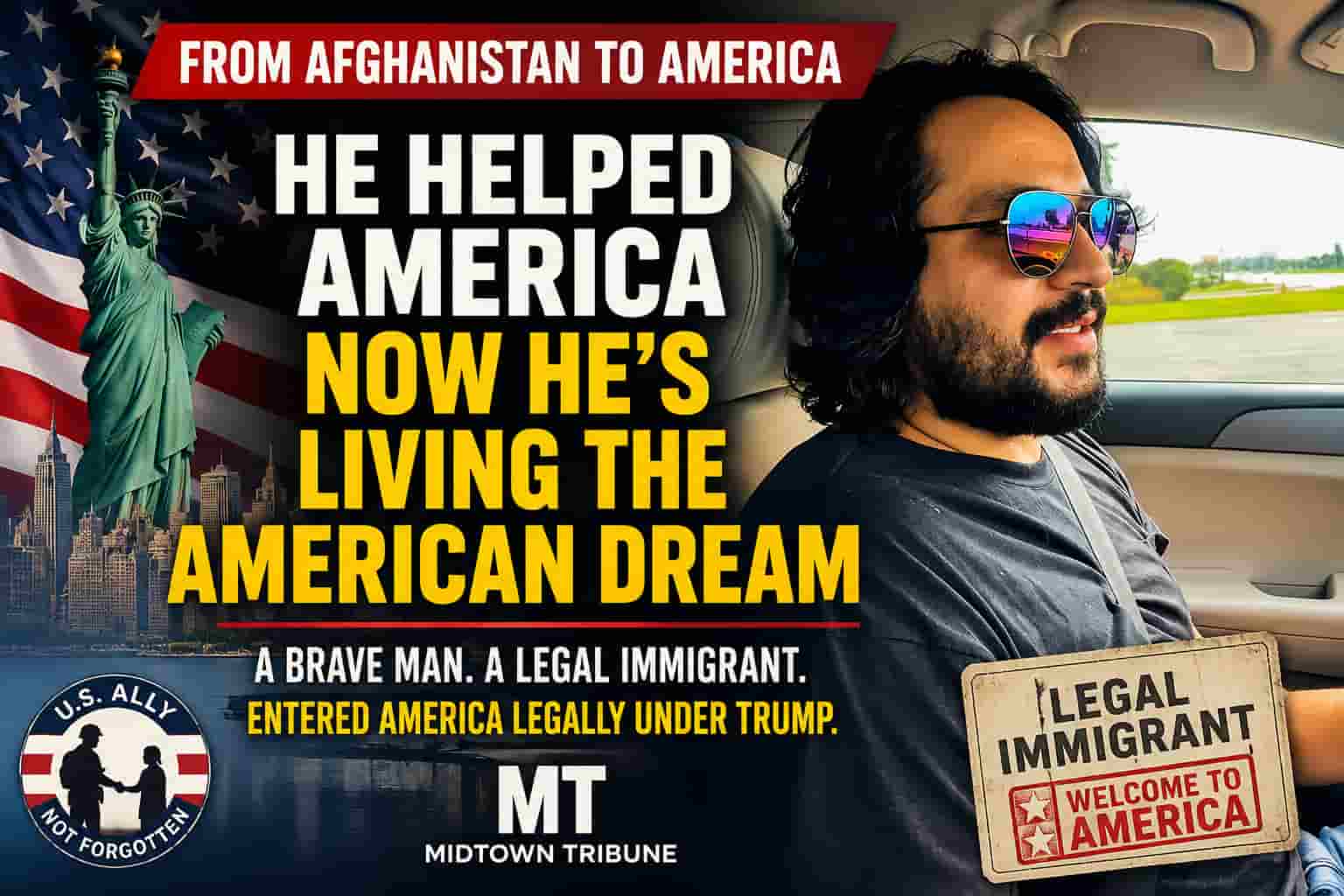
An Afghan man who says he worked for the U.S. government, spent years hiding from the Taliban and eventually reached America through the Special Immigrant Visa program is offering a powerful example of what legal immigration can look like — but the full government record also makes the political story more complicated.
A chance conversation during a ride to the airport turned into an unexpected immigration story for retired U.S. Navy Captain Gary Yuri Tabach.
In a video interview recorded inside the vehicle, Tabach speaks with his driver, an Afghan immigrant who says he arrived in the United States roughly a year ago with his family after obtaining a Special Immigrant Visa, or SIV, based on his work for the United States in Afghanistan.
The man says that today he is working, attending school and raising his family in America.
“Right now, this is my home. It’s my country,” he tells Tabach in the video.
One of his daughters, he adds, was born in the United States.
For Tabach, himself an immigrant who later served in the U.S. military, the encounter became an example of the distinction he draws between legal immigration and illegal entry.
But beyond the political argument, the driver’s account closely resembles a real immigration pathway established specifically for Afghan nationals who provided qualifying service to the United States.
He Says He Worked for America in Afghanistan
The driver identifies himself as originally from Herat, Afghanistan, and says he worked for the U.S. government before the Taliban returned to power.
At one point early in the conversation he says he “came from Iraq.” Later, however, he makes the sequence clear: he is Afghan, left Afghanistan for Iraq, obtained his U.S. visa there, and then traveled from Iraq to the United States.
That detail is consistent with the realities facing Afghan SIV applicants after the U.S. Embassy in Kabul suspended operations on August 31, 2021. The State Department currently tells Afghan applicants that visa interviews must take place outside Afghanistan.
According to the driver, he applied for a Special Immigrant Visa and waited approximately four years.
During part of that period, he says, he was hiding from the Taliban and repeatedly changing locations with his wife and child.
“I change my location every two months, or sometimes three months and sometimes six months,” he says.
Eventually, he says, he received the necessary approval, obtained permission to travel to Iraq, went to a U.S. diplomatic post there and received his visa.
Midtown Tribune has not independently reviewed the man’s SIV file, employment records or immigration documents, so his individual history remains based on his statements in the interview.
The pathway he describes, however, is real.
What Is an Afghan Special Immigrant Visa?
The Afghan SIV program is not the same as simply crossing the border and later requesting permission to stay.
Under State Department rules, qualifying applicants must establish, among other requirements, that they are Afghan nationals and performed qualifying employment in Afghanistan for or on behalf of the U.S. government, or qualifying international forces, for at least 12 months. They must also demonstrate “faithful and valuable service,” supported by documentation and a recommendation.
The modern program traces back to the Afghan Allies Protection Act of 2009, and Congress repeatedly expanded it under both Republican and Democratic administrations.
In March 2024 alone, Congress authorized 12,000 additional Afghan SIV numbers.
That makes the driver’s story important for another reason: he was not describing a loophole. He was describing a congressionally authorized immigration category created for people whose work with the United States could place them and their families in danger.
He Arrived During the Trump Administration
The driver says he entered the United States while Donald Trump was president.
That claim is significant because the Trump administration’s immigration restrictions did not initially treat Afghan SIV recipients the same way as ordinary Afghan visa applicants.
When the administration imposed new restrictions affecting Afghanistan in June 2025, the State Department specifically listed Afghan Special Immigrant Visas as an exception.
Therefore, an Afghan SIV recipient entering the United States legally during that period would have been consistent with the administration’s published policy.
That supports an important part of Tabach’s broader point: a tough immigration policy and legal admission of vetted Afghan allies were not necessarily mutually exclusive.
An administration could restrict broader immigration categories while still admitting people who had qualified through a special legal program based on their service to the United States.
Afghanistan 2021: Trump Set the Course; Biden Executed the Final Exit
The distinction between planning a military withdrawal and executing the disastrous final withdrawal of August 2021 is essential.
President Donald Trump did seek to end America’s long military involvement in Afghanistan. His administration negotiated the 2020 agreement with the Taliban and substantially reduced the number of American troops in the country.
But the official record does not show that Trump planned the chaotic evacuation that Americans witnessed in August 2021.
In fact, the Pentagon’s final public statement on Afghanistan troop levels during the Trump administration said something considerably different.
On January 15, 2021, Acting Defense Secretary Christopher Miller announced that U.S. forces had been reduced to 2,500. He said commanders still had the forces needed to protect American interests, continue counterterrorism operations and support Afghan security forces.
Most importantly, Miller stated that although the Pentagon was planning for the possibility of reducing troop levels to zero, future withdrawals remained conditions-based.
That was the position inherited by the Biden administration.
Biden Made the Decision to Go to Zero
On April 14, 2021, President Joe Biden made his own presidential decision: all remaining U.S. troops would leave Afghanistan.
The Pentagon’s announcement was explicit. Biden ordered the withdrawal of all approximately 2,500 remaining American troops.
He promised that the withdrawal would be conducted safely, deliberately and responsibly.
What followed was the Biden administration’s operation — not Trump’s.
By June 2021, the administration was already proceeding with plans to relinquish Bagram Airfield.
During congressional testimony on June 23, Chairman of the Joint Chiefs of Staff General Mark Milley was directly asked whether the United States was turning Bagram over to Afghan forces.
His answer was straightforward:
“That is the plan. That’s correct.”
The United States subsequently departed Bagram in early July.
General Kenneth McKenzie later explained to Congress that once the U.S. troop level was reduced below approximately 2,500, maintaining Bagram became impractical. By late June and early July, only roughly 650 American troops remained in Afghanistan.
In other words, the decision to reduce the American force below the level required to retain Bagram — and the actual decision to abandon the base — occurred during the Biden administration.
The Evacuation Did Not Begin Until the Final 17 Days
Perhaps the most damaging fact in the government’s own record concerns the timing of the evacuation.
The Pentagon says the formal Noncombatant Evacuation Operation for American civilians, Afghan SIV applicants and other at-risk Afghans began on August 14, 2021.
That was only 17 days before the United States intended to be completely out of Afghanistan.
Secretary of Defense Lloyd Austin subsequently told Congress that the decision about when to begin evacuating civilians and SIV applicants was primarily a State Department decision.
By then, Bagram was gone.
The Taliban was advancing rapidly.
Kabul fell the following day.
The evacuation therefore had to be conducted from Hamid Karzai International Airport amid enormous crowds, Taliban checkpoints and a growing ISIS-K terrorist threat.
On August 26, an ISIS-K suicide bomber attacked Abbey Gate, killing 13 U.S. service members and roughly 170 Afghan civilians.
None of those operational decisions were made by Donald Trump.
Government Inspectors Found Serious Planning Failures
This conclusion does not depend solely on partisan criticism.
A later investigation by the USAID Office of Inspector General found significant shortcomings in USAID’s evacuation planning, coordination and communication during the U.S. withdrawal from Afghanistan.
Government personnel told investigators that there had not been enough scenario planning.
Officials assumed they would have more time.
The State Department’s own Afghanistan After Action Review also documented constantly changing guidance and serious difficulties evacuating people whom the United States had intended to protect.
Many eligible Afghans never reached the airport before the airlift ended.
This is particularly relevant to the Afghan man interviewed by Captain Gary Yuri Tabach.
According to his account, he had assisted the United States, qualified for a Special Immigrant Visa, and nevertheless spent years hiding from the Taliban after the collapse.
What Trump Is — and Is Not — Responsible For
The historical record should therefore distinguish two questions.
Trump is responsible for pursuing negotiations to end the war, signing the 2020 agreement with the Taliban and reducing American troop levels.
That is a legitimate subject for historical debate.
But ending a war through a planned, conditions-based military withdrawal is not the same thing as responsibility for the manner in which the final evacuation was executed under a succeeding president.
There is no official document showing that Trump ordered the Biden administration to abandon Bagram in July 2021.
There is no official document showing that Trump ordered the State Department to wait until August 14 to launch the final Noncombatant Evacuation Operation.
There is no official document showing that Trump ordered American forces to reduce their presence to approximately 650 troops before the civilian evacuation was complete.
And Trump was not president when Kabul fell, when Americans and Afghan allies struggled to reach the airport, when Abbey Gate was attacked, or when the final American aircraft departed Afghanistan.
Those events occurred under President Biden and were executed by the Biden administration.
Bagram: An Important Documentary Qualification
Captain Tabach has repeatedly argued that Trump intended to preserve Bagram as an American strategic asset, and Trump himself has subsequently stated publicly that he intended to keep the base.
There is, however, an important documentary distinction.
The publicly released 2020 U.S.-Taliban agreement contemplated a complete withdrawal of U.S. forces from Afghanistan, including remaining bases.
Therefore, Midtown Tribune cannot state as an established fact that the published Doha Agreement itself contained a provision preserving Bagram.
What the record does establish is that Trump’s final Pentagon policy remained conditions-based, while Biden subsequently made the decision to withdraw the remaining force completely and his administration implemented the plan that relinquished Bagram.
That difference is critical.
From Planned Withdrawal to Emergency Evacuation
Whatever judgment history ultimately makes about the decision to end America’s longest war, the events of August 2021 should not be confused with the Trump administration’s earlier negotiations.
The United States went from a remaining force of 2,500 troops in January — which the Pentagon said could continue counterterrorism and support missions — to approximately 650 troops by the beginning of July.
Bagram was relinquished.
The Afghan government collapsed.
And only then, in the final 17 days, did the United States conduct its massive emergency evacuation.
The U.S. military performed extraordinarily once given that mission, evacuating more than 124,000 people under dangerous conditions.
But the courage and effectiveness of American service members during those 17 days should not obscure the policy and planning decisions that placed them in that situation.
Trump prepared for an American withdrawal from Afghanistan.
The Biden administration decided how the final withdrawal would be carried out — and the Biden administration owns the record of its execution.
The Most Important Complication: Policy Changed Again in 2026
There is another major distinction between the personal story in Tabach’s video and current U.S. policy.
The driver’s arrival roughly a year ago appears to have occurred during the period when Afghan SIVs were still expressly protected from the 2025 restrictions.
That is no longer the full picture.
A Trump proclamation signed on December 16, 2025, and effective January 1, 2026, continued a full entry restriction for nationals of Afghanistan and narrowed previous categorical exceptions. The earlier broad Afghan-SIV exception no longer appears among the proclamation’s listed exemptions. National-interest exceptions remain possible on a case-by-case basis.
The State Department’s current Afghan SIV page consequently warns that affected Afghan applicants may still submit applications and attend interviews but “may be ineligible for visa issuance or admission to the United States.”
Then, effective January 21, 2026, the State Department separately paused immigrant-visa issuance for nationals of Afghanistan and dozens of other countries as part of a screening and public-charge review.
The impact is visible in government numbers.
During the second quarter of fiscal year 2026 — January through March — the State Department reported that only three Afghan SIVs were issued: one to a principal applicant and two to derivative family members. The same report showed 5,978 SIV numbers remaining for Afghan principal applicants as of March 31.
The report also says the government had paused Chief of Mission processing and resumed it only on a limited basis in late January 2026.
That means Tabach’s statement that the current administration is continually “pulling people out” should be treated as his characterization rather than a complete description of present policy.
Thousands Are Still Waiting
The driver’s final message is perhaps the most important part of the interview.
He says he knows other people who helped the United States and remain in Afghanistan.
“There are a lot of people that I know,” he says, describing former U.S. partners who are still waiting for action.
The official numbers show that the Afghan SIV system remains unfinished.
The State Department continues to review previously submitted cases, while new Chief of Mission applications closed after December 31, 2025.
And because the U.S. Embassy in Kabul remains closed, applicants who reach the interview stage generally must find a way to travel to another country for consular processing. The State Department explicitly states that the U.S. government currently does not provide relocation assistance for that journey.
For someone hiding from the Taliban, that can be far more difficult than filling out paperwork.
Midtown Tribune Analysis: What This Story Actually Shows
The strongest part of this story does not require exaggeration.
An Afghan who says he worked for the United States did not simply arrive at the American border and demand admission.
According to his account, he applied, waited for years, obtained government approval, traveled to a third country, received an immigrant visa, entered legally, found work and enrolled in school.
That is precisely the distinction immigration debates too often erase: there is a difference between opposing uncontrolled entry and opposing immigration itself.
His arrival during the Trump administration is also consistent with documented 2025 policy, when Afghan SIV recipients were specifically exempted from Trump’s initial Afghanistan travel restrictions.
But accuracy requires acknowledging the other side of the record as well.
Trump initiated negotiations to end the U.S. military mission and reduced American troop levels, but the final decision to withdraw the remaining forces to zero — including the relinquishment of Bagram Air Base, the timing of the civilian evacuation and the execution of the August 2021 withdrawal — was made and carried out by the Biden administration.
The unresolved policy question is therefore larger than one president:
If America asks foreign nationals to risk their lives helping American soldiers and diplomats, what obligation does the United States have to those who kept their side of the bargain?
The driver in Tabach’s car made it.
Thousands of others may still be waiting.
Who Is Captain Gary Yuri Tabach?
Gary (Yuri) Tabach is a retired U.S. Navy Captain who served in senior NATO assignments.
Born in Moscow in the Soviet Union, Tabach immigrated to the United States with his family in 1976. After graduating from Temple University School of Pharmacy in 1985, he was commissioned as an officer in the U.S. Navy and is widely described as the first Soviet-born person to become a commissioned officer in the U.S. Armed Forces.
During a 26-year Navy career, Tabach held assignments involving the U.S. State Department, American embassies and international military organizations. His positions included work with U.S. diplomatic missions in Moscow, Kazakhstan and Poland; service with a United Nations military observer mission in Georgia; and senior NATO assignments.
From 2006 to 2008, Tabach served as the first U.S. Deputy Director of NATO’s Defence Against Terrorism Centre of Excellence in Ankara, Turkey. He later served as Chief of Staff of the NATO Military Liaison Mission in Moscow, acting as a liaison between NATO’s Military Committee and the Russian Ministry of Defense.
Tabach retired from the U.S. Navy in 2011.
His rank is also documented in the official Congressional Record: a June 6, 2005 Senate record lists Gary Tabach among U.S. Navy officers nominated for appointment to the grade of Captain.
Video and Biographical Sources
- Alaska World Affairs Council — Captain Gary (Yuri) Tabach biography:
https://alaskaworldaffairs.org/archived-events/checkmate-russia-us/ - Gary Tabach — YouTube Channel:
https://www.youtube.com/@garyyuritabach9560
Official U.S. Government Sources
- U.S. Department of Defense — January 15, 2021: U.S. Force Levels in Afghanistan Reduced to 2,500; Further Withdrawals Described as Conditions-Based
- U.S. Department of Defense — April 14, 2021: President Biden Announces Withdrawal of All Remaining U.S. Troops From Afghanistan
- U.S. Congress / GovInfo — June 23, 2021 Hearing: Gen. Mark Milley Confirms the Plan to Turn Bagram Airfield Over to Afghan Forces
- U.S. Department of Defense — Bagram Departure and Timing of the Afghanistan Noncombatant Evacuation Operation
- U.S. Senate Armed Services Committee — September 28, 2021: Afghanistan Withdrawal Testimony by Gen. Milley, Gen. McKenzie and Secretary Austin
- USAID Office of Inspector General — Evaluation of the U.S. Withdrawal From Afghanistan
- U.S. Department of State — Afghanistan After Action Review
- U.S. Department of Defense — Abbey Gate Attack Review
- U.S. Department of State — Steps of the Afghan Special Immigrant Visa Process
- U.S. Department of State — Afghan SIV Laws, Congressional Authorizations and Official References
- U.S. Department of State — Current Afghan Special Immigrant Visa Program Information
- U.S. Congressional Record / GovInfo — Gary Tabach Listed Among U.S. Navy Officers Nominated to the Grade of Captain
Ask Midtown Tribune about this story
Answers are grounded first in this article. Search all Midtown Tribune reporting from the main AI Search page.
AI-generated summary. Verify important details in the linked original articles.