
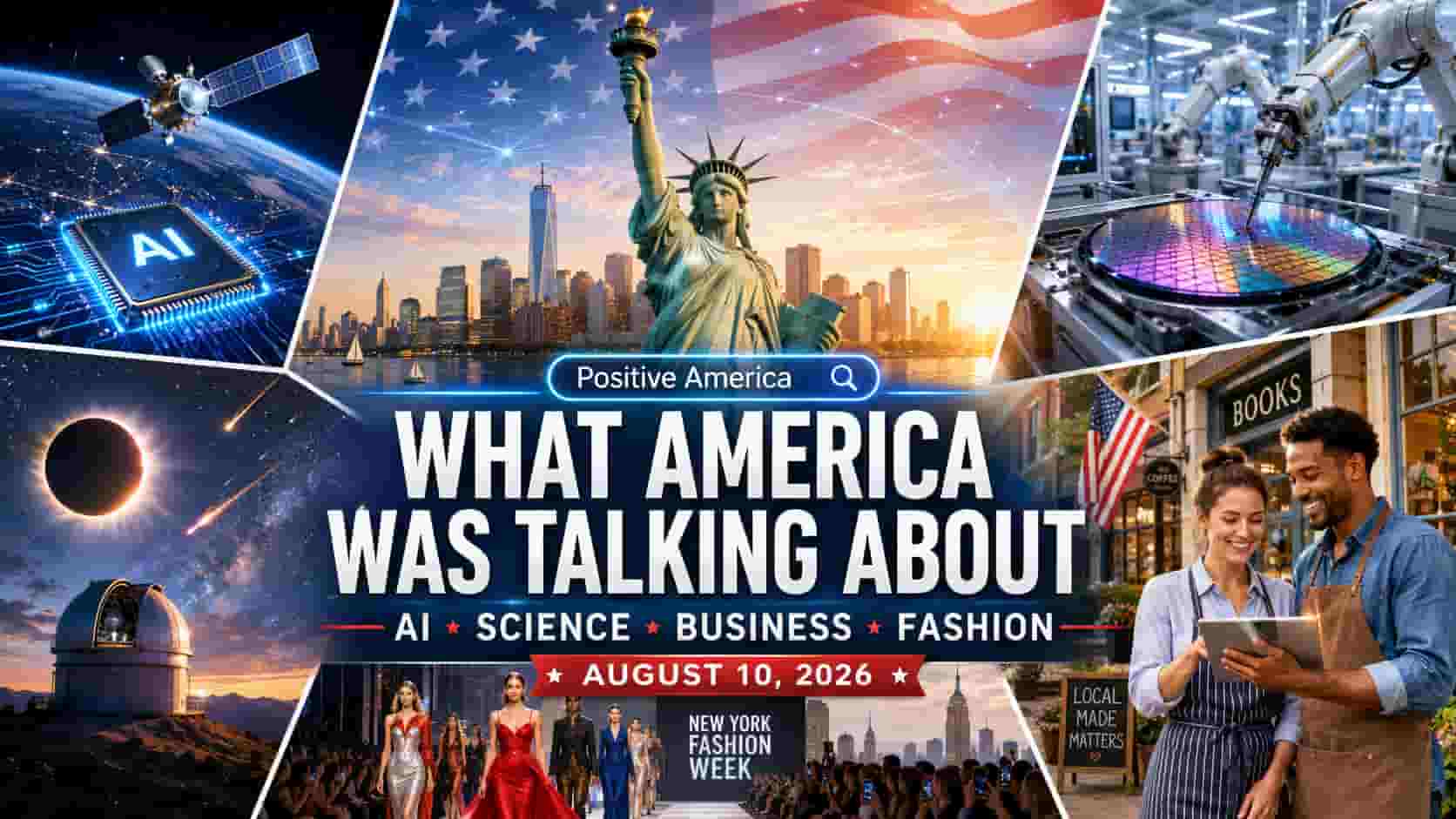
While much of the political news cycle focuses on conflict, another American conversation is unfolding around artificial intelligence, space computing, semiconductor factories, scientific research, small business, astronomy and New York fashion.
America woke up Monday, August 10, to plenty of political arguments.
But politics is not the only story of the country.
Look instead at the official channels of American technology companies, federal science agencies, manufacturing programs, small-business initiatives and the fashion industry, and a remarkably different picture appears.
SpaceX and NVIDIA are working on AI computing in orbit.
Hundreds of billions of dollars are being committed to semiconductor manufacturing in the United States.
The National Science Foundation is building regional AI infrastructure for scientists and students.
Small businesses are being brought into strategic American supply chains.
NASA is preparing for a solar eclipse and one of the year’s best meteor showers.
And New York is already preparing for its next Fashion Week.
America is not only arguing. America is building.
Editor’s note: This is not a scientific ranking of all U.S. social-media activity. It is an editorial morning snapshot of technology, science, business and cultural developments appearing across official government, corporate and professional channels as of August 10, 2026.
1. AI Is Going to Space: SpaceX and NVIDIA’s Starmind AI1
One of the most futuristic technology stories of the morning is no longer science fiction.
NVIDIA is currently highlighting SpaceX’s Starmind AI1 satellite among the major stories on its U.S. homepage.
The company says the satellite’s compute payload will be powered by the NVIDIA Vera Rubin NVL72 platform.
SpaceX describes Starmind as an effort to capture solar energy in space and use it to power high-performance AI computing for Earth.
That represents a potentially significant change in the architecture of computing.
Today, satellites normally collect information and send large quantities of data back to Earth for processing.
The emerging idea behind orbital AI computing is different: process more information where it is generated — in space.
NVIDIA describes the Starmind project as bringing AI-factory computing closer to orbit, while SpaceX presents Starmind as a space-based computing platform powered by solar energy.
The broader question is becoming fascinating:
Where will the data center of the future actually be?
In Virginia?
In Texas?
Or hundreds of miles above the Earth?
Official sources:
NVIDIA:
https://www.nvidia.com/en-us/
SpaceX Starmind:
https://www.spacex.com/spacexai/starmind
2. AI Is Also Coming Back to the Factory Floor
The other side of the AI revolution is much more terrestrial.
On August 5, NVIDIA updated a major feature titled “NVIDIA and Partners Build in America, for America.”
One example is Wistron’s new advanced manufacturing facility in Fort Worth, Texas.
According to NVIDIA, the 324,000-square-foot plant is producing the GB300 Grace Blackwell Ultra Superchip and preparing to manufacture the Vera Rubin Superchip.
NVIDIA says the project represents a combined $700 million commitment to U.S. advanced manufacturing, has already created more than 500 jobs and is expected to expand to 1,000 jobs by the end of the year.
The company says its American partner and supplier network now extends across 43 states and growing.
This is important because the AI economy increasingly requires more than software engineers.
It requires factories.
It requires electricity.
It requires advanced packaging.
It requires cooling systems.
It requires server assembly, construction, logistics and skilled manufacturing workers.
Artificial intelligence is becoming physical infrastructure.
Official source:
3. TSMC’s Planned U.S. Investment Reaches $265 Billion
The scale becomes even clearer in semiconductor manufacturing.
On July 16, the U.S. Department of Commerce announced an additional $100 billion investment commitment from TSMC, bringing the company’s total planned U.S. investment to $265 billion.
Commerce says the expanded plan would result in 12 TSMC facilities in the United States.
That makes semiconductors one of the most consequential industrial stories in America.
Chips sit underneath almost everything in a modern economy:
AI servers.
Automobiles.
Medical devices.
Telecommunications.
Robotics.
Defense systems.
Smartphones.
Satellites.
Cloud computing.
The race over artificial intelligence therefore has another race underneath it:
Who can manufacture the computing infrastructure that AI requires?
Official U.S. Department of Commerce source:
4. NSF Is Putting $100 Million Behind Regional AI Infrastructure
AI computing is also moving deeper into American science.
On August 4, the U.S. National Science Foundation announced its new State and Regional Artificial Intelligence Infrastructure Hubs program.
The initiative is backed by $100 million.
Its purpose is to expand access to computing power, data and other AI resources for researchers, students and educators around the country.
The model is particularly interesting because NSF wants these hubs to operate through regional partnerships involving:
- universities and research institutions;
- state and local governments;
- private industry;
- philanthropy;
- researchers and educators.
NSF says access to sophisticated AI infrastructure remains uneven across the country and argues that advanced computing has become increasingly necessary for frontier scientific research.
That could make the next phase of AI development much broader than Silicon Valley.
Instead of concentrating the most advanced computing resources in a handful of giant companies, the program is designed to make infrastructure available to regional scientific ecosystems.
AI is becoming a scientific instrument.
Official NSF source:
5. America Still Runs on Small Business
The billion-dollar investments make headlines.
But the numerical center of American business remains much smaller.
According to the U.S. Small Business Administration’s Office of Advocacy, the United States has 36,207,130 small businesses.
Those companies employ approximately 62.3 million people, representing 45.9% of private-sector employment.
That means the American economy cannot be understood only through Apple, NVIDIA, Amazon, Tesla, JPMorgan or Walmart.
It also consists of contractors, restaurants, manufacturers, professional practices, family businesses, retailers, technology startups and thousands of companies most Americans will never see on CNBC.
And increasingly, federal industrial policy is attempting to connect those smaller companies to larger manufacturing supply chains.
Official SBA source:
6. SBA Is Offering $9 Million to Strengthen American Supply Chains
One example is the new Supply Chain Acceleration and Logistics Enablement — SCALE — Program.
The U.S. Small Business Administration announced the program on July 23.
SBA says it will provide $9 million in total funding, with as many as 20 grants worth up to $500,000 each over two years.
The program is designed to help smaller businesses increase production and enter strategically important supply chains.
The priority sectors include:
- advanced manufacturing;
- biotechnology and biomanufacturing;
- defense industrial technologies;
- energy and critical materials;
- food and agricultural systems;
- transportation, logistics and industrial infrastructure.
In practical terms, that means the American manufacturing story is not supposed to stop with a giant semiconductor plant.
Those factories require thousands of suppliers.
And many of those suppliers can be small American businesses.
Official SBA source:
7. America Looks Up: A Solar Eclipse Arrives Wednesday
Technology is not the only reason Americans have something to look forward to this week.
On Wednesday, August 12, a total solar eclipse will cross Greenland, Iceland, northern Russia, the Atlantic Ocean, Spain and a small section of Portugal.
The United States will not see totality.
But NASA says a partial solar eclipse will be visible across portions of the northern United States, from Alaska to North Carolina.
NASA will begin live coverage at 1:15 p.m. EDT.
NASA is doing considerably more than broadcasting it.
Agency scientists are planning observations from a WB-57 research aircraft flying at approximately 50,000 feet, while university teams participating in a NASA-supported project will launch scientific balloons to study atmospheric changes during the eclipse.
One safety reminder is essential:
During a partial solar eclipse, ordinary sunglasses are not sufficient protection for direct solar viewing.
NASA recommends certified eclipse glasses or another appropriate solar-viewing method whenever any part of the Sun remains visible.
NASA eclipse information:
8. Then Come the Perseids
The sky will not be finished after sunset.
The annual Perseid meteor shower peaks during the night of August 12 into the morning of August 13.
And 2026 offers unusually favorable conditions.
NASA notes that the peak occurs around the New Moon, creating darker skies and improving meteor visibility away from urban light pollution.
So August 12 offers an unusual astronomical double feature:
Solar eclipse by day. Perseids by night.
For once, one of the most interesting screens in America may simply be the sky.
NASA August skywatching guide:
9. New York Fashion Week Is One Month Away
Back on Earth, New York is preparing for another industry built around creativity.
The Council of Fashion Designers of America has released the preliminary official schedule for New York Fashion Week Spring–Summer 2027.
The official NYFW schedule runs from September 10 through September 15, 2026.
CFDA says the preliminary calendar includes 70 runway shows and designer presentations.
Henry Zankov’s debut collection as artistic director of Diane von Furstenberg is scheduled to open the week on September 10, while Thom Browne is scheduled to close it on September 15.
The calendar includes Calvin Klein Collection, Carolina Herrera, Michael Kors Collection, Tory Burch, Anna Sui, Christian Siriano, Proenza Schouler, LaQuan Smith and many others.
Tommy Hilfiger is among the designers returning to the schedule.
Ralph Lauren plans to present his Spring 2027 collection on September 9, the evening before the official week begins.
Fashion is sometimes presented as entertainment.
In New York, it is also an industry.
Behind every runway show is an ecosystem of designers, manufacturers, photographers, models, production crews, public-relations firms, media companies, hotels, restaurants, transportation companies, stylists, influencers and retailers.
Official CFDA schedule:
10. Right Now at Rockefeller Center: More Than 120 American Flags Reimagined Through Fashion
You do not have to wait until September to see American fashion in Midtown Manhattan.
Through September 4, Rockefeller Center is hosting United Flags of Fashion, presented by CFDA, Vogue, Rockefeller Center and America250.
For the project, leading American designers were invited to reinterpret the flags of the 50 states, U.S. territories and Washington, D.C.
CFDA says more than 120 custom flags are flying around the Rink at Rockefeller Center from July 27 through September 4.
Participants include some of the most recognizable names in American fashion:
Ralph Lauren.
Calvin Klein.
Michael Kors.
Tommy Hilfiger.
Vera Wang.
Tory Burch.
Coach.
Carolina Herrera.
Diane von Furstenberg.
Thom Browne.
And many others.
After the installation closes, CFDA says the flags will be donated to the SCAD Museum of Art for preservation and future public exhibition.
It is an unusually appropriate New York story for America’s 250th anniversary:
the American flag presented not as another object of political conflict, but as a canvas for design, craftsmanship and imagination.
Official project:
So What Is This America Talking About?
There is always political conflict in America.
There always has been.
But there is another national conversation that rarely receives the same volume.
It is about building things.
SpaceX is exploring AI computing in orbit.
NVIDIA and its partners are building AI hardware in America.
TSMC’s announced U.S. investment has reached $265 billion.
NSF is putting $100 million behind regional AI infrastructure.
More than 36 million small businesses continue to form the foundation of American private enterprise.
NASA is preparing to study an eclipse from aircraft and scientific balloons.
The Perseids arrive the same night.
And New York is turning American design into both an industry and a public exhibition.
Political arguments can dominate a news feed.
But they do not tell the entire story of the United States.
The other America is still inventing, investing, manufacturing, starting businesses, conducting experiments, designing clothes and looking toward the next frontier.
And on the morning of August 10, 2026, that story may be considerably more interesting.
Government, Corporate & Official Sources
- SpaceX — Starmind AI Satellite
Official SpaceX project page for space-based AI computing.
SpaceX — Starmind - NVIDIA — Artificial Intelligence Computing
Official NVIDIA page featuring the SpaceX Starmind AI1 partnership and Vera Rubin NVL72 compute platform.
NVIDIA - NVIDIA — Build in America, for America
Official material covering U.S. AI manufacturing, Wistron’s Fort Worth facility and NVIDIA’s domestic supplier network.
NVIDIA — Building in America - U.S. Department of Commerce — TSMC U.S. Investment
Official Commerce Department announcement concerning TSMC’s additional $100 billion commitment and $265 billion total planned U.S. investment.
Commerce.gov — Semiconductor Investment - U.S. National Science Foundation — AI Infrastructure Hubs
Official NSF announcement of the $100 million State and Regional AI Infrastructure Hubs initiative.
NSF.gov — AI Infrastructure Hubs - U.S. Small Business Administration — 2026 Small Business Statistics
Official Office of Advocacy data on America’s 36.2 million small businesses and employment.
SBA — Small Business FAQ 2026 - U.S. Small Business Administration — SCALE Program
Official information on $9 million in grants supporting domestic suppliers and strategic supply chains.
SBA.gov — SCALE - NASA — August 12, 2026 Total Solar Eclipse
Official NASA visibility, scientific research and viewing-safety information.
NASA — August 12 Eclipse - NASA — August 2026 Skywatching Guide
Official NASA information covering the eclipse and August 12–13 Perseid meteor shower peak.
NASA — What’s Up: August 2026 - CFDA — September 2026 Official NYFW Schedule
Official preliminary New York Fashion Week schedule with 70 runway shows and presentations.
CFDA — Official NYFW Schedule - CFDA — United Flags of Fashion
Official information about the America250 fashion installation at Rockefeller Center.
CFDA — United Flags of Fashion - United Flags of Fashion — Official Project
The official digital exhibition featuring participating American designers and their flag designs.
United Flags of Fashion
Source methodology: Midtown Tribune prioritized U.S. government agencies, official corporate sources and recognized industry organizations for factual verification. This feature is an editorial technology, science, business and culture roundup rather than a scientific ranking of all U.S. social-media conversations.
Ask Midtown Tribune about this story
Answers are grounded first in this article. Search all Midtown Tribune reporting from the main AI Search page.
AI-generated summary. Verify important details in the linked original articles.