
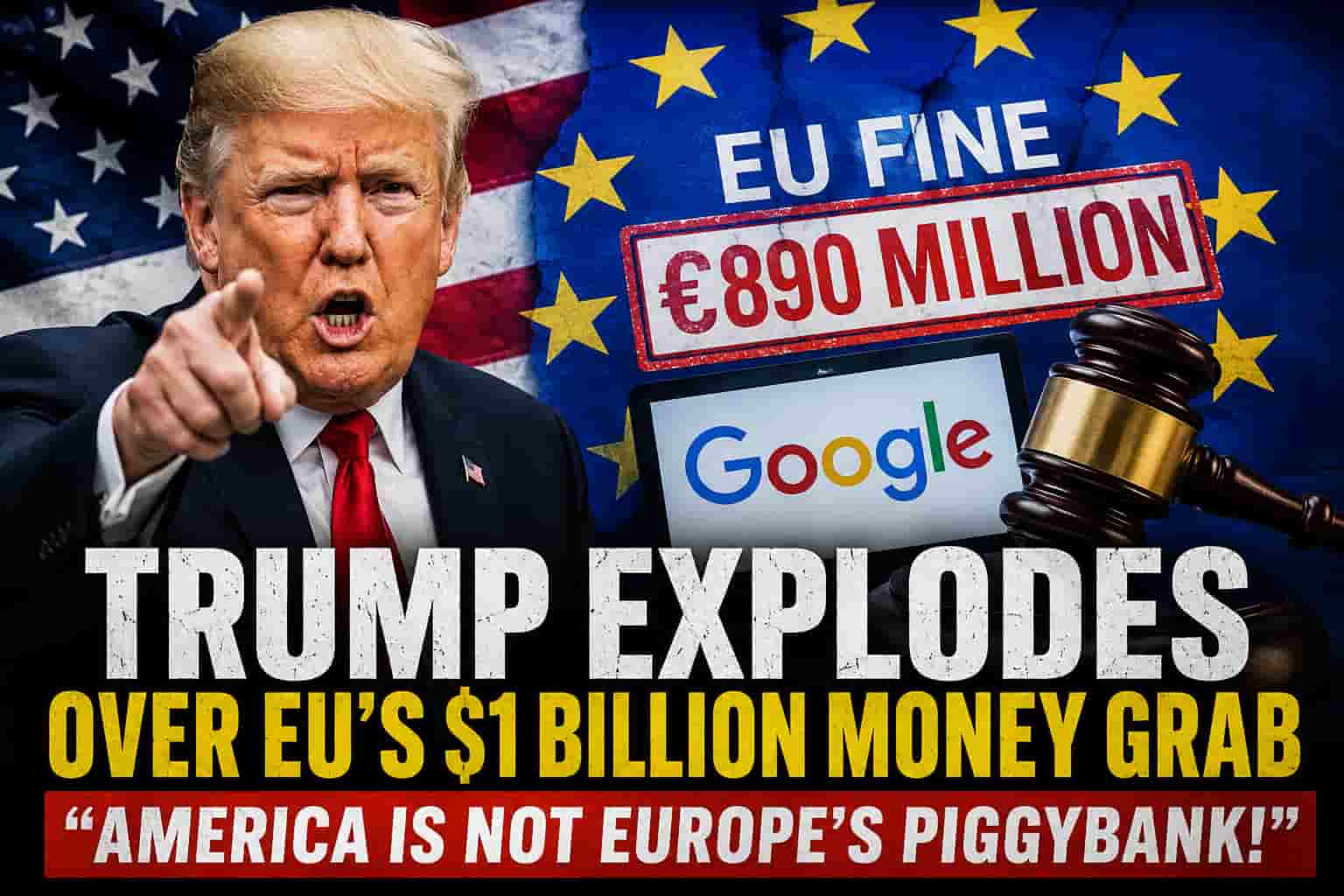
The dispute over Google’s €890 million penalty is rapidly expanding into a broader confrontation over European regulation of American technology companies
President Donald Trump has threatened the European Union with substantial new tariffs after European regulators imposed penalties totaling €890 million — approximately $1 billion — on Google for alleged violations of the bloc’s Digital Markets Act.
Trump announced that his administration would immediately begin a Section 301 trade investigation into what he described as Europe’s discriminatory treatment of American technology companies.
“The United States of America is not a ‘PIGGYBANK’ for Europe, nor will we allow it to be,” Trump wrote in a social-media statement. He accused European authorities of “robbing” American companies and, indirectly, American taxpayers.
The announcement represents a potentially significant escalation in the long-running dispute between Washington and Brussels over the regulation of Google, Apple, Meta, Amazon and other U.S.-based technology corporations.
Why the European Union Fined Google
The European Commission announced two separate decisions against Google on July 23.
The first imposed a fine of €460 million for allegedly favoring Google’s own services in its search results. European regulators said that Google gave greater visibility to its own shopping, hotel, transportation and sports services than to competing third-party platforms.
The second fine, totaling €430 million, concerned restrictions within Google Play. According to the Commission, Google prevented app developers from freely directing users toward alternative — and sometimes less expensive — purchasing channels outside the Google Play ecosystem.
Together, the two penalties amount to €890 million.
The Commission also ordered Google to end the practices identified in the decisions. European officials argue that the Digital Markets Act is intended to make the digital economy fairer and more competitive by placing specific obligations on the largest online platforms, which the EU classifies as “gatekeepers.”
Washington Calls the Penalties Discriminatory
The Trump administration sees the matter very differently.
U.S. Trade Representative Jamieson Greer accused the European Union of adopting an increasingly aggressive approach toward American technology companies.
Greer said the new Google fine followed other European actions involving Google’s Android operating system and search business. He argued that some EU requirements could create privacy and security risks, force American companies to transfer technology or intellectual property, and impose unreasonable financial penalties.
According to Greer, the combined European fines imposed on Google over the years amount to more than 2% of the European Union’s annual budget — a larger contribution than that made by several EU member states.
His comparison was intended to reinforce the administration’s argument that European regulators are not simply enforcing competition rules but are also extracting enormous sums from successful American businesses.
The European Commission rejects that interpretation. It maintains that its decisions are based on European law and apply to companies operating within the European market, regardless of where those businesses are headquartered.
What a Section 301 Investigation Means
Section 301 of the Trade Act of 1974 gives the Office of the U.S. Trade Representative authority to investigate foreign policies that Washington considers unreasonable, discriminatory or harmful to American commerce.
Such an investigation does not automatically produce tariffs. It normally involves a formal review, consultations and an opportunity for public comment before the administration determines whether retaliatory action is justified.
Possible responses may include:
- additional tariffs on European imports;
- restrictions affecting European companies;
- negotiations demanding changes to EU regulatory policies;
- or a settlement between Washington and Brussels.
Trump nevertheless made clear that he expects the investigation to produce a forceful response unless the European penalties are reversed.
He warned that the European Union would “pay a very big price” for what he called illegal and unethical conduct.
More Than a Dispute About Google
The conflict is not simply about one penalty or one company.
At its core, the confrontation concerns who has the authority to regulate the world’s largest digital platforms.
European officials argue that corporations such as Google have accumulated extraordinary influence over search engines, app stores, advertising, online shopping and the distribution of information. Brussels believes special rules are necessary to prevent those platforms from using their dominant positions to disadvantage competitors.
The Trump administration argues that Europe’s digital laws disproportionately target American companies — precisely because U.S. firms dominate the global technology market.
From Washington’s perspective, the EU is using regulation to accomplish what many European technology companies have been unable to achieve through competition.
That argument does not prove that Google complied with the Digital Markets Act. But it explains why the White House now views European enforcement as a matter of national economic interest rather than merely a corporate legal dispute.
A Threat to the Transatlantic Trade Relationship
The timing is particularly sensitive because the United States and the European Union have been attempting to stabilize their broader trade relationship.
Greer warned that the latest European actions were creating “massive uncertainty” for American exports of goods and services and could threaten continued transatlantic trade stability.
A new round of tariffs could affect far more than technology companies.
Depending on the products selected by the administration, additional duties could reach European automobiles, machinery, pharmaceuticals, luxury goods, agricultural products, wine or other major export sectors.
The EU could then respond with its own retaliatory measures against American goods.
Such an escalation would create costs not only for governments and multinational companies but also for businesses and consumers on both sides of the Atlantic.
American importers generally pay tariffs at the border and may pass at least part of those costs to customers. European businesses could similarly face reduced access to the enormous U.S. market.
Regulation or a European Money Grab?
Trump’s description of the penalties as a European “money grab” is politically powerful, but it represents the American administration’s interpretation rather than an established legal conclusion.
The European Commission published specific allegations against Google. It says the company favored its own services in search results and restricted developers’ ability to promote purchases outside Google Play.
Google and the U.S. government are entitled to challenge those conclusions and argue that the rules are unfair, discriminatory or harmful to consumers.
But the dispute must be understood as a conflict between two competing regulatory philosophies.
Europe believes dominant platforms require stronger government control.
The Trump administration believes European regulators are penalizing American success, weakening U.S. companies and indirectly subsidizing European competitors.
Trump Draws a New Line
For years, American technology companies largely fought European penalties through court appeals, compliance negotiations and corporate lobbying.
Trump is now transforming those private legal disputes into a direct government-to-government confrontation.
His message to Brussels is clear: fines against Google, Apple, Meta, Amazon and other American corporations will no longer be treated solely as European regulatory decisions. They may now trigger economic retaliation by the United States.
That approach carries risks. Tariffs can pressure foreign governments, but they can also increase prices, disrupt supply chains and invite countermeasures.
Still, Trump appears determined to use the power of the American market to defend U.S. companies against what his administration considers discriminatory foreign regulation.
The European Union insists that companies doing business in Europe must obey European law.
Trump’s response is equally direct: Europe may write its own rules, but Washington will not stand aside if those rules are used to repeatedly extract billions of dollars from American companies.
The fight over Google’s €890 million fine may therefore become much larger than Google.
It could determine whether the United States and Europe can maintain a stable economic partnership while fundamentally disagreeing over who should control — and profit from — the global digital economy.
Official Sources
- European Commission: Google Fined €890 Million for Digital Markets Act Violations
- European Commission Press Release: Decisions and Penalties Against Google
- U.S. Trade Representative: Ambassador Greer’s Statement on the EU Google Fine
- Office of the U.S. Trade Representative: Section 301 Investigations
- European Commission: About the Digital Markets Act
- European Commission: Digital Markets Act Gatekeepers Portal
- European Commission Digital Strategy: Official Google Fine Announcement
Sources include the European Commission and the Office of the United States Trade Representative. All links lead to official government websites.
Ask Midtown Tribune about this story
Answers are grounded first in this article. Search all Midtown Tribune reporting from the main AI Search page.
AI-generated summary. Verify important details in the linked original articles.