
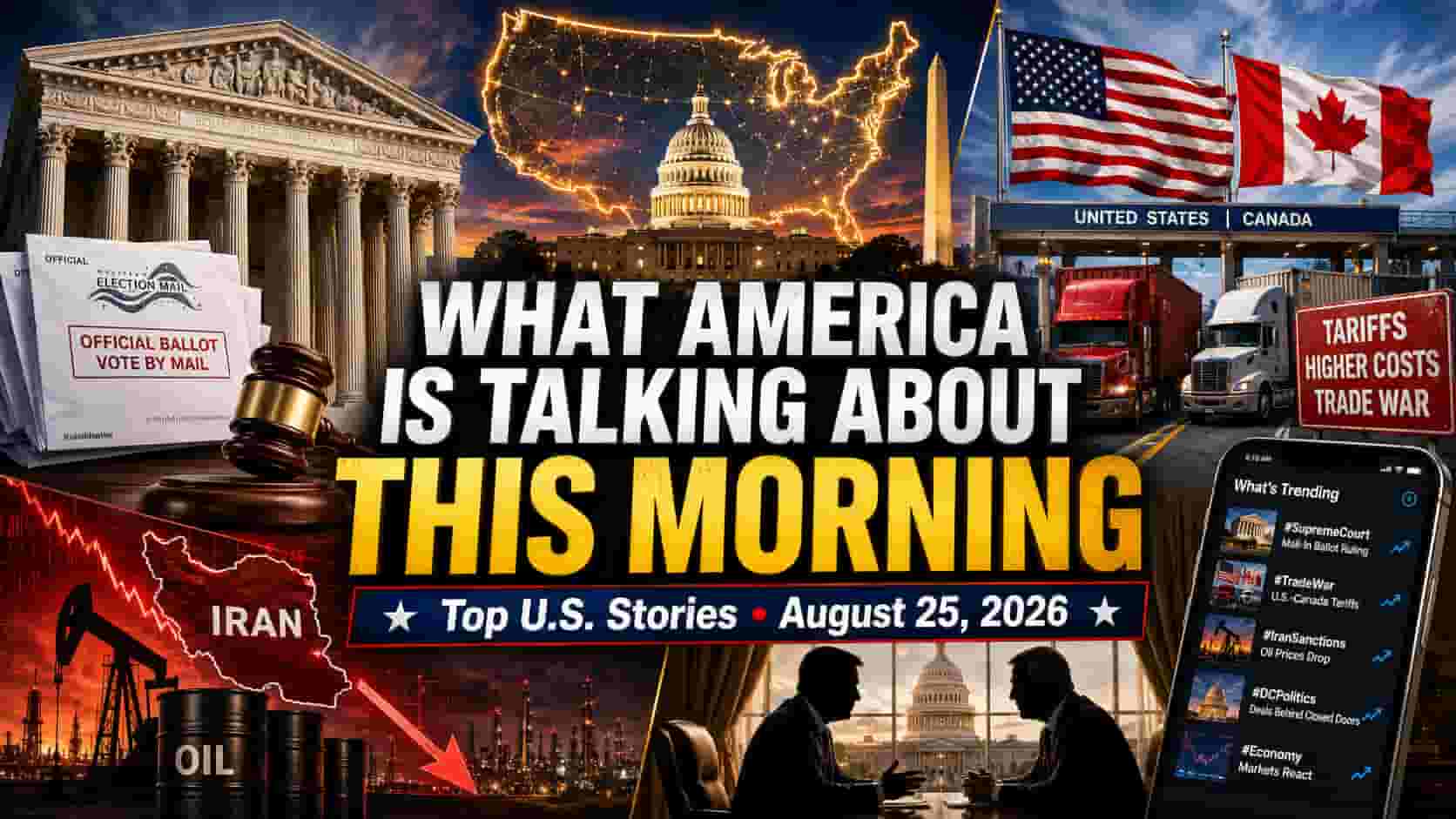
A Supreme Court ruling affecting the Trump administration’s election policies, escalating U.S.-Canada trade tensions, renewed economic pressure on Iran, and an unusual private meeting between House Democratic Leader Hakeem Jeffries and Jared Kushner are driving the national conversation Tuesday morning.
As Americans begin the day on August 25, 2026, politics and the approaching midterm elections dominate much of the national news cycle.
There is no single authoritative measurement of “the most discussed news in America.” Google searches, social-media trends and news coverage measure different things. But several stories clearly stand out across the U.S. information landscape this morning.
Here are the developments worth watching.
1. Supreme Court Gives Trump Administration a Major Win in Election Case
Perhaps the most consequential political development of the morning comes from the U.S. Supreme Court.
On August 24, the Court granted the Trump administration’s request for a stay in Trump v. California, allowing the federal government to attempt to implement an executive order involving federal election administration while the underlying litigation continues.
The Court stressed an important limitation:
“The Court’s disposition of this application does not mean that any measure taken by the Government to implement the Order will necessarily be lawful.”
In other words, the Supreme Court did not issue a final ruling declaring every future implementation measure legal.
Instead, it concluded that the lower court should not have blocked the federal government from attempting to implement the executive order at this stage of the litigation.
The case is especially significant because the 2026 midterm elections are approaching, making any dispute over election administration politically explosive.
Official source: U.S. Supreme Court — Trump v. California, No. 26A124, August 24, 2026
The case also appears on the Supreme Court’s official opinions page as the Court’s August 24 decision.
Supreme Court — Opinions of the Court
Why it matters
The fight is likely far from over.
The Court itself emphasized that future federal measures could still face legal challenges.
That means the central question now shifts from whether the administration may try to implement the order to exactly how federal agencies implement it — and whether those specific actions survive judicial review.
With November approaching, this could remain one of the most important election-law disputes in the country.
2. U.S.-Canada Trade Fight Is Back in the Spotlight
Another major story is the rapidly changing trade relationship between the United States and Canada.
The Trump administration has invoked federal trade authority to impose additional duties on certain Canadian products, including measures affecting motor vehicles.
A July presidential proclamation established an additional 50% ad valorem duty on certain Canadian products identified by the administration.
The White House said the action was intended to respond to what President Trump described as Canadian discrimination against U.S. commerce.
Official source: The White House — Imposing Additional Duties to Offset Canadian Discrimination With Respect to Motor Vehicles
The administration subsequently adjusted the timing of additional duties covering Canadian alcoholic beverages, dairy products and motor vehicles.
Official source: The White House — Temporary Suspension of Additional Duties Regarding Canadian Products
Why Americans should care
The United States and Canada do not operate completely separate automobile industries.
Their manufacturing supply chains are deeply interconnected.
Vehicles and components can cross the border during different stages of production.
That means substantial tariffs can affect more than Canadian exporters.
They can potentially influence:
- American manufacturers;
- parts suppliers;
- dealerships;
- vehicle prices;
- investment decisions;
- manufacturing employment.
The political argument is therefore straightforward but highly contested.
The Trump administration says aggressive trade measures can force better treatment for American commerce.
Critics worry that tariffs can also raise costs for American companies and consumers.
As the new measures take effect and negotiations continue, Canada is becoming one of Washington’s most important economic stories of the summer.
3. Washington Continues Its Economic Campaign Against Iran
Iran remains another major national and international story.
The U.S. Treasury Department has been intensifying its campaign against financial networks that Washington says help the Iranian government move money and obtain foreign currency despite American sanctions.
On August 7, the Treasury Department announced action against networks operating across several countries that it said were helping Iran’s financial system move hundreds of millions of dollars.
Treasury Secretary Scott Bessent said:
“Iran’s shadow banking system is buckling under Economic Fury.”
The administration says the objective is to cut Iran off from revenue and financial channels supporting its government, armed forces and proxy organizations.
Official source: U.S. Treasury — Treasury Dismantles Iranian Regime’s Global Clandestine Currency Networks
What to watch next
The crucial question is not simply whether Washington can impose more sanctions.
It is whether the United States can prevent third-country banks, traders and intermediaries from helping Iran circumvent them.
That makes enforcement — especially outside the United States — as important as the sanctions announcements themselves.
Iran therefore remains both a foreign-policy story and an economic story for Washington.
4. Why Did Hakeem Jeffries Meet Privately With Jared Kushner?
A very different political story is generating attention inside Washington and the Democratic Party.
House Democratic Leader Hakeem Jeffries privately met with Jared Kushner, President Trump’s son-in-law and former senior White House adviser.
ABC News reported on the meeting as questions grew about why one of the country’s most powerful Democrats would privately meet with a member of Trump’s inner circle only months before the midterm elections.
Other reporting indicates that subjects included issues such as housing, immigration and affordability.
The existence of the meeting does not by itself prove that any formal agreement or political deal was reached.
But the timing makes it politically significant.
Why the meeting matters
Jeffries could become Speaker of the House if Democrats win control of the chamber in November.
Kushner, meanwhile, remains personally close to President Trump despite not holding the same formal White House role he held during Trump’s first term.
A private conversation between the two therefore raises several possible interpretations.
It could simply represent an attempt to maintain communication across party lines.
It could be an effort to identify legislation that could move through a divided Washington after the election.
Or it could indicate that both sides are already preparing for the possibility of a major change in congressional power.
The backlash among some Democrats shows how politically sensitive even informal cooperation with Trump’s circle remains.
5. The Sonya Massey Case Returns to the National Conversation
Another story drawing renewed attention is the death of Sean Grayson, the former Illinois sheriff’s deputy convicted in the killing of Sonya Massey.
Grayson died while serving a 20-year prison sentence for second-degree murder.
He had been convicted for the 2024 shooting of Massey after she called 911 to report a possible prowler near her home.
His attorney confirmed his death, and the Illinois Department of Corrections confirmed that he died while in custody outside Illinois.
Grayson had been suffering from advanced cancer.
The original killing became a major national story after body-camera footage was released and prompted renewed debate about police hiring, use of force and accountability.
Grayson’s death has now returned the Massey case to public discussion.
The Bigger Picture: The Midterms Are Beginning to Shape Everything
Although these stories appear unrelated, several are connected by one increasingly important fact:
America is moving rapidly toward the November 2026 midterm elections.
Election rules are before the Supreme Court.
Trade and prices are becoming political issues.
Immigration and affordability surfaced in the Jeffries-Kushner meeting.
Foreign policy toward Iran remains part of the administration’s record.
And control of Congress could fundamentally change the balance of power in Washington.
That means many stories that would ordinarily remain separate are increasingly being interpreted through the same political question:
Who will control Congress after November?
Key Facts This Morning
Supreme Court: The Court granted the Trump administration a stay in Trump v. California, but explicitly did not declare every possible implementation measure lawful.
Canada: The administration has imposed or scheduled substantial additional duties on certain Canadian products as a trade dispute intensifies.
Iran: Treasury continues targeting financial networks that Washington says help Tehran obtain and move money.
Jeffries-Kushner: The House Democratic leader privately met Trump’s son-in-law and adviser, generating political controversy ahead of the midterms.
Sonya Massey case: Former deputy Sean Grayson has died while serving his murder sentence, bringing renewed attention to a nationally significant police shooting case.
Confirmed vs. Still Developing
Confirmed
The Supreme Court issued its Trump v. California decision on August 24.
The White House has formally issued presidential trade actions involving Canada.
Treasury has publicly documented its expanding financial campaign against Iranian networks.
Jeffries and Kushner met privately.
Sean Grayson died while serving his prison sentence.
Still Developing
How the federal government will implement the election executive order after the Supreme Court decision.
Whether additional litigation blocks particular election-related measures.
How the U.S.-Canada tariff dispute ultimately affects prices and manufacturing.
Whether Washington’s economic campaign can significantly restrict Iran’s access to foreign currency.
What political significance, if any, should be attached to the Jeffries-Kushner meeting.
Midtown Tribune Analysis
The most consequential story this morning may not necessarily be the story generating the largest number of social-media posts.
Search popularity, political importance and long-term consequences are different measurements.
Celebrity deaths and sports injuries can produce enormous short-term search spikes.
But for Americans deciding what deserves attention on August 25, 2026, the Supreme Court election ruling, the expanding Canada trade confrontation and the political maneuvering ahead of the midterms have potentially much larger consequences.
The national news cycle is increasingly becoming an election news cycle.
And with November drawing closer, that trend is likely to accelerate.
Official and Primary Sources
U.S. Supreme Court — Trump v. California, No. 26A124, August 24, 2026
Read the official Supreme Court opinion
U.S. Supreme Court — October Term 2025 Opinions
Official Supreme Court opinions index
The White House — Canadian Motor Vehicle Duties
Official presidential action
The White House — Adjustment of Canadian Duties
Official presidential action
U.S. Department of the Treasury — Iran Financial Networks
Official Treasury release
Additional Reporting
ABC News — Jeffries/Kushner meeting
Reporting on the private meeting between House Democratic Leader Hakeem Jeffries and Jared Kushner.
CBS Chicago — Sean Grayson death
Confirmation of Grayson’s death while serving his sentence in the Sonya Massey case.
Ask Midtown Tribune about this story
Answers are grounded first in this article. Search all Midtown Tribune reporting from the main AI Search page.
AI-generated summary. Verify important details in the linked original articles.