
Midtown Tribune | New York | October 24, 2026
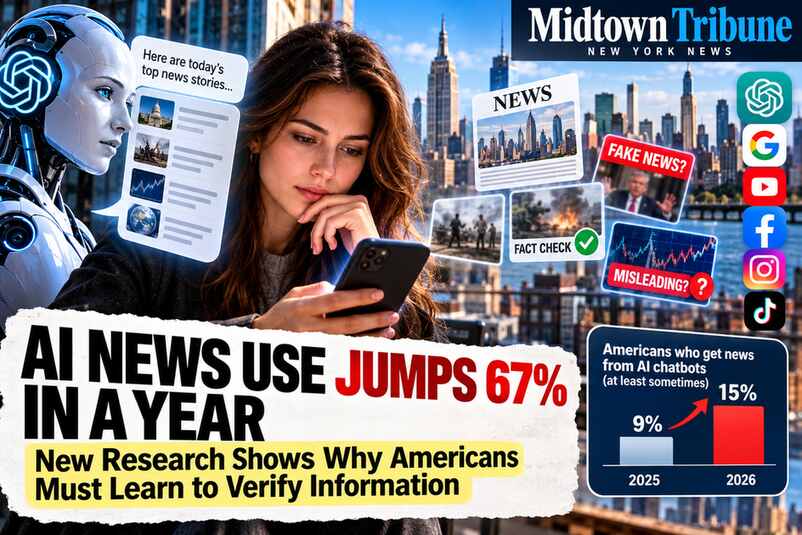
New Pew Research Center findings show that 15% of American adults now get news from AI chatbots, while 59% turn to social media. As artificial intelligence transforms how information reaches the public, researchers and international institutions are emphasizing the importance of fact-checking, media literacy, and independent critical thinking.
Artificial Intelligence Is Changing How Americans Get Their News
For decades, Americans relied on newspapers, television broadcasts, news websites, and search engines to stay informed.
Today, an increasing number are turning directly to artificial intelligence.
Instead of searching through multiple websites, users can ask ChatGPT, Google Gemini, or another AI assistant a question and receive an immediate, seemingly authoritative answer.
But a fundamental question remains:
Does a convincing answer from artificial intelligence necessarily mean that the information is accurate?
The answer is no.
AI systems can misinterpret documents, confuse dates, generate inaccurate citations, and present unsupported claims with remarkable confidence.
New research suggests that the ability to independently verify AI-generated information is becoming an increasingly important component of modern literacy.
On October 19, 2026, the Pew Research Center published new findings on Americans’ news consumption habits.
According to the study, 15% of American adults now get news from AI chatbots at least sometimes, compared with 9% in 2025.
That represents an increase of six percentage points, or approximately 67% relative to the previous year’s figure.
The findings come from a survey of 5,166 U.S. adults conducted August 24–30, 2026, through Pew Research Center’s American Trends Panel.
The results point to an important development: AI is becoming another gateway through which Americans encounter news and public information.
However, the survey does not establish whether AI-generated news summaries are more or less accurate than information from other sources. It measures how people obtain news, not the reliability of individual answers.
Where Americans Get Their News in 2026
Pew Research Center’s latest findings illustrate the growing diversity of digital news sources.
| Digital news source | U.S. adults who use it at least sometimes |
|---|---|
| Search engines | 70% |
| News websites and applications | 66% |
| Social media | 59% |
| Email newsletters | 34% |
| Podcasts | 32% |
| AI chatbots | 15% |
Source: Pew Research Center, News Platform Fact Sheet, October 19, 2026.
These categories overlap because respondents may use several platforms.
Although 15% of Americans get news from AI chatbots at least occasionally, only 1% identify chatbots as their preferred news platform.
Traditional news organizations, search engines, television, and social media therefore remain central to Americans’ information habits.
Nevertheless, AI is developing a meaningful role in the news ecosystem.
The distinction matters because AI-generated summaries frequently present information without the same editorial process used by established news organizations.
An AI response may contain accurate information, but its confident wording should never substitute for documentary evidence.
Social Media’s Expanding Influence
A separate Pew Research Center report on social media and news, also published October 19, found that 59% of American adults get news from social platforms at least sometimes.
That compares with 53% in 2025.
Among adults ages 18 to 29, the figure reaches 75%.
Facebook and YouTube remain particularly significant platforms for news consumption.
In 2026, the shares of all U.S. adults who regularly receive news through specific platforms include:
- Facebook: 40%.
- YouTube: 34%.
- Instagram: 23%.
- TikTok: 20%.
- X, formerly Twitter: 10%.
These figures refer to the adult population as a whole, rather than the share of users on each individual platform.
The two Pew reports are based on the same underlying survey and should not be interpreted as independent samples.
When Popularity Becomes a Substitute for Evidence
On social media, a government announcement, a professional news report, an influencer’s opinion, a political advertisement, and a fabricated claim can appear side by side.
Users must determine for themselves which statements are documented facts and which represent interpretation, speculation, or deliberate manipulation.
A post with millions of views may still contain incorrect information.
Likewise, the number of likes, comments, and reposts tells us very little about whether a particular claim is supported by evidence.
Popularity is not proof. Repetition is not verification. And confidence is not the same as accuracy.
These principles become even more important when artificial intelligence is used to generate, translate, summarize, or distribute information.
Britain Examines AI’s Impact on Children and Education
On October 16, the United Kingdom’s House of Lords Library published an extensive briefing titled Screen Use, Artificial Intelligence and Social Media: Impact on Children and Young People.
The document was prepared for a parliamentary debate scheduled for October 22.
It examines evidence concerning children’s use of digital devices, social media, and generative artificial intelligence.
The briefing identifies potential educational benefits alongside concerns about online safety, development, behavioral outcomes, and exposure to harmful content.
Importantly, the report acknowledges that scientific evidence about the long-term effects of generative AI on young people remains limited.
This distinction is essential.
A correlation between technology use and a particular outcome does not automatically prove that the technology caused that outcome.
Likewise, the fact that students use AI for homework does not establish that the technology either improves or undermines learning in every situation.
The educational implications depend on how the technology is used, what tasks it performs, and whether students continue to exercise independent judgment.
The Real Educational Challenge
The debate is no longer simply whether students should be permitted to use artificial intelligence.
A more important question is whether they understand its limitations.
Students need to distinguish between obtaining an answer and acquiring knowledge.
A chatbot can summarize a historical event in seconds. That does not guarantee that its chronology, quotations, or conclusions are correct.
The ability to challenge and verify these outputs should become an essential part of education.
European Commission Commits €3.5 Million to Media Literacy Projects
The European Commission announced a new funding initiative on October 21 aimed at strengthening media literacy and resistance to disinformation.
According to its official Cross-border Media Literacy 2027 call for proposals, the program has a total budget of €3.5 million.
Applications opened on October 22, 2026, and are scheduled to close on January 20, 2027.
Individual projects may seek grants of up to €500,000, with EU funding covering up to 70% of eligible costs.
The initiative supports international cooperation, practical educational tools, training activities, and programs aimed at increasing public resilience against information manipulation.
A particularly important feature is its emphasis on adults who are no longer enrolled in schools or universities.
The Commission also identifies the growing influence of social media, online personalities, and AI-generated content as challenges that media literacy programs must address.
The significance goes beyond the amount of funding.
The initiative demonstrates that European institutions increasingly view the ability to evaluate information as a practical civic skill requiring dedicated educational investment.
The funding program is intended for eligible international projects under the Creative Europe framework; it is not a general grant opportunity automatically available to U.S. organizations.
UNESCO Promotes Media and Information Literacy Worldwide
UNESCO’s Global Media and Information Literacy Week 2026 is another example of the growing international focus on information verification.
This year’s theme is:
“We All Play a Part — Media and Information Literacy for the People.”
On its official Global Media and Information Literacy Week website, UNESCO lists educational events and initiatives taking place internationally.
The activities address critical thinking, responsible digital participation, AI-generated information, misinformation, and online safety.
Programs listed by UNESCO include workshops for educators, activities for young people, and initiatives encouraging responsible content creation.
UNESCO makes clear that many events are organized independently and that their content does not necessarily represent the organization’s official position.
The listings therefore should not be mistaken for scientific evaluations proving that every program is effective.
They nevertheless demonstrate how media literacy is being addressed across different countries and educational settings.
Why This Matters for New York City
New York City offers a particularly relevant setting for examining these developments.
Residents obtain news from local and national media, international publications, social networks, messaging platforms, and sources operating in numerous languages.
A single story may be translated, summarized, reposted, and interpreted several times before reaching its final audience.
Each additional step creates opportunities for mistakes or distortion.
Consider a hypothetical social media post claiming that New York State has enacted a controversial new law.
The message includes a bill number and a description of what the alleged law requires.
A chatbot may generate a detailed summary.
But the actual legislative record may show that the measure was only introduced, remained in committee, or never became law.
The correct approach is to examine the underlying government record through the New York State Senate’s official legislation database.
Federal legislative claims can similarly be checked through Congress.gov.
Court decisions, government statistics, public budgets, and agency announcements should be evaluated using their respective original sources.
AI can help locate these records, but the documents themselves should remain the foundation of factual conclusions.
Five Rules for Verifying News in the AI Era
The research and institutional publications reviewed here suggest several practical principles for readers.
1. Find the original source.
If a story cites a government announcement, scientific study, court decision, or official statistic, locate the original document.
A secondhand summary is not a substitute for the source itself.
2. Check the date and document status.
A proposed law is not an enacted law.
A preliminary research paper is not the same as a confirmed scientific consensus.
A political promise is not proof that a policy has already been implemented.
3. Separate facts from opinions.
A statement that a government official signed a document can generally be checked against an official record.
A claim that the decision will destroy the economy is an interpretation or prediction requiring additional evidence.
4. Verify AI-generated answers.
Even when an AI chatbot provides citations, users should confirm that the referenced sources exist and actually support the claims attributed to them.
AI systems can misrepresent sources as well as facts.
5. Be skeptical of emotionally manipulative messages.
Posts designed to provoke immediate anger, fear, or outrage deserve particular scrutiny when they provide no supporting documentation.
Emotional language does not automatically mean a statement is false, but it should never replace evidence.
What Schools, Community Organizations, and Newsrooms Should Teach
An effective AI literacy program should do more than demonstrate how to write prompts or use popular chatbot services.
It should teach people how to independently evaluate information.
One practical classroom exercise involves asking students to investigate the same news story in three ways.
First, students locate the story through a conventional search engine.
Second, they request an explanation from an AI chatbot.
Third, they consult the primary document, such as a government statement, scientific paper, or court ruling.
The students then compare the results, identifying factual agreements, discrepancies, missing context, and unsupported claims.
Such exercises help distinguish technical familiarity with AI from genuine information literacy.
For journalists, additional training can cover the verification of quotations, images, audio recordings, and video.
For parents, the focus may include children’s digital safety and responsible AI use.
For older adults, educational programs may emphasize fraudulent messages impersonating banks, government agencies, relatives, or other trusted contacts.
These are proposed educational applications, rather than teaching methods whose effectiveness was directly established by the Pew surveys.
Their results should be assessed through practical testing before and after instruction.
AI Can Help Find the Truth — But It Cannot Replace Verification
The October 2026 research from Pew Research Center demonstrates that Americans’ information habits are evolving.
Artificial intelligence is becoming an increasingly visible news channel, while social media continues to shape how millions encounter public information.
Meanwhile, institutions including the European Commission, UNESCO, and the United Kingdom’s Parliament are devoting attention to the educational and civic implications of these technologies.
There is no reason to treat artificial intelligence as inherently unreliable, just as there is no reason to assume it is always correct.
AI can help users locate documents, translate complex material, compare accounts, analyze data, and identify questions requiring further investigation.
But none of those capabilities eliminates the need for independent verification.
Journalism has always depended on a fundamental distinction between an assertion and documented evidence.
That distinction must remain central as artificial intelligence becomes integrated into everyday information consumption.
In the age of artificial intelligence, the most informed person is not necessarily the one who receives answers fastest. It is the person who knows how to determine whether those answers are true.
Official Sources and Further Reading
- Pew Research Center — News Platform Fact Sheet, October 19, 2026
- Pew Research Center — Social Media and News Fact Sheet, October 19, 2026
- House of Lords Library — Screen Use, Artificial Intelligence and Social Media: Impact on Children and Young People, October 16, 2026
- European Commission — Cross-border Media Literacy 2027, October 21, 2026
- UNESCO — Global Media and Information Literacy Week 2026
- New York State Senate — Official Legislation Database
- Congress.gov — Official U.S. Congressional Legislation Database
Midtown Tribune | New York News, Technology, Education & Media Analysis
Topics: Artificial Intelligence, AI News, ChatGPT, Media Literacy, Disinformation, Fact-Checking, Pew Research Center, UNESCO, New York City, Education, Social Media.
Midtown Tribune Independent USA news from New York
Ask Midtown Tribune about this story
Answers are grounded first in this article. Search all Midtown Tribune reporting from the main AI Search page.
AI-generated summary. Verify important details in the linked original articles.