
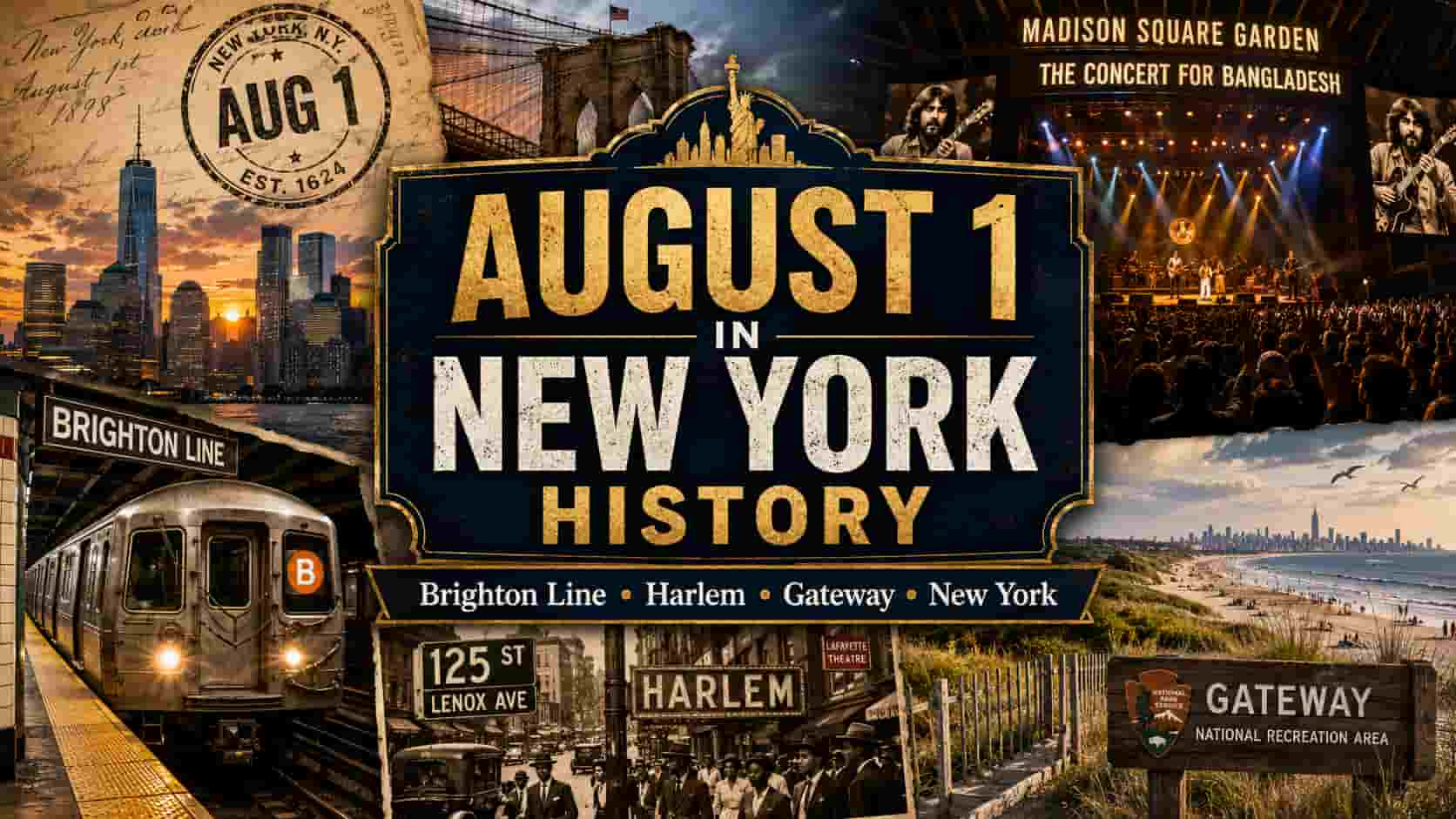
New York history is not shaped only by elections, wars and the construction of skyscrapers. Sometimes the city changes because a subway tunnel opens, a mayor writes a letter, a ship enters the harbor or musicians take the stage for a humanitarian cause.
August 1 marks several important moments in the history of New York City, including a transportation breakthrough for Southern Brooklyn, a major international gathering in Harlem, a deadly episode of civil unrest, the beginnings of Gateway National Recreation Area and one of the most influential benefit concerts ever held.
August 1, 1920: The Brighton Line gained a direct subway connection to Manhattan
One of the most important August 1 events for Brooklyn occurred in 1920, when a new subway tunnel under Flatbush Avenue connected the Brighton Line at Prospect Park with the Fourth Avenue subway near DeKalb Avenue.
The connection gave Brighton Line trains access to the Manhattan Bridge, the Montague Street Tunnel and the Broadway subway in Manhattan. It transformed a former excursion railroad serving Brighton Beach and Coney Island into a much more fully integrated part of New York’s rapid-transit system.
The project was especially significant for neighborhoods along the line, including Flatbush, Midwood, Sheepshead Bay and Brighton Beach. Faster and more convenient access to Manhattan encouraged residential growth throughout central and southern Brooklyn.
More than a century later, the transit corridor remains one of the principal connections between the Brighton Beach area and Manhattan.
August 1, 1920: Marcus Garvey opened an international convention in Harlem
On the same day, Marcus Garvey’s Universal Negro Improvement Association opened its First International Convention of the Negro Peoples of the World at Liberty Hall in New York.
Approximately 2,000 delegates from 22 countries attended. The convention continued throughout August and included meetings, ceremonies, a major parade through Harlem and a mass gathering at Madison Square Garden.
Delegates adopted the Declaration of Rights of the Negro Peoples of the World, which condemned racial discrimination and asserted political, economic and cultural rights for people of African descent. The convention also adopted red, black and green as the colors associated with the movement.
The gathering demonstrated Harlem’s growing importance as an international center of Black political thought. The National Archives notes that the 1920 convention formally ratified Garveyism as the doctrine of the movement and promoted a program of African independence and racial sovereignty.
August 1, 1943: Violence erupted in Harlem
On the evening of August 1, 1943, a confrontation involving a white police officer, a Black woman and a Black soldier triggered widespread unrest in Harlem.
After the officer shot and wounded the soldier, a false rumor circulated that the soldier had been killed. The rumor intensified existing anger over discrimination, policing, high prices, wartime shortages and limited economic opportunities.
Over two days, six Black New Yorkers were killed, more than 500 people were injured, thousands were arrested and businesses suffered millions of dollars in damage, according to records reviewed by the New York City Municipal Archives.
Mayor Fiorello La Guardia and community leaders attempted to restore order through public appeals. WNYC, which was then owned by the City of New York, broadcast calls for calm, while sound trucks carried messages through Harlem’s streets. The Municipal Archives credits those broadcasts and mobile announcements with playing an important role in calming the situation.
The unrest exposed deep racial and economic divisions in New York at a time when the United States was fighting World War II under the banner of democracy abroad.
August 1, 1966: A mayoral letter helped launch Gateway National Recreation Area
On August 1, 1966, Mayor John V. Lindsay wrote to U.S. Secretary of the Interior Stewart Udall proposing that Breezy Point be added to the nation’s system of protected seashores.
Lindsay argued that residents of a major city—particularly working-class families without cars, air conditioning or vacation homes—needed convenient access to beaches and open space.
A carbon copy of the letter remains in the John V. Lindsay collection at the New York City Municipal Archives. The archive identifies the document as one of the earliest steps toward the creation of Gateway National Recreation Area.
The proposal took years to become reality. President Richard Nixon signed the federal law authorizing Gateway on October 27, 1972.
Gateway eventually grew to approximately 27,000 acres of beaches, wetlands, dunes, former military installations and historic sites in New York and New Jersey. Its New York locations include Jamaica Bay, Floyd Bennett Field, Fort Tilden, Breezy Point, Fort Wadsworth and Great Kills Park.
The park represented a major change in federal conservation policy: instead of preserving only remote wilderness, the government would also protect recreational land near densely populated urban communities.
August 1, 1969: The Clearwater entered New York Harbor
On August 1, 1969, the Hudson River sloop Clearwater sailed into New York Harbor.
Folk musician Pete Seeger and his wife, Toshi Seeger, had helped establish Hudson River Sloop Clearwater Inc. in response to severe industrial pollution in the Hudson River. The vessel was built as a replica of an 18th-century sailing sloop and was intended to remind the public of the river’s history and natural value.
Mayor John Lindsay, reporters and a WNYC-TV camera crew joined Seeger aboard the Clearwater as it sailed through the harbor with the Statue of Liberty in the background. The crew performed music and demonstrated traditional sailing techniques.
The Clearwater became an enduring symbol of the environmental movement and of the campaign to clean the Hudson. Its arrival came less than a year before the first Earth Day and preceded the creation of the Environmental Protection Agency and the passage of the federal Clean Water Act.
August 1, 1971: The Concert for Bangladesh filled Madison Square Garden
On August 1, 1971, George Harrison and Ravi Shankar organized two sold-out benefit concerts at Madison Square Garden to support humanitarian relief connected to the crisis in East Pakistan, which would soon become the independent nation of Bangladesh.
The performances brought together Harrison, Shankar, Bob Dylan, Ringo Starr, Eric Clapton, Billy Preston, Leon Russell and other prominent musicians.
More than 40,000 people attended the two shows. UNICEF describes the event as a defining moment in both music history and humanitarian action and reports that the concert, recordings and related projects ultimately generated millions of dollars for relief efforts.
The Concert for Bangladesh helped establish the model for the large-scale celebrity benefit concert. Later events such as Live Aid and numerous disaster-relief concerts followed the same basic idea: use major performers, mass media and a global audience to draw attention and funding to a humanitarian emergency.
Decades later, proceeds connected to the concert continue to support UNICEF programs through the George Harrison Fund for UNICEF.
August 1, 2014: New York’s medical examiner ruled Eric Garner’s death a homicide
On August 1, 2014, the New York City Office of Chief Medical Examiner classified the death of Eric Garner as a homicide.
Garner had died on July 17 after an encounter with NYPD officers on Staten Island. Video of the arrest, including Garner repeatedly saying that he could not breathe, generated national attention and intensified debate about police tactics, accountability and the treatment of Black Americans by law enforcement.
In a statement issued that day, New York City Council Speaker Melissa Mark-Viverito said the medical examiner’s ruling should bring greater clarity to the investigation and called for a thorough and transparent review.
A medical classification of homicide means that a death resulted from the actions of another person. It does not, by itself, establish criminal guilt. Nevertheless, the August 1 ruling became an important development in a case that influenced protests and policing debates across the United States.
Why August 1 matters in New York history
The events associated with August 1 reflect several different versions of New York.
The opening of the Brighton subway connection changed how Brooklyn residents traveled and helped transform entire neighborhoods. Marcus Garvey’s convention made Harlem a center of international political organizing. The 1943 unrest revealed unresolved racial and economic tensions. Mayor Lindsay’s Breezy Point proposal helped preserve waterfront land for public use.
The Clearwater brought environmental activism into New York Harbor, while the Concert for Bangladesh demonstrated the city’s ability to focus global attention on a humanitarian crisis. The Eric Garner ruling showed how an incident on a Staten Island street could become part of a national debate.
Together, these events illustrate how New York’s history is created not only at City Hall or on Wall Street, but also in subway tunnels, neighborhood meeting halls, public parks, concert arenas and ordinary city streets.
Official Sources and Historical Records
The following government archives, public institutions and international organizations were consulted for this article about events that occurred in New York City on August 1.
- NYC Municipal Archives: Coney Island history and the arrival of subway service in 1920
- U.S. National Archives: Marcus Garvey, the UNIA and the 1920 international convention
- Library of Congress: Marcus Garvey, the UNIA and the New Negro Movement
- NYC Municipal Archives: the August 1, 1943 Harlem riot and WNYC’s emergency broadcasts
- NYC Municipal Archives: Mayor John Lindsay’s August 1, 1966 letter concerning Breezy Point and Gateway
- National Park Service: Gateway National Recreation Area
- National Park Service: official Gateway National Recreation Area fact sheet
- NYC Municipal Archives: Pete Seeger and the Clearwater’s arrival in New York Harbor on August 1, 1969
- UNICEF: the Concert for Bangladesh and the history of music-led humanitarian fundraising
- UNICEF Bangladesh: the August 1, 1971 Concert for Bangladesh and refugee relief
- New York City Council: August 1, 2014 statement on the medical examiner’s ruling in the Eric Garner case
- New York City Comptroller: official statement on the medical examiner’s Eric Garner report
Midtown Tribune relies on government documents, municipal archives, official public institutions and records maintained by international organizations. Links open in a new browser tab.
Ask Midtown Tribune about this story
Answers are grounded first in this article. Search all Midtown Tribune reporting from the main AI Search page.
AI-generated summary. Verify important details in the linked original articles.