
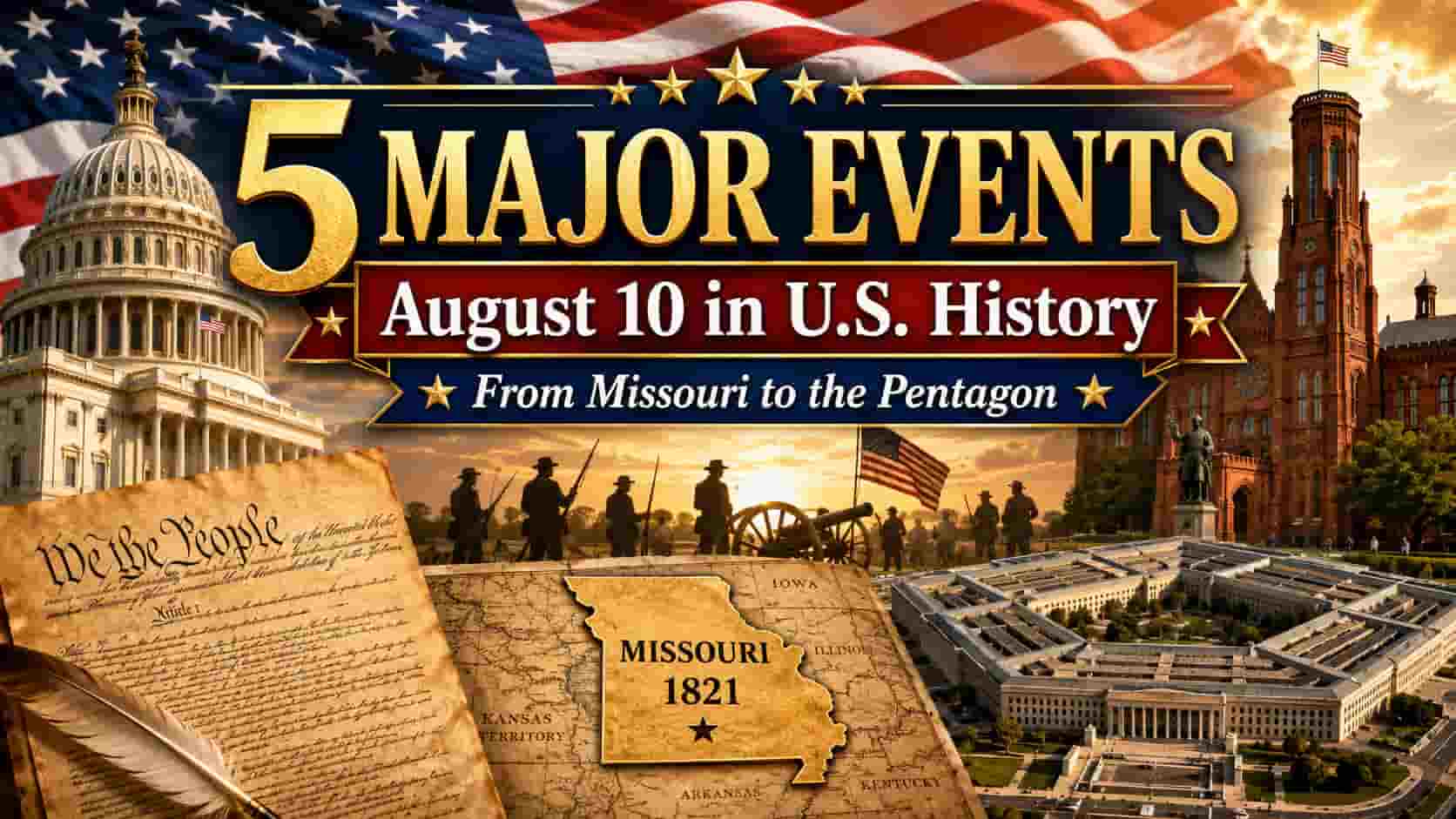
From Missouri statehood to the Smithsonian Institution, the Civil War, the creation of the Department of Defense, and the Gulf of Tonkin Resolution, August 10 has repeatedly marked consequential moments in American history.
For this historical review, Midtown Tribune is looking back more than 50 years. No events after August 10, 1976, are included.
Here are five major events connected to August 10 that helped shape the political, cultural, military, and institutional development of the United States.
1. August 10, 1821 — Missouri Becomes the 24th State
On August 10, 1821, Missouri officially entered the Union as the 24th state.
The date was significant far beyond the addition of another state to the American map.
Missouri’s admission came amid one of the young nation’s most serious political disputes over the expansion of slavery into new states and territories.
The broader political settlement became known as the Missouri Compromise.
Under the compromise, Maine was admitted as a free state while Missouri entered as a slave state, temporarily preserving the political balance between free and slave states in the Senate.
The U.S. Senate describes the Missouri Compromise as one of the major congressional efforts to manage the increasingly dangerous dispute over slavery.
But the compromise did not resolve the underlying conflict.
Four decades later, the United States would be fighting a Civil War over issues that included slavery, federal authority, secession, and the future of the Union.
Missouri itself would become one of the war’s most strategically and politically contested border states.
2. August 10, 1846 — The Smithsonian Institution Is Established
On August 10, 1846, President James K. Polk signed legislation establishing the Smithsonian Institution.
Today, Smithsonian museums are among Washington’s best-known national institutions.
Their origin, however, began with an unusual private gift.
British scientist James Smithson, who had never lived in the United States, left his fortune to the United States for the creation of an institution in Washington devoted to the “increase and diffusion of knowledge.”
According to the Library of Congress, the United States received approximately $508,000 from Smithson’s estate — an extraordinary sum in the nineteenth century.
Congress debated for years over how the money should be used.
Eventually, lawmakers created an institution incorporating museums, collections, research, publications, and educational work.
President Polk signed the establishing legislation on August 10, 1846.
The Smithsonian eventually became one of the world’s most recognizable museum and research systems and remains an example of how a private bequest was transformed into a lasting American public institution.
3. August 10, 1861 — The Battle of Wilson’s Creek
Exactly 40 years after Missouri became a state, Missouri again stood at the center of a major American event.
On August 10, 1861, Union and Southern forces fought the Battle of Wilson’s Creek near Springfield, Missouri.
The National Park Service describes Wilson’s Creek as the first major Civil War battle fought west of the Mississippi River.
The battle was part of a larger struggle over whether Missouri would remain aligned with the Union or fall under Confederate control.
Union Brigadier General Nathaniel Lyon was killed during the fighting, becoming the first Union general killed in action during the Civil War.
Federal forces ultimately withdrew from the battlefield, giving the Southern forces a tactical victory.
But Missouri did not permanently fall under Confederate control.
The state remained one of the most complex battlegrounds of the Civil War, divided politically and militarily between competing loyalties.
There is an extraordinary historical symmetry to the date:
Missouri entered the United States on August 10, 1821. Exactly 40 years later, on August 10, 1861, soldiers fought in Missouri over the future of the Union itself.
4. August 10, 1949 — The Modern Department of Defense Takes Shape
The Pentagon is now one of the most recognizable symbols of American military power.
But the federal department officially known as the Department of Defense took its modern form on August 10, 1949.
That day, President Harry S. Truman signed the National Security Act Amendments of 1949.
The legislation built upon the sweeping national-security restructuring that had begun with the National Security Act of 1947.
Among the most important changes, the National Military Establishment was renamed the Department of Defense.
The amendments also strengthened the authority of the Secretary of Defense and further consolidated the Army, Navy, and Air Force within a unified national defense structure.
The legislation also established the position of Chairman of the Joint Chiefs of Staff.
The changes came at a critical moment.
World War II had ended only four years earlier. The Cold War was intensifying, NATO had been established in 1949, and the Korean War would begin less than a year later.
The August 10 reforms therefore helped create the command and administrative structure that would oversee American military policy throughout the Cold War and beyond.
5. August 10, 1964 — The Gulf of Tonkin Resolution Becomes Law
One of the most consequential August 10 dates in twentieth-century American political history concerns the Vietnam War.
The distinction between the congressional vote and the legal date is important.
Congress approved the Gulf of Tonkin Resolution on August 7, 1964.
However, the official federal statute — Public Law 88-408 — records that it was approved on August 10, 1964.
The resolution authorized President Lyndon B. Johnson to take what it described as necessary measures to repel attacks against U.S. forces and prevent further aggression in Southeast Asia.
It did not constitute a formal congressional declaration of war.
Nevertheless, the Gulf of Tonkin Resolution became the principal congressional authorization used by the Johnson administration as American military involvement in Vietnam expanded dramatically.
Over the following years, hundreds of thousands of American service members were deployed to Vietnam.
The resolution also became central to a much larger constitutional debate:
How much authority should a president possess to wage military operations without a formal declaration of war by Congress?
Congress later repealed the resolution in 1971.
The controversy surrounding Vietnam subsequently contributed to passage of the War Powers Resolution of 1973, an attempt by Congress to reassert its constitutional role in decisions involving prolonged American military action.
Five Dates, Five Different Chapters of America
Taken together, these August 10 anniversaries illustrate nearly a century and a half of American development.
1821: The nation expands — while the conflict over slavery becomes increasingly difficult to contain.
1846: America creates an institution dedicated to science, culture, history, and knowledge.
1861: The Civil War reaches Missouri as Americans fight over the survival of the Union.
1949: The United States reorganizes its military establishment into the modern Department of Defense.
1964: Congress gives the president sweeping authority in Southeast Asia, helping pave the way for a dramatic escalation of the Vietnam War.
They are very different events.
Yet each demonstrates how a single date can connect statehood, knowledge, civil conflict, national defense, and the constitutional limits of presidential power.
And all five occurred on August 10.
Official U.S. Government Sources
Missouri Statehood — U.S. Senate
Official Missouri timeline:
https://www.senate.gov/states/MO/timeline.shtml
Missouri Compromise — U.S. Senate Historical Office
https://www.senate.gov/history/1801.htm
Smithsonian Institution — Library of Congress
History of the legislation establishing the Smithsonian Institution:
https://blogs.loc.gov/law/2023/08/the-smithsonian-institution-the-history-of-the-worlds-largest-museum-and-research-complex/
James Smithson and the Smithsonian — Library of Congress
https://www.loc.gov/item/today-in-history/june-27/
Battle of Wilson’s Creek — National Park Service
https://www.nps.gov/wicr/
Wilson’s Creek Battle History — National Park Service
https://www.nps.gov/wicr/learn/historyculture/brief-account-of-the-battle.htm
National Security Act Amendments of 1949 — Harry S. Truman Presidential Library
President Truman’s statement upon signing the legislation on August 10, 1949:
https://www.trumanlibrary.gov/library/public-papers/177/statement-president-upon-signing-national-security-act-amendments-1949
Department of Defense Reforms — DoD Historical Office
https://history.defense.gov/Historical-Sources/DoD-Reforms/
Gulf of Tonkin Resolution — GovInfo
Public Law 88-408:
https://www.govinfo.gov/app/details/STATUTE-78/STATUTE-78-Pg384
Gulf of Tonkin Resolution — National Archives
https://www.archives.gov/milestone-documents/tonkin-gulf-resolution
Ask Midtown Tribune about this story
Answers are grounded first in this article. Search all Midtown Tribune reporting from the main AI Search page.
AI-generated summary. Verify important details in the linked original articles.