
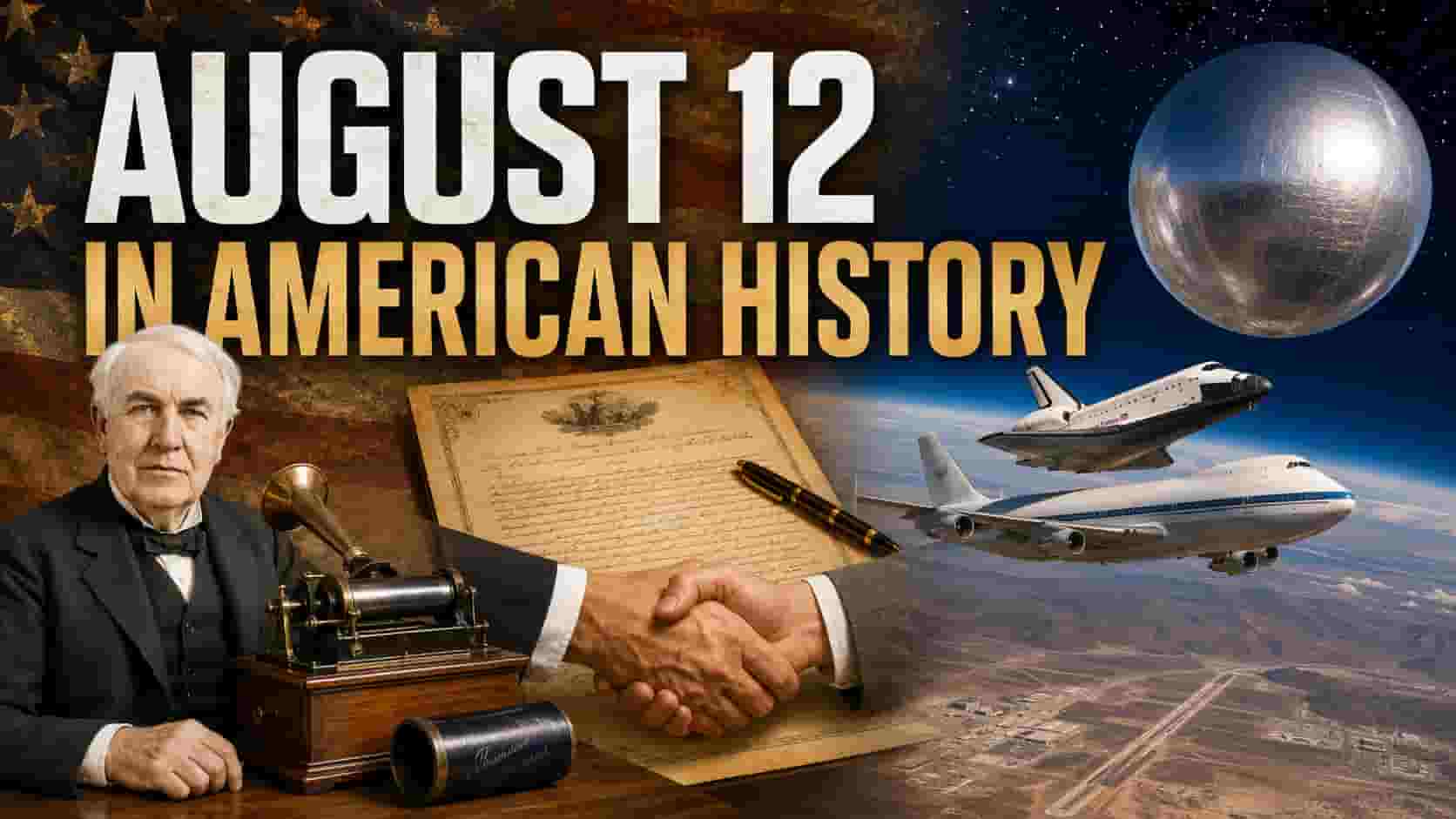
August 12 marks several consequential moments in American history. On this date, a presidential confrontation moved the nation toward its first impeachment, hostilities ended in the Spanish-American War, the federal minimum wage increased, and two pioneering space projects demonstrated technologies that would help reshape modern communications and transportation.
1867: President Andrew Johnson Suspends Secretary of War Edwin Stanton
On August 12, 1867, President Andrew Johnson suspended Secretary of War Edwin M. Stanton and appointed General Ulysses S. Grant as secretary of war ad interim.
The decision came during a bitter confrontation between Johnson and the Republican-controlled Congress over Reconstruction following the Civil War. Stanton supported the congressional approach to Reconstruction and had become one of Johnson’s most powerful opponents inside the administration.
The Senate later refused to approve Stanton’s removal, allowing him to return to office. Johnson subsequently attempted to dismiss him permanently, an action that became the immediate basis for impeachment proceedings.
In 1868, Johnson became the first U.S. president impeached by the House of Representatives. The Senate acquitted him by a margin of only one vote.
The dispute established an enduring constitutional lesson about the balance of power between the president and Congress.
1877: Thomas Edison’s Phonograph Opens a New Era
August 12, 1877, is traditionally recognized as the date Thomas Edison completed the model of his first phonograph—the revolutionary machine that could record and reproduce sound.
The Library of Congress notes that August 12 became the popularly accepted date later, meaning it should not be treated as an indisputably documented completion date. Edison nevertheless developed the phonograph during 1877 and demonstrated that sound could be preserved and played back.
Before the phonograph, a speech, musical performance or other sound disappeared when it ended. Edison’s invention helped create the foundations of recorded music, broadcasting, audiobooks and the modern audio industry.
It was more than a new machine. It changed the relationship between people, information and time by allowing voices and performances to survive beyond the moment in which they were produced.
1898: The United States and Spain Suspend Hostilities
On August 12, 1898, representatives of the United States and Spain signed a peace protocol in Washington that suspended hostilities in the Spanish-American War.
Under the agreement, Spain would relinquish its claim to sovereignty over Cuba, cede Puerto Rico and other islands to the United States, and evacuate its territories in the West Indies. The United States would temporarily occupy Manila while the future of the Philippines was negotiated.
The protocol ended active hostilities, but it was not the final peace treaty. The Treaty of Paris formally ending the war was signed on December 10, 1898.
The conflict became a turning point in American foreign policy. The United States emerged with possessions outside the continental mainland and assumed a substantially larger role in international affairs.
The resulting territorial expansion also produced a national debate over whether America’s constitutional principles were compatible with governing territories beyond its established borders.
1955: The Federal Minimum Wage Rises to One Dollar
On August 12, 1955, President Dwight D. Eisenhower approved amendments to the Fair Labor Standards Act that increased the federal minimum wage from 75 cents to $1 per hour.
The new rate took effect on March 1, 1956. Although the nominal increase was only 25 cents, it represented a 33 percent rise in the minimum hourly wage.
The law, enacted as Public Law 84-381, became an important step in the development of federal labor standards. However, not every worker or occupation was automatically covered. Congress expanded the reach of the Fair Labor Standards Act through later amendments.
The 1955 legislation demonstrated the growing federal role in establishing nationwide workplace standards during America’s postwar economic expansion.
1960: NASA Launches the Echo 1A Communications Satellite
On August 12, 1960, NASA successfully launched Echo 1A, an experimental communications satellite made from a 100-foot-diameter sphere of aluminized Mylar.
Echo did not contain a conventional communications transmitter. Instead, it functioned as a passive reflector. Ground stations transmitted radio signals toward the satellite, and its metallic surface reflected them back to another location on Earth.
The Echo program contributed to the first satellite-relayed voice communications and the first coast-to-coast telephone call using a satellite. President Eisenhower also recorded a message that was transmitted through the project.
Echo helped demonstrate that space-based systems could connect distant parts of the world. The experiment became an important predecessor of the satellite networks now used for television, communications, navigation and internet services.
1977: Space Shuttle Enterprise Makes Its First Free Flight
On August 12, 1977, the prototype Space Shuttle Enterprise completed its first free, crewed flight.
A modified Boeing 747 carried Enterprise to an altitude of approximately 23,000 feet above Edwards Air Force Base in California. The shuttle then separated from the carrier aircraft and, piloted by astronauts Fred Haise and Gordon Fullerton, glided to a successful landing.
Enterprise did not have the engines or thermal protection required for orbital flight. Its purpose was to test the shuttle’s aerodynamics, handling and landing characteristics.
The successful flight demonstrated that the unusual winged spacecraft could return to Earth and land as a heavy glider. Less than four years later, Columbia completed the first orbital mission of the Space Shuttle program.
Why August 12 Matters
The history of August 12 reflects several forces that shaped the United States: the constitutional struggle between Congress and the presidency, America’s emergence as a world power, the expansion of federal labor standards and the ability of American inventors and scientists to transform everyday life.
From Edison’s first experiments with recorded sound to satellite communications and the reusable Space Shuttle, August 12 repeatedly became a date associated with technologies that opened new chapters in American history.
Official Government Sources
- U.S. Senate — Impeachment Trial of President Andrew Johnson
- Library of Congress — Andrew Johnson and Edwin Stanton
- Library of Congress — Mr. Edison’s Phonograph
- Library of Congress — History of the Cylinder Phonograph
- U.S. Department of State — U.S.–Spain Peace Protocol of August 12, 1898
- GovInfo — Fair Labor Standards Amendments of 1955
- U.S. Department of Labor — History of the Federal Minimum Wage
- NASA — Echo 1A and 50 Years of Communications in Space
- NASA — Contributions of the Space Shuttle Approach and Landing Tests
Ask Midtown Tribune about this story
Answers are grounded first in this article. Search all Midtown Tribune reporting from the main AI Search page.
AI-generated summary. Verify important details in the linked original articles.