
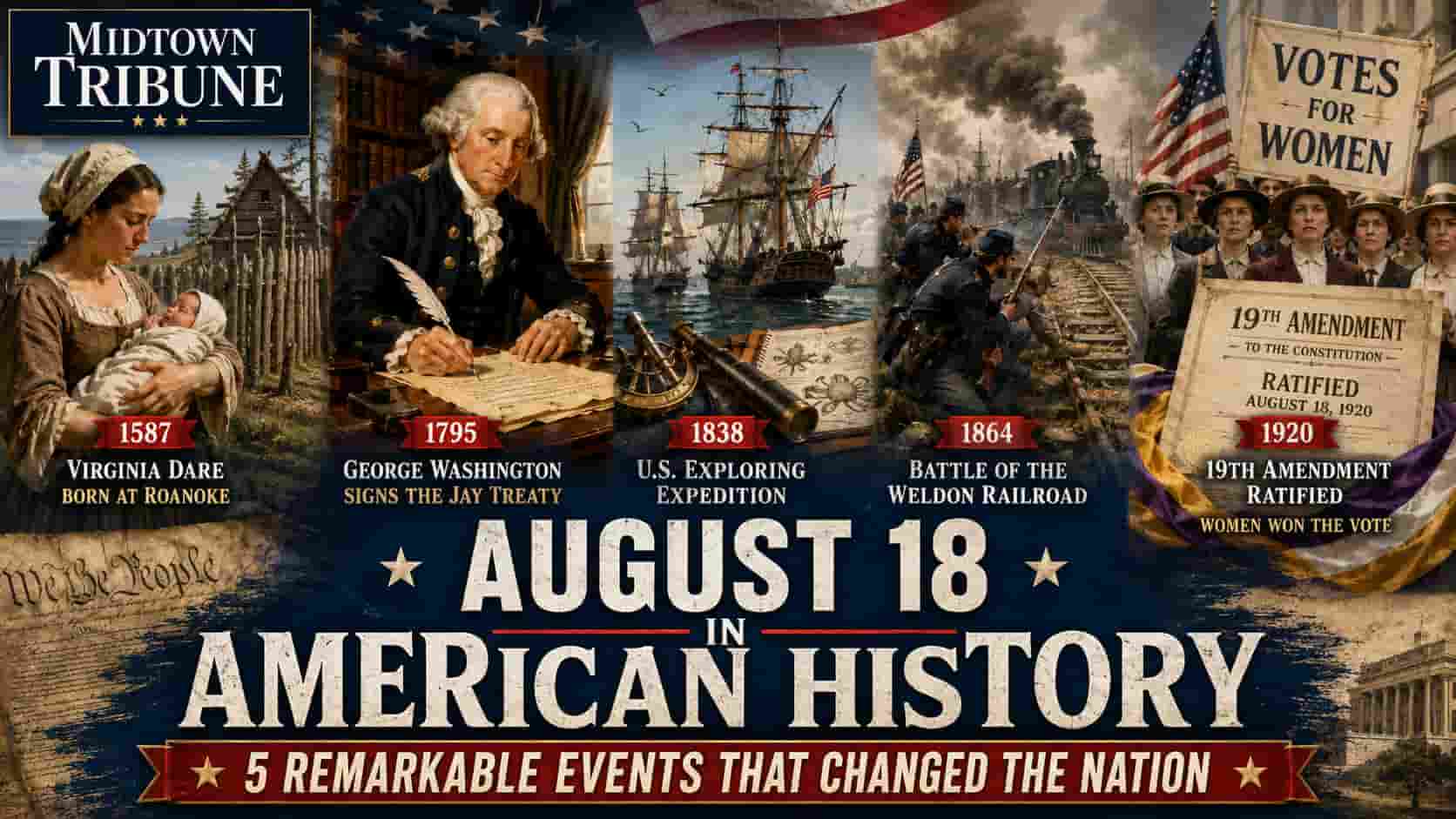
August 18 has marked several turning points in American history — from the mysterious Lost Colony of Roanoke and George Washington’s diplomacy with Great Britain to scientific exploration, the Civil War, and the constitutional expansion of voting rights.
For this historical review, Midtown Tribune used official U.S. government sources only, including the National Park Service, Library of Congress, National Archives, U.S. Department of State, U.S. Navy, and archived White House records.
And because recent political history often dominates anniversary lists, this edition deliberately excludes events from the past 60 years.
1. August 18, 1587 — Virginia Dare Is Born at Roanoke
On August 18, 1587, Virginia Dare was born on Roanoke Island in what is now North Carolina.
The National Park Service identifies her as the first English child born in North America.
Official National Park Service:
https://www.nps.gov/people/virginiadare.htm
Virginia was the daughter of Eleanor and Ananias Dare and the granddaughter of John White, governor of the Roanoke colony.
Her birth occurred during one of the earliest and most mysterious English attempts to establish a permanent settlement in North America.
Just days later, John White sailed for England to obtain supplies.
War between England and Spain delayed his return.
When White finally reached Roanoke again three years later, the colonists — including Virginia and her parents — had disappeared.
Their fate remains one of the great mysteries of early American history.
The settlement became known simply as:
The Lost Colony.
The National Park Service notes that almost nothing certain is known about Virginia Dare after her birth.
Yet her place in American memory became much larger than her brief documented life.
Why does August 18, 1587 matter?
Because Virginia Dare’s birth symbolizes the fragile beginning of the English colonial project that eventually produced permanent colonies along the Atlantic Coast and, almost two centuries later, the United States.
Official source:
National Park Service — Virginia Dare
https://www.nps.gov/people/virginiadare.htm
2. August 18, 1795 — George Washington Signs the Jay Treaty
More than two centuries later, it can be difficult to appreciate how vulnerable the young United States was during George Washington’s presidency.
America had won independence from Great Britain — but another war with the world’s dominant naval power could have been disastrous.
On August 18, 1795, according to the Library of Congress and the White House historical archive, President George Washington signed the Jay Treaty with Great Britain.
Library of Congress:
https://www.loc.gov/collections/george-washington-papers/articles-and-essays/timeline/the-early-republic/
Archived White House history:
https://georgewbush-whitehouse.archives.gov/history/thisday/0818.html
The treaty was named for John Jay, the first Chief Justice of the United States, whom Washington sent to Britain to negotiate.
The two countries still had serious disputes left unresolved after the American Revolution.
Britain continued to occupy military posts in the Northwest Territory.
American and British merchants disputed Revolutionary War debts.
British forces interfered with American shipping.
And war remained a real possibility.
The U.S. Department of State’s Office of the Historian explains that Washington accepted a treaty that was politically unpopular because he believed it would preserve peace with Britain and give the young United States time to consolidate and strengthen itself.
Official State Department history:
https://history.state.gov/milestones/1784-1800/jay-treaty
The treaty helped secure British evacuation of western forts and established mechanisms for resolving several disputes.
But its significance went beyond diplomacy.
The fight over Jay’s Treaty intensified the division between the emerging Federalists and Democratic-Republicans, helping shape America’s first party system.
In other words, August 18, 1795 was not merely about Britain.
It was also about a larger question that has existed throughout American history:
How should a young republic balance principle, national interest, public opinion, and the risk of war?
Washington chose peace.
And the United States gained valuable time to grow stronger.
3. August 18, 1838 — America Launches a Global Scientific Expedition
On August 18, 1838, six U.S. Navy ships departed Norfolk, Virginia, beginning one of the most ambitious scientific voyages ever undertaken by the young United States.
The Naval History and Heritage Command records that the expedition carried 424 officers and crewmen.
Official U.S. Navy source:
https://www.history.navy.mil/our-collections/art/exhibits/exploration-and-technology/alfred-agate-collection/1839.html
The mission became known as the United States Exploring Expedition, or the Wilkes Expedition, after its commander, Lieutenant Charles Wilkes.
It would spend four years traveling around the world.
The expedition surveyed parts of:
- Antarctica;
- the South Pacific;
- Fiji;
- Hawaii;
- the Pacific Northwest;
- the Columbia River;
- and other regions important to American navigation and expansion.
The Library of Congress explains that Wilkes’s expedition mapped hundreds of miles of the Pacific Northwest and gathered enormous quantities of scientific information.
Official Library of Congress:
https://www.loc.gov/exhibits/lewisandclark/lewis-after.html
But one of its most important legacies was what the expedition brought home.
Its scientists collected huge numbers of:
- plants;
- animals;
- shells;
- minerals;
- ethnographic objects;
- geological specimens;
- scientific observations.
Many of those collections eventually became foundational holdings of what developed into the Smithsonian Institution’s National Museum of Natural History.
The expedition was therefore not simply a naval adventure.
It helped transform the United States into a country capable of conducting major government-sponsored scientific research on a global scale.
It also contributed to American geographic knowledge at a time when the nation was expanding toward the Pacific.
August 18, 1838 represented a growing American ambition:
not merely to occupy territory, but to map, measure, document and understand the world.
4. August 18, 1864 — Union Forces Strike the Weldon Railroad
On August 18, 1864, during the Civil War siege of Petersburg, Virginia, Union forces under Major General Gouverneur K. Warren moved against the Weldon Railroad.
The National Park Service documents the battle in detail.
Official National Park Service:
https://www.nps.gov/pete/learn/historyculture/battle-of-weldon-railroad.htm
At dawn, Warren’s V Corps, supported by elements of other Union formations, advanced toward the railroad.
By about 9 a.m., Union troops had reached Globe Tavern and began tearing up the rail line.
At first, the operation was intended as a relatively limited raid.
But Ulysses S. Grant recognized an opportunity.
Rather than withdraw after damaging the railroad, Union forces remained in position and extended their siege lines.
The Confederates repeatedly attempted to drive them away.
They failed.
The result was strategically important.
The Weldon Railroad connected Petersburg with Wilmington, North Carolina, one of the Confederacy’s most important remaining supply points.
After Union forces secured the position, Robert E. Lee’s army could no longer use that direct rail connection into Petersburg.
According to the National Park Service, Confederate supplies had to be unloaded farther south and transported roughly 30 miles by wagon.
That increased the logistical pressure on Lee’s army.
The Petersburg campaign was fundamentally a war of supply and endurance.
Cutting the Weldon Railroad helped tighten Grant’s grip around the Confederate capital region.
The Confederacy would survive for several more months.
But the strategic noose was closing.
The fighting that began on August 18 therefore contributed to the chain of events that ultimately led to the fall of Petersburg and Richmond — and to Lee’s surrender at Appomattox in April 1865.
5. August 18, 1920 — The 19th Amendment Reaches the Ratification Threshold
Perhaps the most consequential August 18 event in American constitutional history occurred in 1920.
On that day, Tennessee became the 36th state to ratify the 19th Amendment.
That provided the three-fourths majority of states required by the Constitution.
The National Archives states:
The 19th Amendment was ratified on August 18, 1920.
Official National Archives:
https://www.archives.gov/milestone-documents/19th-amendment
The amendment declares:
“The right of citizens of the United States to vote shall not be denied or abridged by the United States or by any State on account of sex.”
The struggle had lasted for generations.
Congress had first considered a federal women’s suffrage amendment decades earlier.
Congress finally approved the proposed constitutional amendment in 1919 and sent it to the states.
By the summer of 1920, supporters had secured 35 state ratifications.
They needed one more.
Everything came down to Tennessee.
The U.S. Senate’s official historical account explains that Tennessee became the decisive 36th state on August 18.
Official U.S. Senate:
https://www.senate.gov/about/women-of-the-senate/part3-the-last-trench.htm
One of the most remarkable stories from the vote involved Harry Burn, a 24-year-old Tennessee legislator.
Burn had been expected to oppose ratification.
But he received a letter from his mother urging him to support women’s suffrage.
He changed his vote.
The National Archives preserves the history of that dramatic episode.
https://www.archives.gov/education/lessons/woman-suffrage
The amendment was formally certified several days later, on August 26.
But August 18 was the decisive constitutional moment.
The result changed American elections permanently.
Millions of women gained constitutional protection against voting discrimination based on sex and participated in the presidential election that fall.
The National Archives also correctly notes an important historical limitation: the amendment did not immediately overcome every barrier faced by Black women, Native Americans and other groups whose voting rights continued to be obstructed through other laws and practices.
Nevertheless, August 18, 1920 fundamentally expanded the American electorate.
Five Dates — Five Different Versions of America
These five August 18 events span more than three centuries.
1587: an infant is born in a precarious English colony whose inhabitants will mysteriously disappear.
1795: George Washington chooses diplomacy with Britain rather than risk another potentially devastating war.
1838: U.S. Navy ships leave Virginia on an expedition that expands American science and geographic knowledge.
1864: Union forces sever a vital Confederate railroad during the campaign that will help bring the Civil War toward its conclusion.
1920: Tennessee supplies the decisive vote needed to ratify the 19th Amendment.
The events have very little in common on the surface.
But together they illustrate several recurring themes of American history:
Settlement.
National survival.
Exploration.
Union.
Constitutional rights.
August 18 is therefore more than another date on the calendar.
It is a reminder that the United States was built through a long sequence of decisions, risks, conflicts and constitutional changes — many of which were far from inevitable when they occurred.
Official Government Sources
National Park Service — Virginia Dare
https://www.nps.gov/people/virginiadare.htm
Library of Congress — Washington Signs Jay’s Treaty
U.S. Department of State — Jay’s Treaty, 1794–95
https://history.state.gov/milestones/1784-1800/jay-treaty
White House Historical Archive — August 18, 1795
https://georgewbush-whitehouse.archives.gov/history/thisday/0818.html
Naval History and Heritage Command — U.S. Exploring Expedition
Library of Congress — Wilkes Exploring Expedition
https://www.loc.gov/exhibits/lewisandclark/lewis-after.html
National Park Service — Battle of the Weldon Railroad
https://www.nps.gov/pete/learn/historyculture/battle-of-weldon-railroad.htm
National Archives — 19th Amendment
https://www.archives.gov/milestone-documents/19th-amendment
U.S. Senate — Ratification of the 19th Amendment
https://www.senate.gov/about/women-of-the-senate/part3-the-last-trench.htm
National Archives — Woman Suffrage and the 19th Amendment
https://www.archives.gov/education/lessons/woman-suffrage
Official Government Sources
- National Park Service — Virginia Dare, August 18, 1587
- Library of Congress — George Washington and Jay’s Treaty
- U.S. Department of State — John Jay’s Treaty, 1794–95
- White House Historical Archive — August 18, 1795
- U.S. Naval History and Heritage Command — United States Exploring Expedition
- Library of Congress — The Wilkes Exploring Expedition
- National Park Service — Battle of the Weldon Railroad, August 18, 1864
- National Archives — 19th Amendment to the U.S. Constitution
- United States Senate — Ratification of the 19th Amendment
- National Archives — Woman Suffrage and the 19th Amendment
Ask Midtown Tribune about this story
Answers are grounded first in this article. Search all Midtown Tribune reporting from the main AI Search page.
AI-generated summary. Verify important details in the linked original articles.