
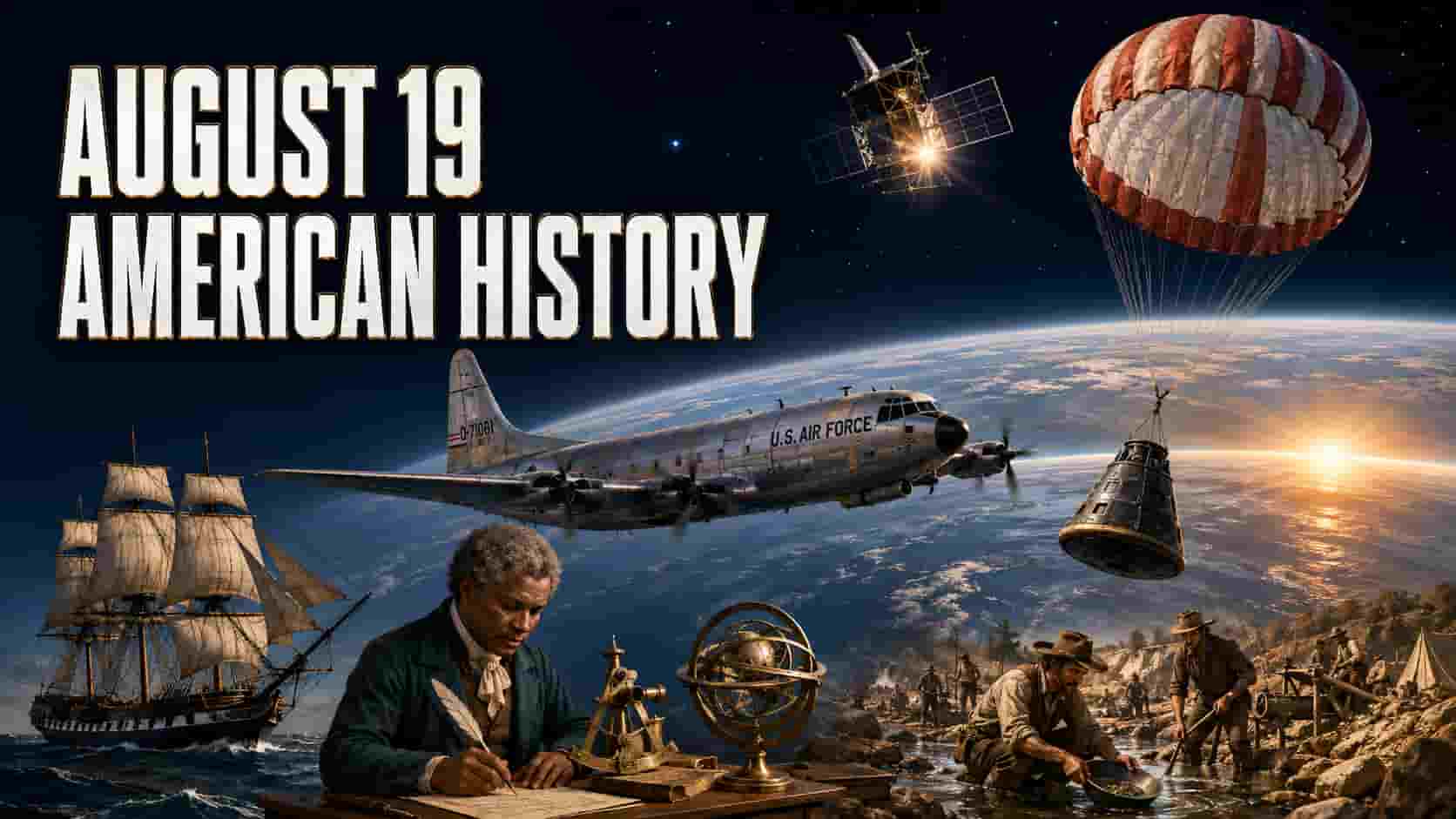
From Benjamin Banneker’s challenge to Thomas Jefferson and the birth of “Old Ironsides” to the California Gold Rush and America’s early triumphs in space, August 19 has repeatedly marked turning points in the nation’s history.
American history is rarely transformed in a single moment. More often, the country changes through courageous words, military victories, technological breakthroughs and news that inspires millions of people to pursue a new future.
Here are five remarkable events that occurred on August 19 and left a lasting mark on the United States.
1. 1791 — Benjamin Banneker Challenges Thomas Jefferson on Slavery
On August 19, 1791, Benjamin Banneker, a free Black mathematician, astronomer and surveyor from Maryland, sent Secretary of State Thomas Jefferson a manuscript copy of his first almanac.
The package also contained a forceful letter challenging Jefferson to reconcile the Declaration of Independence’s promise that “all men are created equal” with the continued enslavement of African Americans.
Banneker argued that Black Americans possessed the same intellectual abilities and natural rights as other people. His own astronomical calculations and almanac served as direct evidence against the racial assumptions of the period.
Jefferson answered on August 30, acknowledging Banneker’s accomplishments and stating that he wished to see proof that Black people possessed talents equal to those of other men. However, as the Library of Congress notes, Jefferson did not provide the practical assistance against slavery that Banneker requested.
The correspondence became an important early American confrontation between the nation’s founding ideals and its treatment of Black citizens. It also established Banneker as one of the most notable African American intellectuals of the early republic.
Official source: Library of Congress — Benjamin Banneker and Thomas Jefferson
2. 1812 — USS Constitution Defeats HMS Guerriere and Becomes “Old Ironsides”
On August 19, 1812, during the War of 1812, the American frigate USS Constitution, commanded by Captain Isaac Hull, encountered the British warship HMS Guerriere in the North Atlantic.
The British Royal Navy was considered the world’s dominant naval force. Yet in a fierce engagement, the American ship’s heavy construction and powerful guns overwhelmed its opponent. USS Constitution dismasted Guerriere, forcing the British vessel to surrender.
During the battle, British cannonballs appeared to bounce off the American frigate’s oak hull. According to the ship’s enduring legend, a sailor exclaimed that her sides were made of iron. The nickname “Old Ironsides” was born.
The victory was militarily limited, but its psychological impact was enormous. At a time when the United States had suffered several setbacks on land, the triumph demonstrated that the young republic could successfully challenge Britain at sea.
USS Constitution remains a commissioned U.S. Navy warship and one of the most recognizable symbols of American naval history.
Official source: Naval History and Heritage Command — USS Constitution vs. HMS Guerriere
3. 1848 — News of California Gold Reaches the East Coast
Gold was discovered at Sutter’s Mill in California in January 1848, but information traveled slowly across the continent. On August 19, the New York Herald published a report bringing the discovery to a massive East Coast audience.
According to the Library of Congress, by 1849 the great rush westward was underway.
The news helped trigger one of the largest migrations in American history. Hundreds of thousands of fortune seekers—later known as the “Forty-Niners”—traveled to California from across the United States and around the world.
The Gold Rush accelerated California’s admission to the Union in 1850, expanded American commerce on the Pacific and contributed to the rapid growth of San Francisco. It also intensified national arguments over whether slavery would be permitted in newly organized Western territories.
The consequences were not positive for everyone. Native communities were displaced and devastated, while mining caused lasting environmental damage. Nevertheless, the Gold Rush fundamentally altered the nation’s population, economy and geographic center of gravity.
Official source: Library of Congress — News of the California Gold Rush Reaches the East Coast
4. 1960 — America Makes the First Midair Recovery of an Object Returning from Orbit
On August 19, 1960, a specially equipped U.S. Air Force C-119 aircraft caught the returning capsule from Discoverer XIV approximately 8,500 feet above the Pacific Ocean.
It was the first successful aerial recovery of an object returning from Earth orbit.
Discoverer XIV was publicly presented as a scientific satellite, but it was part of CORONA, America’s first operational photographic reconnaissance satellite program. The spacecraft carried film that photographed areas of the Soviet Union and other strategically important locations. Because digital transmission technology was not yet available, the exposed film had to be physically returned to Earth.
After the capsule was released from orbit, it descended by parachute. An aircraft then captured it in midair using a recovery apparatus extended behind the plane.
The achievement gave the United States a revolutionary new intelligence capability during the Cold War. Satellite photography could reveal military installations, missile sites and other developments in areas that were difficult or dangerous for aircraft to reach.
CORONA helped establish the foundation for modern American reconnaissance satellites and demonstrated that valuable material could be safely returned from space.
Official source: CIA Historical Records — CORONA Program and Discoverer XIV
5. 1964 — NASA Launches Syncom III, the First Geostationary Communications Satellite
On August 19, 1964, NASA launched Syncom III from Cape Kennedy, Florida.
Syncom III became the first communications satellite placed in a geostationary orbit. At that altitude, the satellite traveled around Earth at the same rate that the planet rotated, allowing it to remain positioned over approximately the same area of the globe.
This was a major breakthrough. Earlier satellites moved across the sky, forcing ground stations to track them and limiting the time available for communication. A geostationary satellite could provide continuous coverage to a large region.
Syncom III transmitted television coverage of the 1964 Olympic Games in Tokyo across the Pacific, demonstrating the potential for live global broadcasting.
The technology pioneered by Syncom helped create the modern satellite communications system used for television, weather monitoring, telephone service, navigation, military operations and internet connectivity.
Official source: NASA — The First Geosynchronous Satellite Program
Five Events, One Continuing American Story
The events of August 19 reflect several forces that have repeatedly shaped the United States: the struggle to honor its founding principles, the defense of national independence, westward expansion and the pursuit of technological leadership.
Benjamin Banneker demanded that America live by its declaration of equality. USS Constitution gave the young republic confidence against a global power. News of California gold redirected the nation toward the Pacific. Discoverer XIV transformed intelligence gathering, while Syncom III helped make instant global communication possible.
Separated by nearly two centuries, these five events illustrate how an argument, a naval battle, a newspaper report and two spacecraft each helped change the direction of the nation.
Frequently Asked Questions
What five events are featured in this article?
The article covers Benjamin Banneker’s 1791 letter to Thomas Jefferson, USS Constitution’s victory over HMS Guerriere in 1812, the East Coast publication of news about California gold in 1848, the recovery of the Discoverer XIV capsule in 1960, and the launch of the Syncom III communications satellite in 1964.
Why was USS Constitution nicknamed “Old Ironsides”?
During the battle on August 19, 1812, British cannonballs reportedly appeared to bounce off the American frigate’s heavy oak hull. The ship consequently became famous as Old Ironsides.
How did the August 19, 1848, report influence the California Gold Rush?
Publication of the gold discovery brought the news to a large East Coast audience. It helped encourage mass migration westward and accelerated California’s population and economic growth.
What made Discoverer XIV historically important?
On August 19, 1960, an aircraft successfully caught the returning Discoverer XIV capsule as it descended by parachute. It was the first successful aerial recovery of an object returning from orbit and an important achievement for America’s CORONA satellite reconnaissance program.
Why was the launch of Syncom III important?
Launched on August 19, 1964, Syncom III became the first geostationary communications satellite. The technology helped establish the foundation for global television broadcasting and modern satellite communications.
Official Historical Sources
- Library of Congress — Benjamin Banneker and Thomas Jefferson
- Naval History and Heritage Command — USS Constitution vs. HMS Guerriere
- Library of Congress — California Gold Rush News Reaches the East Coast
- CIA Historical Records — CORONA and Discoverer XIV
- NASA — The Syncom Communications Satellite Program
Ask Midtown Tribune about this story
Answers are grounded first in this article. Search all Midtown Tribune reporting from the main AI Search page.
AI-generated summary. Verify important details in the linked original articles.