
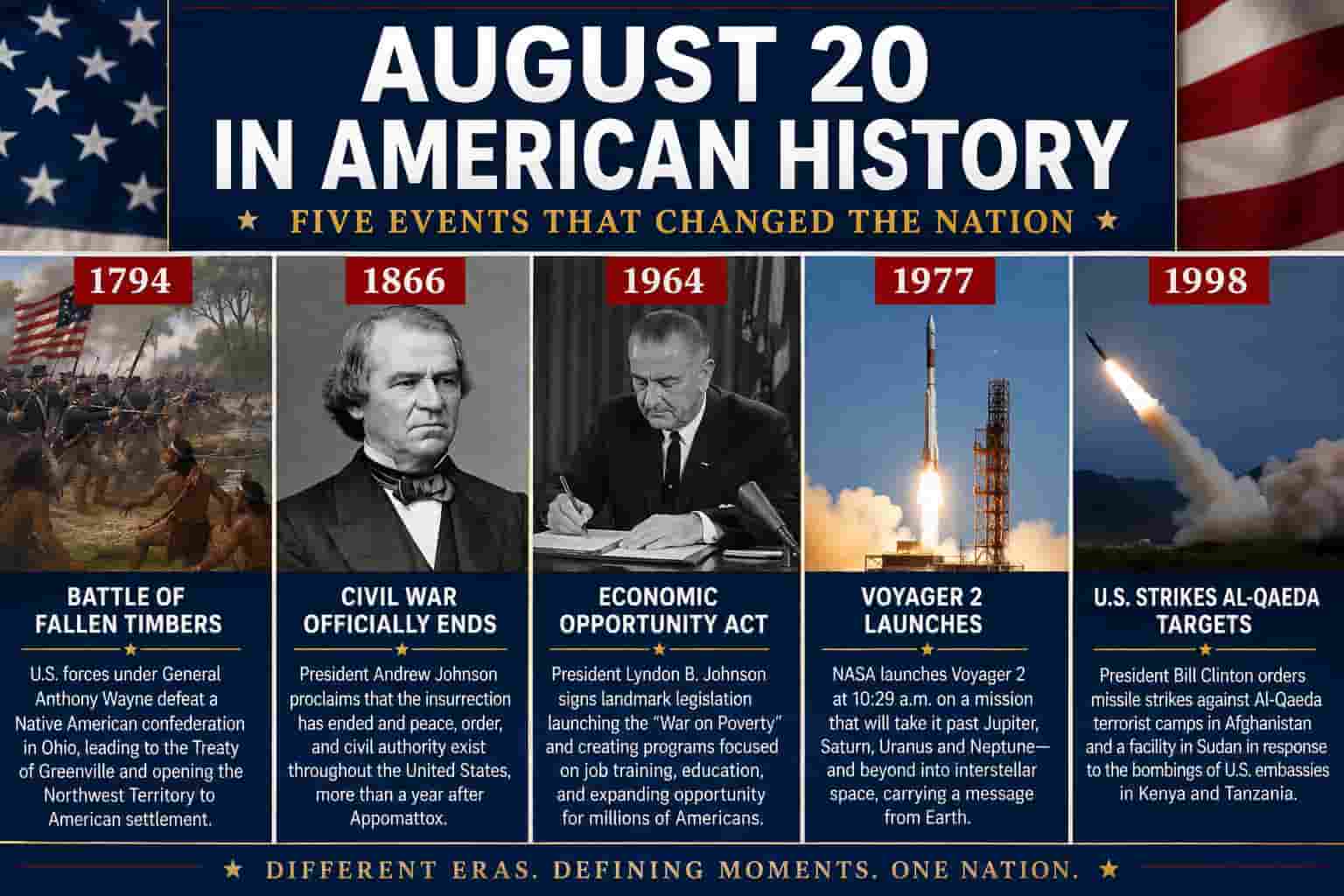
From the Battle of Fallen Timbers to Voyager 2 and America’s early military response to Osama bin Laden, August 20 has repeatedly marked turning points in U.S. history.
August 20 is not one of the dates most Americans immediately recognize.
Yet across more than two centuries, events on this day helped reshape the country’s borders, formally close the Civil War, transform federal social policy, expand America’s reach into the solar system, and redefine the emerging fight against international terrorism.
Here are five major events that happened on August 20 and changed the United States.
1. 1794 — The Battle of Fallen Timbers Reshapes the American West
On August 20, 1794, U.S. forces commanded by Major General Anthony Wayne fought a confederation of Native American nations near present-day Toledo, Ohio.
The battle followed years of violent conflict over control of the Northwest Territory.
According to the National Park Service, Wayne’s Legion of the United States defeated a Native confederation that included Shawnee, Miami, Wyandot and other nations. The American victory helped lead to the Treaty of Greenville in 1795.
Under that treaty, Native nations ceded extensive territory in what is now Ohio and other parts of the Midwest.
The consequences were enormous.
The victory strengthened federal authority in the Northwest Territory and accelerated American settlement westward. But it also came at a profound cost to Native nations whose lands were increasingly transferred to the expanding United States.
The Battle of Fallen Timbers therefore represents both the consolidation of the young American republic and one of the defining episodes in the displacement of Native peoples during U.S. expansion.
Why it mattered: Fallen Timbers helped establish federal control over a strategically important region and opened the way for a major expansion of American settlement.
2. 1866 — President Andrew Johnson Formally Declares the Civil War Over
General Robert E. Lee surrendered the Army of Northern Virginia at Appomattox in April 1865.
But legally and militarily, the Civil War did not simply end that afternoon.
Confederate forces surrendered at different times, and fighting and political instability continued in other parts of the country.
It was not until August 20, 1866 — sixteen months after Appomattox — that President Andrew Johnson formally proclaimed that the insurrection had ended throughout the United States.
The National Archives notes that Johnson’s proclamation formally announced the end of the Civil War.
The proclamation specifically declared that the rebellion in Texas had ended and that:
“peace, order, tranquillity, and civil authority” existed throughout the United States.
The date is important because it illustrates the difference between a famous battlefield surrender and the formal legal conclusion of a national conflict.
The country that emerged from the Civil War was radically different from the one that entered it.
Slavery had been abolished through the 13th Amendment. Reconstruction was underway. The federal government was confronting fundamental questions about citizenship, voting rights, federal power and the future of the former Confederate states.
Why it mattered: August 20, 1866 marked the federal government’s formal declaration that the Civil War was over — and the beginning of a new political struggle over Reconstruction.
3. 1964 — Lyndon Johnson Signs the Economic Opportunity Act
On August 20, 1964, President Lyndon B. Johnson signed the Economic Opportunity Act of 1964, one of the central laws of his administration’s “War on Poverty.”
The legislation stated that its purpose was to mobilize the country’s human and financial resources to combat poverty. It established the Office of Economic Opportunity and created or supported programs focused on job training, education and community-based anti-poverty initiatives.
Johnson described the law not as a permanent welfare payment, but as an effort to expand opportunity.
The legislation became one of the foundations of the Great Society era.
Among the initiatives associated with the Economic Opportunity Act were programs such as the Job Corps, Community Action Programs and other federal efforts aimed at employment, education and poverty reduction.
The law also represented a major philosophical expansion of Washington’s role in social and economic policy.
Supporters saw it as a federal effort to give poor Americans access to education and employment.
Critics argued that expanding federal anti-poverty programs risked bureaucracy, dependency and excessive centralized government.
That argument has never really disappeared.
More than six decades later, the proper role of Washington in fighting poverty remains one of the defining divisions in American politics.
Why it mattered: The Economic Opportunity Act transformed federal anti-poverty policy and helped establish institutions whose descendants continue to operate today.
4. 1977 — Voyager 2 Begins an Extraordinary Journey
At 10:29 a.m. on August 20, 1977, NASA launched Voyager 2 from Cape Canaveral, Florida, aboard a Titan-Centaur rocket.
Nearly half a century later, the spacecraft remains one of the greatest engineering achievements in American history.
Voyager 2 eventually flew past Jupiter, Saturn, Uranus and Neptune.
It remains the only spacecraft ever to visit Uranus and Neptune at close range.
During its journey, Voyager 2 discovered new moons, studied planetary rings and magnetic fields, and returned images that fundamentally changed scientists’ understanding of the outer solar system.
NASA says the spacecraft later entered interstellar space, becoming only the second human-made object to do so.
Voyager 2 also carries the famous Golden Record, containing sounds and images selected to represent Earth and humanity in case the spacecraft is ever encountered by another civilization.
There is something remarkable about the scale of the project.
A machine designed and built in the 1970s traveled billions of miles from Earth and continued communicating across interstellar distances decades later.
Why it mattered: Voyager 2 expanded human knowledge beyond anything previously possible and became a lasting symbol of American scientific and technological ambition.
5. 1998 — The United States Strikes Osama bin Laden’s Network
On August 20, 1998, President Bill Clinton ordered U.S. military strikes against targets in Afghanistan and Sudan following the August 7 bombings of the U.S. embassies in Nairobi, Kenya, and Dar es Salaam, Tanzania.
The embassy attacks had killed more than 200 people and injured thousands.
In an address to the nation, Clinton said the United States had struck facilities connected to Osama bin Laden’s network, which the administration held responsible for the embassy attacks.
Cruise missiles targeted terrorist training facilities in Afghanistan and a facility in Sudan that the administration said was connected to chemical-weapons production.
In a subsequent report to Congress, Clinton stated that U.S. forces had attacked camps and installations used by the bin Laden organization in Afghanistan and a facility in Sudan.
Viewed from today, the date has special significance.
This was three years before the September 11, 2001 terrorist attacks.
By August 1998, the United States already publicly identified bin Laden as a major threat to American national security and was using military force against his network.
The operation therefore belongs to the history of America’s developing confrontation with al-Qaeda long before 9/11 transformed U.S. foreign and national-security policy.
The Sudan strike also became controversial, with later debate over the intelligence used to identify the targeted pharmaceutical facility.
Why it mattered: The August 20 strikes demonstrated that the United States had already entered a direct military confrontation with bin Laden’s terrorist network years before 9/11.
Five Dates, Five Different Americas
The five events could hardly be more different.
1794: the United States was still fighting to establish control over its western frontier.
1866: the country formally emerged from its bloodiest internal war.
1964: Washington dramatically expanded the federal government’s role in fighting poverty.
1977: American technology carried a spacecraft toward worlds no human-made object had ever visited.
1998: the United States launched missiles at a terrorist network whose name would soon become known around the world.
Together, they show how much of American history can be hidden inside a single date.
August 20 tells a story about territory, war, government, science and national security — five recurring themes that continue to shape the United States today.
Official Sources
- National Park Service — Battle of Fallen Timbers
- National Archives — Civil War Surrenders and Formal End of the War
- Congress.gov — Economic Opportunity Act of 1964
- LBJ Presidential Library — Remarks Upon Signing the Economic Opportunity Act
- NASA — Voyager 2
- GovInfo — President Clinton’s August 20, 1998 Address on Military Action in Afghanistan and Sudan
Midtown Tribune Editorial Note: Dates and central factual claims in this article were checked against U.S. government records and official historical sources, including the National Archives, National Park Service, Congress, NASA, presidential records and GovInfo.
Ask Midtown Tribune about this story
Answers are grounded first in this article. Search all Midtown Tribune reporting from the main AI Search page.
AI-generated summary. Verify important details in the linked original articles.