
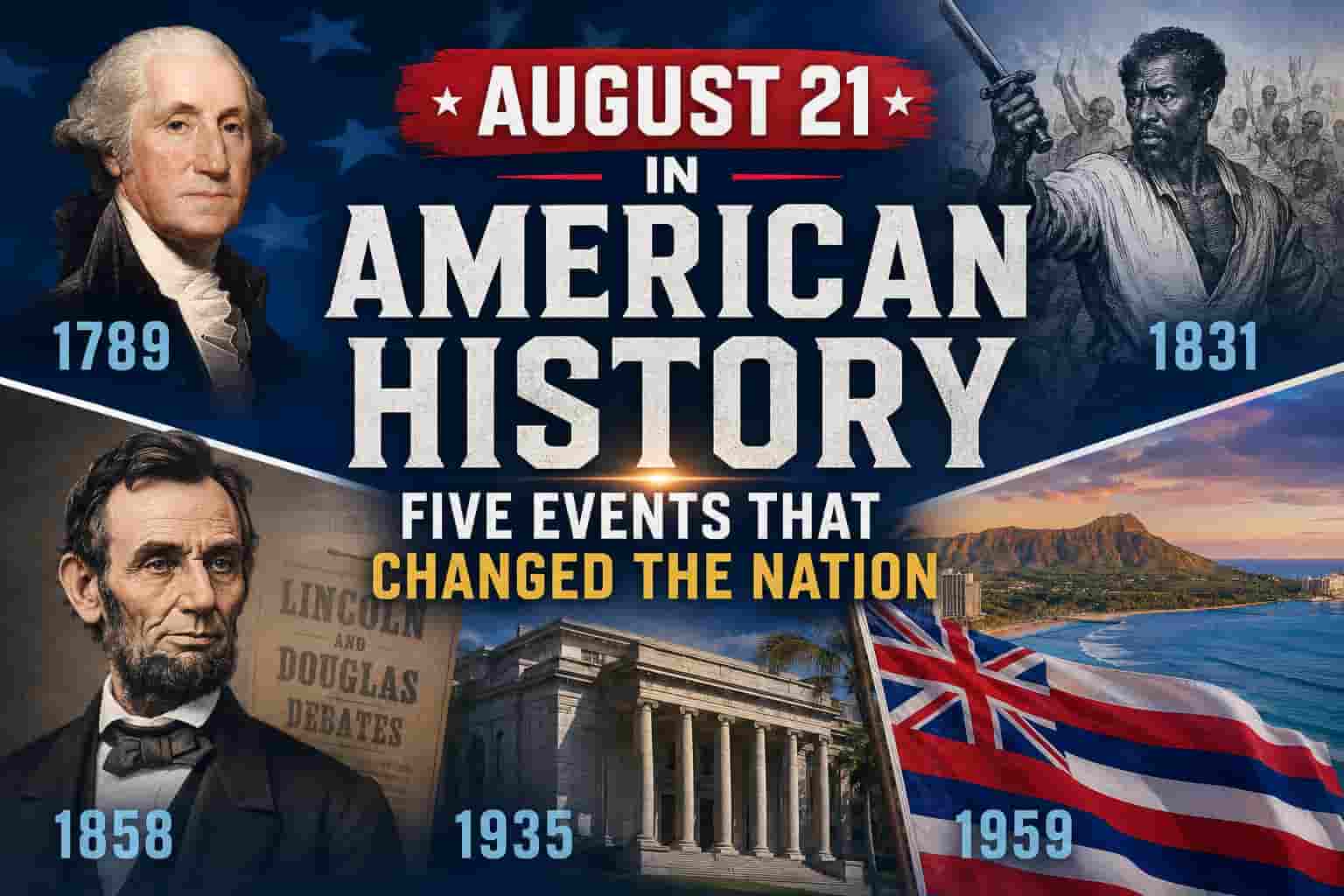
From George Washington defining the relationship between the presidency and the Senate to Hawaii becoming the 50th state, August 21 has repeatedly marked turning points in the American story.
Here are five significant events that occurred on August 21 — each leaving a lasting mark on American government, politics, civil rights, or national identity.
1. August 21, 1789 — George Washington Tests the Constitution’s Treaty System
The Constitution had been in operation for only a few months when President George Washington confronted a basic question: What exactly did it mean for the president to make treaties with the Senate’s “Advice and Consent”?
On August 21, 1789, Washington’s secretary, Tobias Lear, informed the Senate that the president intended to appear before senators the following day to consult with them about negotiations with Native American nations in the South.
The Senate had adopted a resolution that same day establishing a procedure for receiving the president in its chamber.
Washington appeared personally on August 22 with Secretary of War Henry Knox and presented senators with questions concerning the proposed negotiations.
The experiment was historically important. The Constitution created a system in which the president negotiates treaties but cannot ratify them without Senate approval. Washington initially interpreted “advice” quite literally — as consultation between the executive and senators.
The practice of presidents personally appearing before the Senate to negotiate treaty details did not become the norm, but the constitutional division of authority remains fundamental to American foreign policy.
According to the U.S. Senate Historical Office, Washington’s personal appearance before the Senate was an early experiment in defining how the Constitution’s treaty-making provisions would function in practice.
Why it mattered: The first administration was not simply operating under established presidential traditions — it was creating them.
Official source: U.S. Senate — Treatymaking Power and George Washington’s Visit to the Senate
2. August 21, 1831 — Nat Turner’s Rebellion Begins in Virginia
On the night of August 21, 1831, Nat Turner, an enslaved preacher in Southampton County, Virginia, began what became one of the deadliest slave rebellions in American history.
Turner and a small group initially moved from plantation to plantation. The rebellion expanded as additional enslaved men joined them.
Nearly 60 white people were killed before local militia and armed residents suppressed the uprising.
The response was also extraordinarily violent. Black Americans — including people who had not participated in the rebellion — were killed during the retaliation. Turner escaped capture for more than two months before being arrested, tried and executed.
But the consequences extended far beyond Southampton County.
The rebellion intensified fears among Southern slaveholders and contributed to the adoption of harsher restrictions governing enslaved and free Black Americans, including restrictions involving education, assembly and communication.
The uprising also became part of the increasingly explosive national argument over slavery — an argument that ultimately could not be resolved through ordinary political compromise.
The National Park Service describes Nat Turner’s rebellion as one of the events that deepened the sectional crisis over slavery in the decades leading to the Civil War.
Why it mattered: Nat Turner’s rebellion exposed both the violence inherent in slavery and the increasingly unstable political system built around it, three decades before the Civil War.
Official source: National Park Service — The Road to Secession: Nat Turner’s Rebellion
3. August 21, 1858 — Lincoln and Douglas Hold Their First Great Debate
On August 21, 1858, Abraham Lincoln and Senator Stephen A. Douglas met in Ottawa, Illinois, for the first of the seven Lincoln-Douglas debates.
The immediate prize was an Illinois seat in the United States Senate.
The historical consequences were much larger.
According to the National Park Service, the Lincoln-Douglas debates became one of the defining political confrontations of the pre-Civil War era.
Between 10,000 and 12,000 people attended the first debate.
The central political question dividing Lincoln and Douglas was slavery and, in particular, whether slavery should be permitted to expand into U.S. territories.
Douglas accused Lincoln and the emerging Republican movement of radical abolitionism. Lincoln, in turn, argued that Douglas’s political approach could contribute to the national expansion of slavery.
The debates became a national political spectacle.
Lincoln ultimately lost the 1858 Senate contest to Douglas. Yet the debates transformed him from a prominent Illinois politician into a national political figure.
Just two years later, Republicans nominated Lincoln for president.
He won the election of 1860.
The secession crisis and Civil War followed.
The National Park Service’s Lincoln Home National Historic Site notes that the debates helped propel Lincoln onto the national political stage and contributed to his rise toward the presidency.
Why it mattered: A Senate campaign that Lincoln technically lost helped create the national political figure who would become the 16th president of the United States.
Official source: National Park Service — Lincoln-Douglas Debates of 1858
4. August 21, 1935 — America Makes Historic Preservation a National Policy
On August 21, 1935, President Franklin D. Roosevelt approved the Historic Sites Act of 1935.
Its importance is easy to underestimate.
The law established as national policy the preservation of historic American sites, buildings and objects of national significance for the benefit of the American people.
The legislation greatly strengthened the federal government’s role in identifying, documenting and protecting the physical evidence of American history.
Its legacy contributed to programs that would eventually include the National Historic Landmarks Program and the National Register of Historic Places, along with major federal efforts to document historic architecture and engineering.
The federal preservation framework and the Historic Sites Act are documented in official National Park Service federal historic-preservation records.
Fifty years later, Congress formally recognized the Historic Sites Act as a landmark preservation law and specifically cited its contribution to identifying and protecting America’s cultural heritage.
Why it mattered: The United States formally declared that preserving its historical inheritance was not merely a local or private concern — it was a national responsibility.
Official source: National Park Service — Federal Historic Preservation Legislation
5. August 21, 1959 — Hawaii Becomes the 50th State
One of the clearest changes to the map of the United States occurred on August 21, 1959.
President Dwight D. Eisenhower proclaimed Hawaii the 50th state of the Union.
Congress had approved Hawaiian statehood earlier that year, and Eisenhower signed the Hawaii Statehood Act on March 18.
The people of Hawaii then voted overwhelmingly for statehood in a June 1959 plebiscite.
On August 21, statehood became official.
Hawaii’s admission completed one of the most dramatic transformations of the American Union in the 20th century.
The United States now extended thousands of miles into the Pacific, with enormous strategic, military, economic and geopolitical significance.
Hawaii also became the second noncontiguous state admitted in 1959, following Alaska.
The addition required another visible national change: a 50-star American flag, which became official on July 4, 1960.
Official federal records preserved by the U.S. Government Publishing Office document Hawaii’s admission as the 50th state.
Why it mattered: Hawaii’s admission established the 50-state United States familiar to Americans today and reinforced America’s permanent political and strategic presence in the Pacific.
Official source: GovInfo — Congressional Record on Hawaii Statehood
August 21: From 13 States to 50
Taken together, the events of August 21 tell an unusually broad American story.
In 1789, the new federal government was still discovering how the Constitution would work in practice.
In 1831, the institution of slavery produced a violent rebellion whose political aftershocks spread across the country.
In 1858, Abraham Lincoln stepped onto a debate platform that helped propel him toward the presidency and the greatest constitutional crisis in American history.
In 1935, the federal government established preservation of America’s historical heritage as national policy.
And in 1959, Hawaii entered the Union, creating the 50-state nation whose flag Americans recognize today.
That is the recurring pattern of American history: institutions are tested, political conflicts force choices, and the meaning — and even the physical boundaries — of the United States continue to evolve.
Official Sources
- U.S. Senate Historical Office: Treatymaking Power and George Washington’s Visit to the Senate
- National Park Service: The Road to Secession — Nat Turner’s Rebellion
- National Park Service, Lincoln Home National Historic Site: Lincoln-Douglas Debates of 1858
- National Park Service / Federal Historic Preservation Law: Federal Historic Preservation Legislation
- U.S. Government Publishing Office — GovInfo: Congressional Record on Hawaii Statehood
Midtown Tribune — American History Series
Ask Midtown Tribune about this story
Answers are grounded first in this article. Search all Midtown Tribune reporting from the main AI Search page.
AI-generated summary. Verify important details in the linked original articles.