
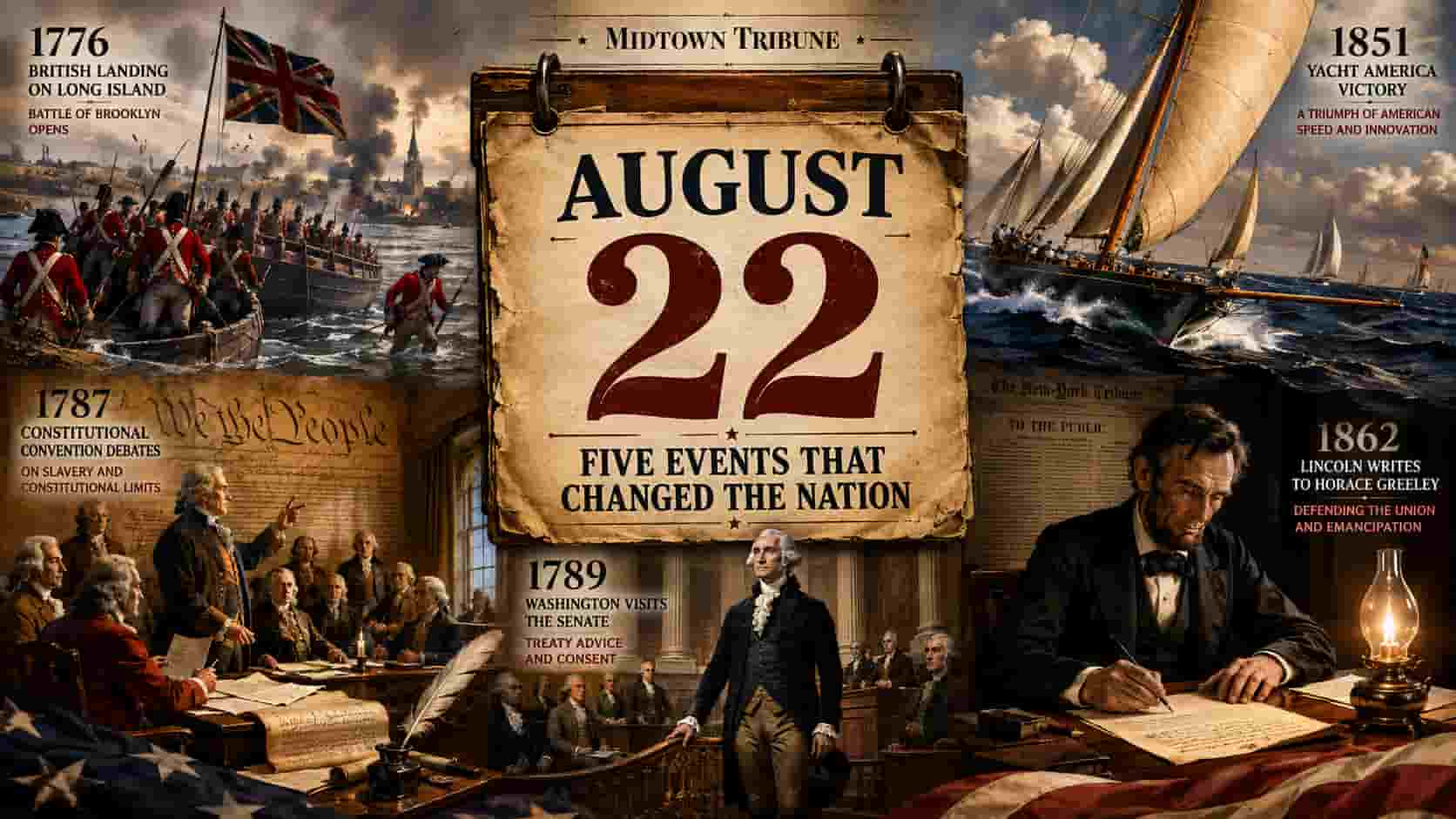
From the British landing that opened the Battle of Brooklyn to Abraham Lincoln’s famous declaration that his “paramount object” was to save the Union, August 22 has repeatedly marked pivotal moments in American military, constitutional, political, and cultural history.
Here are five major events that happened on August 22 and helped shape the United States.
1. August 22, 1776 — The British Army Lands on Long Island
Only weeks after the Declaration of Independence, the new United States faced an enormous military test.
On August 22, 1776, British and Hessian troops crossed the Narrows from Staten Island and began landing on Long Island.
The landing opened the campaign that would lead to the Battle of Brooklyn, also known as the Battle of Long Island — the first major battle fought after the United States formally declared independence.
A contemporary Revolutionary War diary preserved by the National Park Service recorded that American troops were alarmed by reports that approximately 12,000 enemy soldiers had landed near the Narrows and advanced toward Flatbush.
George Washington faced a formidable force. According to the National Park Service, Washington had roughly 19,000 troops spread between Manhattan and Brooklyn, while the British force numbered more than 32,000 trained troops.
Within days, the Americans would suffer a major defeat.
Washington nevertheless managed one of the most important retreats of the Revolutionary War, secretly evacuating thousands of Continental soldiers across the East River from Brooklyn Heights to Manhattan.
Had the Continental Army been trapped and destroyed in Brooklyn, the struggle for American independence could have ended almost as soon as it began.
Why it mattered:
The August 22 landing began the military confrontation for control of New York City. Although Britain captured the city and held it until 1783, Washington preserved the Continental Army — and with it, the possibility of American independence.
Official source:
National Park Service — The Revolutionary War Diary of Moses Sleeper
National Park Service — The Battle of Brooklyn
2. August 22, 1787 — The Constitutional Convention Confronts Slavery and Limits on Government Power
Eleven years later, another critical American struggle was taking place — this time inside the Constitutional Convention in Philadelphia.
On August 22, 1787, delegates debated one of the most divisive questions facing the new nation: the international slave trade.
A draft provision would have prevented Congress from prohibiting the importation of enslaved people.
According to the National Park Service, delegates engaged in an intense debate over slavery before sending the issue to a committee in search of a compromise.
Virginia delegate George Mason, himself a slaveholder, condemned the slave trade and warned that slavery threatened the entire country.
The Convention did not resolve the issue that day. The eventual Constitution prohibited Congress from banning the international slave trade before 1808 — one of the most consequential compromises made during the drafting of the Constitution.
But another development on August 22 would have a lasting effect on American liberty.
The delegates approved prohibitions against:
- bills of attainder, which allow the government to punish individuals legislatively without a normal judicial trial;
- ex post facto laws, which retroactively criminalize conduct that was legal when committed.
Those protections became part of Article I of the Constitution.
Why it mattered:
August 22 exposed two competing realities of the founding era. The Constitution was creating powerful protections against arbitrary government while simultaneously accommodating slavery — a contradiction that would eventually contribute to the Civil War.
Official source:
National Park Service — August 22, 1787: Slavery in a Republic
3. August 22, 1789 — George Washington Personally Goes to the Senate
The Constitution had been operating for only a few months when President George Washington confronted a practical question:
What did the Constitution actually mean when it required the president to make treaties with the Senate’s “Advice and Consent”?
On Saturday, August 22, 1789, Washington and Secretary of War Henry Knox personally entered the Senate chamber at Federal Hall in New York City.
Washington wanted senators to advise him on proposed treaty negotiations with Native American nations in the South.
He presented senators with a series of specific questions concerning instructions for the American negotiators.
The experiment did not go smoothly.
Instead of immediately advising the president, senators began discussing whether the questions should be referred to a committee.
Washington became frustrated.
The Senate’s own historical account says the experience helped establish a precedent: presidents generally would not sit in the Senate chamber while senators debated treaties. Future treaty communications would normally be conducted in writing.
That practice largely survives today.
Presidents negotiate treaties through the executive branch and then submit them to the Senate, where a two-thirds vote of senators present is required for ratification.
Why it mattered:
Washington’s frustrating visit helped define the practical separation between the executive and legislative branches in foreign policy.
The Constitution provided the words.
August 22 helped determine how those words would actually work.
Official source:
U.S. Senate — President Washington Visits the Senate
U.S. Senate — Historical Overview of Treaties
4. August 22, 1851 — The Yacht America Defeats Britain and Creates the America’s Cup Tradition
Not every event that changes a nation occurs in a legislature or on a battlefield.
On August 22, 1851, an American-built schooner named America sailed around England’s Isle of Wight against British yachts in a Royal Yacht Squadron race.
The American vessel won.
The U.S. Naval History and Heritage Command records that America had been constructed in New York for a syndicate led by John Cox Stevens, commodore of the New York Yacht Club.
The purpose went beyond sport: its American owners wanted to demonstrate American shipbuilding and sailing ability on the international stage.
The victory accomplished exactly that.
The trophy eventually became associated with the winning yacht and became known as the America’s Cup.
The Smithsonian notes that America had been the only American entry competing against fourteen British vessels.
The competition grew into one of the most famous international trophies in sports.
The original America later acquired another American connection: during the Civil War, the vessel entered service with the United States Navy.
Why it mattered:
The victory became an early international demonstration of American engineering, shipbuilding and maritime skill at a time when the United States was still establishing its reputation among older European powers.
Official source:
Naval History and Heritage Command — America I
Smithsonian American Art Museum — The Yacht America
5. August 22, 1862 — Lincoln Defines His Central Civil War Objective
On August 22, 1862, President Abraham Lincoln wrote one of the most famous letters of his presidency.
New York Tribune editor Horace Greeley had publicly criticized Lincoln for moving too slowly against slavery.
Lincoln responded with an open letter from the Executive Mansion.
His most famous statement was direct:
“My paramount object in this struggle is to save the Union.”
Lincoln explained that his official policy toward slavery would be determined by what he believed was necessary to preserve the United States.
The historical context makes the letter particularly important.
Lincoln had already presented a preliminary draft of the Emancipation Proclamation to his Cabinet on July 22, one month earlier.
He was waiting for a favorable military moment before publicly announcing it.
The Library of Congress notes that Lincoln’s response to Greeley helped prepare the public for the possibility that emancipation could become a military measure necessary to save the Union.
Exactly one month later, on September 22, 1862, Lincoln issued the Preliminary Emancipation Proclamation.
The final proclamation took effect January 1, 1863.
Lincoln ended his August 22 letter by distinguishing his governmental responsibility from his personal beliefs, noting his personal wish that all people could be free.
Why it mattered:
The letter provides an extraordinary window into Lincoln’s constitutional reasoning at one of the most consequential moments in American history.
Preserving the Union was his stated presidential objective.
Emancipation was rapidly becoming one of the principal means by which he intended to accomplish it — and would fundamentally transform the meaning of the Civil War.
Official source:
Library of Congress — Abraham Lincoln to Horace Greeley, August 22, 1862
Library of Congress — Abraham Lincoln and Emancipation
August 22: War, Constitutional Government and the Meaning of America
Taken together, these five events reveal several recurring themes in American history.
On August 22, 1776, the survival of the Revolution itself was at stake as British troops landed on Long Island.
On August 22, 1787, the Constitutional Convention struggled simultaneously with slavery and protections against arbitrary government.
On August 22, 1789, George Washington and the first Senate began defining the boundaries between presidential and legislative power.
On August 22, 1851, an American vessel demonstrated the growing technical and maritime capabilities of the young nation before an international audience.
And on August 22, 1862, Abraham Lincoln publicly explained the objective that guided his presidency during the Civil War: preservation of the Union.
Different generations faced different crises.
But the underlying questions remained remarkably consistent:
Could the United States survive?
How should constitutional power be exercised?
What freedoms should government protect?
And what exactly did it mean to preserve the American nation?
Those questions made August 22 far more than another date on the calendar.
They helped shape the United States itself.
Official Sources
- National Park Service — Revolutionary War Diary of Moses Sleeper
- National Park Service — Battle of Brooklyn
- National Park Service — August 22, 1787: Slavery in a Republic
- U.S. Senate — Treaties and Washington’s August 22, 1789 Visit
- U.S. Senate — Treaties: Historical Overview
- Naval History and Heritage Command — America I
- Smithsonian American Art Museum — The Yacht America
- Library of Congress — Lincoln to Horace Greeley, August 22, 1862
- Library of Congress — Abraham Lincoln and Emancipation
Ask Midtown Tribune about this story
Answers are grounded first in this article. Search all Midtown Tribune reporting from the main AI Search page.
AI-generated summary. Verify important details in the linked original articles.