
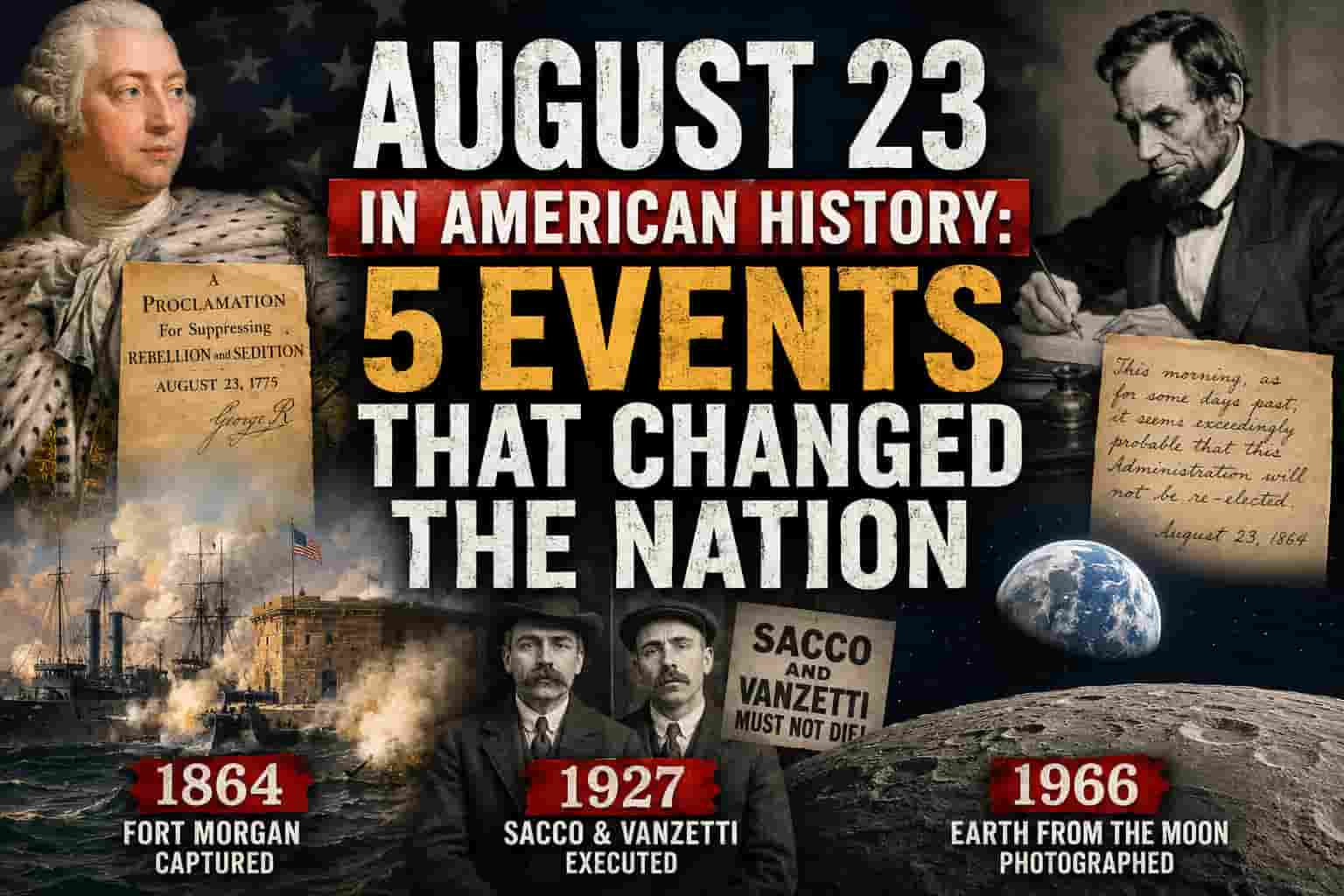
From King George III formally declaring the American colonies in rebellion to Abraham Lincoln quietly preparing for the possibility of losing the presidency, August 23 has marked several extraordinary turning points in American history. It is also the date of a decisive Civil War victory, one of America’s most controversial executions, and a photograph that changed how humanity saw its own planet.
Here are five major events that occurred on August 23.
1. August 23, 1775 — King George III Declares the American Colonies in Rebellion
Only four months after the fighting at Lexington and Concord, King George III issued the Proclamation for Suppressing Rebellion and Sedition on August 23, 1775.
The proclamation declared that the American colonies were in a state of “open and avowed rebellion” against the Crown.
This was an enormously consequential moment.
The Continental Congress had not yet declared independence. Many Americans were still hoping that reconciliation with Britain was possible. But the King’s proclamation increasingly transformed the conflict from a dispute over colonial rights into a struggle between the British government and people it now officially regarded as rebels.
The National Archives notes that after the proclamation, increasing numbers of colonists began seriously considering a complete break with Britain.
Less than eleven months later, Congress adopted the Declaration of Independence.
National Archives — The Declaration of Independence: How Did It Happen?
The official House of Representatives historical collection also preserves the proclamation and identifies its date as August 23, 1775.
U.S. House of Representatives — King’s Proclamation for Suppressing Rebellion and Sedition
Why it mattered
The British Crown was effectively closing the political door on reconciliation. By officially defining the colonial resistance as rebellion, King George helped accelerate the process that ultimately produced an independent United States.
2. August 23, 1864 — Union Forces Capture Fort Morgan and Break Confederate Control of Mobile Bay
During the Civil War, control of Southern ports was strategically critical.
On August 23, 1864, Union forces captured Fort Morgan, Alabama, eliminating the last major Confederate defense of Mobile Bay.
The victory followed Admiral David G. Farragut’s famous naval attack earlier that month.
During the August 5 assault, the Union ironclad Tecumseh struck a Confederate mine — then commonly called a “torpedo” — and sank.
Farragut nevertheless ordered the fleet forward in the action remembered for the phrase:
“Damn the torpedoes! Full speed ahead!”
The Library of Congress records that the capture of Fort Morgan on August 23 broke Confederate dominance over the Gulf Coast port.
Library of Congress — Today in History: August 23
Mobile itself did not immediately fall, but the Confederacy had lost one of its remaining important gateways to international trade and military supplies.
Why it mattered
The victory further tightened the Union blockade, weakened the Confederate war economy and provided badly needed good news for the North during a summer when public confidence in the Civil War effort was deteriorating.
And that political crisis leads directly to another extraordinary event that occurred on exactly the same day.
3. August 23, 1864 — Abraham Lincoln Secretly Prepares for the Possibility of Losing the Election
On the morning of August 23, 1864, President Abraham Lincoln believed he was probably going to lose reelection.
The Civil War had become long and extraordinarily bloody. Political opposition was increasing, military progress had stalled, and even members of Lincoln’s own political coalition were divided over his policies.
Lincoln wrote a remarkable memorandum:
“This morning, as for some days past, it seems exceedingly probable that this Administration will not be re-elected.”
But Lincoln then made an extraordinary pledge.
If defeated, he wrote, it would still be his duty to cooperate with the president-elect between the November election and inauguration in order to “save the Union.”
Lincoln folded and sealed the memorandum.
He then asked members of his Cabinet to sign the outside without allowing them to read what he had written.
The original document survives in the Abraham Lincoln Papers at the Library of Congress.
Library of Congress — Abraham Lincoln’s August 23, 1864 Memorandum
The National Park Service explains that Lincoln feared his likely Democratic opponent, General George B. McClellan, could come to power under political pressure to negotiate an armistice with the Confederacy — potentially jeopardizing preservation of the Union.
Lincoln’s prediction proved wrong.
Weeks later, the fall of Atlanta dramatically changed public perceptions of the war. Lincoln won reelection with approximately 55% of the popular vote and 212 electoral votes, compared with 21 for McClellan.
Why it mattered
Lincoln’s secret memorandum offers a remarkable example of the American constitutional tradition of peaceful transfer of power.
Even during a civil war, Lincoln was preparing to cooperate with a political opponent if voters removed him from office.
His reelection instead allowed him to remain president through the final months of the Civil War, the passage of the 13th Amendment through Congress, and the destruction of slavery as a legal institution in the United States.
4. August 23, 1927 — Sacco and Vanzetti Are Executed
Shortly after midnight on August 23, 1927, Massachusetts executed Italian immigrants Nicola Sacco and Bartolomeo Vanzetti in the electric chair.
The two anarchists had been convicted of the 1920 robbery and murders of a paymaster and guard in South Braintree, Massachusetts.
But their case became one of the most controversial criminal prosecutions in American history.
Supporters argued that anti-immigrant sentiment and hostility toward their radical political beliefs had contaminated the proceedings.
The case generated protests around the world and attracted prominent intellectuals and writers.
The National Park Service notes that their execution eventually contributed to legal reform in Massachusetts, providing stronger impartial appellate review in capital cases.
NPS — Nicola Sacco and notable Ellis Island immigrants
The Library of Congress preserves photographs of the final public protests on August 23, 1927.
Library of Congress — Final Public Protests Against the Execution of Sacco and Vanzetti
The controversy never completely disappeared.
Questions about the evidence, fairness of the proceedings and possible political prejudice continued for decades.
Why it mattered
The Sacco-Vanzetti case became a lasting American symbol in debates over:
- immigration;
- political radicalism;
- due process;
- capital punishment;
- prejudice in criminal trials;
- and the ability of courts to remain impartial during periods of political fear.
It became much larger than the guilt or innocence of two defendants.
It became a national argument over whether the American justice system was capable of protecting unpopular people from popular passions.
5. August 23, 1966 — America Photographs Earth From the Moon
On August 23, 1966, NASA’s Lunar Orbiter 1 took a photograph unlike anything Americans had seen before:
Earth rising above the surface of the Moon.
NASA identifies it as the first photograph of Earth taken from lunar orbit.
The spacecraft was on its 16th orbit of the Moon when it photographed the Earth approximately 345,700 kilometers away, with the cratered lunar horizon in the foreground.
NASA — Lunar Orbiter Photographs the Earth
NASA later described the photograph as a historic view showing Earth as an isolated celestial body suspended in space.
NASA — August 23, 1966 Lunar Orbiter 1 Earth Image
The Lunar Orbiter program’s primary mission was practical: NASA needed detailed photographs of the Moon to identify potential landing sites for the Apollo program.
But this image produced something much larger.
For the first time, Americans could see their world from lunar orbit — years before Apollo 8’s famous Earthrise photograph and before humans walked on the Moon.
Why it mattered
The picture symbolized the extraordinary technological acceleration of the American space program.
Less than three years later, Apollo 11 would land astronauts on the Moon.
It also helped introduce a new visual perspective: national boundaries were invisible from space, while Earth appeared small, distant and isolated against the darkness.
Five August 23 Events — Five Different American Turning Points
August 23 connects five very different chapters in the American story.
1775: The British Crown formally declared the colonies in rebellion.
1864: Union forces destroyed Confederate control of Mobile Bay.
1864: Lincoln privately prepared to surrender presidential power if voters rejected him.
1927: Sacco and Vanzetti were executed in a case that transformed debate about immigration, political prejudice and criminal justice.
1966: An American spacecraft photographed Earth from lunar orbit for the first time.
Together, these events span the creation of the United States, the preservation of the Union, constitutional government, civil liberties and America’s emergence as a technological and space power.
That is what makes August 23 a surprisingly important date in American history.
Official and Primary Sources
National Archives
King George III’s August 23, 1775 proclamation and the road to independence
U.S. House of Representatives — History, Art & Archives
King’s Proclamation for Suppressing Rebellion and Sedition
Library of Congress
August 23 — Capture of Fort Morgan
Library of Congress — Abraham Lincoln Papers
Lincoln’s August 23, 1864 “Blind Memorandum”
National Park Service
The Election of 1864
National Park Service
Sacco and Vanzetti
Library of Congress
Final protests against Sacco and Vanzetti’s execution
NASA
Lunar Orbiter I photographs Earth — August 23, 1966
Midtown Tribune | American History | August 23, 2026
Ask Midtown Tribune about this story
Answers are grounded first in this article. Search all Midtown Tribune reporting from the main AI Search page.
AI-generated summary. Verify important details in the linked original articles.