
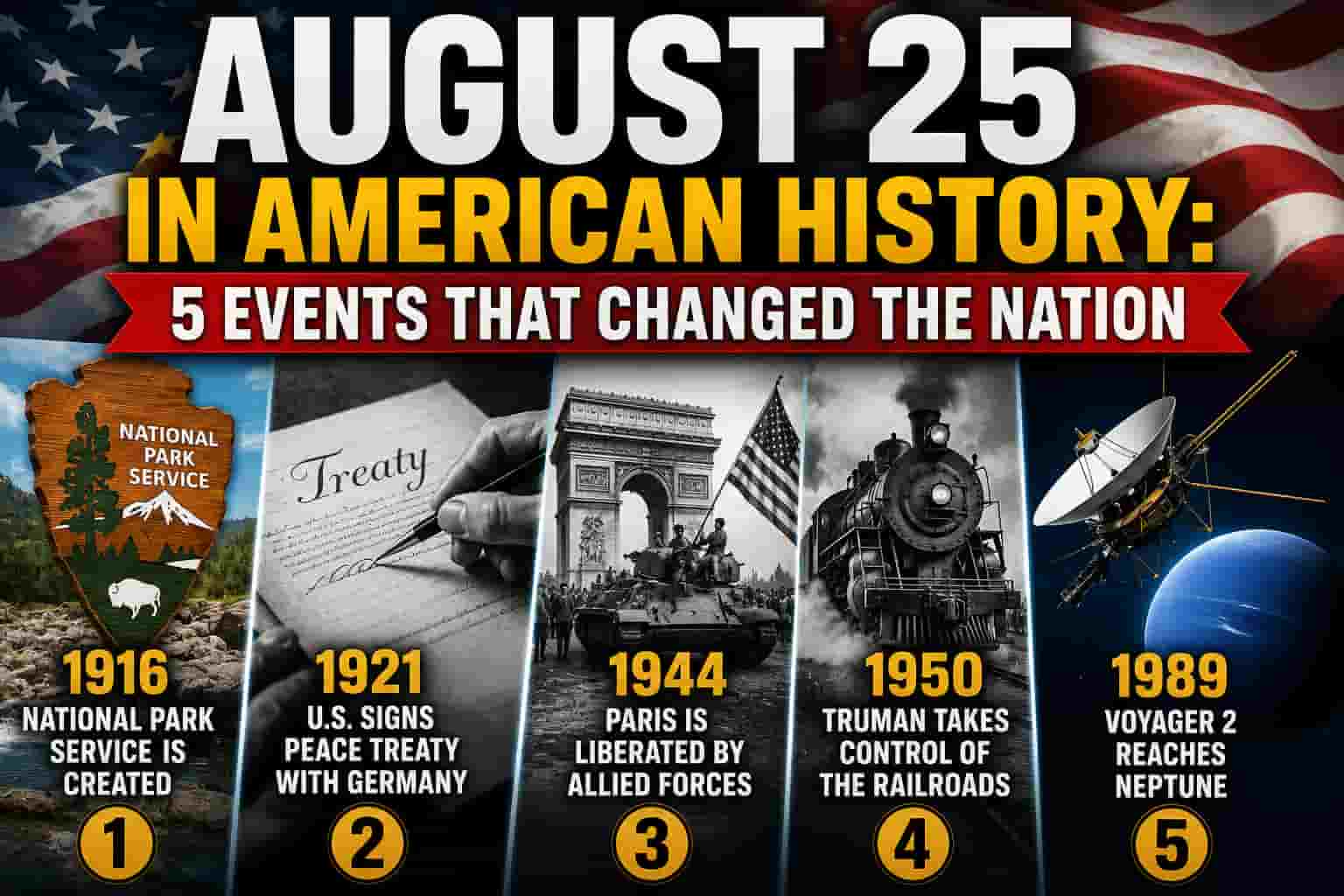
From the creation of the National Park Service to the liberation of Paris and Voyager 2’s historic encounter with Neptune, August 25 has marked turning points in American government, diplomacy, war, labor policy, and science.
Here are five significant events that occurred on August 25 — and why they still matter to the United States today.
1. August 25, 1916 — President Wilson Creates the National Park Service
On August 25, 1916, President Woodrow Wilson signed legislation creating the National Park Service, establishing a single federal agency responsible for protecting and administering national parks and monuments managed by the Department of the Interior.
Before 1916, the United States had already created famous national parks such as Yellowstone and Yosemite, but there was no single federal agency dedicated specifically to managing the growing system.
The law commonly known as the National Park Service Organic Act gave the new agency a dual mission: preserve America’s natural and historic resources while allowing the public to enjoy them without destroying them for future generations.
That principle became one of the foundations of federal conservation policy.
Today, the National Park Service manages more than 400 park units covering over 85 million acres, including national parks, monuments, historic sites, battlefields, seashores and memorials.
National Park Service — Creation of the NPS
Why it changed America
The 1916 law transformed conservation from a collection of individual federal decisions into a permanent national institution.
It helped ensure that landscapes such as the Grand Canyon, historic battlefields, presidential homes and other nationally significant places would be protected not simply for the generation that controlled them, but for Americans who had not yet been born.
2. August 25, 1921 — The United States Signs Its Own Peace Treaty With Germany
World War I had ended militarily with the Armistice of November 1918, but the United States took a different diplomatic path from its European allies afterward.
The U.S. Senate refused to ratify the Treaty of Versailles, which meant that the United States needed a separate agreement to formally restore peaceful relations with Germany.
On August 25, 1921, representatives of the United States and Germany signed the Treaty of Berlin.
The State Department’s historical records describe it as a treaty restoring the friendly relations that had existed between the two countries before the war.
The agreement demonstrated something important about the American constitutional system: a president could negotiate international agreements, but major treaties still required the constitutional involvement of the Senate.
U.S. Department of State — Treaty With Germany, August 25, 1921
Why it changed America
The episode reflected America’s complicated relationship with international institutions after World War I.
President Wilson had been one of the principal advocates of the League of Nations, yet the United States ultimately stayed outside it.
The separate peace with Germany therefore became part of a larger shift toward a more cautious American foreign policy during the 1920s.
3. August 25, 1944 — American and French Forces Liberate Paris
One of the most symbolic moments of World War II occurred on August 25, 1944, when Paris was liberated after more than four years of German occupation.
French Resistance forces had already begun an uprising inside the city.
The French 2nd Armored Division and the U.S. Army’s 4th Infantry Division then entered Paris and helped eliminate the remaining German resistance.
U.S. Army historical records state that both divisions entered Paris on August 25 and that German commander Lt. Gen. Dietrich von Choltitz formally surrendered that afternoon.
The American Battle Monuments Commission likewise records August 25, 1944, as the day Paris was liberated by French and American forces.
U.S. Army — Liberation of Paris
Why it changed America
The liberation of Paris was more than a battlefield victory.
It demonstrated that the Allied invasion launched on D-Day, June 6, 1944, had succeeded in breaking German control of much of France.
For the United States, it was also another step in an enormous military campaign that would eventually carry American forces across Western Europe and into Germany.
Paris became one of the most visible symbols that Nazi occupation in Western Europe was collapsing.
4. August 25, 1950 — Truman Orders the Federal Government to Take Control of the Railroads
On August 25, 1950, President Harry S. Truman issued Executive Order 10155, ordering the federal government to take possession and control of much of the nation’s railroad system.
A nationwide railroad strike was scheduled to begin on August 28.
America was also fighting the Korean War, which had begun only two months earlier.
Truman argued that uninterrupted railroad transportation was essential to national defense, public health and the functioning of the country.
His order directed the Secretary of the Army to take control of the railroad systems beginning at 4 p.m. on August 27 and operate them in the name of the United States government.
Harry S. Truman Presidential Library — Executive Order 10155
Why it changed America
The railroad takeover illustrates just how expansive presidential emergency power could become during war and labor crises.
The episode also belongs to a larger constitutional debate over the limits of executive authority.
Only two years later, Truman would attempt to seize the nation’s steel mills during another labor dispute.
That action produced the landmark Supreme Court case Youngstown Sheet & Tube Co. v. Sawyer (1952), in which the Court ruled against the president.
The events of the Truman era therefore remain central to modern debates over how far presidential emergency powers can extend.
5. August 25, 1989 — Voyager 2 Reaches Neptune
On August 25, 1989, NASA’s Voyager 2 spacecraft made its historic close encounter with Neptune.
After traveling billions of miles through the solar system, Voyager 2 passed within roughly 3,000 miles — about 5,000 kilometers — of the planet.
It became the first — and so far the only — spacecraft to visit Neptune at close range.
Voyager discovered extraordinary features in the Neptune system, including evidence about the planet’s rings, atmosphere and magnetic field.
Its cameras also observed remarkable geological activity on Neptune’s moon Triton, including geyser-like plumes erupting from its frozen surface.
The Neptune encounter completed Voyager 2’s unprecedented tour of the four giant outer planets:
Jupiter, Saturn, Uranus and Neptune.
NASA — Voyager 2 and the Neptune Encounter
Why it changed America
Voyager 2 represented one of the greatest engineering achievements of the American space program.
The spacecraft had been launched in 1977, yet NASA engineers continued communicating with it across billions of miles while using gravitational encounters with planets to extend its mission.
The Neptune encounter dramatically expanded humanity’s knowledge of the outer solar system and demonstrated what long-duration robotic exploration could accomplish.
Voyager’s legacy continues in modern NASA missions exploring increasingly distant regions of space.
Five Very Different Moments — One Date
August 25 connects remarkably different chapters of American history.
1916: America created a permanent institution to protect its natural and historic inheritance.
1921: the United States formally restored peace with Germany on its own diplomatic terms.
1944: American soldiers helped liberate Paris from Nazi occupation.
1950: a president used extraordinary federal authority to prevent a national railroad shutdown during the Korean War.
1989: an American spacecraft reached Neptune after a journey across the solar system.
Together, these events illustrate several recurring themes in the American story:
preservation, constitutional government, military power, presidential authority, diplomacy and scientific exploration.
Official Sources
U.S. National Park Service — National Park Service Organic Act and agency history
Creation of the National Park Service
U.S. Department of State, Office of the Historian — Treaty Between the United States and Germany, August 25, 1921
Foreign Relations of the United States, 1921
U.S. Army Center of Military History — World War II chronology and Liberation of Paris
U.S. Army — Liberation of the City of Light
Harry S. Truman Presidential Library — Executive Order 10155
Possession, Control, and Operation of Certain Railroads
NASA — Voyager 2 Neptune Encounter
NASA History of Space Science and Voyager 2
Ask Midtown Tribune about this story
Answers are grounded first in this article. Search all Midtown Tribune reporting from the main AI Search page.
AI-generated summary. Verify important details in the linked original articles.