
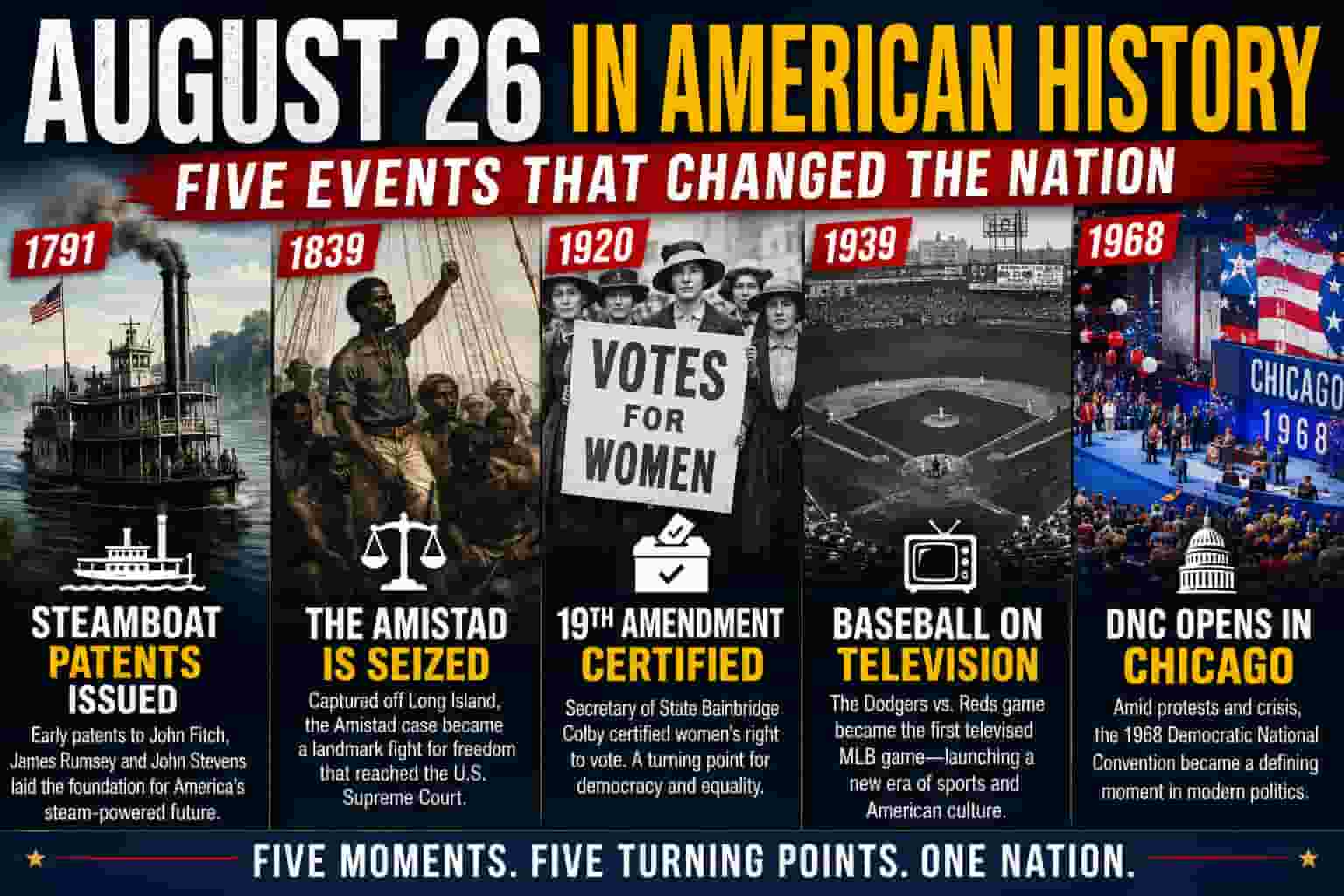
From the first federal steamboat patents to the certification of women’s voting rights and the political upheaval of the 1968 Democratic National Convention, August 26 has repeatedly marked turning points in American technology, law, civil rights, media and politics.
Here are five important events that occurred on August 26 and helped shape the United States.
1. August 26, 1791 — America Issues Early Steamboat Patents
Only a few years after the Constitution took effect, the new federal government was already confronting one of the questions that would become central to America’s economic development: how should inventors be rewarded for new technology?
On August 26, 1791, inventors John Fitch and James Rumsey were each granted federal patents involving steamboat technology.
According to the Library of Congress, the two men were rivals who developed different approaches to using steam power for transportation.
Fitch had already demonstrated an experimental steamboat on the Delaware River in 1787 before members of the Constitutional Convention. His system used steam power to operate oar-like paddles.
Rumsey developed a different method based on water-jet propulsion.
The patents were part of the young nation’s emerging system for protecting inventions.
The significance went beyond the individual inventors.
Steam propulsion would eventually transform transportation along America’s rivers, connecting farms, towns and commercial centers while reducing the cost and time required to move goods and passengers.
The Library of Congress notes that steamboats became particularly important to the economy of the eastern United States before railroads eventually overtook them as the dominant form of inland transportation.
Another early American inventor, John Stevens, also received one of the early patents involving applications of steam power on August 26, 1791, according to the Smithsonian Institution.
Why it mattered
The patents demonstrated something that became fundamental to American economic development: the federal government would protect intellectual property while private inventors competed to turn new technology into commercially useful products.
That system would later support generations of American inventors in transportation, communications, manufacturing and computing.
2. August 26, 1839 — The Amistad Is Seized Off Long Island
On August 26, 1839, the U.S. surveying brig Washington encountered and seized the Spanish schooner La Amistad near Long Island.
The event triggered one of the most important slavery-related court cases before the Civil War.
The people aboard the Amistad were Africans who had been illegally kidnapped, transported across the Atlantic and sold in Cuba.
Led by Sengbe Pieh, commonly known in the United States as Joseph Cinqué, the captives rebelled aboard the ship and attempted to force their Spanish captors to sail them back to Africa.
Instead, the Spaniards secretly steered the vessel north along the American coast.
According to the Naval History and Heritage Command, the revenue cutter Washington found the Amistad near Montauk Point on August 26.
The Africans were taken into custody, setting off an extraordinary legal battle over whether they were enslaved property or illegally kidnapped free people.
The case eventually reached the U.S. Supreme Court.
Former President John Quincy Adams, by then a member of the House of Representatives, argued on behalf of the Africans.
The Supreme Court ultimately ruled that the Africans had been unlawfully enslaved and were entitled to their freedom.
The National Archives maintains the original records and Supreme Court materials from the Amistad case.
Why it mattered
The Amistad case became a national confrontation over slavery, international law, property rights and human freedom.
It energized the growing American abolitionist movement and demonstrated that the fight over slavery was increasingly reaching the nation’s federal courts and political institutions.
The controversy also foreshadowed the much larger constitutional confrontation over slavery that would ultimately culminate in the Civil War.
3. August 26, 1920 — The 19th Amendment Is Certified
One of the most consequential changes to the American electorate became official on August 26, 1920.
Secretary of State Bainbridge Colby certified the ratification of the 19th Amendment to the U.S. Constitution.
The amendment declares:
“The right of citizens of the United States to vote shall not be denied or abridged … on account of sex.”
Congress had approved the amendment on June 4, 1919.
For it to become part of the Constitution, three-fourths of the states had to ratify it.
Tennessee became the crucial 36th state to approve the amendment on August 18, 1920.
Eight days later, Colby formally certified its ratification.
The National Archives describes the August 26 certification as an event that changed the American electorate forever.
The amendment was the result of decades of political organization, demonstrations, lobbying, civil disobedience and campaigns by generations of suffrage activists.
The National Archives preserves the text and ratification history of the 19th Amendment.
Why it mattered
The amendment prohibited governments from denying voting rights because of sex and dramatically expanded political participation in the United States.
Its passage did not mean that every American woman could immediately vote freely.
Racially discriminatory laws and practices continued to prevent many Black women and other minority voters from exercising their rights for decades.
But constitutionally, August 26, 1920 marked a fundamental expansion of the American electorate.
That is why August 26 is now observed as Women’s Equality Day.
4. August 26, 1939 — Major League Baseball Comes to Television
On August 26, 1939, Americans witnessed an early glimpse of a revolution that would eventually transform sports, advertising and popular culture.
A game between the Brooklyn Dodgers and Cincinnati Reds at Ebbets Field in Brooklyn became the first televised Major League Baseball game.
The Dodgers won 6–1.
The audience was tiny by modern standards because very few Americans owned television sets.
But the technological implications were enormous.
The Smithsonian’s National Postal Museum describes the August 26, 1939 Dodgers-Reds game as the first televised baseball game and notes that visitors at the RCA exhibit at the New York World’s Fair were able to watch the broadcast.
The game was played at Ebbets Field roughly 12 miles from the fairgrounds in Queens.
Television was still experimental technology.
Within two decades, however, televised sports would become a defining component of American mass media.
Why it mattered
Television fundamentally changed professional sports.
Instead of being limited to spectators inside a stadium or listeners following radio broadcasts, sporting events could eventually reach millions of homes simultaneously.
That transformation created enormous new markets for advertising, broadcasting rights and professional athletics.
Today, television and streaming contracts are among the most valuable assets in American sports.
The modest Brooklyn broadcast of August 26, 1939 helped demonstrate what that future could look like.
5. August 26, 1968 — The Democratic National Convention Opens in Chicago
On August 26, 1968, the Democratic National Convention opened in Chicago.
It became one of the most turbulent political conventions in modern American history.
The United States was already deeply divided.
The Vietnam War had produced a massive antiwar movement.
President Lyndon B. Johnson had announced that he would not seek another term.
Senator Robert F. Kennedy had been assassinated in June.
Earlier that year, Martin Luther King Jr. had also been assassinated.
Against this background, thousands of protesters arrived in Chicago while Democrats gathered to select their presidential nominee.
The protests and confrontations outside the convention became as historically important as the proceedings inside.
Television cameras showed violent clashes between demonstrators and police to audiences across the country.
Vice President Hubert Humphrey ultimately won the Democratic presidential nomination.
But the images coming from Chicago reinforced the sense that the United States was experiencing an extraordinary political and social crisis.
Even before the convention opened, the FBI was monitoring the possibility of serious violence. A July 1968 FBI memorandum preserved by the National Archives specifically discussed concerns surrounding demonstrations planned for the convention beginning August 26.
Why it mattered
The 1968 convention became a symbol of the divisions produced by the Vietnam War, generational conflict and the political upheaval of the late 1960s.
It also changed the Democratic Party.
After the convention, Democrats created the McGovern-Fraser Commission, which helped fundamentally reform the presidential nomination process.
The old system, in which party leaders and convention delegates exercised enormous control over nominations, increasingly gave way to presidential primaries and caucuses in which voters had a much larger role.
The modern American presidential primary system grew in significant part from the political crisis surrounding the 1968 convention.
August 26: Innovation, Freedom, Media and Political Change
These five events occurred in very different eras, but they reveal recurring themes in American history.
On August 26, 1791, the young republic was developing a patent system capable of encouraging technological competition.
On August 26, 1839, the capture of the Amistad placed the meaning of slavery and freedom before the American legal system.
On August 26, 1920, the certification of the 19th Amendment dramatically expanded constitutional voting rights.
On August 26, 1939, television began demonstrating how radically it could change the way Americans experienced sports and mass culture.
And on August 26, 1968, the Democratic National Convention opened in Chicago amid a political crisis that would help reshape the way America chooses presidential nominees.
Together, they make August 26 a notable date in the continuing story of American invention, constitutional rights, media and democracy.
Key Facts
1791: Federal steamboat patents are granted to pioneering American inventors.
1839: U.S. authorities seize the Amistad off Long Island, beginning a legal battle that reaches the Supreme Court.
1920: Secretary of State Bainbridge Colby certifies the 19th Amendment.
1939: The Brooklyn Dodgers and Cincinnati Reds play the first televised Major League Baseball game.
1968: The Democratic National Convention opens in Chicago amid political unrest over Vietnam and the direction of the country.
Sources
Library of Congress — August 26, 1791
Today in History: Steaming Along — John Fitch, James Rumsey and the Steamboat
Smithsonian Institution — Early American Steam Technology
John Stevens’ “Little Juliana” and Early Steam Patents
U.S. Naval History and Heritage Command — August 26, 1839
Today in Naval History: The Amistad
National Archives — The Amistad Case
The Amistad Case: Documents and Supreme Court Records
National Archives — August 26, 1920
19th Amendment to the U.S. Constitution: Women’s Right to Vote
National Archives — Constitution
Amendments 11–27: Official Text of the 19th Amendment
Smithsonian National Postal Museum — August 26, 1939
The First Televised Major League Baseball Game
Library of Congress — August 26–29, 1968
Democratic National Convention, Chicago, Illinois
National Archives — FBI Records on the 1968 Democratic Convention
FBI Memorandum Concerning the Democratic National Convention
Ask Midtown Tribune about this story
Answers are grounded first in this article. Search all Midtown Tribune reporting from the main AI Search page.
AI-generated summary. Verify important details in the linked original articles.